Skeletons for Stories
When I first mooted (last century) to author a story of our adventure in Central Australia in 1977, Dad told me, “No! You’ll upset people.”
So, I waited decades, then wrote a private copy for my dad. Dad was appreciative but thought our safari adventures in 1981 would be more entertaining. Hence the creation of my travel memoir, Trekking with the T-Team: Central Australian Safari 1981.
The 1977 pilgrimage to the Centre languished in the draw for another decade, until enough time had passed to hopefully not offend people, and it had morphed into a historical travel “faction”; a story based on real events, some real people and others made up. In fact, before publishing my latest book, The T-Team with Mr. B: Central Australian Safari 1977, I included a disclaimer to that effect.
Why all the drama?
You see, as we know in life, an individual’s image of themselves, their reputation is important to them. Their reputation, social status, and what others think of them is vital for their survival and advancement in society.
With this in mind, you could wonder how accurate is history? Especially as individuals and cohorts of high status must maintain their reputations to keep that high status. I mean surely kings have never been murderers, leaders been despots, sports and movie icons immoral.
Have they?
I wonder…
Meanwhile, certain internet platforms are full of happy, well-adjusted individuals with thousands of friends.
Anyway, that being said, it’s not just these days that people have put their best face forward and hide their proverbial skeletons in cupboards. I confess that there are bony “proverbials” in our family history—locked away, key lost…
An elderly relative told me that I couldn’t put my missionary great-grandmother’s letters relating to her Caesarean birth experience in the Cameroon Africa in 1899 into the Lutheran Archives. Too personal, she said. Somehow, they are there now.
If my great-grandmother’s birth experience is too sensitive for some, imagine the real spicy skeletons that exist in families. Again, in our family, those fascinating stories have been leaked by enterprising characters who have written about them and published the works, these being limited publications such as family histories, part of a research study or as a theological study in one case. With the theological study book, we were told plainly, we were forbidden to read that book. Heaven help us if we developed sympathy for the good doctor with a problem with alcohol addiction. I read the book and found it fascinating and encouraging as it revealed in a very real and practical way, God’s love and grace for his broken people.
So, here I am thinking, just the type of stories the rest of the world would be interested in. Stories with grit, guts and depth. Stories that can change our thinking. Help grow us to be better people. Yet, because of an individual’s or community’s sensitivities and threat to their individual or collective reputations, these life-experiences remain ethereal, talked about in whispered tones around the dinner table after a few drinks, or when reminiscing the past with elderly relatives.
Well, that’s my family.
On the other side, there are writers who have no inhibitions when it comes to publishing juicy details on their family’s or friends’ misfortunes and unfortunate life-choices. They change the names, add spicy details of their own creation (just to give a little “kick”), and on they go to entertain their readership. Nothing like those skeletons to fire up the imagination. My eyes widen as one tells me about their friends or family they’ve included (without their knowledge) in the latest novel. I muse how common this modus operandi of writing is.
However, the rest of us, especially in Indie Scriptorium are sensitive to the feelings of family, friends and associates, and have shrouded our characters’ real-life identities in history, Science fiction, fantasy, as well as conglomerating them with several people we know while at the same time veiling the situations to disguise them. That way, no one gets offended or takes us to court…hopefully. As I mentioned, disclaimers about characters not resembling anyone in real life help.
So, I bring this missive to it’s conclusion, for now; our life’s journey, the people we meet, the people we from whom we are descended, the choices we make and the consequences that come from those choices, all enrich our lives and creativity with the stories they generate. And the skeletons in the cupboard also have stories to tell. In whatever way we decide to tell those secret spicy stories, whether as history or fiction, true characters or disguised ones, you never know, it may be those stories that will have influence for good and growth for the reader.
What do you think? Let us know in the comments below.
© Lee-Anne Marie Kling 2023
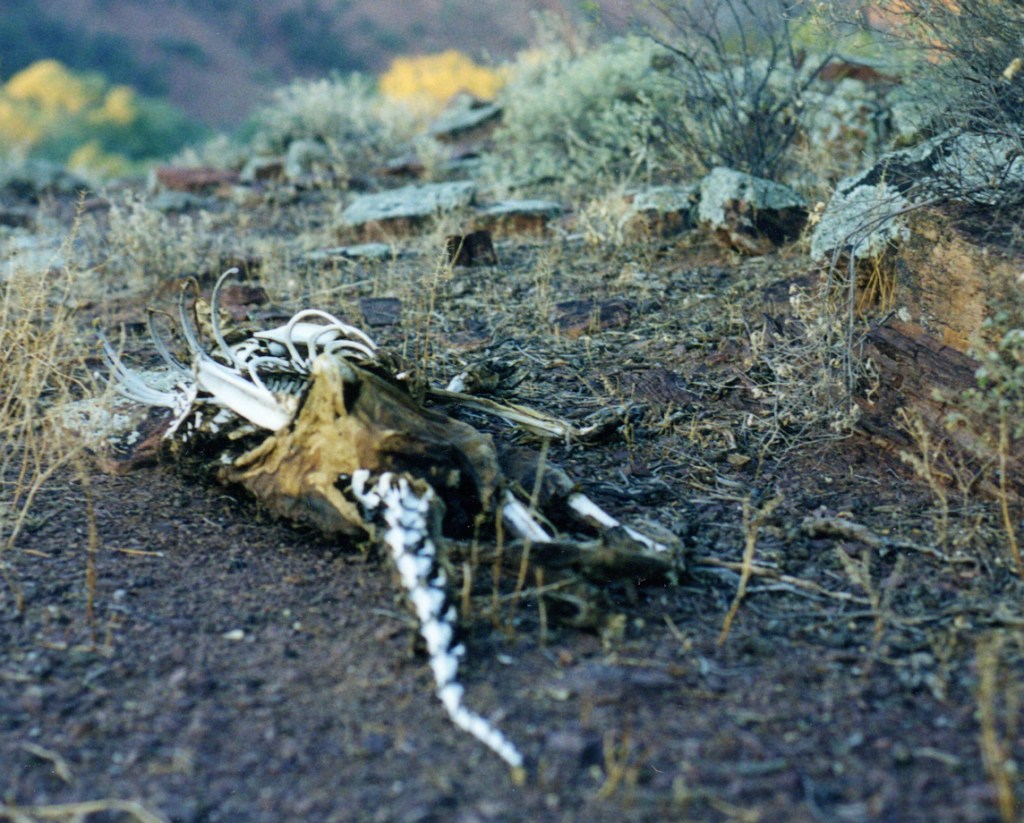
Feature Photo: Kangaroo bones, Brachina Gorge, Flinders Ranges © L.M. Kling 1999
 Indie Scriptorium -- Self Publishing Collective