Several of us authors have recently completed our latest projects–our books. Here’s a timely revisit of an early post from Indie Scriptorium.
Marketing–Building a Website

Check it out, click on the link below.
Several of us authors have recently completed our latest projects–our books. Here’s a timely revisit of an early post from Indie Scriptorium.
Check it out, click on the link below.

Hello everyone,
I recently had the pleasure of attending an author talk given by Australian rural crime writer, Fleur McDonald. My friend, who is an avid fan of Fleur, booked tickets then invited me along.
I’ve only been to a few author talks at Adelaide Writer’s week but this was a local event at the Hallett Cove Civic Centre and Fleur is a South Australian born writer, so I was happy to attend.
As an emerging author, I also wanted to get some ideas about how to plan an event. You never know I might get invited to talk about my own writing experience some day.
Local author Nina D. Campbell interviewed Fleur. and this worked well. They covered a lot of interesting topics. Much of the talk centred around Fleur’s life as a mother, farmer and aviator. She also touched on her history as a writer, her research, writing processes and delved into a few of her characters. It was a funny and entertaining presentation which was thoroughly enjoyed by the audience, including me.
The organisation of the event was excellent with a comfortable venue, free wine or soft drinks, lots of promotional banners, a local bookstore selling the books and of course book signings. It was a superb night.
For more information about Fleur McDonald visit her web site https://www.fleurmcdonald.com
Also discover Nina D. Campbell – a South Australian crime author https://ninadcampbell.com.au
For an excellent blog about planning an author talk see Tess Woods – Six secrets of giving successful and sought after author talks https://www.tesswoods.com.au/six-secrets-to-giving-successful-author-talks.html
Cheers Elsie King ©2025
Feature Photo: Elsie with Fleur © Elsie King 2025
~ William Faulkner

Feature Photo: Flinders Rockpool (c) Alison McDonald 2017
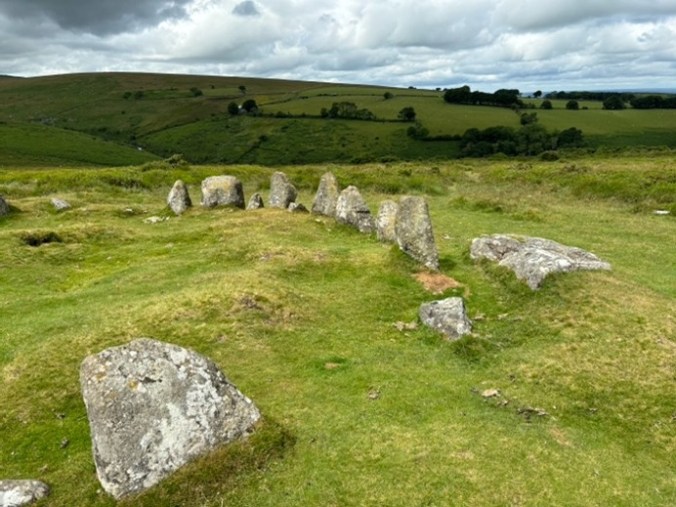
A photo of a prehistoric stone circle on Dartmoor. (L.C. Wong©2024)
Why is it there? What was the meaning? Who raised the stones? Why? All of these questions foster ideas for a story, poem, an opening scene or a theme for a novel.
Then practice painting this picture with words. Describe the colours, the view, the atmosphere created by the clouds and light. Put a character in there and give them a dilemma.
Add a suitable quote from William Shakespeare:
“And this our life, exempt from public haunt,
Find tongues in trees, books in the running brooks,
Sermons in stones, and good in everything.”
~ As You Like It (1599)
Cheers Elsie King
Back in January I found out about an upcoming competition. With regular life in suspension and a bit of time on my hands I thought – “Give it a go. Why not? Nothing to lose.” One was required to write a memoir – couple of thousand words and a cash prize. Beyond the address for submission there were no more details.
But what exactly is a memoir? As a keen member of a local camera club, I’ve had photographs disqualified as “out of category” or “didn’t meet the brief”. I didn’t fancy putting time and effort into a couple of thousand words to have them peremptorily discarded in such a cavalier fashion. Obviously, memory is involved. Is it just autobiography or is there some twist I’m not aware of? Bit of research seemed to be in order.
The first dictionary I consulted (fairly simple; from my schooldays) told me it was “an autobiography; a reminder”. I had a sneaking feeling that for this writing competition there was a bit more to it than that. So, off to my great big two volume Shorter Oxford to discover that this word has been in use for centuries. Way back then, half a millennia ago, it simply meant “a note; a memorandum; a record – often an official one”.
A couple of hundred years later it had morphed into something much closer in meaning to our twenty first century perception – “a record of events or history from personal knowledge or from special sources of information”. All connected to memory and autobiography but with a bit of a twist as well in that interviewing then writing an account of someone else’s memories seemed to be in order too. Right then though I was more concerned with my own personal recollections of my own life.
My very earliest memory is of a big wooden table in the middle of a dim room. I was sitting in my highchair at one end of the table; to my left, a door standing ajar; a window next to it and beyond the verandah the gentle slope of a sunlit, golden hillside. I was aware of the rest of the house to my right, behind me and away across the table in the far wall, there was another window with, next to it, in the corner a wood stove, shrouded in shadow. However, my attention was caught by movement outside on the hillside. It was a rabbit or more probably a hare, lolloping across; stopping to nibble or look around before continuing its leisurely progress. The Easter Bunny! I was filled with immense excitement.
Now, so many, many decades later, I have no idea whether that was my own idea or whether my parents had suggested it. I was four months past my second birthday; the memory and the magic of it still clear and vivid.
My memories of a happy childhood are not at all a story continuing through the years but a series of pictures, many pictures randomly stamped on a blank canvas, like vignetted photos: crystal clear but with blurred edges. The competition? The time on my hands somehow evaporated. Life last January has also become a blur.
© Mary McDee 2025
Feature Photo: Wilderness Tamed for Tourists © Alison McDonald 2017
After Elsie’s “Thingamajig” poem last week, what better than Mary McDee’s writing tips for poetry.
Click on the link and check it out for yourself.
Feature Photo: After a Rain Shower (c) Alison McDonald 2017
*
“Where’s the thingamajig?”
I cry in despair,
I rummage in drawers,
Look under the chair.
*
“What, the TV remote?”
The hubby suggests,
“No, I’ve found that,
On that old wooden chest.”
*
It’s essential, it’s needed,
My heart races,
I search through cupboards
And dusty obscure places.
*
But what’s it called?
I just can’t remember,
The thingamajig, thingy,
I had it last December.
*
Hubby sighs and shrugs,
“Well, I’ve no idea.
You’ll manage without it.
Your innovative my dear.”
*
And just when I give up,
Well, stone the crows.
There it is, the stapler,
Right under my nose.
*
On my desk!
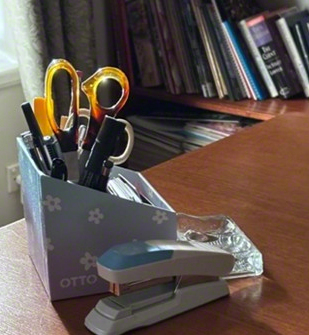
By Elsie King © 2025
Feature Picture provided by Elsie King

“Life is too short to stuff a mushroom.” Shirley Conran.
I want to welcome Berenice to Indie Scriptorium and congratulate her on her wonderful blog about procrastination. The problem of procrastination is something I don’t struggle with very often. My nemesis is overcommitment and that can have the same consequences as procrastination.
I am currently writing my fourth novel, editing my third novel, have provided manuscript feedback for several fellow writers and foolishly decided to go back to university to complete a Bachelor of Letters in Creative Writing. I can cope, it is doable, I can study and write.
I tried for five weeks and realised it was definitely not doable. The university course was exciting and stimulating but I’ve discovered a novel length work requires a singular commitment.
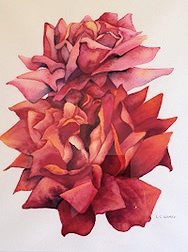
Writing a novel for me requires both writing and time to let your conscious and sub-conscious brain work out plot holes, motivations and what your characters will do and say next. It is as complex as drawing up roses and then getting all the petals formed, coloured and shaded to complete a satisfying painting. The university topics were fabulous distractions and something had to go.
I am no longer a university student.
Cheers Elsie King © 2025
Painting by L.C. Wong © 2023
George had never been on a holiday in his life.
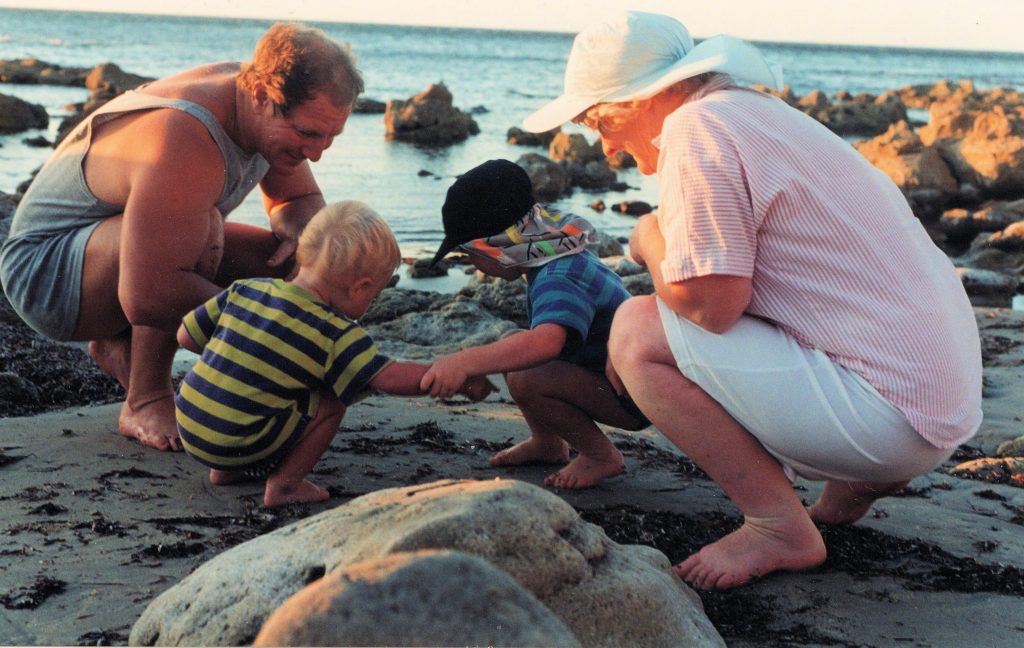
Yet, here he was on a school camp, water swirling around his ankles as he stared at the wide expanse of ocean. Exploring some rocks, he peered into a rockpool, and saw something shimmering under wavy seaweed tendrils. He pulled it out, scattering some little crabs. Peeling the fronds off the thingamajig he saw that it was a disc with squiggles instead of words and a hole in the middle.
‘How strange,’ he thought, ‘what is it? Definitely not Australian.’
He was keen to know if he’d found a treasure.
(100 words)
© Berenice Norris 2025
Feature Photo: Crab-Hunting at Sellicks Beach © L.M. Kling 1995
 Indie Scriptorium -- Self Publishing Collective