Writing for Readers

Keep it Simple

A friend once told me: “Reading a novel is like eating cake. If you start reading something expecting “chocolate cake” but instead have “vanilla”, you feel cheated.”

Such is a reader’s experience when they pick up your book or download it as an e-book. They have certain expectations of the story from looking at the title and cover, reading the blurb, and glancing at page 100 (yes, that’s a thing).

However, the writing and language of the prose within can make or break the book’s success. If the writing is not up to standard, that is, it’s hard to understand, and a slog to read, then, you have lost your reader’s interest, I’m afraid to say.

In this blog I’ll stick to the “nuts and bolts” of what makes a piece of writing readable. That is, the language used, and writing conventions.

We may think that we have to wow the reader with clever phrases and words put all together like we are painting a fancy picture. This type of writing is called “purple prose”. Many writers have been there, believe me. Anyway, I don’t know about you, but I have.

Thirty-something years ago, I wrote about climbing Mt. Giles with my dad, brother and cousins. I did just that trying to convey the magic of the MacDonnell Ranges and the beauty of the Central Australian landscape. I gave my offering to Dad. His feedback: too much “purple prose”. That “purple” piece has been binned, so, here’s an example from the Reedsy website and their blog on “purple prose”:


“The mahogany-haired adolescent girl glanced fleetingly at her rugged paramour, a crystalline sparkle in her eyes as she gazed, enraptured, upon his countenance. It was filled with an expression as enigmatic as receding shadows in the night. She pondered whether it would behoove her to request that she continue to follow him on his noble mission…”¬~Reedsy (What Is Purple Prose? Writing 101: Definition, Tips, and Examples)

The Lesson: Keep it simple. Write as you speak. I should have known, as this is what I’d been instructing my English students at the time. Stick to strong verbs (doing words) and nouns (things, places, people). But avoid, if possible, too many adjectives (words used to describe nouns) and adverbs (words describing verbs, usually ending in -ly). Again, the Reedsy blog mentioned above has examples of how to simplify and strengthen your writing. As an exercise of simplification from the Reedsy example above, I have rewritten the first phrase as: “The girl glanced at him…”

The Aim is to have a piece of writing that is easy to read, easy to understand, and to be a rewarding and growing experience—not a waste of time or hours your reader, if they persevere with your work, will never get back.

The reason the language we speak and write has rules and conventions is for the sake of the reader. We want our stories to be understood, don’t we? Like a recipe for a cake, or road rules for driving, spelling and grammar norms help readers understand and enjoy what the writer has written.

To help with keeping my grammar and spelling in line, one of the tools I use is Microsoft Word Editor to refine my writing. Check “Editor” out if you have Microsoft Word.

Another internet tool is “Grammarly”. I downloaded and took the “Grammarly” test with one of my chapters from a detective novel I have been working on The Culvert. I found the exercise helpful in highlighting where my grammar needs correction. “Grammarly” offers a limited free service, but for a more in-depth check, a subscription is required. For some writers, “Grammarly” might be just the editing tool they have been searching for.

Simply put, the best ideas for a story may be wasted unread if the writing is not easy to read for the reader. Remember, write as you speak, and keep it simple.

© Lee-Anne Marie Kling 2024
Feature Photo: Cake © L.M. Kling 2010

Cosy Mysteries

What is a Cosy Mystery?

Quaint English villages are the typical settings for Cosy Mysteries, but any small, interesting community will suffice.

I admit that I’d never heard about Cosy Mystery novels until I attended a wonderful presentation by Morgana Best at the Romance Writers of Australia conference in Adelaide 2024. Cracking the Cozy Mystery session opened my eyes to this delightful, popular genre.

I personally love crime books, especially Nordic noir, the darker the better but even this avid reader sometimes finds the desperate situations, vivid descriptions and awful outcomes too much to bear. Waking up in the middle of the night with detailed images of beheadings, disfigurements and accompanying gore is unsettling. Psychopathic villains can haunt my nightmares and leave me looking for a good romance at the library the next day.

Maybe it’s time to read some Cosy Mysteries instead? A murder without mess, a whodunit solved by an untroubled, clever amateur sleuth with a happy outcome.

But there are conventions for writing these very popular tales.

  • The sleuth must be likeable, unexpectedly clever and an amateur. They might want to hide their brilliance under a bushel.
  • The investigator must have a strong motivation to solve the crime; a sense of justice, a desperate relative, someone falsely accused or police incompetence.
  • The mystery must be cleverly crafted with copious red herrings, but the reader discovers all the clues in the end.
  • Good research is essential into murder techniques, police procedures, coronial enquires, autopsies and medical assessments.
  • No blood, gore or graphic descriptions of the crime.
  • No blasphemy, cursing or coarse language.
  • No sex but a touch of sweet romance is allowed.
  • The victim must be flawed and/or unlikeable but must still engender some sympathy to warrant the investigation.
  • The setting is a small, appealing community with lots of quirky residents.
  • No animals or children should be harmed.
  • You can add smart dogs, strange cats and unusual but endearing pets/wildlife.
  • The police should not be involved unless they get it wrong and need to be enlightened.
  • The mystery/murder must be solved, and everyone live happily ever after until the next victim bites the dust.

These books sell in their millions every year. There are many sub-genres including romantic, historical and paranormal themes. Many Cosy Mystery writers do a series of books and get a following of avid fans.

The genre can be traced back to Agatha Christie, who introduced readers to her clever sleuth, Miss Marple in the 1930s. Other famous historical mystery writers are Dorothy L. Sayers, Margery Allingham and Ngaio Marsh. These four ladies were the Queens of Crime in the early to mid-twentieth century.

Cosy Mystery books have engendered many television series: Death in Paradise, Agatha Raison, Shakespeare and Hathaway, Father Brown and Sister Boniface to name a few.

I certainly will be looking out for some cosy entertainment at the local library. As for writing one, the ideas are circling. A murder of crows over a distant field …

For more reading, I found the following articles informative:

Ingram SparkWhat is a Cozy Mystery and why is it so popular? An article by Debbie Young September 2019

Crime reads – Cozy Mysteries aren’t going anywhere, in fact, There’re as Popular as ever. By Olivia Blacke February 2021.

And please have a look at the cat inspired web site of Morgana Best – writer of paranormal cosy mysteries and the lovely lady who inspired this blog.

https://morganabest.com/?srsltid=AfmBOopE7umy0DbgeDXb3F0C4yuAqH6y3eLB3fsmUOsVcLyuNJRh2cd-

Cheers Elsie King ©2024

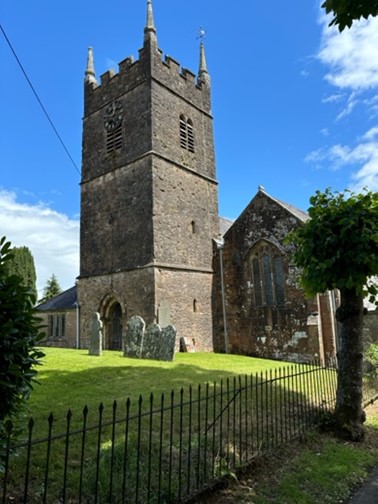
Photo by L.C. Wong ©2024 – North Lew Church – Devon

Swamped

Word Meaning Analysis

For many of us, the word “swamp” doesn’t have much in the way of appealing connotations with its implications of boggy, muddy, and probably smelly too. Many a frustrated mother has applied the word to a child’s bedroom along with orders, “Clean it up! Or at least keep the door shut! Please!”

The Macquarie Dictionary tells us that a swamp is: “a piece or tract of wet spongy land; marshy ground; an area of still, often stagnant water, infit for cultivation”.

Nothing appealing there, is there?

Words are powerful. How we use them; the pictures we get in our head when hearing them are often beyond our conscious control—we hear, we respond (and at times react. Sometimes in quite unexpected ways!)

In the far South East of our state of South Australia, “swamp” has a vastly different meaning. Here the land is flat, seemingly as level as a tabletop. Apart from the many acreages that were cleared and planted with pines, the country is studded with magnificent, giant red gums: Eucalyptus Camaldulensis.

You could see this part of the world as upside down; a reverse of “normal” where usually so-called “flat land” is actually a series of low, rolling hills and shallow valleys. Here, mile after mile of the South East however, there is not a hill to be seen, not even a gentle rise. Instead of the “gentle rises” there are dips: downs rather than ups, huge shallow bowls in the land surface. As it is so flat there are no rivers of streams but in winter all those lower parts can function as drainage sumps. Again, due entirely to that word “sump”, a less that appealing picture.

The very earliest settlers must’ve found these vast stretches of winter water an impediment, their animals could well have trampled round and in and through creating bog holes while areas for cultivation and cropping were dictated by the sheets of water impeding their workaday world. To those folk, “swamp” would surely have been seen as appropriate.

Late settlers, however, learned to work around all the water. They learned to appreciate the myriad of water birds that flocked to their swamps. They saw beauty in all those clear, still sheets reflecting the giant gums so often standing alongside.

The children of these settlers had a magical childhood where they could catch tadpoles and tortoises; paddle around in homemade rafts; climb the nearby trees; construct cubbies; build boats; and, on a convenient bank, dig out dockyards for those boats.

This was also my childhood too and it was truly magical. Along with that magical childhood, I also learned how words can be used in a way that varies their meaning—there is much more to them than mere definitions in a dictionary.

“Lake” would be far more appropriate word for the magnificent sheets of water teeming with life that were an integral part of my younger years. But “swamp”, for South Easterners like us stuck.

Such is life!

Those of us who write, however, must always be careful with our words. We cannot assume our reader will interpret what we have written in the same way that we intend. And yet we mustn’t go into long, convoluted explanations—a sure and certain way to ensure we’ll have not readers! It is truly a balancing act demanding skill, awareness, and sensitivity.

Nobody has ever said that skillful writing, effective writing is, to put it colloquially, a walk in the park. It takes time, care. And consideration—lots of that! The rewards: the satisfaction; the sense of achievement outweigh the pain and frustration many times over though, don’t they?

So just keep on writing.

© Mary McDee 2024

Feature Photo: Swamp? Or Lake? Mt. Gambier, South Australia © L.M. Kling 2001

100-Word Challenge

I have been mulling over what stops us. What makes us stall from reaching our potential? Our potential to write that novel in our heads. Finish that story. Take up the challenge we are given and run with it to the end. Often, it’s the way we see ourselves. Our limitations. When faced with the challenge, our song is, “I can’t. I’m not good enough.” We reinforce our self concept with the chorus, “I failed that (insert challenge) at school.” Or “I was sacked when I did (that particular challenge)”. It got me thinking that when we define ourselves by our limitations, we work ourselves into a corner.

One fun activity that our Writers’ group found useful was the 100-word challenge. This little task helps fire up the creative juices, refine writing skills, and simply work around the limitations we writers put on ourselves.

Below is an example from my collection.

Worked

…Into a Corner

All afternoon, our backyard echoed with the hum of the cement-mixer, and intermittent scraping. Dad, armed with a trowel, smoothed the cement over an area pegged to become the back patio. Metre by metre, he pasted his way back.

Mum stood on the porch, and with hands on her hips, remarked, ‘And how are you going to get out of this one?’

In an ocean of soft cement, Dad looked around him, lost. ‘Er…um…I’ll work it out.’

Tracks back to the lawn-edge smoothed, Dad stood and admired his DIY job.

Next morning, paw-prints made their way to the rainwater tank.

© L.M. Kling 2019

Feature Photo: Dad Concreting back Patio © M.E. Trudinger circa 1978

***

Have a go at the 100-word challenge.

If you like you can drop us a line with your creation.

We’d love to see what you come up with in the comment section.

Further Education in Writing

University Options for Creative Writing

I was fortunate enough to attend a session curated by Associate Professor of Creative Writing, Amy T. Mathews at Flinders University at the 2024 Romance Writers of Australia conference. Called Romancing Academia I was intrigued to find out how a university course tackled the most popular form of fiction, romance.

It was an amazing revelation. Doctor of Philosophy doing romance?

The presenters were brilliant speakers who spoke passionately about their PhD. topics. Their analysis of the tropes used in Romance was entertaining, enlightening and inspiring.

It became obvious that Romance was much more than light entertainment to these academics. One session delved deep into the sociological, historical, psychological value of strong independent romantic heroines. It discussed how feminism is portrayed in popular literature.

Another session looked at the ways writer’s avoid incorporating characters of ethnic diversity or Indigenous characters for fear of getting it wrong.

The issue of informed consent in romantic relationships was another lively topic for a thesis.

Another speaker examined the arranged marriage trope which was contrasted with the reality of arranged marriages in many modern societies. It was explained that arranged marriages can be culturally acceptable and a welcomed way for single people to meet potential partners.

Romancing Academia was informative and enjoyable. It also highlighted for me the opportunities available for writers who want to hone their craft.

I’ve been writing for five years and have produced two historical romance novels. I’ve learnt lots by researching and writing blogs for Indie Scriptorium. I’ve honed my skills as I’ve analysed the work of other writers in my critique group. I’ve acquired information about writing romance from the Romance Writers of Australia articles and wonderful sessions at RWA conferences.

 Looking back, it’s amazing how much my writing craft has developed. When I started my first novel, I didn’t have a clue about what I even needed to know. Luckily, I had two university degrees and a career in social work so I could portray characters well and understood the motives that drive people. I relied on good beta readers and editors to get my ideas into readable prose.

But do I need more? The more I write the more I realise I don’t have the skills to adequately portray the ideas, themes and goals that I want to write about. The Romancing Academia session made me think more carefully about what I write. I’ve come to realise that my passion is portraying realistic history in the format of entertaining fiction. I love history, especially neutralising the misogynist and racist biases that have been offered up over time. To do this with authenticity in fiction is not easy.

Romancing Academia opened my eyes to the possibility of enrolling in a university course that focuses on creative writing. A way of fast tracking the knowledge and skills I need to become a better writer.

In South Australia, all three of our universities offer undergraduate and post-graduate courses in Creative writing.

  1. University of South Australia offer:
  • Bachelor of Arts (Creative Writing and Literature)
  • Bachelor of Creative Industries
  • Graduate and Masters degrees

For information contact 8302 2376 or you can submit an on-line enquiry. Visit their web site https://study.unisa.edu.au for more information.

  • University of Adelaide offer:
  • Bachelor of Arts majoring in Creative Writing

For more information phone 8313 7335 or 1800 407 527 or visit their website https://adelaideuni.edu.au/study/degrees/bachelor-of-arts-creative-writing

  • Flinders University offer:
  • Bachelor of Creative Arts (Creative Writing)
  • Bachelor of Letters (Creative Writing) (Graduate Entry)
  • Bachelor of Creative Industries (Writing and Publishing)
  • Master of Creative Arts (Creative Writing) and other Post Graduate Degrees.

For more information contact 1300 345 633 or visit their web site: https://www.flinders.edu.au/study/creative-arts-media/writing

For me, this is an option I’m considering.

Elsie King©2024

Feature image: Graduation Cap © Shutterstock image 2024