In our Wednesday Writers’ Group, we have been refining our techniques by learning to be economical with our words. It’s so easy to slip into unnecessary repetition and belabouring our points. The 100-word challenge helps us writers to prune our words to the absolute minimum and make each word count.
In doing this exercise myself recently, I was forced to examine what facts were necessary, and how much I can rely on the readers’ intelligence to “get” the story. Often, we underestimate our readers and thus repeat and go into minute detail that bogs down the story, causing our readers to become bored and not turn the page.
So, here’s my 100-word challenge, fresh from my memoir collection. It may not be perfect, but it is 100-words.
***
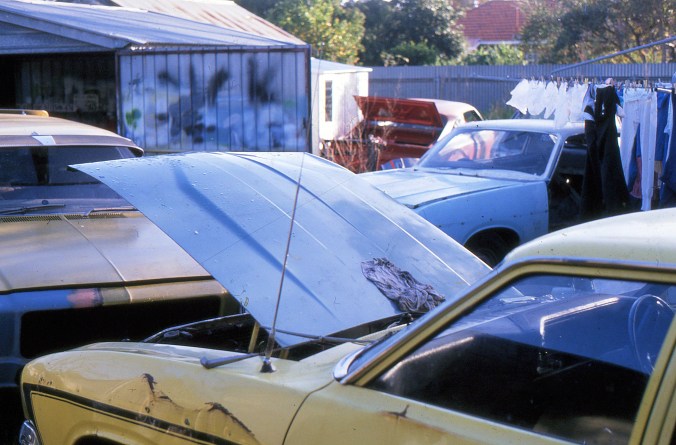
[Intro: Rick, my brother, loved resurrecting car wrecks. The backyard shed became his workshop, and the local wreckers his go-to.]
The “Yota”
A fossick in the car-graveyard yielded the broken shell of a Toyota. Rick revived it. He spray-painted it green.
‘Can’t miss the frog-car,’ I’d say.
One Sunday morning, Mum and Dad needed a car to drive to church.
Without permission, they drove the roaring ‘Yota down the driveway.
I slept in.
Minutes later, the ‘Yota roared back up the drive.
Doors slammed.
Mum cussed.
I scrambled out of bed. Mum never swears.
‘What happened?’ I asked.
‘The police picked us up and defected the car,’ Dad said.
‘That’s what happens for taking the car without permission,’ I replied.
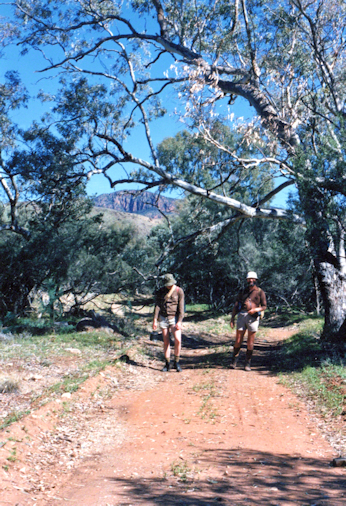
Our bushwalk included some city-slicker newchums. Crossing a wide plain between mountains, we noticed cows in the distance. They began wandering across to check us out. Newchums, trailing behind with heads down, slogging it out, were only half way across when we reached the fence.
Suddenly the newchums became aware of large creatures approaching. They walked faster; the cows came closer. Newchums trotted. So did the cows. Newchums ran. The cows, udders swinging, galloped alongside. We doubled up laughing.
Newchums, white faced and panicked, arrived safely, totally oblivious that your average dairy cows are peaceable animals. But curious as cats.
Back in January I found out about an upcoming competition. With regular life in suspension and a bit of time on my hands I thought – “Give it a go. Why not? Nothing to lose.” One was required to write a memoir – couple of thousand words and a cash prize. Beyond the address for submission there were no more details.
But what exactly is a memoir? As a keen member of a local camera club, I’ve had photographs disqualified as “out of category” or “didn’t meet the brief”. I didn’t fancy putting time and effort into a couple of thousand words to have them peremptorily discarded in such a cavalier fashion. Obviously, memory is involved. Is it just autobiography or is there some twist I’m not aware of? Bit of research seemed to be in order.
The first dictionary I consulted (fairly simple; from my schooldays) told me it was “an autobiography; a reminder”. I had a sneaking feeling that for this writing competition there was a bit more to it than that. So, off to my great big two volume Shorter Oxford to discover that this word has been in use for centuries. Way back then, half a millennia ago, it simply meant “a note; a memorandum; a record – often an official one”.
A couple of hundred years later it had morphed into something much closer in meaning to our twenty first century perception – “a record of events or history from personal knowledge or from special sources of information”. All connected to memory and autobiography but with a bit of a twist as well in that interviewing then writing an account of someone else’s memories seemed to be in order too. Right then though I was more concerned with my own personal recollections of my own life.
My very earliest memory is of a big wooden table in the middle of a dim room. I was sitting in my highchair at one end of the table; to my left, a door standing ajar; a window next to it and beyond the verandah the gentle slope of a sunlit, golden hillside. I was aware of the rest of the house to my right, behind me and away across the table in the far wall, there was another window with, next to it, in the corner a wood stove, shrouded in shadow. However, my attention was caught by movement outside on the hillside. It was a rabbit or more probably a hare, lolloping across; stopping to nibble or look around before continuing its leisurely progress. The Easter Bunny! I was filled with immense excitement.
Now, so many, many decades later, I have no idea whether that was my own idea or whether my parents had suggested it. I was four months past my second birthday; the memory and the magic of it still clear and vivid.
My memories of a happy childhood are not at all a story continuing through the years but a series of pictures, many pictures randomly stamped on a blank canvas, like vignetted photos: crystal clear but with blurred edges. The competition? The time on my hands somehow evaporated. Life last January has also become a blur.
Have a Happy and Blessed Easter. As it is the Easter weekend and in keeping with our months of memoir, a story of my Easter break in 1986, camping in the Gammon Ranges with my father and future husband.
THE BIRTH OF “BUNYIP CHASM”—THE PAINTING
You need to loosen up with your painting,’ my art teacher said.
So, with a palette-knife, I did with my painting of Bunyip chasm.
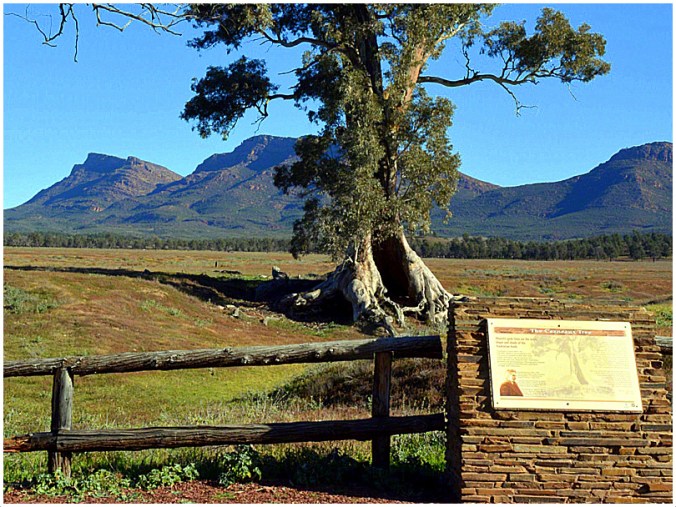
Over the Easter break in 1986, Dad took my boyfriend (future husband) and me to the Gammon Ranges. Dad had gone there the previously with his photographer friend and he was keen to show us some of the scenic secrets these ranges held.
We bumped and rolled in Dad’s four-wheel drive Daihatsu down the track into the Gammon Ranges. We camped near Grindell’s Hut, backpackers’ accommodation. A murder-mystery from the early Twentieth Century involving the hut’s owner, spiced our discussion around the campfire that night. Then we set up a tent, for boyfriend, on the ground above the bank of the creek. I placed my bedding also above the creek under the stars. Dad opted for his “trillion-star” site underneath a river gum. No tent for him, either.
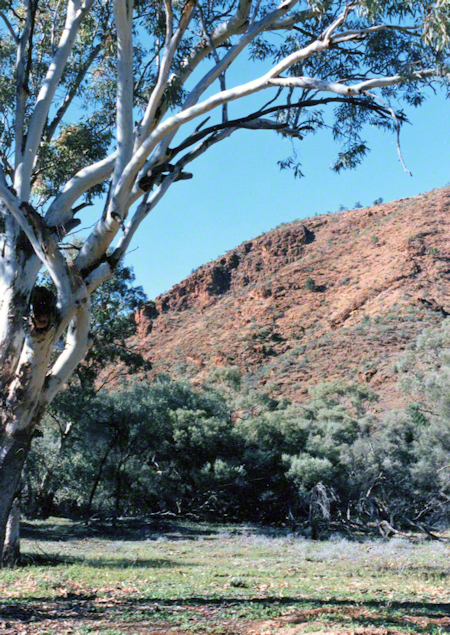
The next day Dad guided us along the Balcanoona creek bed shaded by native pines to Bunyip Chasm. After an hour or two of hobbling over rounded river stones, we arrived at a dead-end of high cliffs.
‘Come on, we better get back,’ Dad said and then started to hike back the way we came.
We trailed after Dad. Although native pine trees shaded our path, the hiking made me thirst for a waterhole in which to swim. I gazed up at the lacework of deep blue green against the sky and then, my boot caught on a rock. I stumbled. My ankle rolled and twisted.
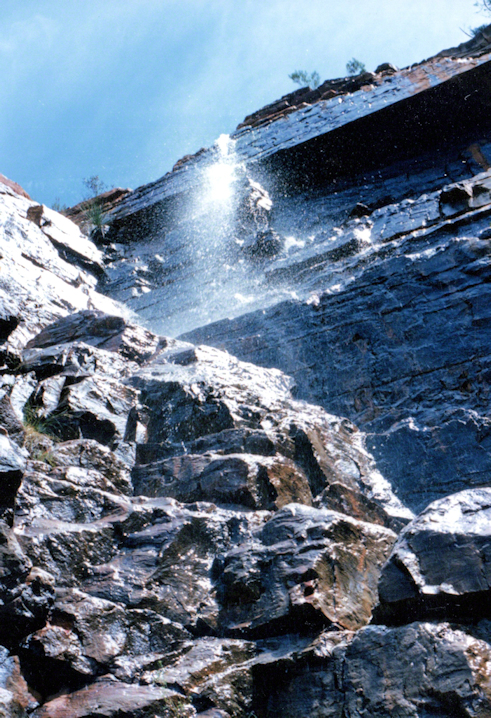
After about ten minutes, with my ankle still swollen and sore, I hobbled after the men. We climbed down a short waterfall and at the base, I looked back. The weathered trunk of an old gum tree leaned over the stream, three saplings basked in the late-afternoon sunlight against the sienna-coloured rocks, and clear water rushed and frothed over the cascading boulders and into pond mirroring the trees and rocks above.
‘Stop! Wait!’ I called to the men.
‘We have to keep on going,’ Dad said and disappeared into the distance.
Boyfriend waited while I aimed my camera at the perfect scene and snapped several shots.
Then holding hands, we hiked along the creek leading to our campsite and Dad.
‘I’m going to paint that little waterfall,’ I said.
We walked in silence, enjoying the scenery painted just for us—the waves of pale river stones, the dappled sunlight through the pines, and a soft breeze kissing our skin.
[In memory of my father Clement David Trudinger (13-1-1928—25-8-2012)]
Feature Photo: Minor bird versus Sulphur-crested cockatoo (c) L.M. Kling 2019
Recently, our Indie Scriptorium group was invited to speak at a memoir group led by our new member, Berenice. A challenge facing writers of real life, people and experiences is how to tackle situations that are not perfect and may bring embarrassment to those mentioned in their life-stories.
So for this week, we are revisiting a post by Mary McDee who gives some advice on how to tackle those thorny issues.
The team at Indie Scriptorium is excited to introduce our newest member, Berenice who joined us at the end of 2024. We hope you enjoy her insights into what challenges us as writers from time to time.
Procrastination
What it is, and what it isn’t.
It has been said that procrastination is ‘the thief of time’, and indeed it is, but it is very often misunderstood. How many times have we heard people describe themselves as a procrastinators when they turn up late for appointments, fail to meet deadlines or admit to having piles of unfinished projects that they meant to tackle when they had more free time? Procrastination can even be a common problem with writers of all genres.
In my personal experience, I have found that procrastination is more than a lack of time management skills, being disorganised or lacking motivation. In conversation with other writers who speak about their ambition to create significant works, they find that the end goal may feel daunting, causing them to avoid their projects and become distracted. I’ve heard of a description called ‘Imposter Syndrome’ where writers feel that their work is not good enough, that they are deluding themselves and may even experience the fear that their work may not achieve the desired outcomes, such as the approval of others, especially that of their more successful peers. I have realised that I often set high expectations of myself and in reviewing my work, question my ability, leading to hesitation, frustration and avoidance.
In the Shakespearian play of Richard 111, the king says, ‘I wasted time and now Time doth waste me,’ which is for me an apt description about how I feel about the many times I have put off doing writing tasks which have been waiting to be completed. I believe my issue is in aiming for perfection in my writing and spending endless hours editing, rewriting and revising my work, while anxiously aware that I am not progressing further than several reworked drafts. This causes self-doubt and stress as I worry that I might never finish the project which I started with so many ideas and enthusiasm.
The danger for people, like me, who know that they have a tendency to procrastinate, is that they are often inclined to ‘multi-task’ and get distracted by a whole range of disconnected activities instead of focussing on the one, single writing activity that requires their full attention. External distractions like social media, domestic duties, the telephone and television or personal hobbies can divert their attention away from writing. I may instinctively know that this is counterproductive and feel guilty about wasting precious time but may justify this by convincing myself that I will do better the next day, week or month, until often it all congeals into a familiar procrastinating blur…again. This may form a habit, creating a vicious cycle from which it seems virtually impossible to escape. When that happens to me, I feel embarrassed, stressed and vulnerable, avoiding the emotional task required to continue the work at hand.
I have spent many years trying to understand why, when I seemingly have no valid reason to put off performing some writing tasks, I often am caught at the last minute frantically working under stress to produce work of a high standard. Even if I micro-manage my time to avoid this occurring, it still happens. Even identifying as a procrastinator is tantamount to assuming that there is a controlling mechanism in my brain holding me ransom to a habit I am struggling to break. It has not always been so. As a studious child and student, I found the creative experience of writing my joy and pleasure, a circumstance that ironically carries on to this day as a mature person.
Ask yourself, ‘What have I as a so-called procrastinator done to help overcome the feelings of being overwhelmed, fear of failure, self-doubt, burn-out and disappointment?’
These are some of the strategies that I have employed that might prove helpful.
First of all, recognise that you might be having a problem and that you can do something to minimise the situation.
Set smaller tasks in your writing project. These may be a certain number of words, or a manageable amount of writing time, with a timer to help you stay on task. (I have a cute little kitchen chook timer.)
Don’t include detailed editing for every session of writing, other than the obvious small spelling and punctuation errors as they arise. (I use the Review function in Windows.)
The review function Read Aloud may help to pick up minor errors.
Join a writing group such as “Shut Up and Write’ where the focus is on actually writing for a set time, not talking, critiquing or sharing during the writing session.
Positive SELF-TALK. I Am, not I’m Not…….
Avoid multi-tasking instead of writing. Do the necessary distracting activities first, then stop and concentrate on writing. Focus on that. If the phone rings, ignore it. You can check your messages later.
Don’t stress if you can’t spend time writing because of family obligations, appointments and other social activities. Enjoy a healthy, happy, active lifestyle as far as possible.
Writing can be hard. But that’s okay. Choose your own way of managing the demands on your time but give your writing the attention and enthusiasm it deserves.
Procrastination can also be a coping mechanism when you are working too long on a project, allowing you time to rest and recover. If you are not being overworked by writing too much, for too many hours…this does not apply to you. Hint Wink!
Find a supportive friend, fellow writer, mentor who will offer constructive criticism and encouragement. That includes YOURSELF.
“Watch your thoughts; they become words. Watch your words; they become actions. Watch your actions; they become habits. Watch your habits; they become character. Watch your character; it becomes your destiny.” — Lao-Tze
[I have spent hours reading the diary of my Great Aunt Dora. The story begins all full of the hopes of a young 18-year-old first-generation Australian girl whose parents had migrated from Germany to South Australia around 1877. I know her story, I knew and loved my great Aunt Dora. She will never marry. One of many women of her time, when, after World War 1, there were not enough men to go around. I imagine this is what life in the 1920’s was like for her, a maiden aunt caring for her parents.]
Dora
She had one once. Before the war. He came from Hamburg. A distant relative from the family. But the Great War intruded. He was the enemy. Interned. Never to return. She perched on the bench in the Royal Botanical Gardens. Watching. Men promenading in pale pinstriped suits, on their arms women in their frilly-white Sunday best, giggling. Easy for the men, she thought. Pick and choose. Pick and choose. Even the damaged men, the cripples, have a chance. She sniffed. What about me? Is that my future? Caring for my aging parents? No choice but to be an old maid?
Having read Elsie King’s first two historical romance novels, A Suitable Bride and A Suitable Heir, I can highly recommend them. Both are well researched and are a good read. Hence, when deciding what to post for this week, I couldn’t go further than Elsie’s post on the subject of research.








 Indie Scriptorium -- Self Publishing Collective