I’ve never really understood or considered tropes when I write something. I find it easier to write with a theme in mind. But Tropes are apparently important enough in the romance genre to provide the theme for the Romance Writers of Australia conference 2024. Time to do some research.
The Collins Pocket English Dictionary defines a Trope as ‘a figure of speech.’
The Collins National Dictionary is more extensive. It defines Trope as ‘a word or phrase used metaphorically.’
Roget’s Thesaurus of English Words and Phrases links Tropes with metaphors. And a metaphor is a way of describing one thing with a phrase that describes something else.
Examples: Courage – a heart of a lion
Love – the light of my life
Lazy – a couch potato.
A look at Wikipedia (bless them) says that the word Trope has undergone “a semantic change” and is now used as a rhetorical (persuasive) device in creative works.
So, to summarise: A trope used to be a figure of speech but has morphed into a commonly used metaphorical device in genres of rhetorical creative fiction. In simple terms they are the themes that readers want to have in a novel.
Some common romance tropes are:
Happy ever after
Lovers torn apart, fight to get back together
Forbidden love
Love triangles
Enemies to lovers
Amnesia
I have a secret
Some historical novel tropes are:
Marriages of convenience
Dual timelines
Political/social upheavals
Actual historical figures
Protagonists ahead of their time.
Research driven plots.
Fantasy tropes may include:
Good versus evil
Quests
Magic
Mythological species
Time travel
The list of tropes can be extensive for each genre but from what I’ve read it’s important that the trope is subtle, that it emerges with the story or it can become a dreaded cliché. These are tropes used so often they become a bit of a joke. Think of the dreaded Bodice ripper.
I hope you found my exploration of tropes useful. I have discovered that I definitely like happy endings, most of my characters are ahead of their time and some engage in marriages of convenience. I also like to use historical research to describe political and social upheavals.
And these tropes put me firmly into my genre; historical novels with a touch of romance.
My photo is of the black sand beach in Iceland made famous in Game of Thrones. Yet another example where an image can be used as a literary trope.
Now I have to work out what costume I’ll wear at the RWA conference that will clearly define a romantic trope.
I must admit I’ve only begun my journey onto this path. At this stage, it’s more of a side-gig than a career. So, I thought I better do research before spouting words of wisdom about what ghost writing is all about.
After gleaning a few articles online, I realised an experienced and quality writer could make a decent career out of ghost writing.
If only I had known, I could’ve seamlessly transitioned from research writing to ghost writing without a thought…once my boys had both gone to school. Imagine the flexibility, working from home and the money. Extra money for house renovations, more trips overseas, and perhaps a caravan for that longed-for lap around Australia.
But such literary adventures were not to be for me at that time.
These blog posts also advised that for landing a good ghost writing contract, a writer needs to prove their skill and worth by having published a book or two.
Now that I have spent the last fifteen years in writing groups honing my skills, have published five books, and recently set up with my writer friends, Indie Scriptorium Self-Publishing Collective, the time has come to investigate the prospect of ghost writing.
The idea arose out of a recent job I acquired to help a friend who is writing a biography of her mother whose family suffered under the Nazis during World War II. Each week she hands me another handwritten chapter which I type up and expand in places. The story is good, it’s there, but needs glue words and verbs in sentences to make it flow.
I realised that I had become a ghost writer. Or was I a hybrid editor?
In this case, although my friend is paying me an amount that they can afford, I’m doing the work as a favour, more in line with the ethos of Indie Scriptorium where a community of writers trade skills to get the work completed, and the book published.
Hiring a ghost writer can be expensive, but let’s say a person does get a ghost writer and has completed the work. Although some ghost writers claim to be a one-stop shop of the publishing process, it is advisable to have the book edited, test read, and proof read by different sets of eyes. In this regard, Indie Scriptorium might be ideally suited to help an aspiring author prepare their completed manuscript as we have the combined skill set to edit, proofread and design covers for their book. A couple of us can even help those who want to self-publish to upload their competed work onto a publishing platform. Done either for an agreed amount of money or in trading skills.
Is there an option for Indie Scriptorium to offer a ghost writer or two in the future? Currently, I personally, am still exploring this possibility. Such a venture, if undertaken to the best of my ability, would be a full-time task, and my other projects such as my novels, would have to be set aside for a time. The reality is, I still have stories in my head that I want to tell. And I am working on my friend’s assignment. Their mother’s story is one I have been waiting ten years to be told and shared with the world.
These are my personal thoughts on Ghost Writing, but for a more professional view about ghost writing here are a couple of articles you may like to look at.
My venture into the world of Murder Mystery/Crime Writing has guided my path to digging into life and death of a different kind—Family History. Crimes, even cold case crimes are being solved by DNA analysis and technology from which family trees are built.
As I have delved into the realms of ancestry, through the My Heritage site and the wonderful tool of crowdsourcing that is available there, I have stumbled on some historical “crimes” that would make even the resident artificial intelligence (AI) called “My Heritage Consistency Checker” laugh or more likely jump up and down (virtually) in conniptions of frustration.
Before I launch into a few of these amusing tales, I might remind you fellow writers that such errors can easily be made when one thinks the research is all too hard or that editing is boring and makes one fall asleep.
My all-time favourite historical faux pas—I get a “Smart Match” from a fellow family historian who has ticked the box that my great-grandfather, born in 1839, is still alive. Quite a feat, he’d be almost 200-years old if he is. And, if he is still in the land of the living, where is he? I have few questions I want to ask him. His answers, I’m sure would make for great reading. I can see the title now: “How my great-grandfather met my great-grandmother.” Oh, and of course, what’s his secret for staying alive?
For two weeks, ye old “My Heritage Consistency Checker” complained that my dad’s cousin’s grandmother was too young at 14 years of age to be married. Good on it for picking this detail up. More like the morality police than an AI (artificial intelligence) with knowledge of historical context (we’re talking mid 1800’s here in Australia). Anyway, the mystery spurred me down that proverbial rabbit-hole where it seemed, according to official birth and marriage records, a certain ancestor had to get married, if you know what I mean. So, I’m guessing that her parents gave consent for the “shot gun” wedding. The young couple (well, the groom with the shotgun to his head wasn’t so young, but) went on to have at least ten children.
How does this angry AI relate to writing?
You may have developed an uneasy relationship with your editor, or fellow writer/test reader who questions certain details of your story. For example, from my experience, my writing mentor was adamant that a planet can’t have two suns. Another time, a fellow writer insisted that cattle did not exist in Central Australia. I did my research, and armed with the evidence to the contrary, I proved them incorrect.
A friend asked me to type up and edit their relative’s biography. I began reading the story and soon discovered key details relating to birth and marriage were missing or vague. Now, I’m not adverse to a few “circas” now and then. I plop them in all the time when acknowledging my grandfather’s photos in my posts, or when “playing” with my family tree for centuries-long gone ancestors, in the hope a “smart match” or record might show up courtesy of a more obliging My Heritage AI.
But with a biography, a historical record of this person’s forebears, the lack of detail bothered me. I asked the friend if they had any documents. No, they replied, all too hard, and expensive.
So, putting on my Indie Scriptorium hat, and having the resources and research skills, I offered to do the relevant investigation for them.
When writing a history, it is vital to get the right dates, places, times and people. This is true also for drafting a novel or story. If you want your story to be believable, you need to do the research and at least get your timeline sorted. Make note of significant events in that period which may impact your characters. Take time to plot the dates and places to ensure it’s do-able and believable.
There are other examples, but I will reserve those for another time, another blog post.
All my life, words have fascinated me – their meanings and double meanings, along with puns, jokes, and varied pronunciations. How we put them together for impact; to make poems or stories or paint pictures in a reader’s imagination is grist to my mill, floats my intellectual boat.
So choosing English as a major subject when I got to university was a no-brainer. And when I discovered that Linguistics was one of the third year options, I couldn’t wait to enrol.
Before this, High School Latin had opened my eyes to the fact that languages other than English have very different rules; can be structured differently; are often quite a different kettle of fish. This was amazing! Putting the verb at the end of the sentence? Changing the last syllable of the word instead of using one of the “little words” (e.g: to/for/by/with/from…) as those ancient Romans had done? Wow!!
All this opened up the wide world of translation and how tricky it can be to “get it right”; get the original author’s attitude and intentions across accurately; convey as many as possible, of the subtleties of the original.
Conversations with multi-cultural friends, some of whom were fluent speakers in not just two but several languages were frustrating as these people took all the differences for granted. None shared my passion for words; so they quickly found our “chats” boring. And me weird.
Consequently, I was forced to turn to books in my quest for enlightenment. The only books readily available that provided varied renditions of the original text was the Bible. So I go down all sorts of rabbit holes, spanning several centuries of translations in this adventure.
And after all that long-winded background bumph we come to the point of this blog; a blog designed for those of us who write. Finally I hear you say (if you are still with me, of course!!).
A couple of days ago I read and compared several accounts of the Last Supper; that final, pivotal meal before the crucifixion, that Jesus shared with his disciples; the meal which Judas walked out of to meet with the High Priests and betray him.
Several of the modern translations wound up their account with:
“So Judas left, going out into the night”.
Others (including the King James Version) rendered the same incident as:
“So Judas left. And it was night.”
Only a very small difference – a single sentence of eight letters versus two sentences of seven letters.
But it hit me like a bomb.
The strength and implicit emotion; the sense of impending doom, that that second sentence gave when contrasted with the first was palpable. The first was an accurate but matter-of-fact, almost journalistic rendition. The first, set alongside the heart-wrenching vividness of the second, was just ordinary writing in my eyes.
Of course you may not agree. We all see and interpret things very differently. Which is a good thing; makes life interesting!
When we speak we add to our words with both our voice and our facial expressions, as well as gesture, stance… There are a hundred and one ways of getting our meaning across as we become aware of responses from those to whom we are speaking. There is an immediacy in the spoken that is not available in the written. So we have to compensate.
As writers, we need to develop awareness of those aspects of writing that are more than merely putting words together. This is what divides great writing from the simply pedestrian. How those words are arranged, organized, juxtaposed one with the other is important. How our words are divided into sentences and punctuated can make a huge difference to how we get our message across to the reader. These are the things that make our writing truly impactful.
We writers consider words as our stock-in-trade; valuable servants to our need for self-expression; treasured allies in our creative pursuits. They have meanings that give messages; messages that, at times, are subtle or can be misinterpreted or confusing. Consequently they must be treated with care and respect if we are aiming for clarity and impact when we use them.
I learned this lesson many decades ago so let me tell you how it happened.
“A house is not a home.” My father was adamant.
I must have been about ten or twelve years old; it was a mealtime and I had been sounding off about something or other. I have no idea what I’d said to elicit this from Dad but my memory of that situation and his response to me is very clear. He was firm, very firm. But gently so as he went on to explain what he saw as the difference.
“A house is a building”, he said; “nothing more – bricks and mortar; walls and a roof. A house is not a home until people are occupying this sheltering structure. Even then it is not a proper home if those residing there do not care about each other; were not considerate, respectful of each other; welcoming to strangers and willing to share whatever they had, however little that might be.
A shed, a tent or a bark humpy could be just as much a home as a fancy mansion. Indeed, a fancy mansion where there is no peace; where people are always fighting, abusive, rude, or out to take others down is no home at all. A place where everything is only for show, designed to impress; aligned to elicit awe and admiration from visitors but is, in fact, a veneer for misery could never ever be a home.”
My parents lived their beliefs and, apart from the values such conversations inculcated in me, this particular episode stuck. It gave me a great respect for the importance of accuracy in my use of language as well as triggering a lifelong fascination for the subtle differences in the meanings of words.
A few years later, a High School English teacher emphasised the point but in a different way. He was talking about the nature of poetry and told us that, in essence, poetry was:
“The very best words arranged in the very best order”
As a budding writer I remember thinking, “Surely that applies to anything I write, not just poetry?” At the time, like Brer Rabbit, I just lay low and said nuffin’ – I was far too shy to question someone I saw as an expert. But those words stuck and became a guiding light; a light that is far from easy to follow all the time, believe me!!
Many, many years later my sister-in-law, Nancy, completely and unintentionally in this matter of word precision, turned the tables by setting me straight on the use of another word (as well as the importance of care when conversing with littlies).
This time it was her grandchildren who were involved. They’d been excitedly telling me about something planned for their father that was to be a surprise. I’d responded along the lines of “So you’re being careful to keep it a secret?” At which point Nancy told me that, in their home, they don’t talk about “having secrets”. It was always “Keep the surprise”.
Discussing it later, out of earshot of the small ones, she told me that they wanted to ensure the children were brought up in an atmosphere where openness was the norm as they felt that “keeping secrets” could lead to trouble down the track.
Despite my fascination with words and unrelenting passion for accurate usage, it was something I’d never thought of before! Point taken! And appreciated!!
Language is communication. It can be subtle and suggestive. Words are powerful. And the implications of those words can be even more powerful. So it behoves us as writers to consider every word we write with the utmost care – but not in the initial first draft stage where we simply spit out our ideas; get it all down out of our heads and onto paper.
The “working with words” bit is part of the editing process. But that is another story for another day.
Over Christmas break, I was asked to read through and critique a friend’s murder/mystery novel. It was a historical novel set in a South Australian location. I had previously got the gist of the storyline from the author’s presentation to the critique group we both attend.
LE the author provided me with a proof copy of her novel. This is a brilliant idea and has inspired me to produce a proof version of my next novel for my beta readers and reviewers. The beauty of a proof copy is that you read the novel as if it is a completed novel but you can scribble comments and use a red pen on the proof. Getting a proof copy through a self-publishing platform or a local printer is usually low cost so you can get several copies for your critique readers. The author can then amend the downloaded novel on whatever platform is used and release the edited final version.
I got a proof copy of my first novel from Draft2Digital and believe the cost was $40+ dollars. Proofs through Amazon are cheaper. It would be a good idea to do some research prior to getting a proof copy printed.
LE also provided a questionnaire for her critique readers. Another really sensible option that gets you the feedback you want. The questionnaire covered:
Title feedback
Plot clarity.
Setting place and time
Interest engagement
Character engagement
Dialogue suiting each character
Character arcs for the main protagonists
Pacing
Word usage and wordiness/repetition
Consistent POV
Show and tell
Tone/style of writing suit the period
Amount of description vs action
Satisfying ending
Overall readability and clarity
Additional feedback
In addition, I would have asked if the cover and blurb accurately reflect the content and engage the readers’ interest.
LE’s questionnaire mostly covers the type of feedback one would get from a structural edit. This may also be called a manuscript appraisal. It is the bones of the novel and generally doesn’t include items such as spelling, grammar and punctuation but that depends on the person doing the critique what, and how much they choose to focus on. The structural edit focuses on the plot, pacing and if the characters engage with the reader. It is about ensuring the book is interesting enough for the reader to get to the end with a satisfied smile.
A line or copy edit usually covers correct word usage, research accuracy, time lines, un-necessary repetition, consistency with names, places and descriptions. It also covers overuse of words or phrases, dialogue tags, too many adverbs, head hopping with POVs and grammar, punctuation and spelling. The copy edit makes your work more readable and easier to understand so you can get to the end with a satisfied smile.
The proof edit may pick up some of the above if they’ve slipped through the eagle eyes of the copy editor but usually focus on formatting, typos and glitches rather than major problems with the writing style. Some readers find glitches and typos really annoying but unfortunately they do sneak in even with novels that are traditionally published. Annoying but it shouldn’t be so pervasive that they stop your reader getting to the end with a satisfied smile.
I have read LE’s novel once through and made some initial comments but will read it again to focus on the structural elements requested in the feedback.
Being in a critique group provides me with a wonderful opportunity to really study my fellow writers’ work and makes me think through what a good novel is all about. I have found I’m getting better at picking up my own mistakes and my own work improves in this process.
It’s that time of year. In Australia, the end of the year signals groups winding up and the inevitable array of Christmas parties, exchanging of gifts and cards. In my writers’ groups we exchange cards, small presents and some give their latest book or manuscript to peruse. I’ll be guilty of doing that very thing this year, I hope. (Still in the process of editing my latest a detective novel, Fly on the Table.) Together with my fellow writers, I am looking for feedback. I’m hoping that over the holidays, my “test readers” will find the time and interest to read the manuscript. I want my novel to be the best it can possibly be.
But Feedback, that proverbial “elephant in the room” can be difficult for some readers to handle. So, here’s a revisit to an earlier blog. Check it out, I hope you find it useful.
Some time ago, a member of our writers’ group recently published a book.
‘I don’t want to tell anyone,’ they said, ‘because I needed a lot of help.’
Certain members of the writers’ group ensured they revealed and celebrated the news; their achievement was our achievement. A book doesn’t happen in isolation; it’s a group effort. Just as a village raises a child, for the best outcome, a community or group births a book. There’s the writer with the ideas, then comes the editor, test-readers, friends and family, the proof-reader and finally, the audience, the readers out there in reader-world.
We write stories for readers, that’s why the editing process is vital. A story needs to be readable to be effective. Readers need to understand the story to enjoy it. It’s the reason language, especially written language has rules for grammar, spelling, and the art of storytelling has a structure.
So, you’ve finished your masterpiece, but now the challenge: how will you go about editing your work? That’s where the writers’ group comes in. Fellow writers are your work’s first point of contact. Their reaction to your story will tell you if your creation is a winner or a flop. Either way, there will be more work required to perfect your piece of genius—more pen to paper, more fingers tapping on the keyboard, more pain and hair-pulling before your work can be “birthed”.
Once you have completed your work, file it away in a drawer for about three months. You need distance between you and your “baby”. When you revisit your work, you may be amazed at how brilliant you have been putting all those words together in such a clever way, or be horrified at how the gremlins of grammar, spelling, typos, weasel words, repetitions, and so on have bred and multiplied. With fresh eyes, you’ll see ways to improve your story, thus creating your second draft.
Repeat the process of draft and distance until you feel it’s ready to meet fresh eyes that don’t belong to you. But who?
Ever had trouble getting someone to peruse your work? Suddenly, they’re all busy. Or they take your story and sit on it for months, years… Again, happy are those in a writers’ group. Or be bold and blog. Consider serialising your work on Wattpad, even. If you are wanting to sell your novel down the track, having a http://www.presence and band of followers may help.
For those finishing-touches to refining your work, you may seek out a professional editor. When paying an editor, ensure that you define the time and rates in a contract. For Trekking With the T-Team, I negotiated an hourly rate and a limit on the number of hours the editor would work on my book.
There are two types of editing: big picture and proof-reading. Big picture editing looks at the plot, pace, character development, language use and content. Proof-reading deals with the technical side of the work such as grammar, spelling, and formatting. But as my friend who’s an editor said, ‘It’s hard to separate the two. If the content and ideas trigger you, then it’s difficult to be objective and it affects how you respond to the piece.’
So, while it may be preferable for an editor to be outside the genre in which you are writing, it may not work for your book. A good editor, of course, is impartial, but they are still human and will approach your story from their worldview. And on the other side, we as writers are human and see the world through a filter of attitudes and the way we see ourselves. A good editor who is paid, then, is only as good as the receptiveness to feedback of the writer who pays them. After all, you are paying for that objective set of eyes, and feedback based on their experience as a reader and what they perceive as good literature or entertainment. In the end, whatever comments an editor makes, it’s up to you, the writer, to implement those changes—it’s your work, your story.
The last step of editing is proof-reading; the nit-picking of the piece before it surfaces for publication. Ernest Hemmingway, in an interview for The Paris Review (1958), said that he rewrote the end of Farewell to Arms 39 times before he was satisfied with it. However, each writer is different. I use five different coloured pencils: 1) grammar, 2) spelling, 3) word-use, 4) formatting, and 5) content. That being said, I am sure I have perused my works near 39 times by the time it reaches the Amazon shelves.
Other tips: • Reading out aloud helps with sentence structure, flow, and the art of storytelling. Even better, if you can bear it, use a voice-recorder as you read out your story, and then play it back. • Line by line editing. Print out your story and then use a ruler under each sentence to concentrate on each word. Effective for exposing typos and formatting flaws. • Start with the last chapter first, and so work through your piece backwards. Again, helps with plot-holes, character consistency and pacing. • Have an English grammar book and a dictionary within reach, for you’ll be reaching for them repeatedly. I’ve discovered that an online dictionary, or Google are also reliable resources, but beware, as dodgy information slips through the cracks of the Internet.
In the end, it’s up to you, but it’s also a group effort. We are all part of the larger community collective of writers, readers, sharers and receivers of ideas. And I cannot stress enough, the more you read, the more effective your writing will become. We learn from each other.
Recent talk in my writer’s group: one of us is in the throes of self-publishing and was filling us in on some of the trials and tribulations she was enduring. Currently, her chief complaint is that the route she’s chosen to follow does not provide her with a “proof copy” for checking prior to final go-ahead before printing the number of copies she requires.
What has really stunned her however is that her complaints to a writer acquaintance elicited the response, “What on earth do you want a proof copy for?”
We, too, were stunned at this response and began to quote examples, from our own experience, of how essential it is to proofread the “final copy” of any work. Lest you are tempted to feel the same way, let me list a few that we came up with:
1. Numbering on the table of contents page was not in line with the actual page number of each chapter in the body of the work.
2. Words, phrases and even complete slabs of print omitted or relocated.
3. Pages printed upside down or reversed.
Bottom line is – you can’t trust technology!
With the best will in the world, mistakes happen, glitches, hiccups, whatever you want to call them, occur in the best regulated circles so everything has to be checked. And rechecked!
Sometimes it is simply a small step in the process has been overlooked by the author. This was what had happened in #1. above: she’d neglected to send her file as a PDF. So easily done!!
But not always – the machine itself (maybe its human operator) can have a bad day and stuff things up by accident.
Perhaps the classic in this last was one involving my brother. He writes and self-publishes technical books and was somewhat diverted on receiving the proof copy of his latest effort. The cover looked great. But the book itself was quite a bit thicker than he’d expected. Opening it up revealed, not the words he’d labored over but the complete text of a romantic novel – a genre he never read, let alone ever wanted to write.
Imagine the waste if he’d by-passed requiring a proof copy and had simply taken delivery of the couple of hundred copies he expected to sell.
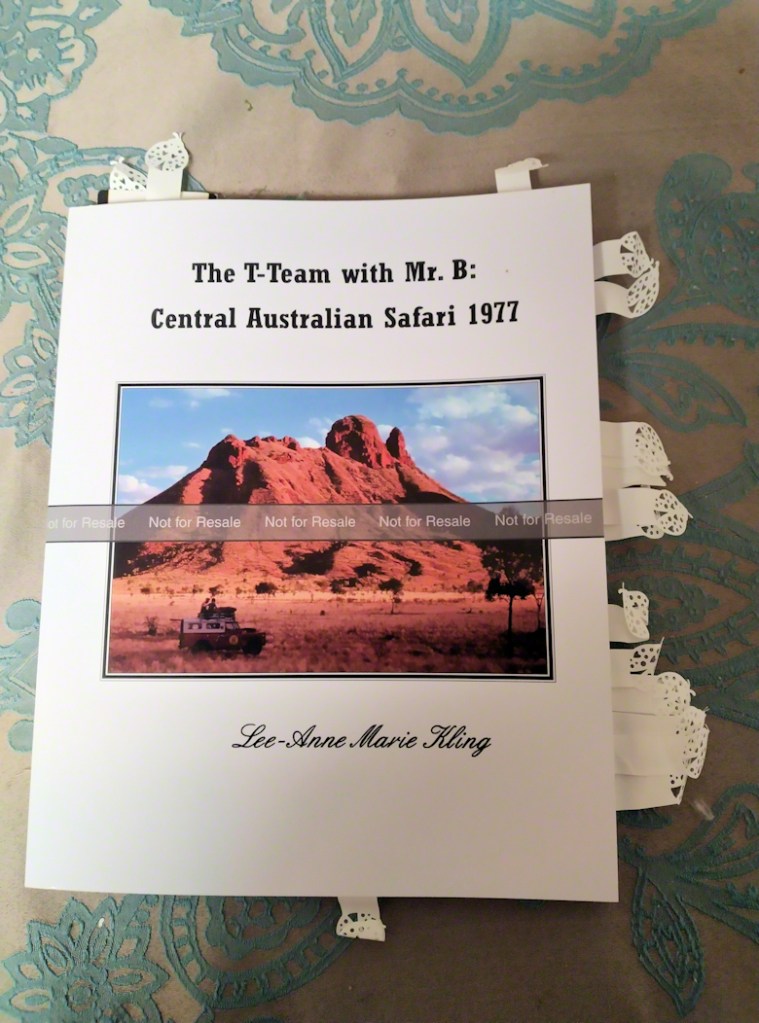
Comment from IS Administrator: Same company, different result. About the same time that the fellow above-mentioned author had published their book and had trouble having a proof copy delivered, I had published The T-Team with Mr. B. No problem having a proof copy delivered as you can see from the photo above. Had the publishing company’s policies changed in a matter of days? Or was something else going on?
Fellow authors, I invite you to share your experiences on publishing and having your books printed. Let us know in the comment box below.
Just write. Get the first draft down without thinking about it… Just do it.
For me, putting down a first draft is magical. The characters take over, the ideas flow and the dialogue takes your plot in unforeseen directions. But when I read over my surging words of creativity, I realise that repetition has crept into the work and that needs to be assiduously weeded out.
I have a tendency to overuse certain words and phrases such as smiling, feeling, frowned and ‘took a deep breath’. I also add extraneous words that I don’t need. She stood up. He sat down. She screamed loudly. Three words that are not needed at all, at all, at all.
Another major flaw is my inclination to belabour a point. I find in the first draft I often have up to three different paragraphs all saying the same thing but with different words or with the smallest of twists. This is demonstrated in the first line of this blog. Readers find this particularly annoying, as it implies they are not bright enough to get your message the first time.
I also use appellations repetitively. I will name a character time and time again when there are only two people in the scene and he or she will suffice. Miss Baker will look out the window. Miss Baker will sit down. Miss Baker will stand up. Miss Baker will scream loudly. Oh no, here we go again. When I go over my first draft, it’s not uncommon to find I’ve started several paragraphs on one page with Miss Baker…. Boring, boring, boring!
I’m finding that the more I write and edit my work the more aware I become of my tendency to be repetitive. I am using repetitions less and I’m starting to see the repetitions in my first read through and can correct them quickly. Except I’ve just used the word repetitions, or its derivatives, four times in the above paragraph. Sneaky little things.
The trouble with repeating ideas, words and phrases is that it’s damned annoying for the reader and slows down your pacing. Learning to spot the problems and editing them out is important and will make your writing zing.
But you say, can’t repetition be a helpful literary device? Homer’s Oedipus certainly uses repetition as a literary device when he writes about the “wine dark sea” which he uses 12 times in the text. It is thought that this type of repeated phrase is a device to assist oral story tellers remember the story line.
Then there’s Martin Luther-Kings’ speech “I had a dream.” A repeated phrase which provides emphasis and also gives the speech a rhythm and flow that captures attention. Repetitions are often used in speeches deliberately to hammer home a idea.
I recently had the pleasure of critiquing another writers’ first draft and noticed they repeated a characters action at least three times on the first page. It made the action stand out and emphasised the point that the character was skilled in meditation and philosophy. Over use or a useful device to emphasis the characters’ abilities?
Repetitions are a double-edged sword. They can sneak in uninvited and slow your writing down or you can use them deliberately and they can be a powerful literary device. Awareness is important so after the first draft look out for unplanned repetitions and cut, cut, cut.









 Indie Scriptorium -- Self Publishing Collective