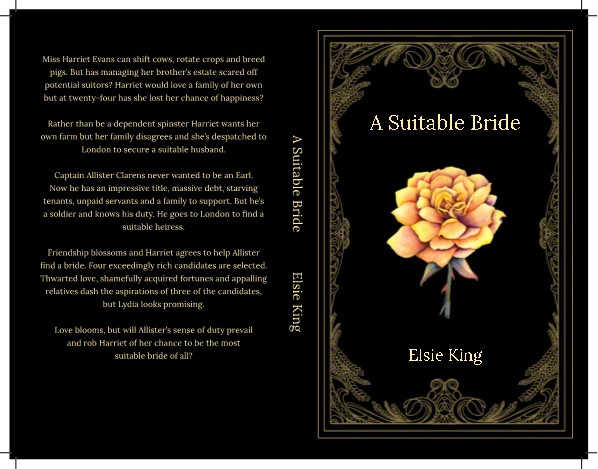
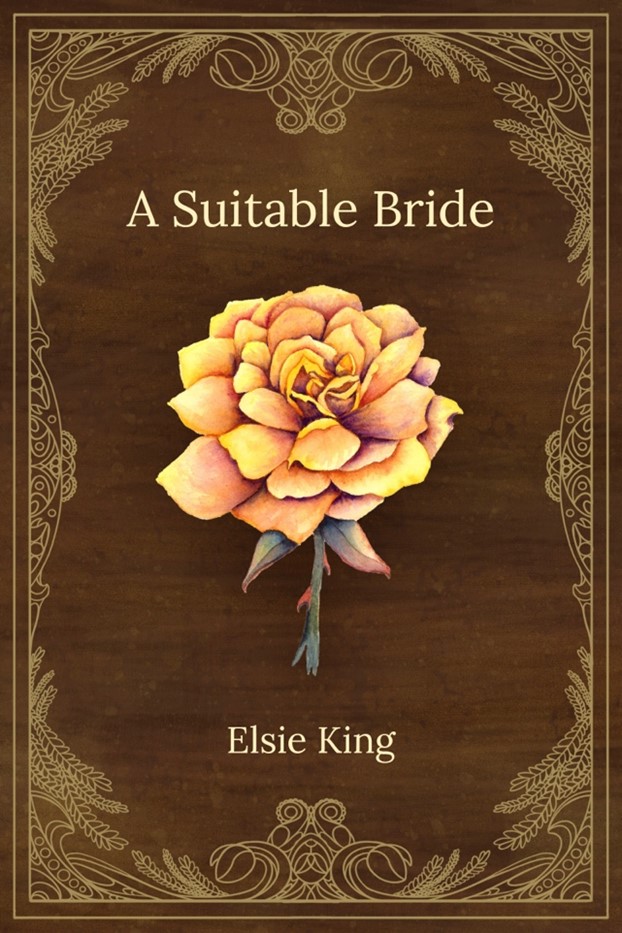
Welcome to my new novel, A Suitable Bride. Impossible love, the dire need for an arranged marriage and a happy ending firmly place this novel into the Romance genre. And yes it’s set in the Regency era.
I got lovely feedback from my first novel A Suitable Heir so I hope my readers will enjoy this second foray into my favourite time in history.
The book will be available from the 30th April in both e-book and print copies. Please visit my website www.elsiekingauthorartist.com for links to purchase on-line.
I read an article by Draft2digital that said the best marketing for your first book is to publish a second. I certainly hope that this is true. Enjoy.
I must admit I’ve only begun my journey onto this path. At this stage, it’s more of a side-gig than a career. So, I thought I better do research before spouting words of wisdom about what ghost writing is all about.
After gleaning a few articles online, I realised an experienced and quality writer could make a decent career out of ghost writing.
If only I had known, I could’ve seamlessly transitioned from research writing to ghost writing without a thought…once my boys had both gone to school. Imagine the flexibility, working from home and the money. Extra money for house renovations, more trips overseas, and perhaps a caravan for that longed-for lap around Australia.
But such literary adventures were not to be for me at that time.
These blog posts also advised that for landing a good ghost writing contract, a writer needs to prove their skill and worth by having published a book or two.
Now that I have spent the last fifteen years in writing groups honing my skills, have published five books, and recently set up with my writer friends, Indie Scriptorium Self-Publishing Collective, the time has come to investigate the prospect of ghost writing.
The idea arose out of a recent job I acquired to help a friend who is writing a biography of her mother whose family suffered under the Nazis during World War II. Each week she hands me another handwritten chapter which I type up and expand in places. The story is good, it’s there, but needs glue words and verbs in sentences to make it flow.
I realised that I had become a ghost writer. Or was I a hybrid editor?
In this case, although my friend is paying me an amount that they can afford, I’m doing the work as a favour, more in line with the ethos of Indie Scriptorium where a community of writers trade skills to get the work completed, and the book published.
Hiring a ghost writer can be expensive, but let’s say a person does get a ghost writer and has completed the work. Although some ghost writers claim to be a one-stop shop of the publishing process, it is advisable to have the book edited, test read, and proof read by different sets of eyes. In this regard, Indie Scriptorium might be ideally suited to help an aspiring author prepare their completed manuscript as we have the combined skill set to edit, proofread and design covers for their book. A couple of us can even help those who want to self-publish to upload their competed work onto a publishing platform. Done either for an agreed amount of money or in trading skills.
Is there an option for Indie Scriptorium to offer a ghost writer or two in the future? Currently, I personally, am still exploring this possibility. Such a venture, if undertaken to the best of my ability, would be a full-time task, and my other projects such as my novels, would have to be set aside for a time. The reality is, I still have stories in my head that I want to tell. And I am working on my friend’s assignment. Their mother’s story is one I have been waiting ten years to be told and shared with the world.
These are my personal thoughts on Ghost Writing, but for a more professional view about ghost writing here are a couple of articles you may like to look at.
Incubating an idea for a story is an interesting process. As a novelist my inspiration most often comes from a theme. It might be the rights of women, the importance of family or equality and fairness. At other times the theme emerges as I write.
When I reflect on the themes that are important to me as a writer I can trace the influences on my life. My mother was a strong feminist even before it was a movement. Her actions in life were all about doing things her way, standing up for those less fortunate and being a strong advocate for what she considered right for her family.
My education as a Social Worker strengthened my principles of feminism, justice, equality and being non-judgemental. I learned to respect a person’s self-determination, even if it was outside the norm. I’m also a pacifist and abhor violence and war.
Stop Pushing was a story where the themes emerged without pre-planning. At a writers’ group we were given a ten-minute exercise to complete a piece of writing inspired by a sentence that contained the words stop pushing. I just wrote. Top of my head the story just emerged with flow of consciousness. It wrote itself. I liked the original and took it home to refine. “Stop Pushing” is the final short story and I like to think it is one of my best pieces of writing. I hope readers enjoy it and also look for the themes that are entrenched in the story.
Stop Pushing
It was a peculiar name. Who would ever call a bloke Stop Pushing? Snowy Jones reckoned it was him that got it wrong. Said he had asked the new bloke for his name and got told it was Pushenko, or something foreign like that. Now Snowy was ‘bout eighty-five at the time, deaf as a post and with a few wallabies loose in the top paddock, so it makes sense he got it wrong. Snowy decided it must be Pushing, and that was that.
I never found out where the Stop came from; but it is Australia, and everyone gets called something short that’s fitting. Stop Pushing sort of emerged, settled and became part of the lingo, and that was that.
Stop arrived in the early fifties. Bought Warren, the goat’s old place on the edge of town. The sheila’s tried to do the neighbourly thing and get him to the RSL chook night, but Stop wouldn’t have any of it. But he turned up in the front bar every Friday, have two beers and then go home at closing time, did that all of his life. And he always fronted at the dawn service on Anzac Day, stood at the back, then drifted away like a drizzle on a breeze.
Stop was a funny bloke. You wouldn’t believe he had a sense of humour; and he didn’t! Never smiled or laughed. Ordered his beers with a nod to the barman and said nothing else; to anyone. There were no laughter lines on Stop’s dial. He had deep gauges around his mouth, sunken cheeks and eyes that emerged from the black pits of hell. He was thin as a long dead cadaver and looked no different in forty-odd years.
What Stop did on the small holding we never knew. He kept himself to himself, and we were alright with that. He was quiet, clean, and took up very little room at the bar. After, a few years, his bar stool became a protected zone on Friday nights. “Oi, you can’t sit there, that’s Stops’ corner.”
It was in the nineties and the local fire crew had just mopped up after a blaze that grazed right up to the edge of town. The pub put a couple of hundred on the tab and everyone got plastered, really plastered. A few of the younger fella’s got a bit out of hand; as you do when you face off a fire for the first time. A kerfuffle broke out over some bloke’s missis, and the two Romeos took to some shoving, right into Stops’ corner of the bar.
Stop was jostled, he swayed, then toppled sideways, fell to the floor. The fire chief rushed over and tried for a pulse, but then shook his head sadly. They propped the poor old bastard back up on his stool and raised their glasses in remembrance. Stop Pushing was no more.
Now Stop Pushing could have just faded into obscurity, but a couple of months after the funeral, a bloke in a suit called a meeting in the front bar of the pub. The suit said he was a “lawyer for the deceased known as Stop Pushing.” Turns out Stop was worth a bob or two and left all his money to the town. He was some sort of fancy writer. Not a Steven King type writer, but he did history books which he sold to schools and universities, for a fair bit of money.
Well, the CFS got a new fire truck, the oval got a new stand with change rooms underneath and Warren, the goat’s place, got turned into a community library with meeting rooms and even computers.
He also donated a new park bench at the war memorial. The plaque was short and to the point, “In memory of Stephan Pushenko”
There was a lot of talk about Stop for a few years after his passing. One of the teachers did a bit of digging and found out the poor bloke had come from Poland and done time in Auschwitz. There was some speculation that he was from some rich Jewish family, or he was a Romany or even a poof, but I don’t think that mattered to anyone in the pub.
I reckon Stop found his way to our small place in Australia. He was taken in, given a new name, and left to be himself. He never did anybody any harm and ended up doing everyone a lot of good. Whatever ghosts he needed to bed, he did it quietly.
I like to believe Stop found serenity here. He took in the ordinary life; the fires battled, the footy games won, the cricket games lost, the jokes, the gossip and the yarns. We gave him back a life, and he took what he needed, then gave back in spades.
Visitors to the pub may find it a bit strange but at closing time every Friday, to this day, some joker will raise his glass and shout, “Stop Pushing” and everyone will raise a glass and repeat “Stop Pushing” and have a laugh. For a memorial, you can’t get better than that.
Scams, it seems we’re inundated with them and in the publishing world it is no different. A fellow WordPress blogger, Scam Hunter has offered an excellent and detailed post on this subject.
In a previous blog I mentioned that the best form of marketing is to write a second book. I’m about to test that theory and my second book A Suitable Bride is at the proof-reading stage with a release date hopefully soon. (I’m reluctant to name a date until the book has been fully edited as many things tend to intervene and I have to apologise for the delay.)
My first novel A Suitable Heir was marketed to family and friends, through the indie table at the Romance Writers of Australia Conference and on their magazine Hearts Talk. I sold some through my art group. We tried a local market with no success. I sold about fifty books through this process and was reasonably happy with the outcome but hopefully can increase sales for my next book.
My problem, and I think it is a problem for many writers, is that I don’t have the knowledge, inclination or time to devote to marketing. I admire those writers who have taken the plunge and got a large following of readers and are making a good living from their craft but marketing is not my forte. However, as a member of Indie Scriptorium I feel that I have an obligation to get some understanding of the various marketing techniques and report on my findings. I would love to find a book marketer who is able to market my novels for me at a reasonable cost but first I think it’s important to know what sort of marketing you want for your books.
Types of Marketing Services
Getting the book ready for the market- includes cover design, blurb, the correct Search Engine optimisation (SEO), the best keywords for your book, an author bio and reviews of previous books and make the price competitive.
Advertising – can include social media advertising, Amazon advertising, Goodreads and many other platforms
Setting up an author website and learning how to use it effectively.
Having marketing material, banners business cards, bookmarks etc.
Getting an e-mail campaign started
Doing author talks, book launches and making media releases
Listing your book with online distributors such as Amazon, Booktopia and Book depository.
Each of these areas of marketing will need to be extensively researched and require a working knowledge of the various social media and web pages. There are lots of options in most categories. I will do the Google searches, look at countless You-tube videos and try to work out the sometimes-confusing web sites and social media platforms for my own edification and to inform IS followers.
The other option is to hire a book marketer. A quick google search for book marketers in Australia reveals lots of options that all want your e-mail address so they can bombard you with sales pitches for the rest of time. It’s also a matter of buyer beware as some of these book marketers are vanity publishers who promise a lot, take your money and deliver a shoddy product and leave you in the lurch. I will keep searching for book marketers who may provide a good service at a reasonable price and keep you informed.
Indie Scriptorium has provided some blogs about some marketing techniques. See our previous blogs on SEOs, cover designs, blurbs, websites but the above is a very large checklist and we still have a way to go.
I already have a website, business cards, reviews and I’m happy with my cover design, author bio and blurb for my second novel. I will be reviewing my SEO and making sure my keywords are the best for my novel.
My initial focus will be on my social media, look at Amazon and Facebook adverts and explore Goodreads and other book distribution services. Going local and using my existing contacts in Romance Writers of Australia, organising a book launch and networking with local writing and book clubs will also be in my plan. Hopefully I can share what has worked for me, and what didn’t. Stay tuned for more on marketing.
Indie Scriptorium is beginning a new tradition in 2024. Every fourth Sunday of the month we will be featuring a guest writer.
This week, the Indie Scriptorium team have invited fellow Adelaide artist and writer, Robert Richardson to share a poem from his recently published book on poetry, Words and Rhyme.
Some months ago, Mary McDee wrote a post giving tips on writing good poetry. We had quite a bit of interest in the article and some further questions pertaining to the mechanics of an effective poem.
The following poem by Robert Richardson is an excellent and catchy summary of the main types of poetry and how to write them.
If you’d like to read more of Robert Richardson’s poetry book, click on the link below:
Cheers,
Lee-Anne Marie Kling (c) 2024
Feature Photo: Words and Rhyme cover(c) Robert Richardson 2023
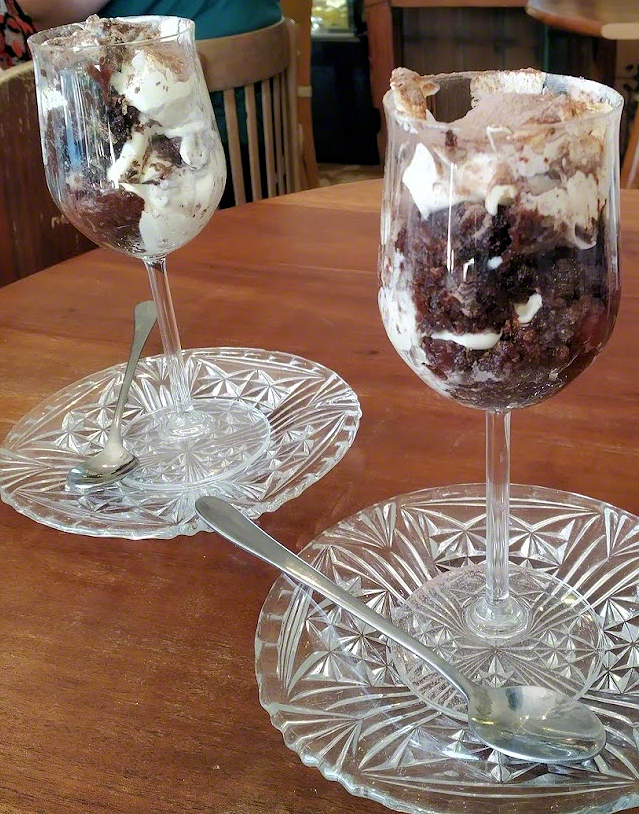
Last Friday, Mary and I attended a party at a local Café that we patronise every Wednesday between Bible study and Writers’ Group. We go there for lunch and have started to get to know some of the regulars there as well as the manageress. She makes a delicious Black Forest Cake.
Anyway, on the way, I remarked, ‘Wow, it’s been a week already since the market.’
So, how did we go? You ask.
What you must understand is that the main stream media did its best to deter people from doing anything—apart from activating their fire-safety plan. Or second to that, heading to the nearest bunker and hunkering down waiting for the apocalyptic storm to pass.
As it turned out, the doom and gloom weather forecasters were out by a couple of days. Clouds shrouded Adelaide by mid-afternoon, even a few spots of rain. The fires never happened. The evening of the market turned into a balmy twenty-something degree Celsius, perfect for strolling in the market or enjoying Christmas festivities.
However, the damage by media had already been done and no one but a hardy few, ventured outside their homes to attend. In the end, traders traded amongst themselves. I bought a native orchid and a couple of Christmas cakes. Elsie bought my significant-zero-number birthday present, a handy art pouch that I can use when painting en plein air.
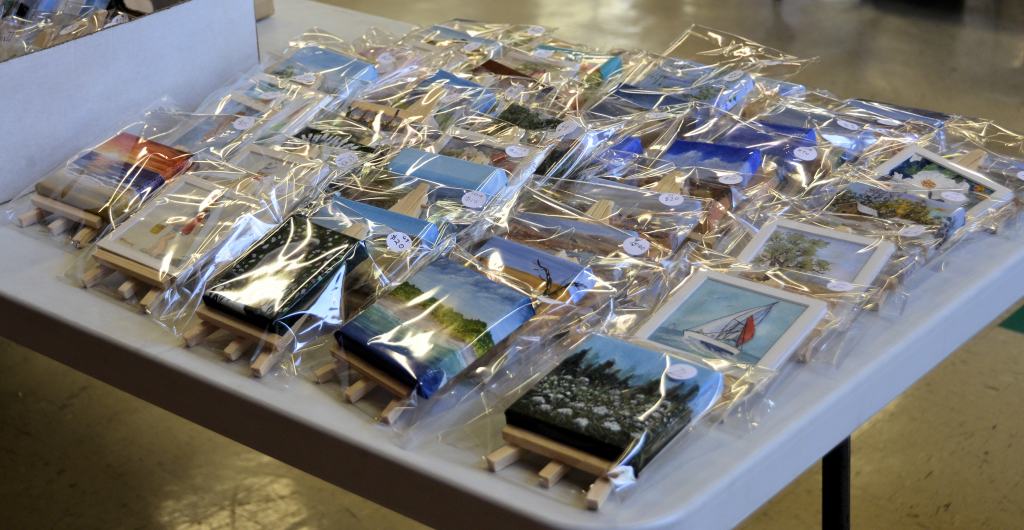
And finally, after no financial transaction action all evening on our stall, a neighbouring vendor bought one of my books, and Elsie’s great nephew one of my miniature paintings. Minutes before, we had sold one of Elsie’s cards while she was away from the table having a break.
Disappointing? No, I don’t think so. I have come to believe that the market experience is more than just buying and selling goods. It’s about community. Building relationships. Being a regular reassuring presence. Being there to listen to people, to connect with people.
Now at times, during the evening, this connecting was difficult to do. We were situated right under the main entertainment; a couple of merry “Elves” singing Christmas songs. They were doing a jolly good job of it, drumming up that seasonal spirit—except that they sang to no one but the vendors most of the time. Where we were the music blared at top volume. When some hapless soul did enter the market and pass our stall, they sped around the tables, glancing only briefly at our books and artwork. Communication, even amongst us concluded in sign language and I resorted to sharing writing in my notebook; a kind of note-passing between friends.
When the music-makers took a break, we had opportunity to connect with potential buyers or people who just wanted someone to listen to what was going on in their world.
While packing up, one of the neighbouring vendors gave some advice; cards don’t sell, they said, and every time is different, so don’t give up. From the brief debrief we had, we decided that in the future, we’ll look at selling smaller paintings and trying to get a stall far, far away from the entertainment.
As for connection, the market is just one way for advertising Indie Scriptorium and our indie-published books. After years of going to this local café I mentioned Mary and I go to every Wednesday, I finally gave one of my books, The T-Team with Mr. B to the manageress to read as a Christmas present. The Lost World of the Wendswas given to a young writer who also comes to this café, and also I gave away a bookmark advertising Indie Scriptorium.
Building the “brand”, the business by networking takes time, especially with the strident voice of professional media, but slowly but surely I feel, people are catching on and it’s happening for Indie Scriptorium.
A heart-felt thank you to all you faithful followers and newcomers to our Indie Scriptorium blog. Merry Christmas and we wish you a successful New Year in your endeavours.
This Friday we, the members of Indie Scriptorium, will be selling our books, artwork and cards at the
Reynella Neighbourhood Centre Inc. Twilight Christmas Market. 164 South Road, Old Reynella Friday 8 December 4 – 7pm
If you are in Adelaide, come and visit us there.
Not only will you be able to see the books and artwork which we have produced, we will be available to discuss with aspiring authors, such topics as: Helpful tips on becoming a writer, publishing your own book, and marketing options.
Pitching can be defined as short verbal promotion of your book to a publisher or agent. The pitch can be face to face or on-line. It’s usually is between three and ten minutes. In some instances, the pitching appointment is a set time and you may need to alter your pitch to fit.
Elevator pitches are very quick and so named to capture the scenario of entering a lift with a popular publisher. You have just moments to convince them they need to accept your book for publication before the lift stops at the next floor. Pressure indeed.
The Australian Society or Authors and Romance Writers of Australia organise pitching sessions which get hopeful authors in front of people in the publishing industry. The ASA have courses for authors to learn all about pitching and also offer Literary Speed Dating sessions. The RWA offers pitching sessions as part of their annual conference.
But do you want or need to pitch your book to a publisher? Many writers decide to self-publish so don’t need to pitch their novel. However, if you would prefer to have your novel traditionally published, or you want an agent, then pitching is essential.
There is considerable information on line about how to formulate the perfect pitch. If you Google Author Pitching Formula a variety of web sites appear. I have done a pitch and used a formula but it went out the window in the actual interview. I would suggest doing the research and picking out the formula that suits you and your novel and construct it according to the time constraints of the publisher/agent.
At the minimum the pitch should cover:
That the book you are pitching is completed, fully edited and formatted and ready for submission.
The title (even if it’s a working title)
Word count
The specific genre and target audience
A brief description of the main characters
The conflict and resolution
Why it’s different from anything else.
With longer pitches you can include your author credentials and experience
What target market you envisage for your book
What books are similar to yours.
When you’ve written, re-written, practiced, timed and learnt your pitch off by heart take a course in deep breathing and mindfulness for anxiety and you’re ready to pitch.
Two articles from Romance Writers of Australia, Hearts Talk magazine provided some interesting and helpful ideas.
Rachel Sweasey The Importance of Pitching June 2023 suggests for Zoom pitching appointments
Practice looking calm and happy prior to the pitch. Smile maintain eye contact.
Be on time
Be prepared
Dress in the same style as your Author bio picture so the publisher/agent can put a face to your picture on your submission.
Have answers to expected questions on post-it notes stuck to the edge of your screen to act as prompts if you dry up. This way you won’t have to shuffle through notes and can maintain focus on the interviewer.
Amy Hutton Pitch Perfect April 2023 suggests:
Have a solid synopsis
Learn the pitch by heart
Make sure you know what a particular editor/agent is looking for before making a pitching appointment.
Allow time at the end of the pitch for questions
Have answers prepared about your character, themes, yourself and your writing history
If you have time include courses, groups and workshops you’ve attend
Also include your social media and marketing experience
Pitching is a difficult, nerve-wracking experience but it can get your book read rather than being left to languish at the bottom of a slush pile.
The art of pitching is different to presenting your book to potential readers. This is also a great skill to learn for both traditional and self-published authors. I will address author presentations in my next blog.






 Indie Scriptorium -- Self Publishing Collective