Indie Scriptorium — Self Publishing Collective

Helping Each Other Publish

Skip to content
  • Home
  • About Us
  • Blog
  • Books For Sale
  • Introducing Indie Scriptorium
  • Links–More for You
Search

Publishing

Publishing Pointers–Where to Publish Your Books

June 11, 2023 / lmkling / 4 Comments

It’s a wonderful feeling when you finally have your book written, edited, proof read and formatted and covered with a beautiful dust jacket or e-book cover. Now is the time to upload your book to a publishing platform but which one is the best for you?

There are many authors who do not want or need to sell their books online. Writers of local history, a memoir or an anthology of short stories put together by a writers’ group may choose to distribute their work without using online publishers. So, the first option would be to find a local printer and negotiate a number of copies and price. Mary McDee will explore this option in depth in a later blog.

Below I have listed the publishers that I have decided to consider when I publish my books. You can upload to as many or few publishers that you choose as they are not exclusive.

  1. Amazon Kindle Direct Publishing (KDP) – This is the most popular platform to get authors into print. They are free and fast at getting your book available to readers. They have world-wide distribution and royalties are around the 70% mark. You will need to have an Amazon account so you can use the service. Amazon will publish e-books (to read on a computer, tablet or Kindle reader) paperbacks and even hardcover books. These can be ordered by the author for distribution or they supply a print on demand (POD) service which means a customer sees your book online and orders a copy which is then paid for (includes postage) and sent directly to the customer’s address. Amazon provide a plethora of tutorials and videos all of which appear to be user friendly. The process of uploading to KDP is meant to be easy but as of yet I haven’t tried it out. I will certainly be doing a blog about my experience in the near future. Amazon have a printing facility in Australia.
  2. Google Play Books – this publishing platform is similar to Amazon but only does e-books. They have a Partner Centre for authors and you will need to open an account. An advantage of publishing on Google Play Books is that they have a recommendations system that makes it easier for readers to find your books using Google searches.
  3. Barnes and Noble is another publisher who allows you to order e-books, paperbacks and hardcover books. It offers 70% royalties and is similar to other publishers.
  4. Draft2Digital is a different type of publisher called an aggregator. They distribute your books to other booksellers. They have recently started to distribute print book on demand but not in all areas. It is well worth exploring the advantages of using Draft2Digital. They also offer a free and easy to use formatting service which I will explore in a future blog. The royalties for Draft2Digital are lower than publishing directly with other retailers.
  5. Ingram Spark is another aggregator and they have a wide network of distribution to places like schools, libraries and retail chains. They excel at paperback and hardcovers, and you can use Ingram Spark in tandem with other retailers like Amazon. The royalties are less and they used to have a setup fee of $49 dollars but this has been waived since 1st May 2023. They also offer free revisions for a set period of time.

There are a number of other publishing services available for authors. It is important to be wary of publishers who demand fees for their services and always look carefully at any contracts especially relating to copyright.

 Having a few different platforms presenting your books is referred to as Going Wide.  This distributes your book to as wide a range of readers as possible. There are no restrictions to publishing on several different platforms at the same time. However, there are restrictions to using the same ISBN on different book formats. You have to have a different ISBN for a paperback, audio and hardback but you don’t need a ISBN for an e-book.

If you use Amazon and opt for Kindle Unlimited you have to be exclusive to Amazon. This is a service that allows readers to pay a monthly fee to be able to download any number of books they want. Authors benefit by getting paid by the pages read rather than the purchase of the entire book. You can opt to have your book exclusively on Kindle direct for a set contract time of 90 days or leave it there indefinitely.

I have provided an overview of the different publishing options. I recommend that authors explore the advantages and disadvantages of several sites and also seek more information on-line.

I found the following information invaluable:

www.yourpublishingguide.com/blog/7-best-places-to-publish-your-book

Cheers Elsie

©Elsie King 2023

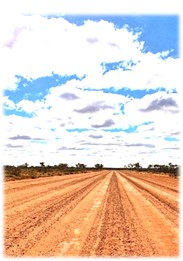
Photo attributed to Creative Commons.

Share this:

  • Share on X (Opens in new window) X
  • Share on Facebook (Opens in new window) Facebook
Like Loading...

Publishing Pointers–Distribution Channels

June 3, 2023 / lmkling / Leave a comment

12 different Ways to get your book out there

So, you’ve written your book, edited and polished it. It’s ready for the world to see. But how do you get your book out there, so that the world can see it? Rather than repeat the wisdom of many writers and bloggers who have come before me, I will summarise the avenues of publicity from my experience and research over the years. For more information, you can click on the links provided throughout this post.

  1. Library—You may want money for your labour of blood, sweat and words, but your local library is a good place to start for making your book, if it is a hard copy, visible. There’s something about local authors and people who are interested in reading the world created by someone who lives in their community. If you are part of a writers’ group who meet in a local library, the library is only too happy to receive one of your books to put on their shelves.

In Australia we have Australian Library Services, an organisation who distribute books to libraries throughout Australia. One point to keep in mind when submitting your book to ALS, ensure that the quality of the printing is good, as a poorer quality book will not last the distance in the rigours of repeated borrowing.

Another point to keep in mind in Australia is that you are required to submit or register your book with your State Library and National Library. In the old days you had to trek into town to your State Library and deliver the book to them personally. Nowadays the National Library of Australia (NLA) has a website where you are able to upload your book for registration. I was interested to discover that NLA has been developing an online digital publication tool Trove where a treasure of historical and recent publications can be found. Another avenue where someone finds your book.

2. Family and Friends—never underestimate the value of family and friends to benefit from your book. Make the most of gatherings with loved ones or social outings to share your recent accomplishment (your book) in the hope that they will buy a copy. If not, your book maybe a handy gift for birthdays and Christmas.

3. Bookshops—Mainline bookshops and even small boutique ones can be a teeny bit snobby when it comes to accepting Indie-produced books for their shelves. Mostly, these sacred shelves are reserved for the books from traditional publishers. But, it’s worth a try. I had a friend who travelled down this footpath with her book and with perseverance and her gift of salespersonship, she was able to get the vendors of some big booksellers to stock her book. Even made some sales. She said the downside of having her books in the bookshops is that it can take some months for the books to sell, so no profit until they do. Added to that was that some bookshops sold the book and “forgot” to pay her.

4. Writers’ Fellowships or Genre Group such as Australian Society of Authors, or Romance Writers of Australia can provide support for your work and an avenue and ready audience to receive/buy your work. After all, if you are part of a Writers’ Group, they, who have helped you produce the book will only be too willing to receive a copy (probably free as they helped you, didn’t they). That being said, they have family and friends who may like a copy too and pay for it.

5. Online Publishing Platforms: eg. Goodreads, Smashwords, Amazon—I personally have published my books through Amazon. As the biggest online retailer, and the fact that I found uploading the book to Kindle and also the facility to have my books printed, made it a no-brainer for me. One thing to say, when publishing your book, you need to be patient and careful to read the proof copy to prevent typos and glitches from being published. Take the process slowly, don’t rush or panic. Engage the help of a friend if you feel wobbly about the whole computer-technical side of Indie publishing through a digital platform.

A website, Your Publishing Guide, has extra information that may help you choose which and how many platforms to use.

6. Blogging/Website offering your book as a PDF or link to your book—When I began my Indie publishing venture, a younger, more tech-savvy friend advised that I should have developed my blog or website months before publishing my first two books. They said that my book sales would have been better if I had had a “following”. Eight years down the track, so to speak, and with over five hundred followers, not sure if that’s true, but, hey, every little bit helps. And, every so often, I make a sale.

7. Word of mouth (always keep your “business card” handy…and a box of your books in your car)—most of my hard-copy books have been sold this way. People ask, “What do you do?” I answer, “I’m a writer.” Next I’m telling them about my book and offering my business card, and a copy of my latest book. And they buy the book.

8. Coffee Shops—often you see in coffee shops books in a little pile or on a shelf for customers to read when they are sipping their drink. Just the other week, Mary McDee and I spied a locally produced book on the shelf of our favourite café. Gave me an idea to offer one of my books to add to the pile.

I might add here, since it is more community than library, that it does no harm to add your book to the collection of books offered in a community library. You know, those book boxes that have popped up all over the suburbs on footpaths or next to community centres and the like.

9. Markets and Fairs—if you have more than one book on offer, or you collude with one or two friends who have published books, hiring a stall or table at a market or fair might work for you. My experience was that the sales were not forthcoming. At fairs, people are looking for cheap homemade and second-hand items, not brand-new books. Also, you need to cover the cost of the hire of the stall or table. Never-the less might be worth a try. I’d reckon that if you had a regular stall at a market, and had other creations to sell like art, cards, craft, clothes even, you may have more success selling your books.

10. Clubs as a guest speaker —ie Probus, U3A, church, Rotary. When you write and publish your book, this is what you sign up for. If you published through a traditional publisher, they would expect you to deliver on this sort of publicity. Most of my books have been sold through book launches (at church) and being a guest speaker.

11. Online Promotional Services —ie ISBN, Amazon advertising. I’ve noticed that the ISBN agency are regularly sending information and advice to me through email on how to promote my books. When you register your book with the ISBN agency, they require you to give a synopsis of the work and provide the book cover and blurb. Same with any sort of advertising. Ensure that your synopsis, blurb and cover attract the reader by being eye-catching and engaging. For some helps you can read Elsie King’s posts on “Publishing tips—Writing a Standout Synopsis” and her recent post on “Publishing Pointers—The Book Cover”. 

12. Social networks —ie Facebook, Twitter, Instagram. All I can say about this is that it’s yet another way to lead potential readers to your book. The main advice I have read over the years of blogging, is that you need to stick to one platform and not get all tangled up with dozens of social media platforms. Go with the one that works best for you and then link the other platforms to that one. I have stuck with WordPress as it is a safe place and well regulated to keep out the likes of Trolls and Spammers. Then I have set up the links to Facebook, although I had to become an administrator of a new Facebook page. I had links to Twitter, but it never really went anywhere, and now has flown the coop.

I might mention here that I have an Author page on Amazon. Not sure about other people’s experiences, but I have found the page basic with very little scope for editing mistakes made by me. For example, it insists on calling me “Mrs. Lee-Anne”. Really? Bit strange in the 21st century.

***

One thing I have learnt from my publishing adventure, is that I have made discoveries and have grown along the way. I have received some feedback that I need to spoon-feed my audience with a step-by-step guide on how to…whatever the topic is. However, in the words of a teacher friend of mine, “We learn by doing, not just hearing.” Besides, there are many step-by-step guides out there on the web and I doubt another one by me would make much difference for the tech-challenged. So, for all who have yet to launch into the world of publishing your book and distributing it, the best way of getting your book out there is by being bold and doing just that: have a go and get your book out there.

© Lee-Anne Marie Kling 2023

Feature Photo: Trekking with the T-Team on display © L.M. Kling 2018

Share this:

  • Share on X (Opens in new window) X
  • Share on Facebook (Opens in new window) Facebook
Like Loading...

Publishing Pointers–DIY Book Cover

May 13, 2023 / lmkling / Leave a comment

Cover Design–How to DIY Your Cover

In my last blog, I suggested that getting a professional illustrator or buying a ready-made book cover is the way to go for most writers. Purchasing a cover, you like and fits with your genre, can be easy and time effective and doesn’t cost too much.

If you can work with a graphic designer or illustrator, it will cost more but may be worth the money to get a cover that attracts readers and markets your book. A good illustrator can provide images of your characters and this may be super important if you have imaginary beasts and extra-terrestrials you want to introduce to your readers visually.

I wanted a book cover that used my original artwork and reflected the Regency era as well as the genre. I looked at many websites offering pre-made covers and couldn’t find a template that was anywhere close to what I wanted.

I played in Canva and Microsoft Word and came up with a few ideas but found the process time consuming and sometimes frustrating. I also don’t have the technical skills to get the quality of the image right. To purchase programs like Photoshop is expensive and just wasn’t worth it for a few covers. So, I have now engaged a graphic designer to help me achieve the cover I envisage.

However, if you want to try to do your own cover design and have the time to play, I will provide some basic exercises that will lead you in the right direction.

Working in Microsoft Word

The word program is not an easy option but is doable if you have the time and energy to fiddle. It does often mean that you will disappear down a rabbit hole and emerge much later with a cover design, or not.

Step 1: Open a blank document. (Go to your tool bar and select “File”, then select “Blank Document) Choose custom size that best suits your book size.

[Screen shot 1: Selecting a blank document]

    Step 2: Select “Layout” in your tool bar and put in some margins that reflect the size of the cover you want. I suggest a standard size such as 15cm x 23cm (6 x 9 inches) You can decide on your own margins by clicking the arrow besides the margins diagram and scrolling down to custom margins and then setting the margins to best suit your cover size.

    [Screen shot 2: selecting Layout]

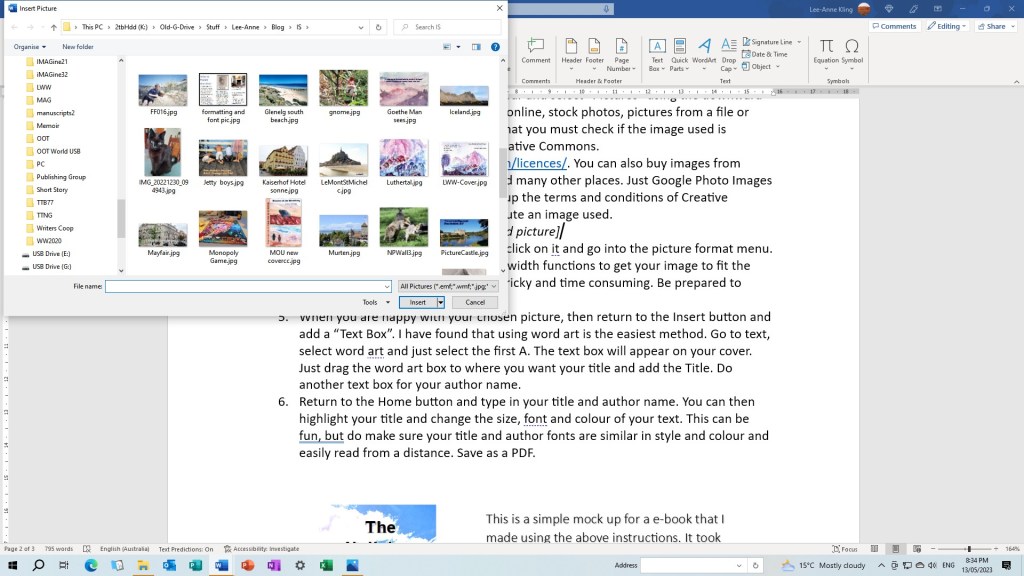
    Step 3: Click your mouse on “Insert” in tool bar and select “Pictures” using the downward arrow. You can select an image from online, stock photos, pictures from a file or from your photos. Please be aware that you must check if the image used is copyrighted. I select photos from Creative Commons. http://creativecommons.org.au/learn/licences/. You can also buy images from places like Shutterstock, Pinterest and many other places. Just Google Photo Images to buy, or similar. It is worth looking up the terms and conditions of Creative Commons licences and how to attribute an image used.

    [Screen shot 3: Inserting your selected picture]

    Step 4: Once you have selected your image, click on it and go into the picture format menu. You can use the crop and height and width functions to get your image to fit the size of your front cover. This can be tricky and time consuming. Be prepared to experiment and learn as you go.

    [Screen shot 4: Formatting your picture]

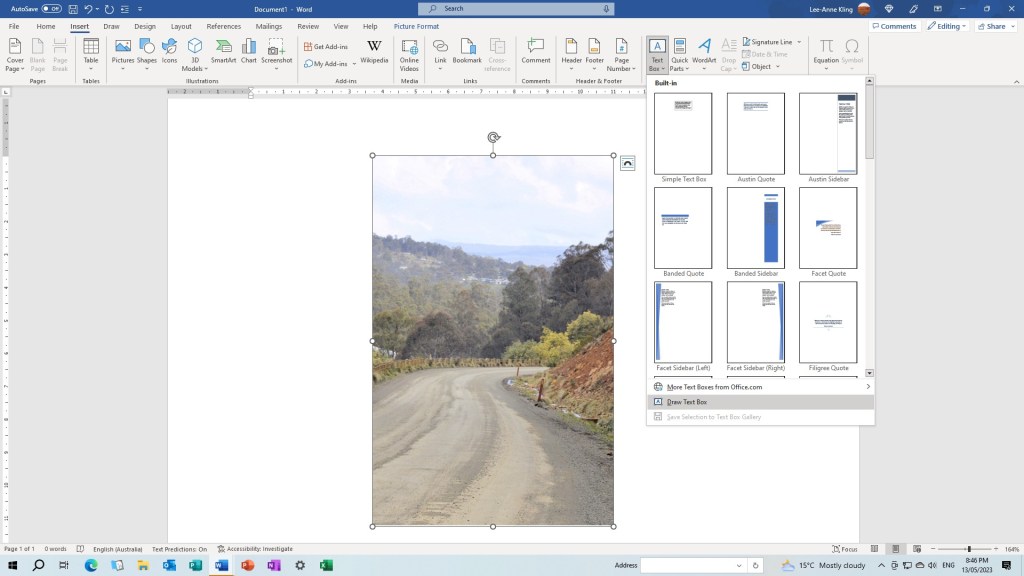
    Step 5: When you are happy with your chosen picture, then return to the Insert button and add a “Text Box”. I have found that using word art is the easiest method. Go to text, select word art and just select the first A. The text box will appear on your cover. Just drag the word art box to where you want your title and add the Title. Do another text box for your author name.

    [Screen shot 5: Text Box]

    Step 6: Return to the Home button and type in your title and author name. You can then highlight your title and change the size, font and colour of your text. This can be fun, but do make sure your title and author fonts are similar in style and colour and easily read from a distance. Save as a PDF.

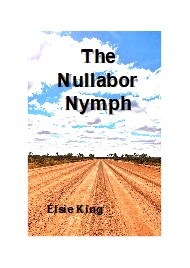
    This is a simple mockup for an e-book that I made using the above instructions. It took several hours to complete. There are a host of videos on You Tube which give more detailed instructions that I would recommend you look at. To complete a paperback cover with a back cover and spine you will need to do further research.

    There are many programs on YouTube that will demonstrate a more sophisticated, and possibly easier ways of designing a book cover. Good luck, I’m going to a professional.

    Elsie King ©2023

    Image: Attribution by Creative Commons.

    Share this:

    • Share on X (Opens in new window) X
    • Share on Facebook (Opens in new window) Facebook
    Like Loading...

    Publishing Pointers–Landing a Contract

    May 6, 2023 / lmkling / Leave a comment

    IF YOU EVER LAND A CONTRACT

    Recently I was chatting to a fellow writer who told me that years ago she’d had a book accepted and published by one of the big-name publishers.  It was a textbook in her field of expertise and intended for teachers.  She’d been thrilled; it sold well and she’d been paid her share of the profits.  All good.

    That was many years ago and her book has been long out of print but, now retired she continues to write; is deep into a novel and a leader in her writer’s group.  When she mentioned the name of the publisher I was particularly interested as I too had once been offered a contract on a book for teachers that I was in the throes of writing.  This was many years ago but, unlike her, I refused to sign the contract I was offered.

    “Why on earth not?”  You might well ask.

    Ever since I learned to read I’ve been bewitched by print; always had my nose in a book; accused of “even reads Weetbix packets” …  So I read that contract carefully and got my knickers in a knot over two of the items hidden away in all the legal verbiage: copyright ownership and payment if there happened to be the need for a second edition.

    As far as the first of those two went; the big-name publisher would own the copyright if I signed that contract.  No way!  All those words, the book I’d been labouring over was my precious baby.  Nobody else was going to own it; have control; do what they wanted with it.

    Regarding the payment issue: the contract stated I was to receive 10% of the sales price.  Fine.  I knew that was more or less the going rate, standard procedure.  But then it went on to say I’d only get seven and a half percent if there happened to be a second edition.  This made no sense to me.  Surely a second edition would be easier, simpler and cheaper to produce as all the set-up stuff would be in place so it would be nothing more than a reprint.

    At the time I was inexperienced and totally unaware that most contracts are negotiable. So I simply clenched my jaw; dug my heels in; squashed my feelings (thrilled, validated…) and wrote a polite note of refusal – no reason given.  Which was stupid, I know now.  But back 8then I had no-one to help or advise me.

    Ever since I’ve checked to see who owns the copyright of any book that comes my way!  As a by-the-by; the copyright of virtually every book produced by that big name publisher is owned by them.  Which means the author has probably been duped due to a combination of excitement and trust (i.e. ‘trust’ being lack of knowledge re the importance of checking).

    We are always told “Buyer Beware”.  And the same applies to contracts – if you are ever lucky enough to be offered one.                                                                                                                                

    © Mary McDee 2023

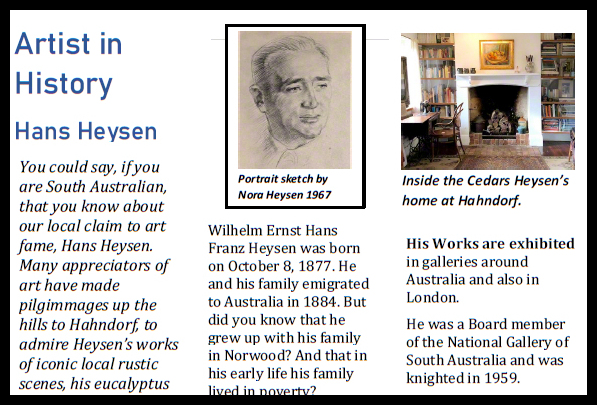
    Feature Photo: The Sign © S.O. Gross circa 1950

    Share this:

    • Share on X (Opens in new window) X
    • Share on Facebook (Opens in new window) Facebook
    Like Loading...

    Publishing Pointers–Fonts and Formatting

    April 29, 2023 / lmkling / Leave a comment

    Fonts and formatting

    When asked to write on this topic, I thought, What am I going to say that is new and enlightening? Another “reinventing the wheel” moment was creeping up on me and I seriously considered deferring the topic for a later date.

    Glad I didn’t.

    After some research, mostly on the trusty internet, I discovered some gems of information that I never knew before or had forgotten. Or is it a case of changing trends?

    I first published, indie-style, back in 2015 through CreateSpace.  After diligently doing my research on formatting and fonts for producing a hopefully professional quality print book, and then following the advice given on CreateSpace, I converted my Word document to PDF and uploaded it to the scrutiny of CreateSpace. After a week of uploading several more corrected copies of my book, getting the margins, formatting right and ridding the document of that mysterious phenomena, embedded text, finally “they” were happy and congratulated me on successfully publishing my book.

    Ah, those were the days.

    Since then, CreateSpace has been taken over by Amazon. Which is fine. Amazon also has plenty of advice and a step-by-step process to make the whole ordeal of uploading one’s precious work for publishing a pleasant experience.

    So, asked to do fonts and formatting and I thought, Simple; for formatting, use template provided by Amazon, or whoever one chooses to go with to print one’s books, and select a popular and familiar font that is reader-easy. How hard is that?

    When I began the research, I began to understand why. In the eight years since I published The Hitch-hiker and Mission of the Unwilling, changes in how to present one’s body of work had crept in.

    So, thus enlightened, here are…

    10 new, and maybe not so new, facts I have learnt about fonts and formatting:

    1. The body text of your print book should be in a serif font. A serif font has little flourishes or links at the base of the character that make the words easier to read. New Times Roman is an example of a Serif font.
    2. Headings or captions—San Serif, “san” meaning “without”. So without the little bits at the bottom of the letter that make the words easier to read in a body of text. But they make good headings or captions. Calibri is an example of a San Serif font.
    3. Some fonts are under licence, and you have to pay for that license if your book is going to print. Even some fonts offered by Microsoft Word were not exempt from having to pay the price of print. And here I’d been using my favourite font with abandon. A font that was recommended by CreateSpace back in 2015. On further investigation about fonts offered by Microsoft word, I found Microsoft’s explanation for the use of fonts. In the Microsoft Website it states:

     Fonts that come with Publisher do not have license restrictions, which means they can be embedded in your publication and printed anywhere. Fonts that do not come with Publisher, however, might be restricted.

    Well, that’s good to know. After all, we pay a yearly subscription for Microsoft Office, so there should be some benefits.

    4. Popular font “Garamond” has been around since the 16th Century and was invented by Claude Garamond who was a Parisian engraver.

    5. Avoid downloading free fonts. You might end up downloading a virus.

    6. Your font is recommended to be 12pt in size. Well, that’s news to me. Way back in 2015, the recommended size of font was 11pt. Are readers’ eyes needing a larger font?

    7. Line spacing is recommended now to be 1.5 spacing. I must confess that a little more space between the lines is easier on the eye. Now, with my novella, The Hitch-hiker, I formatted with double spacing and I felt that the book looked like it was aimed at junior high school level. However, with my other books, I had the normal 1 space to minimise the number of pages. More pages in a book, more the book costs.

    8. A popular print book size is 15cm wide x 23cm tall. That’s with the book closed. When put into print form on the page, the spread of the two pages side by side is 30cm across. However, there are options for variation. Your professional printer or publishing platform should provide you with the options. For breathing space, set your margins to 2.5cm on all sides. I remember reading a very popular fantasy book bought from a well-known bookstore. The margins in that book were too narrow. After reading for hours, I suffered cramp in my thumb after pressing the spine to hold the book open to read this very thick book. So, be kind to your readers and don’t give them thick-book-narrow-margin thumb. Again, your printer/publishing platform should have parameters for you to follow. They might even provide a template into which you can copy and paste the body of your text.

    9. For fiction writing, indent paragraphs by 1cm. For non-fiction, paragraphs can be divided by one line space. Check other books in your genre to see what the formatting conventions are and follow suit.

    10. Don’t forget to insert page numbers. No need to number the title page, though. Odd numbers are on the right hand page, and even numbers on the left.

    What do you know, once I get started, I virtually can keep on going. However, there’s plenty of information offered on the internet, or in books on the subject. Below I have listed references I have found useful to help you on your way to publishing your book/s.

    Wishing you all the best as you tackle this next stage in indie publishing.

    © Lee-Anne Marie Kling 2023

    Feature Photo: an example of my MAG newsletter editing © Lee-Anne Marie Kling 2023

    References:

    • The Write Life—How to format a book
    • Selfpublishing.com—Book Formatting
    • Reedsyblog— 10 Brilliant Fonts for Your Book Layout
    • IngramSpark—The Best Fonts for Books
    • Creativindie—8 Amazing Fonts

    Share this:

    • Share on X (Opens in new window) X
    • Share on Facebook (Opens in new window) Facebook
    Like Loading...

    Publishing Pointers–The Book Cover

    April 22, 2023 / lmkling / 1 Comment

    Think of the book cover as your best marketing tool.

    Imagine a potential reader is browsing the shelves or a table at your local bookseller. They love historical romance and they browse to find their favourite authors. None there, so then they browse for similar books to try out. It is the cover that will attract this reader, so it has to be right.

    The book cover is the full wrap-around. It includes the title, artwork and author’s name. The Spine provides the title and author and the back includes the blurb, the ISBN and publishing details.

    What makes an excellent cover?

    • It should scream out the genre through the use of design photos, images and art.
    • Display the title and author in a striking but easy-to-read font and style.
    • It must be beautiful and use colours that reflect the contents.
    • The design should grab attention, be unique, but also contain elements that are popular in the genre. It pays to do the research.

    Can you make your own cover?

    Most self-publishing groups recommend you hire a professional to design your cover, especially if you are not an artist or a technical wizard using a computer. I suggest you save up some money and pay a professional.

    Finding a designer is a matter of a few easy searches on Google using the keywords, “book cover designs” and there will appear a long list of companies offering to make a wonderful book cover just for you. The prices vary a lot and can be anywhere between $500 and $800 dollars.

    You can also buy book covers that are pre-made. If you add something like “Paranormal Romance book cover” in your Google search, you will find an array of potential designs where you just add your title and the author’s name to a pre-made design.

    Pre-made designs include the front cover, back cover and spine, and each design is unique. Browse the designs and choose one that suits your book, and this may be a simple and cost-effective way for you to cover your book. Remember that you will need your back cover blurb, ISBN, reviews and whatever author information you wish to include. The costs of using a pre-made is cheaper than having your cover made up from scratch. The average price for an e-book and a print edition is between $100 – $300, but there is a lot of variation.

    If you want something unique, contact a graphic designer and/or illustrator. What’s the difference, you ask? A graphic designer uses licensed stock photos and images. An illustrator will create your cover design using your characters and ideas from your book.

    But what if you want to be the designer? You may have a specific design that is not on offer anywhere, or you want to have full artistic control over your book. Perhaps it is a matter of cost. Be warned that designing a book cover for self-publishing requires time to master the elements of book cover designs and technical skills. Not for the faint-hearted, but yes, it is doable. More on this next time.

    Places to look for more information: Reedsy.com>book-cover-art -, Canva for design templates. Elite Authors, Paper and Sage Book Cover design. Explore their websites as they have some interesting and informative articles.

    Cheers: ©Elsie King 2023

    Book cover photo from Creative Commons


    Share this:

    • Share on X (Opens in new window) X
    • Share on Facebook (Opens in new window) Facebook
    Like Loading...

    Publishing Pointers–The Third Road to Publication

    April 15, 2023 / lmkling / Leave a comment

    THE THIRD ROAD TO PUBLICATION

    We’ve told you about vanity publishers – the smooth-talking rogues who take your money and give you little or nothing in return.  Keep right away from them, however desperate you are to have your precious work published.  They are bad news; really, really bad news.

    We’ve told you about the legit, big-name publishers who will give you a contract, provide editorial advice and pay you based on sales of your book.  These people are in business; the point of business is to make a profit so they will (very sensibly!) only accept for publication work which they can be pretty sure will help their bottom line – making money.  I don’t wish to discourage you, but unknown newbies probably have a better chance of winning the lottery.  By all means give it a go.  But with eyes wide open.

    Which leaves us with the third option: self-publishing.  This is a perfectly respectable road to travel which many have, very successfully, done so already.  As with most things in life there can be pitfalls however.

    There are essentially two alternative ways to go if you choose to embark on a self-publishing venture.  The first is the publishing platform route such as Amazon of which I have no experience.  In a future blog, Lee-Anne intends to discuss this option as she has practical knowledge.

    The other way is to handle the whole business yourself using a local printer.  There are a great many steps between completed manuscript and final product.  So let’s get down to business.

    Editing.  You MUST have your work checked by a competent person not closely involved with your work; someone with a dispassionate, clear-eyed view; someone who is able to judge writing critically; someone with a nit-picking eye for detail.  Above all someone who is kind. 

    I’m sure you will have gone over and over your words; changing, omitting, adding, clarifying…  The sad fact of the matter is that none of us has a completely discriminating approach to our own work as we are both emotionally involved with those words and phrases and also “see what we expect to see”.  This last is a psychological reality we all need to accept. 

    Editors question factual allusions; check for consistency of names, events, places, relationships… as well as the overall “tone” of the writing.  They look at the big pic as well as smaller details.

    Many people confuse editing and proofreading.  The two are quite different: this last deals with spelling, grammar, typos, layout etc.  in short, the general appearance and readability of the finished work.  Editing and proofreading could be seen as bookends: editing is the first step after completing your manuscript; proofreading the last before the final print run that yields you a box of books ready for sale.

    You should ideally engage the services of a professional editor and be prepared to pay for his/her time, expertise and advice.  By and large a friend or relative who is an avid reader or a high school English teacher will not cut the mustard, however keen such a person is to help you out.  Use them as a reader/commentator; value their input but do not confuse them with an editor!

    Next you have to decide on such details as size and format for your book (portrait or landscape)* font and font size; back cover blurb; ISBN; the “reverse title” page information.  We will give you specific details re each of these in future blogs.

    Then it is off to your selected printer – again, specific details in a future blog.  By rights, you should be given a dummy copy (Proof) to check out and proofread before giving the final O.K.  This checking step is critical, (point of no return, as it were!) so do it carefully.  Please.

    Now you can order the number of copies you think you can sell and know you can pay for.

    Finally, finally you pay the printer; receive a box (or boxes!) of books and gloat over them.  You have achieved your dream to see your work published; your name (or chosen “nom-de-plume”) adorning the cover.  Wow!!

    However, there is still one last step; for some of us the most difficult of all: sales.  This involves publicity, distribution, record keeping.  Again, more in a future blog.

    Good luck.  Have fun.  And get stuck into creating your next book.

    *Note:

    “portrait” format means the vertical is longer than the horizontal, taller more than wide.                                                          “landscape” format means the reverse (width is more than the height)and is usually reserved for picture books, with or without text.

    © Mary McDee 2023

    Feature Photo: Road back from Mannum, Pallamana, South Australia © L.M. Kling 2020

    Share this:

    • Share on X (Opens in new window) X
    • Share on Facebook (Opens in new window) Facebook
    Like Loading...

    Advertising–My Journey So Far

    April 9, 2023 / lmkling / Leave a comment

    Advertising On Amazon—My Journey

    How do you get your work “out there”?

    So, you’ve written your book, and maybe you’ve progressed as far as self-publishing the book on Amazon or Goodreads or some such platform for indie authors and their books. Then, you sit back and watch the royalties roll in. Except, they don’t.

    You check on your stats and there’s nothing. Just one long flat line.

    You check your book’s rating. It’s so buried under the weight of millions of competing books on the shelf, it doesn’t even have a rating.

    This is not right, you think, my book is brilliant. It should be a best seller. Something’s wrong with the platform. You complain to the relevant platform on the community chat forum. And you discover you’re not the only one.

    Advice comes in. Get reviews, they say. Easier said than done, these days. You discover that the heady days of the early internet when reviews were free and easy to come by, now are screened by certain seller platform’s review scrooges. Any hint of association in real life or friendship, and the review is banned. Reviews are also not published on such platforms that are well-known but remain not mentioned, if the reviewer has not bought more than $50 worth of goods from that selling platform.

    So, again, the question, “How do we get our work out there? Noticed?”

    Having been given this task to share with you my wisdom, I considered doing some research and conveying the wisdom of other, more successful experts in the field of advertising. I decided against that as “reinventing the wheel” so to speak, is not my thing. If you want to get your head around advertising, there’s plenty to offer on the internet.

    Instead, I’ll share with you my journey with advertising and getting my books and paintings noticed. Here are a few pointers:

    • Word of Mouth—many, many years ago, my brother started up his own business as a mechanic. He never placed an ad in the paper (such were the times before the internet), yet his business grew. Satisfied customers recommended him to friends and family. I leant from this example the basic lesson of marketing, do an excellent job (key word here is excellent) and your business grows by word of mouth. This principle, then, I used when growing my tutoring business.
    • Networking—when I’m out and about, and I’m chatting with people, inevitably, they ask, “What do you do?” So, I tell them what I do. When this happens to you, make sure you have a few business cards handy, and some of your work/books handy. I’m not one for pounding the footpath and asking bookshops to consign my books, but I have a friend who has done just that with her book with some success. The thing is, is to be social, meet new people and don’t be afraid to show them your books.
    • Online presence—I think Indie Scriptorium has covered this particular aspect in detail. These days with the prevalence of the internet, look at having a blog or website as another avenue of networking. Just remember, building your online presence takes time, effort and some risk. But to get your book out there, if you are prudent and discerning, the risk is worth the reward of getting the fruits of your labour, your book, noticed.
    • Advertise—a friend who has their own business once said, “You need to spend money to make money.” Meaning that money spent advertising will be rewarded with sales. I also heard an advertising expert speaking on the radio once say that a person needs to be exposed to a product seven times before they notice its existence. Which means many times more exposure to buy the product.

    At this present time, I have a couple of my books being advertised. I have Trekking with the T-Team: Central Australian Safari 1981 nominated for Prime Reading with Amazon, and I’m trialling The Hitch-Hiker with Amazon Ads. The Prime Reading has yielded some sales, mainly through the Kindle Lending Library, some nibbles, but no sales yet from the Amazon Ads for The Hitch-Hiker.

    What I like about the Prime Reading is that it’s like a cat (generally, not my cat, but most other cats); they take care of themselves. I nominate, and the Prime Reading programme does the rest and I get some sales and royalties.It’s all done for me, and I don’t have any control over when and where the advertising takes place. Much like a cat.

    However, the Amazon Ads is different. You could say, keeping with the pet analogy, it’s like a dog. You have to feed it—money and walk it—check on its progress and adjust your settings to how you want to advertise and how much you want it to bid for you to make the advertising happen. You have more control. With Amazon Ads, you limit the cost so that you don’t go over-budget, and you can regulate the pace at which the advertising occurs. You can have a fast-moving campaign, or one that moves at a slower pace. Much like owning a dog, depending on what breed of dog you have, I guess. Never owned a dog, actually.

    The main takeaway is to get your work out there. If its hidden in a drawer, or file on your computer, waiting for it to be perfect, no one is going to see it. If its buried under a load of competitors on the internet, it’s up to you to take it to the next level and make it visible. Tell your friends and family, network face to face, and online, and advertise.

    Stay tuned for future blogs where we will take a closer look at branding, digital platforms and getting yourself recognised.

    Happy Easter!

    © Lee-Anne Marie Kling 2023

    Feature Photo: Schrodinger’s Cat © L.M. Kling (nee Trudinger) circa 1984

    Share this:

    • Share on X (Opens in new window) X
    • Share on Facebook (Opens in new window) Facebook
    Like Loading...

    Publishing Pointers–Back of Title Page

    April 1, 2023 / lmkling / 2 Comments

    Back of Title Page

    It’s a strange name, but it’s where you will usually find the page of your book or novel that sets out the information that asserts you as the author and owner of copyright.

    Also known as the Copyright Page, it isn’t a legal requirement to include, but highly recommended.

    Copyright covers you as soon as a piece of writing is written, typed or otherwise transcribed by an author. The copyright is for your entire life plus 70 years. It is common practice to sign your work with a copyright symbol, © (On an android computer press keys Ctrl and Alt together and press letter C. On a Mac computer press Option then G) Follow this with the date and the authors name (or pen name)

    Information on the back of the title page can also include:

    1. The publisher’s name, address, website and trademark if they apply
    2. Copyright – © (publication year) followed by the author’s name or pen name.
    3. A disclaimer–for a novel, this may include that all names, characters, places and events are fictitious and any resemblance to persons living or dead is coincidental. (I suggest that you have a look at the title pages of several books similar to your own for ideas about what you want to include) The disclaimer is to protect an author from lawsuits about libel and plagiarism. If in doubt get a legal opinion.
    4. All rights reserved. –This protects your book from being stolen. Also recommended to include: No part of the publication can be reproduced in any form (electronic, mechanical, photocopied, recorded) without the written permission of the publisher/author. Some copyright pages mention that unauthorised use may result in criminal prosecution and/or civil damages. A statement asserting the author’s moral rights can be included. (In these days of electronic and AI factors, it may be advisable to ensure extensive protection for your book.) This book is not in the public domain is another protective statement. The National Library of Australia have a list of Books that are no longer under copyright protection (remember the life of the author + 70 years) which can be reproduced unless the copyright is extended by a relative, publisher or someone managing the author’s estate.
    5. Include the ISBN number.
    6. Add the date of the first printing and the dates of subsequent editions.
    7. You may choose to add that the book, including e-books, record is in the National Library of Australia. The library provides a neat logo and the statement “A catalogue record for this work is available from the National Library of Australia.” Go to the National Library of Australia website, publisher services and get full instructions for this process. Getting your work in the catalogue will ensure its availability to all libraries in Australia. (In addition, all authors and publishers have a legal obligation to submit a copy of their book to the National Library and also the library in your state and territory)
    8. Acknowledge copyright for the cover design and any art works or borrowed material in your book. You may also wish to add information about formatting if using a copyrighted format.
    9. You can add your website, social media contacts and/or contact information.
    10. Some authors use the copyright page to acknowledge their team and referenced material, but if this is extensive, a separate Acknowledgements page will work better.

    There is a wide variety of copyright page formats. Some authors use a minimal amount of information, while others include detailed information covering all potential problems. I suggest looking online for examples, check out similar books to your own and do the research. You can also access the Australian Society of Authors who provide information for authors. I would also suggest joining this organisation if you intend publishing and marketing books. They have a wide range of services, including legal advice for members.

    The self-publishing phenomenon has meant that there are millions of books out in the market and unfortunately, there are scammers and other criminals who will take advantage. Taking your time and investigating what information you want to include on your copyright page is important and it may stop a lot of heartbreak and expense.

    The information provided in this blog is of a general nature and will hopefully give you some basic information about copyright pages. If in doubt about any required, inclusions and copyright issues, or if you believe that your book has been pirated then seek out legal advice.

    Citations:

    © Elsie King 2023

    1. Australian Society of Authors – website – find an answer/questions about copyright
    2. National Library of Australia – website- services for publishers- Legal deposit – Prepublication data service.
    3. Donna Munro – How to Self-Publish in Oz – Warm Witty Publishing 2021 – pages 23-24.
    4. Authority Pub – website – https://authority.pub/book-copyright-page – pages 10-11 

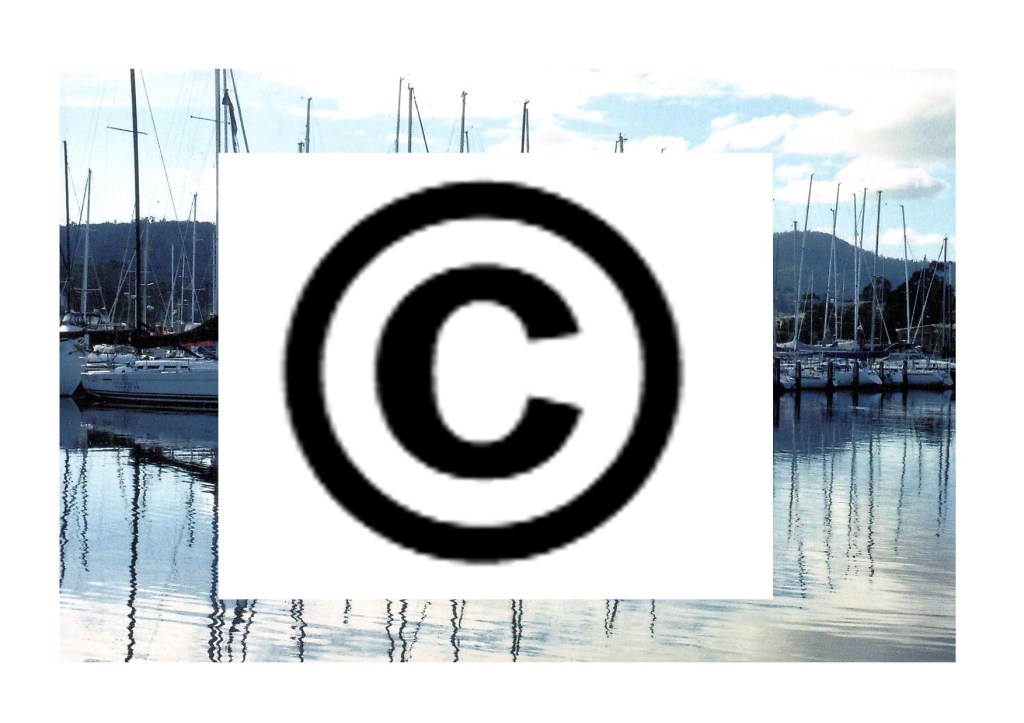
    Feature Photo creation: Bellerive Marina photo under copyright © L.M. Kling 2023

    Share this:

    • Share on X (Opens in new window) X
    • Share on Facebook (Opens in new window) Facebook
    Like Loading...

    Publishing Pointers–Three Roads to Publication

    March 25, 2023 / lmkling / 1 Comment

    Three Roads to Publication

    We writers all want to be published, don’t we? 

    Feel the pride and joy of seeing the product of our labours (complete with our name on the cover) flying off the shelves of bookshops.  A dream come true!

    But first we have to deal with the process of publication itself – no easy undertaking for most of us.  The thing to understand before launching ourselves into this world is that there are essentially three roads to choose.

    The first is the so-called “vanity publishers” who, like ravening wolves, are out there ready to prey on the innocent and uninformed.  A few weeks ago we told you of a friend of ours caught by one.  It cost her a great deal of worry, financial loss she could ill-afford and, along with lies and empty promises, only a single copy of her work.  These people are out and out rogues; sweet talkers who make sure they operate within the law so you have no redress.  Avoid them – your dreams will be shattered.

    The second road is right at the other end of the scale, eminently honest, respectable, ethical and helpful IF you are fortunate enough to have your work accepted – and that’s the rub, the sticking point!  Getting accepted when you are a newbie writer or do not yet have a reputation in the wider world is not impossible.  But highly unlikely.

    I’m talking here about the big, well established publishing houses e.g. Penguin, Random House etc, etc.  These people are in business which means they must make a profit.  If they don’t they will be unable to stay in business.  Consequently they will not accept anything they not fully convinced will sell and sell well.  Anything they do accept they will work very hard to ensure is saleable.  And they will expect you to work along with them to achieve this.  That is the reality of the situation.

    The other reality they have to deal with is that they receive a great many submissions from hopeful authors, often to the point of inundation. These are assigned to what has been elegantly termed “the slush pile” to be looked at (maybe assessed) sometime in the future when things are a bit quiet or when someone, for some unaccountable reason, has a little time on their hands or when…  Your submission may not surface for many moons; you may never hear from them.  Sad but true.  Just remember, they are running a business and if a business is not run in a businesslike way it will not survive.

    However, if by some magical happenstance your work is accepted you will be offered a contract which is a binding legal document so you must read it carefully before signing, regardless of how excited, delighted, up in the air, over the moon you are.  At that point your precious manuscript will be given to one of their editors whereupon you may be tempted to feel this picky person does not appreciate the deathless prose you laboured over so long and so hard.  However, you will be expected to be polite, to acknowledge that this person is good at their job and has years of successful experience behind to back it up.  It behoves you to listen and co-operate!’/

    The publisher deals with the printer, pays the bills and arranges distribution.  This last (distribution) is an aspect of the whole shebang that you will probably be expected to contribute to by being part of author signing events in bookshops; by giving talks about your book or maybe being interviewed.  If you do happen to make it onto this road – heartiest congratulations.

    Not many do though – make it on to that second road, that is.

    In which case, you will probably choose the third road – self-publication.  Nowadays this is a viable and worthwhile road to embark on.  But one with many ins and outs which we plan to go into in full in future blogs.

    © Mary McDee 2023

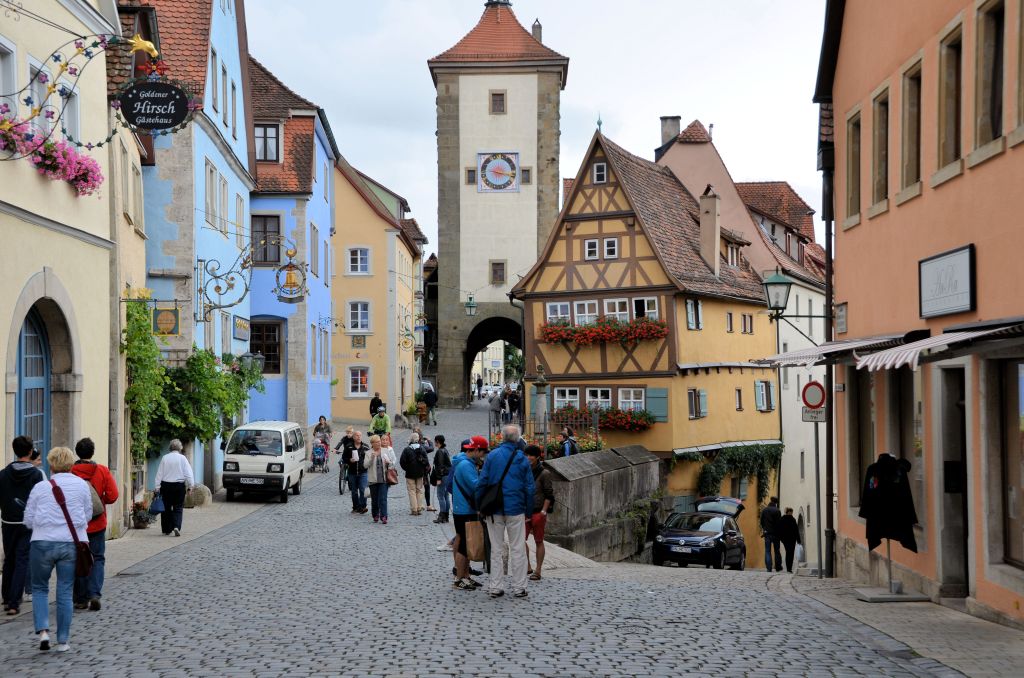
    Feature Photo: Where two roads meet–Rothenburg ob der Tauber © L.M. Kling 2014

    Share this:

    • Share on X (Opens in new window) X
    • Share on Facebook (Opens in new window) Facebook
    Like Loading...

    Posts navigation

    ← Older posts
    Newer posts →
    Blog at WordPress.com.
    Indie Scriptorium — Self Publishing Collective
    Blog at WordPress.com.
    • Subscribe Subscribed
      • Indie Scriptorium -- Self Publishing Collective
      • Join 95 other subscribers
      • Already have a WordPress.com account? Log in now.
      • Indie Scriptorium -- Self Publishing Collective
      • Subscribe Subscribed
      • Sign up
      • Log in
      • Report this content
      • View site in Reader
      • Manage subscriptions
      • Collapse this bar
     

    Loading Comments...
     

      %d