This day, being Australia Day and the nearly 250 years of baggage that goes with it, I made an executive decision to re-blog my missive on the fine line writers literally “walk” when storytelling.
Check out the link below.
~ Lee-Anne Marie Kling
This day, being Australia Day and the nearly 250 years of baggage that goes with it, I made an executive decision to re-blog my missive on the fine line writers literally “walk” when storytelling.
~ Lee-Anne Marie Kling
This season reminds me of resolutions to turn over a new leaf, maybe starting a novel that has been percolating over the past year, or years.
This is the year to get going, but how?
Here is a poem, a re-blog, by Mary McDee to encourage and inspire to write…
Feature Photo: Hologram (c) L.M. Kling 1984
In 1986, all pumped up from a successful finish to my university degree, I began writing my “Great Australian Science Fiction” novel. I chose Science Fiction because I thought it would be easy to write.
Hah!
At every opportunity, I inflicted the latest chapter of this rough and raw work on my friends.
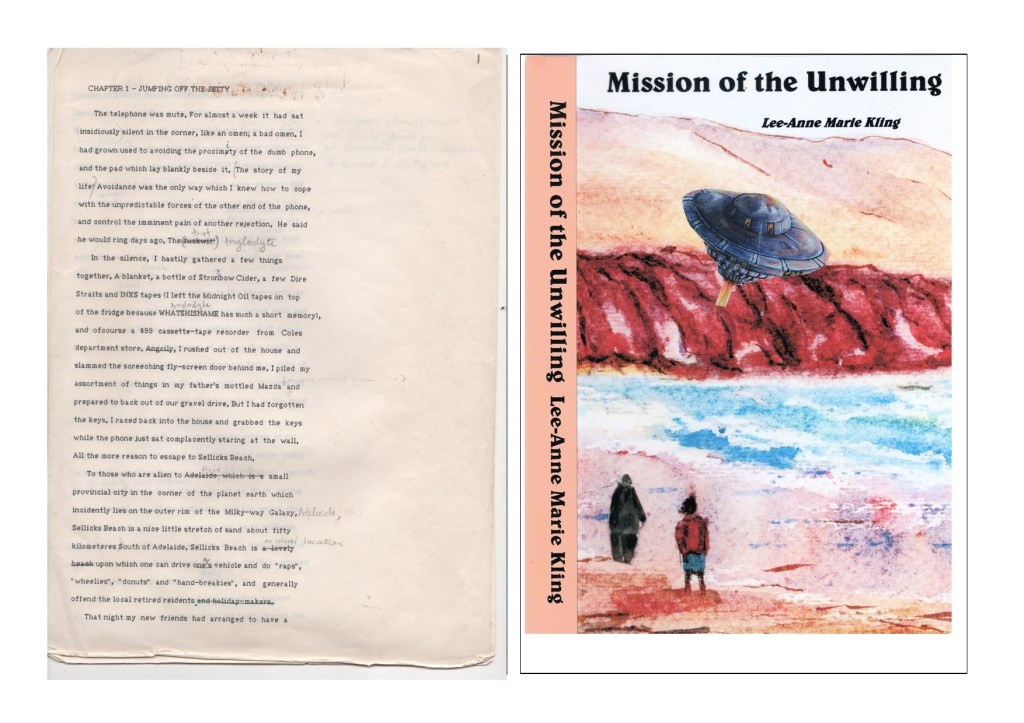
Below are the first few paragraphs of the very first draft of “Mary’s Story”, which 30 years later would be Mission of the Unwilling, written in 1986. The reason the title changed? Well, frankly, my writing mentor at the time thought the title, “Mary’s Story” was a bit lame. So, the book title had to change to something that would grab the reader. As a result, the main character had a name change.

Here I am inflicting this piece that needs a great deal of TLC to polish it into shape, so you can see that I was just like any other hopeful author, making all the mistakes common to novice writers. Have a look and see what you would’ve changed to improve this piece.
Twenty years passed. The manuscript languished in the cupboard. Unfinished. I had progressed halfway through. Lost my way. Lost in space and time, you could say.
Then a spark, and an idea. The story changed and continued to its end. As technology had progressed from Commodore and floppy disks to Windows PC and CDs, I had to rewrite the whole novel. Not a bad move, actually.
After printing off the reams of paper that made up the book, I took it to my uncle who was in the writerly business.

Suffice to say, he was not amused and gave feedback: Basic errors like no page numbers and glaring grammatical mistakes to using a ridiculous amount of speech attributions. It would seem that my years of motherhood had been detrimental to my writing craft. Bad habits in my writing had developed. He recommended joining a writers’ group.
Writing is a craft that requires honing skills and words to impact the reader in a positive way. Test readers, editors, fellow writers are essential to a manuscript developing from a rough draft to a polished piece ready for publishing. There is no shame in reworking or rewriting a story.
I recall my writers’ group mentor saying that with feedback: listen to it, consider it and if it works for you, implement it. If not, put the suggestion aside. It’s your writing, it’s your voice.
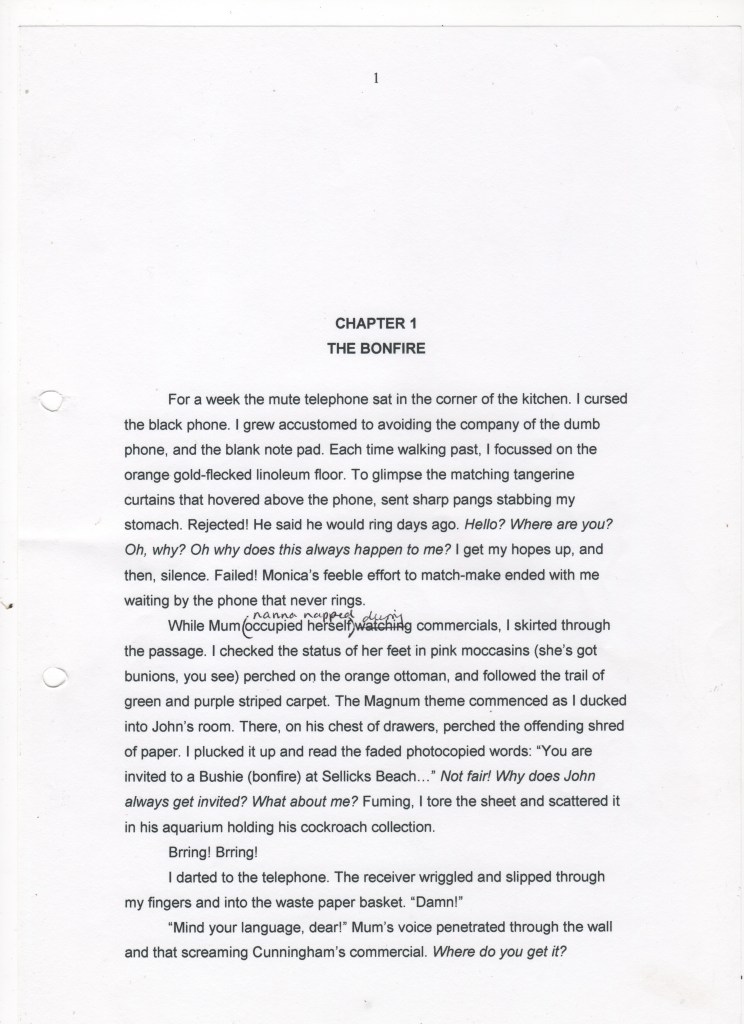
You may see in the sample 4 and 5, that I took most of what my writing mentor advised. There were suggestions further on in their manuscript appraisal, that I didn’t agree with. One was the use of the expression “Man!” which they said wasn’t used in the 1980’s that it was only an expression that turned up in the 1990’s. I begged to differ, as I lived through the 1970’s and 1980’s as a teenager/young adult and behold, I remember the expression “Man!” being used; not just locally in Adelaide youth circles, but also on the television.

[4. Sample of mentor’s feedback]
My mentor stressed that we need to consider our readers. Who is our audience? What do you want your story to say to them? Is the story for entertainment? Or do you have a point to make? In the end, you won’t be sitting alongside them and being able to point to a word and say, “Sorry, I didn’t mean that—this is what I did mean.”
Our written work needs to stand on its own literal two feet and make sense to the reader without the author having to be the virtual translator, and thus committing the mortal writing “sin” of “author intrusion”. Author intrusion is when the author tells the reader how they should see, think and understand the narrative. For example, think of “author intrusion” like explaining the punchline of a joke.

[5. After many more drafts, and 30-years later—Mission of the Unwilling, those paragraphs as they were, published in 2015.]
The editing process never ends. More changes in 2022: A cover aligning with the War Against Boris Series, a new “preamble” chapter, more proof corrections and formatting done to make a second edition. check out Mission of the Unwilling as it looks now.
The final result is about refinement of the work: sentence tightening, word tweaking, word cutting and polishing the prose. All through revising and proof-reading.
Now I know you’re all hanging out for the nitty-gritty; the how do I make my writing good? Make it shine? How do I make my story clear and interesting for my readers?
For a start, invest in a good “How to Write” or “Grammar and Spelling” book. The reason we have and learn this language tool of grammar is to keep us all speaking and writing our particular language on the same page. It’s like a cake recipe. Follow the recipe, the cake bake is a success. It’s so that we understand each other. Adhering to the grammar and spelling rules helps readers understand what you have written. Not misunderstand. Of course, rules can be broken for effect, but you need to know the rules of your writing craft well to have the skill to know how to bend (or even break!!) them.
As I have mentioned in previous blogs, the World Wide Web is full of resources for writers. So, no need to “reinvent the wheel”. I have mentioned Microsoft Word Editor and Grammarly but there are other websites out there you can search for and find.
Our own Indie Scriptorium’s Mary McDee has some good grammar tips which you can look at. Click on the link here on her post on the Little But Important Words as an example.
I come back to the lesson I learnt from my dad: Keep It Simple.
Use basic sentences. Avoid purple prose. Use strong verbs and choose words that are understood by most readers. Be consistent.
After all, the aim of reading is for the reader to have an experience they find enjoyable and worth their time.
© Lee-Anne Marie Kling 2024
Feature Photo: First draft of manuscript and the final Mission of the Unwilling Cover
We, at Indie Scriptorium met last week and reflected on our direction and purpose, especially in relation to our weekly blogs. Recently, I came across this post by fellow blogger, Anthony Robert, which to me, hits the spot when it comes to getting out there and increasing our presence.

Not enough cash
so I have to choose
choosing…
and choosing…
always a matter of choosing
~$~
To choose is so hard
and it’s always a matter of choosing
I can’t have it all.
~$~
The stuff that I want,
the stuff that I need,
the stuff that’s for me –
why is it always
a matter of choice?
~$~
But no.
There’s no choice,
no choice at all.
It’s my friend that I have to consider.
He needs me and loves me,
depends upon me;
he’s my friend.
I cannot allow him to starve,
so it does have to be
that small tin of food
for my cat.
(c) Mary McDee
Feature Photo: Holly (c) L.M. Kling 2015

Writing a book is difficult enough, but getting it edited, published and marketed adds three additional jobs to the process. A new author must go through a tremendous learning curve and expend a lot of time and effort to get their book completed to a professional standard. Luckily, there are some places to turn to for help. I have listed three organisations I have used for support, advice and information.
“Editors work with writers for the benefit of readers. They help writers get their message across with greater clarity, elegance, forcefulness and insight.”
The Institute of Professional Editors encompass editors, of all types from both Australia and New Zealand. They offer some excellent services for writers.
Check out their website for helpful articles about what editors do, the three types of editing and how editors are trained and accredited. They also cover the skills needed to be an editor. They even have advice on self-editing.
The IpEd. web site offers information about how to brief an editor and how to make a contract with one.
The Find an Editor Service is an invaluable way of finding the right editor for your project, whether it’s a romance, a history book or an academic paper. The search engine asks you some simple questions and then provides a number of editors that will fit your criteria.
I have used this service and found a wonderful editor who whipped my two novels into shape.
This professional organisation has been established for over forty years. A.S.A. provides services to aspiring, emerging and established authors and illustrators.
Services Include:
• On-line courses on a wide range of topics.
• Providing advice on subjects such as copyright, royalties and contracts.
• Supplying information about fair rates of pay for authors and illustrators.
• Offering mentorships and manuscript appraisals.
• Providing guidelines and templates for contracts.
• They make submissions to Parliament about issues affecting authors and illustrators.
• A find service for creators and illustrators.
• Speed dating – 3-minute sessions to pitch your work to an agent or publisher. ($30 fee)
Annual membership fees (2024)
Associate – $160
Full member – $215
Contact information:
Website: https://www.asauthors.org.au/contact-us/
E-mail: asa@asuthors.org
Phone: 2911 1000
This is a state wide service for authors, both aspiring and published. They are located in the Institute Building on the corner of Kintore Road and North Terrace. Right next door to the State library.
People can join for an annual fee of $98. Concession card holders and young writers can join for $60.
They offer courses, workshops writing festivals and other activities both on-line and in-person. There are fees for all activities but members get a 30% discount.
In addition, Writers SA provide manuscript assessments, pre-submission assessments, mentorship programs, feedback, consultations and synopsis audits. All these services are provided at a cost. The fees are negotiable depending on the scope of the service and size of the manuscript.
It is certainly a good idea to browse through Writers SA web site. Look at Opportunities to discover competitions and publishers seeking submission. They also have a list of Writer’s groups throughout South Australia. You can also subscribe to their free newsletter and read their blog.
They are also on Facebook, Twitter and Instagram.
Happy Writing
Elsie King©2024
“The only time I feel alive is when I’m painting.” – Vincent Van Gogh. “I can’t change the fact that my paintings don’t sell. But the time will come when people will recognize that they are worth more than the value of the paints used in the picture.”

A current example of those discouraging times when our books don’t sell; I recall my experience during two years in art exhibitions of not selling—not one, not even a cheaper unframed painting. So, at the time, I could relate to Vincent Van Gogh.
As writers we too feel disheartened when our books don’t sell. We’ve spent hours, weeks, months, maybe years writing, refining and producing our “babies” just to see them sit there on the shelf, unloved, unwanted, buried under millions of competing books in the Amazon ranking list.
Perhaps you were one of those authors who attempted to take the traditional route, sending query letters to potential agents or big-name publishers, only to receive the rejection letter months down the track. And this happened over and over again.
Or maybe like me, you saw the writing on the wall, bypassed all that palaver; went straight to Amazon, Draft to Digital, (or some other online publishing service) and self-published. Whichever way, the result is the same, the product must be sold. Even in traditional publishing, we are selling our books to the publisher then, if we are successful, they expect us to promote our books at book launches, speeches and signings.
Advertising, it’s all about marketing and advertising.
So, here I was, I had my “baby”, (actually “babies” — five books now), and to advertise, I have my blog, my website and most recently, Indie Scriptorium Self-Publishing Collective. Week in, week out I blog and post. I try and keep up with my followers by reading, liking, and following their blogs. Sometimes I offer my books for free on Kindle. I’ve tried a bit of advertising too. Slowly my contingent of followers has grown.
Yet, I see my friends or associates on social media pumped up with successes and bestsellers to their name. There’s influencers who have monetised their websites and now own a portfolio of properties. Then there are the bloggers who have 100,000-plus followers.
How do they do it?
All the while, here’s you and me, the wallflowers, missing out.
Believe me, being a wallflower is discouraging.
But, fellow wallflowers, don’t be discouraged.
Don’t give up.
Persevere.
I keep reminding myself that those success-stories often start with struggle. The people who are successful in sales, most often put themselves and their products out there. They spread the net far and wide, so to speak. They don’t give up when faced rejection. They keep on going. They have goals. And when they fail, they pick themselves up and keep on running.
True, there are some for whom success falls in their laps. But for most of us, we need to make the effort to reap the rewards.
The comment Van Gogh makes resonates with me. Although he sold only one painting in his life, he believed in his work, and the timeless quality of his art, as one can see from his quote at the beginning of this post.
I believe that’s how it is for me when I am writing, and also painting. I feel alive. And echoing what so many of my fellow “creators” say, I would rather be creating than getting bogged down in all the marketing and advertising. Like Van Gogh, I can’t change the fact that my books or paintings don’t sell…
But one day, the time will come…
© Lee-Anne Marie Kling 2024
Feature Photo: The Sunflower; a Van Gogh icon © L.M. Kling 2018

I was fortunate enough to attend a session curated by Associate Professor of Creative Writing, Amy T. Mathews at Flinders University at the 2024 Romance Writers of Australia conference. Called Romancing Academia I was intrigued to find out how a university course tackled the most popular form of fiction, romance.
It was an amazing revelation. Doctor of Philosophy doing romance?
The presenters were brilliant speakers who spoke passionately about their PhD. topics. Their analysis of the tropes used in Romance was entertaining, enlightening and inspiring.
It became obvious that Romance was much more than light entertainment to these academics. One session delved deep into the sociological, historical, psychological value of strong independent romantic heroines. It discussed how feminism is portrayed in popular literature.
Another session looked at the ways writer’s avoid incorporating characters of ethnic diversity or Indigenous characters for fear of getting it wrong.
The issue of informed consent in romantic relationships was another lively topic for a thesis.
Another speaker examined the arranged marriage trope which was contrasted with the reality of arranged marriages in many modern societies. It was explained that arranged marriages can be culturally acceptable and a welcomed way for single people to meet potential partners.
Romancing Academia was informative and enjoyable. It also highlighted for me the opportunities available for writers who want to hone their craft.
I’ve been writing for five years and have produced two historical romance novels. I’ve learnt lots by researching and writing blogs for Indie Scriptorium. I’ve honed my skills as I’ve analysed the work of other writers in my critique group. I’ve acquired information about writing romance from the Romance Writers of Australia articles and wonderful sessions at RWA conferences.
Looking back, it’s amazing how much my writing craft has developed. When I started my first novel, I didn’t have a clue about what I even needed to know. Luckily, I had two university degrees and a career in social work so I could portray characters well and understood the motives that drive people. I relied on good beta readers and editors to get my ideas into readable prose.
But do I need more? The more I write the more I realise I don’t have the skills to adequately portray the ideas, themes and goals that I want to write about. The Romancing Academia session made me think more carefully about what I write. I’ve come to realise that my passion is portraying realistic history in the format of entertaining fiction. I love history, especially neutralising the misogynist and racist biases that have been offered up over time. To do this with authenticity in fiction is not easy.
Romancing Academia opened my eyes to the possibility of enrolling in a university course that focuses on creative writing. A way of fast tracking the knowledge and skills I need to become a better writer.
In South Australia, all three of our universities offer undergraduate and post-graduate courses in Creative writing.
For information contact 8302 2376 or you can submit an on-line enquiry. Visit their web site https://study.unisa.edu.au for more information.
For more information phone 8313 7335 or 1800 407 527 or visit their website https://adelaideuni.edu.au/study/degrees/bachelor-of-arts-creative-writing
For more information contact 1300 345 633 or visit their web site: https://www.flinders.edu.au/study/creative-arts-media/writing
For me, this is an option I’m considering.
Elsie King©2024
Feature image: Graduation Cap © Shutterstock image 2024
Our Indie Scriptorium Team has been busy this week preparing for a fantastic local author event, Wordfest. If you happen to be in Adelaide, come to Woodcroft Library, 3 to 7pm this Tuesday September 10.

Indie Scriptorium Self-Publishing Collective Anthology 2024 will be available in print from this date.

As well as the anthology, we will be selling our print copies of our books which include:
A Suitable Heir by Elsie King
The T-Team with Mr. B: Central Australian Safari 1977 by Lee-Anne Marie Kling
Cheers
(c) Lee-Anne Marie Kling

A synopsis is like describing a photo and including every detail that the eye beholds in a couple of paragraphs. It has to be succinct, engaging and include the style and themes of the novel. A pitch is a very short synopsis. An elevator pitch even shorter.
A synopsis is mostly used to sell your novel to an agent or a publisher. It is also useful to summarise your novel for presentations and marketing. However, don’t use a synopsis with potential readers or you will be giving away too much information.
My critique group has recently tackled the difficult issue of writing a synopsis and it spurred me on to revisit this topic. A 300–800-word synopsis is a document that sells your work, hooks the agent/publisher and gets your manuscript out of the slush pile.
So, where do you begin? Start by defining what is happening (the status quo). Bring in the inciting incident, the developments leading to the crisis and finish with the resolution of the crisis.
When writing a synopsis, it is important to include:
Of course you cannot possibly publish the synopsis for your own novels. So, I decided to do a synopsis of a book that most people have read or know the ending through multiple movies and television shows. With abject apologies to Jane Austen, I will attempt a synopsis of Pride and Prejudice.
Pride and Prejudice – Long Synopsis (462 words)
A historical romantic novel of 122,189 words. Suitable for readers of refined literature.
Elizabeth Bennett (Lizzy) is the second eldest of five unmarried sisters whose financial circumstances leaves them all in the unenviable position of needing to marry into money. Lizzy is bold, intelligent, reads extensively and declares she will not marry unless in love.
Mr Darcy an extremely rich, handsome, gentleman accompanies his friend Mr Bingley to Netherfield. The arrival of two eligible men rouses excitement in the Bennett household. While Bingley forms an attachment to older sister Jane, Lizzy quickly concludes that Darcy is cold and proud, and she spurns him despite his large fortune.
Jane and Bingley fall in love and a proposal is expected, then Bingley mysteriously leaves for London. Jane is heartbroken and Lizzy incensed by her sister’s rejection. Her anger intensifies when she is expected to marry her cousin, the incorrigible Mr Collins. She refuses and Mr Collins finds solace with Lizzy’s best friend.
The arrival of the militia to the district brightens the lives of the Bennett sisters. Lizzy meets Wickham an exceedingly handsome but poor Lieutenant and the son of Darcy’s late steward. Wickham accuses Darcy of cheating him out of a legacy. This firms Lizzy’s prejudice against Darcy.
While visiting Mr and Mrs Collins, Lizzy again encounters Darcy who is visiting his aunt, Lady Catherine de Bough. Lizzy is discombobulated to receive an ill-considered marriage proposal from Darcy. She angrily rejects him because he admits that he stopped Bingley marrying her sister.
Darcy realises too late that he has fallen in love with Lizzy. He makes such a hash of his proposal that he fears he has lost any chance of overcoming her prejudice. He does warn her about the sleezy Wickham who’d tried to elope with his younger sister.
An unexpected holiday in Derbyshire with her uncle and aunt allows Lizzy to visit Pemberton, Darcy’s stately home. She is mortified when Darcy arrives and finds her there. This second chance allows Darcy to reveal his love and admiration for Lizzy and her preconceptions mellow. During this renewed courtship Lizzy learns her youngest sister Lydia has absconded with Wickham and her family face ruin. Darcy forsakes Lizzy and their romance seems doomed.
But Darcy searches for, and makes Wickham marry Lydia. He apologises to Bingley for interfering in his courtship and encourages him propose to Jane. Bingley proposes and Jane accepts. Darcy’s actions prove to Lizzy that he loves her.
A visit from the formidable Lady Catherine de Bough, warns Lizzy that Darcy is contemplating marrying her against his family’s wishes. Lady Catherine claims Darcy is engaged to her daughter and demands Lizzy reject her nephew. Lizzy refuses and realises she has fallen in love with Darcy. When he proposes she gladly accepts.
Short Synopsis – 256 words
Historical romantic novel. 122,189 words.
When Mr Bingley brings his friend Mr Darcy to his new country house, Mrs Bennett expects one of them will marry one of her five unmarried daughters. Jane and Mr Bingley are attracted but Lizzy finds Darcy’s proud contempt insufferable.
Jane is jilted by Bingley leaving Lizzy incensed. Her mood intensifies when she is expected to marry her odious cousin, Mr Collins. Despite Mrs Bennett’s pressure, Lizzy resists, Mr Collins and he marries her best friend instead.
The arrival of the militia to the district brightens the lives of the Bennett sisters. Lizzy is attracted to Lieutenant Wickham, the poor son of Darcy’s steward. Learning that Darcy withheld an inheritance from Wickham firms Lizzy’s prejudice.
A visit to Mr and Mrs Collins forces Lizzy to again spend time with Darcy. He’s fallen in love and proposes but his admission that he stopped Bingley marrying Jane ruins his chances. He warns Lizzy Mr Wickham has a penchant for very young girls.
While holidaying in Derbyshire with her aunt and uncle, Lizzy visits the Darcy stately home. Darcy arrives unexpectedly and Lizzy is mortified but this second chance allows Darcy to court Lizzy. Her preconceptions mellow. Just as the romance blossoms Lizzy learns that Wickham has run off with her youngest sister. This means ruination for her family and Darcy abandons Lizzy.
But Darcy searches for Wickham and makes him marry Lizzy’s sister. He encourages Bingley to propose to Jane. His actions prove his love for Lizzy. When he proposes she gladly accepts.
Elevator Pitch – 19 words
A regency romance revealing that first impressions can be misleading and true love can overcome both pride and prejudice.
Shorter Elevator pitch – 3 words.
Love overcomes prejudice.
Jericho Writers has an excellent web site: How to Write a Novel Synopsis. It includes step by step instructions and clear guidelines.
Cheers!
© Elsie King 2024
Photo: L.C. Wong©2024 – Icelandic reflections.
 Indie Scriptorium -- Self Publishing Collective