

As a member of Indie Scriptorium one of our duties is to write and publish blogs on aspects of writing, editing, publishing or marketing every three weeks. Two years later we are doing a review of our blogs with the idea of putting them into an anthology.
As we currently only have three members the task of blogging has proved to be onerous. We would love to have some new members but …. Coming up with a topic, doing the research, writing 500-1000 words that make sense can be challenging. Making sure the blog is professionally written, properly edited and provides valuable information can be time consuming.
Indie Scriptorium has posted over a hundred blogs in two years. We have a following of 70 people and occasionally get positive feedback with likes from Facebook. Friends from my writing groups have also said they read the blogs and find them helpful. Yay.
But is the time and effort worthwhile for a busy writer who would rather be working on their next novel or short story?
I was recently asked where I find the time to blog? I responded without thinking. Oh, it’s a pain but I actually get a lot out of blogging. And on reflection that is true.
Doing a regular blog means that I am constantly researching writing skills, how to edit, what steps do you need to do to publish a book do a cover and burb, write a synopsis and market a book. (I need to do more research on this topic) In addition I have learnt about the legal, moral and technical issues to do with writing.
Looking back, I’ve realised that blogging has improved my writing style, made me a better editor and critique partner, has got me two books published and will in the future get my books marketed. The blogs have been like a course in creative writing, done with good friends and we have people who find our efforts helpful. We also will have a book of blogs later in the year for people to buy in the near future. That’s enough good reasons to keep me going.
Cheers
© Elsie King 2024
[Our Indie Scriptorium team have been putting together an anthology of some of our posts over the last two years. As I hunted around my messy computer filing-system for a number of these cheeky posts that went hiding, I came across this gem that somehow got buried in the vast layers of time. Amazing what one finds when searching for something else. So, with a few changes, here it is…Enjoy and be encouraged.]

People spend their lives building their own kingdoms. As creators, we often measure success by how far our name-brand spreads over the “Empire” of the internet, world, community, and how much “gold” (money) we’ve amassed through the sale of our product.
When I first started exhibiting my paintings, friends, family, and fellow artists asked, ‘Have you sold?’ and ‘How many paintings have you sold?’
The fact that I had sold made me an authentic artist.
Same can be true as an author of two self-published works of fiction. Again, like a broken record, those interested asked, ‘How many books have you sold?’
Answer, ‘Er, um…not that many.’
Then the implication I should have gone through the traditional route of getting a publisher.
Yup, maybe, probably…still deciding if I’ll do that with future books, especially the travel ones that have colour photos on glossy pages—the coffee-table variety. Not sure how I’d go…I mean, I’m not an unpublished “virgin” since I’ve gone ahead and self-published on Amazon. I got impatient, afraid I’d remain invisible with a pile of rejection letters, and my novel manuscripts languishing as a PDF-file on my computer hard-drive (the hard copies stored in a box in my closet).
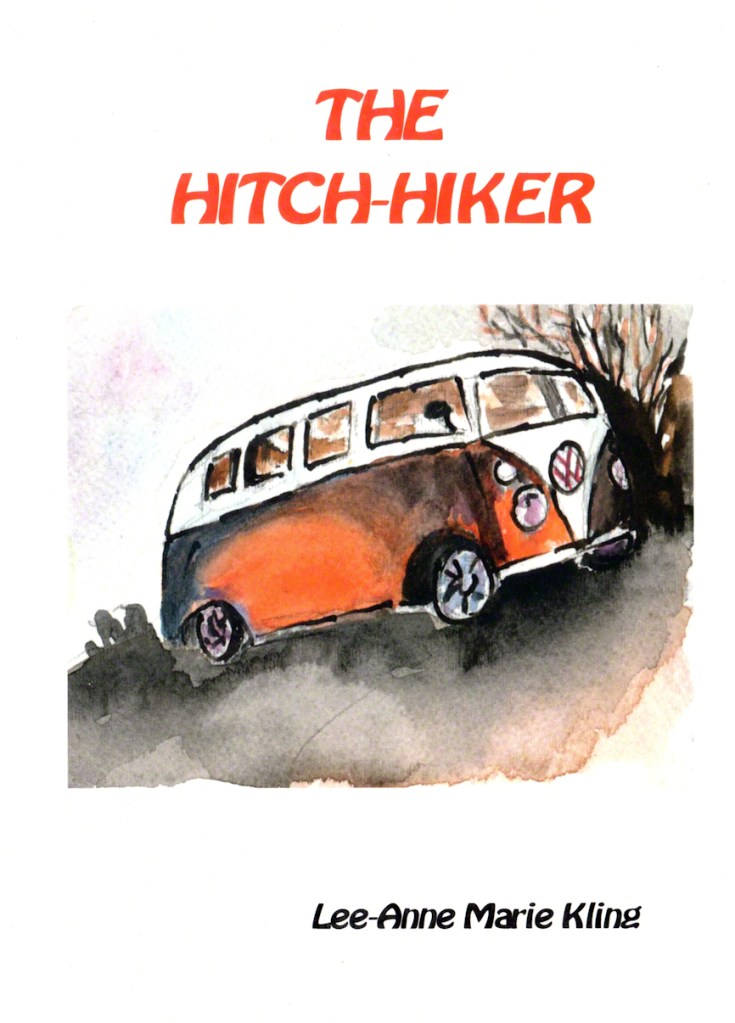
So, I published The Hitch-hiker (a novella) and Mission of the Unwilling (novel), on Amazon. Check them out. You can download them for the cost of a cup of coffee and find out what mischief Boris gets up to.
After publishing, having a little launch in our South Aussie pre-Christmas summer sweltering in 40 degrees Celsius, then a DIY advertising with bookmarks, flyers and emails, I decided to do research on how other Indi-authors built up their e-book kingdoms. There must be a secret method for digging up the buried gold of success in sales.

I discovered a mine of information lighting up my computer screen. I also discovered a precious nugget in an old Australian Artist Magazine—stand-out quality. In today’s language, I assume that means “brand”.
So, when at our SALA exhibition launch, a friend told me they knew which paintings were mine, that I had a unique style, I thanked them. I was on the right track with my “brand”.
But my books? Well, there’s Boris…albeit swamped by millions of other characters on Amazon.
Then, I discovered a gem—blogging. Not in the way I anticipated, though. I was optimistic. With my blogging presence, out there, I expected sales to rise and hundreds of instant visitors to my blogsite. My works were brilliant, right?
My posts drowned under the deluge of millions of other posts, tweets, Facebook pages, and other more successful blogs. For weeks, I remained South Australia’s best kept secret. Even my mum couldn’t find me—not even with my help on her computer.
Fellow writers at my writers’ group suggested I needed to post articles more frequently, get those WWW- “neural”-pathways (Algorithms) working by increasing traffic. Still, the site remained as lively as a cemetery.
Over time, I gathered a band of followers: friends, family, colleagues from church, writers’ and art group. Interest ensued—all Australian—no likes.
Undeterred, I wrote and published posts once or twice a week. Writing, my therapy. The articles available for free, my gift to the world. I prayed that there’d be others out there who’d find my words, and consider them useful, inspirational, amusing.
Week by week, comments and likes (mostly from mum) trickled in. Then, a comment from someone I didn’t know…and a visitor from the United States. Oh, what joy!
A friend encouraged me. I’d improved since they first started reading my blogs. Yes, writing is a craft; the discipline and practice refined my skill to communicate.
I read posts from other bloggers. I liked the posts that resonated with me. I knew I must start commenting. Friends who had websites and blogs said that’s how you make your presence known in the blogging community. I usually read WordPress articles late at night and was concerned my comments would come across as sleep garbled. Eventually, I plucked up the courage to comment. My first comment was about cats.
Each month, slow and steady, the number of followers, likes and visitors grew. My site on WordPress, the first place I visit each day when I open my computer. What countries have visited today? Check the emails. Who has liked me? Who’s following? I visit their sites and see what gems of writing, stories, photos, or paintings they have.
My world has opened; I read stories from every continent…and my stories shared around the globe.

The treasure I found by entering the world of bloggers, is not the gold I collect in my bank account for my own kingdom from my own works, but the cities of gold we share collectively as writers and artists. We put our stories out there and celebrate each other’s works.
So, a heart-felt thank you for all you who have followed, liked and visited my humble site—and thank you all for your stories, insights, artwork and photography.

So, if you’ve started up a blog/website and are waiting for it to be noticed, don’t give up. Keep writing, reading, commenting, liking and following and watch your readership grow.
© Lee-Anne Marie Kling 2016; updated, 2024
Feature Photo: Orange-Golden Sunset (c) L.M. Kling 2024
It’s my opinion a good opening line isn’t essential for your story or novel, but it won’t do it any harm.
My critique group decided to revisit the essentials of writing as a way of everyone learning from the same page and improving our collective efforts at finding the right words for our various projects.
First topic – opening lines.
I realised that when I read a novel I don’t get put off by the opening line hence my opinion that a good opening line is not essential is from my personal experience. However, I love books written in third person in past tense so if the first line has an omniscient POV and is written in the present tense I tend to put it back on the library shelf.
So, what makes a good opening line?
I googled the above question and found some great information.
The Literary Hub presented an article by Allegra Hyde.
Literary Hub
A good opening line “should capture your characters voice, it should carry your style, and it should be relevant and meaningful enough to engage your readers and entice them to read onto the next line.” An, “elegantly balanced dose of clarity and curiosity.”
However, it should not be “so heavy that it weighs on you or so literary that it chases away or confuses the reader.”
Allegra also suggests that the opening lines clarity should provide a sense of time, place, character and plot. The curiosity can involve the element of tragedy, conflict, mystery that fuels your story.
Jericho Writers
Jericho Writers
https://jerichowriters.com › good-opening-sentences
Suggest a short clear sentence that grabs the readers attention.
Use verbs correctly and adjectives sparingly.
Use words that add weight.
It doesn’t have to be loud; subtlety can be effective.
After doing this research I decided that for me a good opening line:
I then found some examples of opening lines I loved:(you can’t beat the classics)
Albert Camus – “Mother died today.”
Jane Austen – “It is a truth universally acknowledged, that a single man in possession of a good fortune, must be in want of a wife.” (apparently the most famous opening line ever)
Charles Dickens – “Marley was dead: to begin with.” (love this one)
So, putting the new knowledge into our own writing I have selected to test out some ideas for my new romantic short story Honeygate.
Just doing this exercise has raised my awareness of the importance of an opening line and given me some directions so I can play around with various types of lines and find the best one.
What I found particularly helpful is that using a first-person POV would work well for this story. My heroine has felt the impact of the hero’s gaze and is discombobulated enough to forget her speech she can have the stage from here on and tell us her story from her perspective.
Hope this makes sense
Cheers Elsie King©2024
The illustration is attributed to an Unknown Author is licensed under CC BY-NC-ND.

Ever since time began
We’ve been telling tales
Entertaining others
With stories of people and perfidy
Friendship, revenge
Cowardice and bravery…
Imagination soars –
We can see those we create,
Hear their voices,
Eavesdrop their chatting.
We know them so well,
How they dress,
Where they live,
Who they love
Or hate….
What it is that they feel
And why…
When it was that the conflicts
They’re embroiled in began –
For a story must have conflict,
Conflict and resolution.
Ever since we could speak
We’ve been telling tales.
Yarning round campfires;
Huddled in caves
As storms howl;
Rain drowns our world
So we seek comfort,
Seek to pass time,
Seek to get into the mind
Of our mates,
We build shared memories
And forge a community.
Time passed.
Scratchings on stone became letters –
A letter for each sound that we spoke.
Those letters made words
So now we recorded our doings and thoughts,
Our buying and selling, Our songs and our stories…
(c) Mary McDee 2024
Feature Photo: Around the Campfire (c) L.M. Kling 2010

A huge apology for being a day late posting this week’s blog. As Mary McDee says (often), “Technology, you can’t trust it.” She says this while spending the week chasing Dorper sheep (Goat-Sheep Cross), from the neighbour’s yard back into her own. They are more stupid than actual sheep, much like she thinks computers are.
Anyway, ‘twas a computer crisis at Mrs. T’s (my mum), that sent the weekend into wobble-world. That with the default of chasing ancestors down familial rabbit holes, I have done little in the way of preparing an article to post, let alone any idea what to post on the chosen topic, World Building.
Then inspiration struck. At the proverbial last-minute. Why not do a spot of World Building from one of my developing novels? Why not, indeed!
I searched around for a worthy template—one that was interesting, not too many questions (just enough for the exercise) and one that was memorable. I didn’t have to look far on the World Wide Web, to find this little beauty: GRAPES.
“G” for Geography
“R” for Religion
“A” for Achievements
“P” for Politics
“E” for Economics
“S” for social Structure
There’s even a colourful chart with two or three questions under each heading to help with the process, courtesy of Amanda Schlindwein. Thank you, Amanda, for posting this helpful model which you can see if you click on the link to her website.
So, here goes. I will use the book that I have been posting serially on Wattpad, Diamonds in the Cave as my world building muse. (I won’t be addressing every question in the GRAPE help. The post would end up being too long, otherwise.)
How does the region’s climate and placement affect the characters in your story? The village of Luthertal on Pilgrim Planet (approximately 20 light years from earth) suffers extremes of temperature and weather conditions because of orbiting two suns. After emigrating from Eastern Europe from the 19th century, where climate was more stable, they find the change confronting, confusing, hard on their stamina and they become angry. They need to vent their anger and frustration. As a primarily farming community, the droughts, fires and floods that fail their crops, and kill their livestock, cause them to seek someone to blame. Hence a perfect storm for parties of evil intent to stir up the idea of witch hunts.
What do your characters believe in?
One God and the founder of European Protestantism, Martin Luther. But they, being Wends, are synchronistic, never having relinquished the superstitions, magic and healing practices from their “heathen” ancestors. So, there’s this conundrum; a person who fails to attend church each Sunday is called a “heathen”, but it’s okay to believe that breaking a wishbone of cooked chicken and the person getting the larger portion can make a wish. Or a character must trust in God to heal them, and the church prays for them, but it’s acceptable to treat the sick with herbal remedies as according to the long tradition of apothecary. I might digress here that my two-times great grandfather came from the region of Lusatia (which is where the Wends come from). Before he became a doctor he studied, at Herrnhut, the base of the Moravian Brethren, (so we’re talking seriously Christian here), the medicinal art of apothecary. Maybe some Lutherans would’ve had a problem with that, but we’re talking about a particular community, the Wends or Sorbs. So, writing from my own family history experience, which is partially Wend, I can see this community of Luthertal being more open to magic and the supernatural. One day I might write on these supernatural experiences that my family and relatives have experienced.
What has this civilisation created that has withstood the test of time?
As mentioned above, being an agricultural community, the Wends are robust and healthy. They have their Wendish culture of dress and traditions. They are remembered as an industrious people, but also as a deeply religious God-fearing people. In fact, they feared God so much they escaped the persecution and oppressive norms put upon their religious practices that they planned to emigrate to South Australia. Unfortunately, an evil alien called, Boris who pretended to be God’s ambassador, led them astray and transported them to the Pilgrim Planet with plans to enslave them and breed an army from them.
Who controls the society and how do they control it?
Although in Diamonds in the Cave the Wendish community are emerging from the ruthless fascist control of Boris, having been saved from his clutches by the good guys Intergalactic Space Force (IGSF), in my previous book, The Lost World of the Wends, they are still politically and structurally fragile and finding their way. They have reverted to the ways of old where the Burgermeister runs the village and decisions are made by all villagers gathering in the church. The Wend community is by this time a theocracy. However, Boris still has his influence with a couple of his agents hiding in plain sight in the village. These agents are stirring up the Wend community to seek out witches and burn them.
What is considered valuable? And how are products bought and sold?
Apart from food and the products from farming used to be self-sustaining, as was the custom back in Eastern Europe in the mid-nineteenth century, mining minerals and ore for power and energy for space travel is taking off. Mutants who have been freed from slavery under Boris have been brought in to help develop the village building houses and mining in the local mountain range of Mount Martin. The Wend villagers begin to regard the mutants with suspicion and they become targets for witch-burnings.
The currency that the Wend community use are “pfennig” (pennies) and thalers, like what they used in Saxony in the mid-nineteenth century. Products are bought and sold at market which is open every day except Sunday. Sunday is the Lord’s day, a day of rest.
Who are the most important people?
The Burgermeister (Herr Biar), the pastor and the doctor (Dr. Zwar), who in Diamonds in the Cave is the pastor. Prestige is shown by the assets the high-status ones have. The doctor owns a Mercedes. Herr Biar has a beautiful, large brick house and large farm.
Least important people?
The mutants, old single women (Gertrude) and women who don’t fit in the community (the female heroine, Minna). They are the prime targets for witch-burnings.
***
That’s all for my little exercise for starters. I found it helpful to clarify my ideas for the world in which my characters live in Diamonds in the Cave.
Have a go yourself using the GRAPE template or click on the links below to try one of the other templates that looked useful.
Let us know how you go? Or if you have found a template that works for you, send us a link.
© Lee-Anne Marie Kling 2024
Feature photo: Late autumn vineyard, Wirra Wirra, Maclaren Vale © L.M. Kling 2024
Worldbuilding Template: 101 Prompts to Build an Immersive World (kindlepreneur.com)
Get A Free World Building Template With 100+ Questions (richiebilling.com)

Some time ago we told you the sad story of friends of ours caught up by a so-called “vanity publisher”. When their work was accepted (with a great deal of enthusiasm!) by this publisher, they were over the moon. Slowly, however, joy turned to frustration and financial loss to the tune of more than $30,000-oo. With nothing more to show for it all than only one single copy of their book they were hugely ashamed and embarrassed – not at all surprising as they are very savvy and have always dealt with life in a business-like way.
Fortunately, this bitter experience has not killed the urge to write. But it could well have done so.
However, we have become aware of the fact that, as well as this vanity publishing racket, there are a number of other matters connected with writing that are causing a degree of confusion among those of us who dream and scribble and dream some more.
The two words we want to deal with today are “printing” and “publishing”. They are not the same and they are not inter-changeable. Let me repeat that so you get the message –
THEY ARE NOT INTER-CHANGEABLE
Printing is something you can do yourself. All you need is a laptop; a ream of plain paper; a printer attached to your laptop; card for a cover and a good strong stapler or comb binding machine. Your magnum opus won’t look all that professional, of course, but it will be printed. If you require a better-looking job, you can source a printing business, make an appointment to discuss the details of exactly how you want your book to look; how many copies you would like and how much it will cost. End of story.
You may have ordered only a few copies to give away, in which case you pay up; collect; distribute and (hopefully!) bathe in the glow of all the congratulatory comments. End of story. On with the next.
On the other hand, you may have ordered a hundred copies with a view to selling them. Have you decided on a marketing plan? How do you intend to publicise your book so eager buyers will be aware that it is available for sale? Do you have a list of bookshops that might be willing to stock your deathless prose?
If you decided to jump on this bandwagon, you have now become a publisher. Congratulations!! I really hope you succeed and make at least enough money to cover your costs and maybe have a celebratory dinner as well.
Bottom line: publishers are businesspeople whose essential business is to produce books, market them and make a profit. They do not author books although some do occasionally commission a book on a particular topic from an author they know and believe in. Once they have found a book they consider marketable, the author is offered a contract. After this is signed the publisher works hard to ensure a profitable outcome; hard work that involves, among other things, editing, proofreading, printing and marketing – and that printing is done by a printing firm; a separate business.
Publishers are not printers and printers are NOT publishers. Not a case of “never the twain shall meet”. Far from it. Much more a case of mutual dependence as each cannot function without the other. Think of it as complementary co-existence.
© Mary McDee 2024
Feature Photo: Winter Elm Mirror-Design © L.M. Kling 2020 (artistic design 2024)
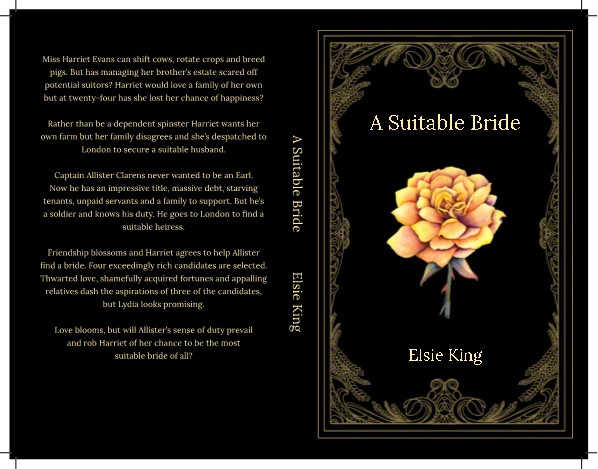
Welcome to my new novel, A Suitable Bride. Impossible love, the dire need for an arranged marriage and a happy ending firmly place this novel into the Romance genre. And yes it’s set in the Regency era.
I got lovely feedback from my first novel A Suitable Heir so I hope my readers will enjoy this second foray into my favourite time in history.
The book will be available from the 30th April in both e-book and print copies. Please visit my website www.elsiekingauthorartist.com for links to purchase on-line.
I read an article by Draft2digital that said the best marketing for your first book is to publish a second. I certainly hope that this is true. Enjoy.
Cheers ElsieKing©2024. Cover by Kate Smallwood © 2024 – www.deviouscat.com.au

Ever since the very earliest times of mankind there have been folk who seem to be driven to want to collect and study things around them – right up to the children of today who collect rocks or insects or… as well as those who can’t seem to resist dismantling anything they can get their hands on just to “See how it works, Nan”. When they grow up they might become a motor mechanic; a scientist; a…
Those who are fascinated by languages; how people speak; how words can be put together; how they are pronounced; how those languages themselves change over the centuries are termed “linguists”. I’m not talking here about those folk who speak several different languages; who seem to be able to pick up a new language apparently effortlessly. No, I mean those who want to come to grips with the nuts and bolts of either languages in general or one language in particular.
As far as English is concerned these “language scientists” (linguists) have decided that all the words of our language fit into one of two groups – no not nouns and verbs – but content words and function words.
The thousands upon thousands of content words are the ones you can get some sort of picture in your head; so long as it is within your own field of experience. These are words like horse or run or blue or slow or fight or…
The function words on the other hand are those that many school teachers will tell children are the “little words”; the ones that make no sense on their own alone; no sense until they are linked to an appropriate content word. Consider for a moment in/on/by/at/out/of/off… You need to link them to words like house or horse or horrid or happy and you can start to get a picture.
All in all there are only about a couple of hundred of these important “little words”. Use the wrong one in the wrong place and your writing can easily become confusing or even meaningless.
Consider for a moment “the” and “a”: many of us use these more or less indiscriminately, not realising that each has a specific meaning and must be used with care when writing.
“A” is generalist – yes, it is a word even though only a single letter; a dog/ a house/ a person are all non-specific – any dog, house or person whatever the size, shape, colour…
“The” on the other hand, is much more limited: “the dog” is one particular dog involved in a particular action; “the house” could be the one next door or the one you lived in as a child; or etc…
So, use with care. Please.
A couple of other points: “an” is merely “a” used when the next word begins with a vowel, e.g. “an apple”/”an orange” etc. but even this is not so simple (wouldn’t y’ know it!!) as most of us have been taught that vowels are the letters a/e/i/o/u. Not so.
Vowels are sounds; speech sounds, that is. And it is the beginning sound of the next word that governs the use of “a” or “an”. Just say aloud to yourself “a happy holiday”. No problem? Now try it again but with “honourable person” instead of “happy holiday”. Not so easy, is it. “An honourable person” is much easier to say because the letter “h” is virtually silent.
Forget using letters to decide whether to use “a” or “an”; go for the sound when you say aloud whatever it is that is puzzling you. We do this without thinking when we are speaking so go for the spoken word/phrase if in doubt. Much simpler than trying to remember a bunch of rules along with their exceptions. There are always exceptions!!
There is more to say about function words, their glitchy bits and the angst they can cause those of us impelled to write but we’ll leave it for another time.
© Mary McDee 2024
Feature Photo: “Engrish” © L.M. Kling 2014
All my life, words have fascinated me – their meanings and double meanings, along with puns, jokes, and varied pronunciations. How we put them together for impact; to make poems or stories or paint pictures in a reader’s imagination is grist to my mill, floats my intellectual boat.
So choosing English as a major subject when I got to university was a no-brainer. And when I discovered that Linguistics was one of the third year options, I couldn’t wait to enrol.
Before this, High School Latin had opened my eyes to the fact that languages other than English have very different rules; can be structured differently; are often quite a different kettle of fish. This was amazing! Putting the verb at the end of the sentence? Changing the last syllable of the word instead of using one of the “little words” (e.g: to/for/by/with/from…) as those ancient Romans had done? Wow!!
All this opened up the wide world of translation and how tricky it can be to “get it right”; get the original author’s attitude and intentions across accurately; convey as many as possible, of the subtleties of the original.
Conversations with multi-cultural friends, some of whom were fluent speakers in not just two but several languages were frustrating as these people took all the differences for granted. None shared my passion for words; so they quickly found our “chats” boring. And me weird.
Consequently, I was forced to turn to books in my quest for enlightenment. The only books readily available that provided varied renditions of the original text was the Bible. So I go down all sorts of rabbit holes, spanning several centuries of translations in this adventure.
And after all that long-winded background bumph we come to the point of this blog; a blog designed for those of us who write. Finally I hear you say (if you are still with me, of course!!).
A couple of days ago I read and compared several accounts of the Last Supper; that final, pivotal meal before the crucifixion, that Jesus shared with his disciples; the meal which Judas walked out of to meet with the High Priests and betray him.
Several of the modern translations wound up their account with:
“So Judas left, going out into the night”.
Others (including the King James Version) rendered the same incident as:
“So Judas left. And it was night.”
Only a very small difference – a single sentence of eight letters versus two sentences of seven letters.
But it hit me like a bomb.
The strength and implicit emotion; the sense of impending doom, that that second sentence gave when contrasted with the first was palpable. The first was an accurate but matter-of-fact, almost journalistic rendition. The first, set alongside the heart-wrenching vividness of the second, was just ordinary writing in my eyes.
Of course you may not agree. We all see and interpret things very differently. Which is a good thing; makes life interesting!
When we speak we add to our words with both our voice and our facial expressions, as well as gesture, stance… There are a hundred and one ways of getting our meaning across as we become aware of responses from those to whom we are speaking. There is an immediacy in the spoken that is not available in the written. So we have to compensate.
As writers, we need to develop awareness of those aspects of writing that are more than merely putting words together. This is what divides great writing from the simply pedestrian. How those words are arranged, organized, juxtaposed one with the other is important. How our words are divided into sentences and punctuated can make a huge difference to how we get our message across to the reader. These are the things that make our writing truly impactful.
And isn’t this what we all want?
© Mary McDee 2024
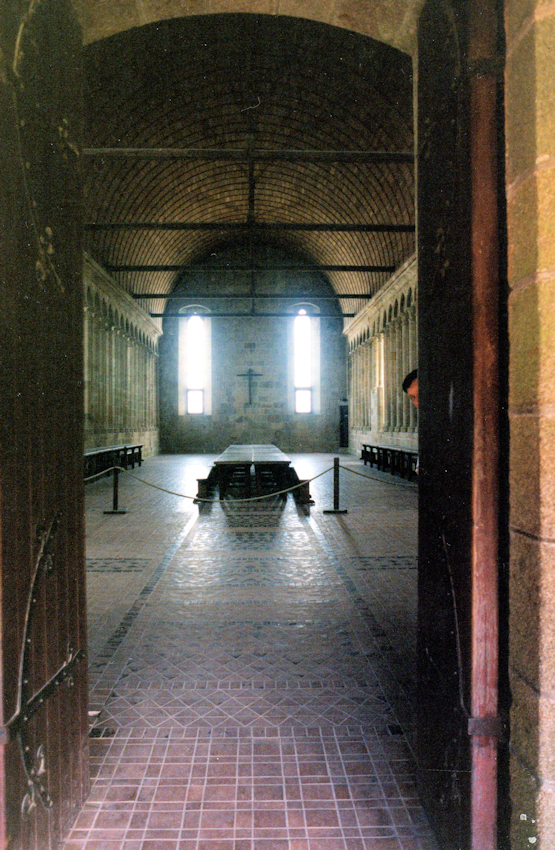
Feature photo: Le Mont St. Michel, Dining Room, a room reminiscent of Christ’s Last Supper © L.M. Kling 1998
 Indie Scriptorium -- Self Publishing Collective