This day, being Australia Day and the nearly 250 years of baggage that goes with it, I made an executive decision to re-blog my missive on the fine line writers literally “walk” when storytelling.
Check out the link below.
~ Lee-Anne Marie Kling
This day, being Australia Day and the nearly 250 years of baggage that goes with it, I made an executive decision to re-blog my missive on the fine line writers literally “walk” when storytelling.
~ Lee-Anne Marie Kling

Photo: Brighton Jetty, January 19, 2025 (c) L.M. Kling 2025
A discussion with family members about e-books and recently bought Kindles, reminded me of options we have as writers of where to publish our books.
Click on the link above to check out this blog from the past by Elsie King.
Cheers,
Lee-Anne Marie Kling
This season reminds me of resolutions to turn over a new leaf, maybe starting a novel that has been percolating over the past year, or years.
This is the year to get going, but how?
Here is a poem, a re-blog, by Mary McDee to encourage and inspire to write…
Feature Photo: Hologram (c) L.M. Kling 1984


Above are two attempts at describing the same event. In the first I’ve used pronouns, he, his, he felt. This is me as the writer intruding, describing the action. I’ve also said he felt scared, telling not showing the fear. This is third person subjective.
In the second I’ve got rid of the pronouns, added more sensory information to illustrate fear, added internal dialogue and provided a detailed memory. It required more words but gives a deeper experience for the reader. This is third person subjective deep point of view. (Also known as 3rd person limited or 3rd person close)
Using Deep Point of View (Deep PoV) is a writing style that has become increasingly popular in the past two to three decades. It is tricky to understand, and I’ve found requires a lot of study and practice. The idea is that you tell your story from the perspective of the character, that the story emerges through their experience which includes what they see, hear, feel, taste and smell. Add some thoughts, opinions and memories and then remove the narrator’s voice, (he felt, he thought, she wondered, she saw.)
Changing your natural writing style is challenging work but I think adopting deep PoV can make the writing zing and allows the reader to engage more closely with the characters. But do I need to use deep PoV all the time and for all my characters?
I write Historical novels set in the Regency era. The writing style of authors such as Jane Austin, Charlotte Bronte and Charles Dickens use third person, but the narrator is always popping in with observations and opinions. I want my own novels to reflect the writing style of the era in which they are set but I also like to adopt the modern deeper point of view. It’s a challenge.
Having done some reading into this complex topic I have come to a set of rules that work for me as a writer. It’s a work in progress; I am learning new things all the time and making adjustments, but I thought it might help people if I share my guidelines.
These are my recommendations. They will not suit everyone, and they are a work in progress. My idea is that I write the first draft of my novel/short story and select the character who will be the PoV character for the scene/chapter but not focus on creating the deep PoV until I’ve done a structural edit. I will then do an editing sweep looking at strengthening the sensory input, opinions, thoughts, memories and actions in strategic scenes in the book.
Points of view is a complex topic. I found the following articles and books helpful.
https://www.masterclass.com/articles/how-to-write-deep-pov
https://thewritepractice.com/deep-pov/
https://theeditorsblog.net/2011/11/16/deep-pov-whats-so-deep-about-it/
I also used Richard Bradburn’s book Self-Editing for Self-Publishers, Reen Publishing 2020
I’m still finding my way with PoV. I don’t head hop as much, but I can’t say that I am deeply conscious of using deep PoV as I write my first draft, but it’s an effective and powerful tool for introducing new characters. For me it works for one or two characters in a novel and is valuable to use in highly emotive, pivotal scenes. I do enjoy giving my character’s opinions and internal dialogue as it brings the reader closer to the character.
Cheers and Merry Christmas
Elsie King© 2024
In 1986, all pumped up from a successful finish to my university degree, I began writing my “Great Australian Science Fiction” novel. I chose Science Fiction because I thought it would be easy to write.
Hah!
At every opportunity, I inflicted the latest chapter of this rough and raw work on my friends.
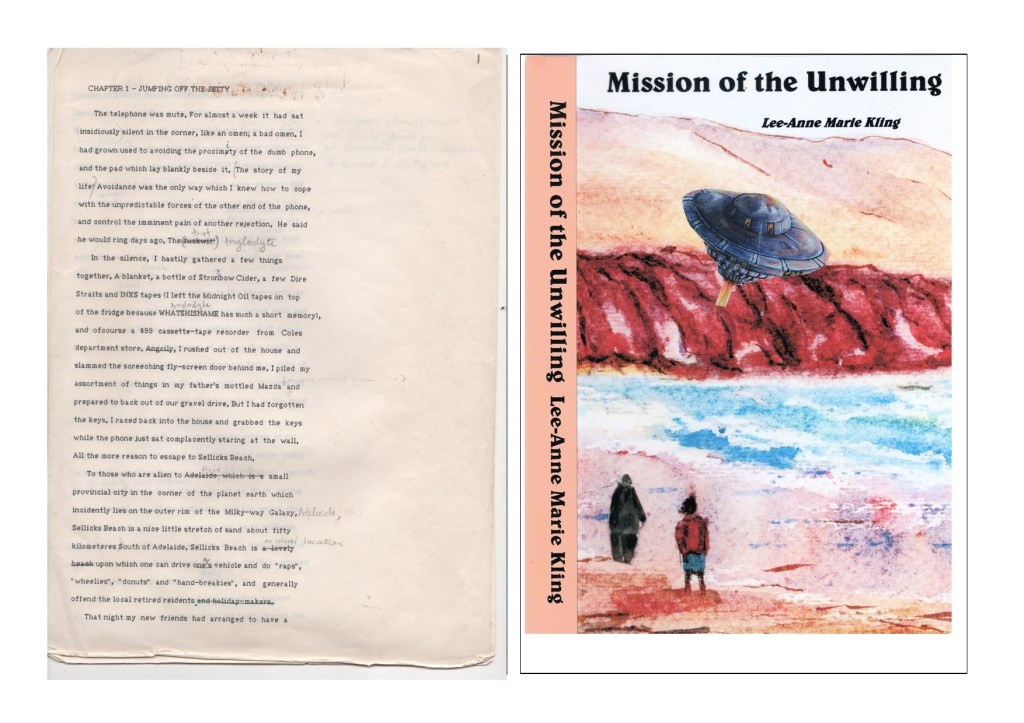
Below are the first few paragraphs of the very first draft of “Mary’s Story”, which 30 years later would be Mission of the Unwilling, written in 1986. The reason the title changed? Well, frankly, my writing mentor at the time thought the title, “Mary’s Story” was a bit lame. So, the book title had to change to something that would grab the reader. As a result, the main character had a name change.

Here I am inflicting this piece that needs a great deal of TLC to polish it into shape, so you can see that I was just like any other hopeful author, making all the mistakes common to novice writers. Have a look and see what you would’ve changed to improve this piece.
Twenty years passed. The manuscript languished in the cupboard. Unfinished. I had progressed halfway through. Lost my way. Lost in space and time, you could say.
Then a spark, and an idea. The story changed and continued to its end. As technology had progressed from Commodore and floppy disks to Windows PC and CDs, I had to rewrite the whole novel. Not a bad move, actually.
After printing off the reams of paper that made up the book, I took it to my uncle who was in the writerly business.

Suffice to say, he was not amused and gave feedback: Basic errors like no page numbers and glaring grammatical mistakes to using a ridiculous amount of speech attributions. It would seem that my years of motherhood had been detrimental to my writing craft. Bad habits in my writing had developed. He recommended joining a writers’ group.
Writing is a craft that requires honing skills and words to impact the reader in a positive way. Test readers, editors, fellow writers are essential to a manuscript developing from a rough draft to a polished piece ready for publishing. There is no shame in reworking or rewriting a story.
I recall my writers’ group mentor saying that with feedback: listen to it, consider it and if it works for you, implement it. If not, put the suggestion aside. It’s your writing, it’s your voice.
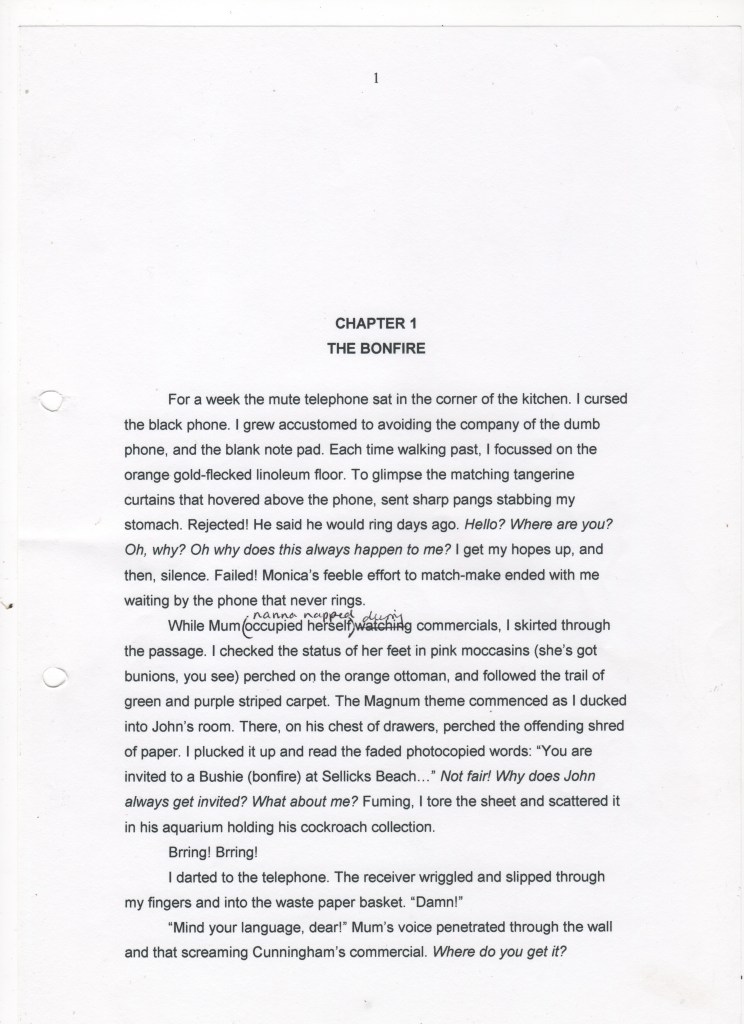
You may see in the sample 4 and 5, that I took most of what my writing mentor advised. There were suggestions further on in their manuscript appraisal, that I didn’t agree with. One was the use of the expression “Man!” which they said wasn’t used in the 1980’s that it was only an expression that turned up in the 1990’s. I begged to differ, as I lived through the 1970’s and 1980’s as a teenager/young adult and behold, I remember the expression “Man!” being used; not just locally in Adelaide youth circles, but also on the television.

[4. Sample of mentor’s feedback]
My mentor stressed that we need to consider our readers. Who is our audience? What do you want your story to say to them? Is the story for entertainment? Or do you have a point to make? In the end, you won’t be sitting alongside them and being able to point to a word and say, “Sorry, I didn’t mean that—this is what I did mean.”
Our written work needs to stand on its own literal two feet and make sense to the reader without the author having to be the virtual translator, and thus committing the mortal writing “sin” of “author intrusion”. Author intrusion is when the author tells the reader how they should see, think and understand the narrative. For example, think of “author intrusion” like explaining the punchline of a joke.

[5. After many more drafts, and 30-years later—Mission of the Unwilling, those paragraphs as they were, published in 2015.]
The editing process never ends. More changes in 2022: A cover aligning with the War Against Boris Series, a new “preamble” chapter, more proof corrections and formatting done to make a second edition. check out Mission of the Unwilling as it looks now.
The final result is about refinement of the work: sentence tightening, word tweaking, word cutting and polishing the prose. All through revising and proof-reading.
Now I know you’re all hanging out for the nitty-gritty; the how do I make my writing good? Make it shine? How do I make my story clear and interesting for my readers?
For a start, invest in a good “How to Write” or “Grammar and Spelling” book. The reason we have and learn this language tool of grammar is to keep us all speaking and writing our particular language on the same page. It’s like a cake recipe. Follow the recipe, the cake bake is a success. It’s so that we understand each other. Adhering to the grammar and spelling rules helps readers understand what you have written. Not misunderstand. Of course, rules can be broken for effect, but you need to know the rules of your writing craft well to have the skill to know how to bend (or even break!!) them.
As I have mentioned in previous blogs, the World Wide Web is full of resources for writers. So, no need to “reinvent the wheel”. I have mentioned Microsoft Word Editor and Grammarly but there are other websites out there you can search for and find.
Our own Indie Scriptorium’s Mary McDee has some good grammar tips which you can look at. Click on the link here on her post on the Little But Important Words as an example.
I come back to the lesson I learnt from my dad: Keep It Simple.
Use basic sentences. Avoid purple prose. Use strong verbs and choose words that are understood by most readers. Be consistent.
After all, the aim of reading is for the reader to have an experience they find enjoyable and worth their time.
© Lee-Anne Marie Kling 2024
Feature Photo: First draft of manuscript and the final Mission of the Unwilling Cover
We, at Indie Scriptorium met last week and reflected on our direction and purpose, especially in relation to our weekly blogs. Recently, I came across this post by fellow blogger, Anthony Robert, which to me, hits the spot when it comes to getting out there and increasing our presence.

This blog was planned to discuss Deep Point of View (PoV). However, as I went through the previous blogs published by Indie Scriptorium, I realised we had omitted to talk about points of view in general. I decided to do a quick catch up on this important topic for writers.
Point of View in writing identifies who is telling the story. There are three main points of view to choose from: first person, third person and omniscient. The second person point of view can be used but is rare in fiction.
Discussions about PoV’s can be complex and difficult to get your head around so I will try to keep it clear and simple.
Many writers tend to select the PoV that they find most comfortable for both reading and writing. I love books written from the third person PoV and struggle with first person PoV. So, when I started writing I naturally wrote in third person.
There are also trends in acceptable writing conventions. Historically the omniscient PoV was popular but in modern times first and third person PoV novels are most common. In recent times many people strongly advocate for the third person limited PoV as it engages the reader with the characters and makes the writing zing. In fact, some editors and judges of competition see anything but Deep PoV as poor writing. This has become a rule that deserves a separate blog, so stay tuned.
There are lots of good articles on line with further information about PoV. I found
Complete Guide to Different Types on Point of View: Examples of Point of View in Writing provided examples and exercises. https://www.masterclass.com/articles/complete-guide-to-point-of-view-in-writing-definitions-and-examples
Also look at the Jericho writers blog, Points of View in Fiction Writing by Harry Bingham. https://jerichowriters.com/points-of-view-in-fiction-writing-with-plenty-of-examples/
For a comprehensive discussion about PoV I suggest, Self-Editing for Self-Publishers by Richard Bradburn ©2020 Reen Publishing. (pages 315-335)
Cheers Elsie
Elsie King © 2024
Feature Photo: Frog © This Photo by Unknown Author is licensed under CC BY-NC-ND

A friend once told me: “Reading a novel is like eating cake. If you start reading something expecting “chocolate cake” but instead have “vanilla”, you feel cheated.”
Such is a reader’s experience when they pick up your book or download it as an e-book. They have certain expectations of the story from looking at the title and cover, reading the blurb, and glancing at page 100 (yes, that’s a thing).
However, the writing and language of the prose within can make or break the book’s success. If the writing is not up to standard, that is, it’s hard to understand, and a slog to read, then, you have lost your reader’s interest, I’m afraid to say.
In this blog I’ll stick to the “nuts and bolts” of what makes a piece of writing readable. That is, the language used, and writing conventions.
We may think that we have to wow the reader with clever phrases and words put all together like we are painting a fancy picture. This type of writing is called “purple prose”. Many writers have been there, believe me. Anyway, I don’t know about you, but I have.
Thirty-something years ago, I wrote about climbing Mt. Giles with my dad, brother and cousins. I did just that trying to convey the magic of the MacDonnell Ranges and the beauty of the Central Australian landscape. I gave my offering to Dad. His feedback: too much “purple prose”. That “purple” piece has been binned, so, here’s an example from the Reedsy website and their blog on “purple prose”:
“The mahogany-haired adolescent girl glanced fleetingly at her rugged paramour, a crystalline sparkle in her eyes as she gazed, enraptured, upon his countenance. It was filled with an expression as enigmatic as receding shadows in the night. She pondered whether it would behoove her to request that she continue to follow him on his noble mission…”¬~Reedsy (What Is Purple Prose? Writing 101: Definition, Tips, and Examples)
The Lesson: Keep it simple. Write as you speak. I should have known, as this is what I’d been instructing my English students at the time. Stick to strong verbs (doing words) and nouns (things, places, people). But avoid, if possible, too many adjectives (words used to describe nouns) and adverbs (words describing verbs, usually ending in -ly). Again, the Reedsy blog mentioned above has examples of how to simplify and strengthen your writing. As an exercise of simplification from the Reedsy example above, I have rewritten the first phrase as: “The girl glanced at him…”
The Aim is to have a piece of writing that is easy to read, easy to understand, and to be a rewarding and growing experience—not a waste of time or hours your reader, if they persevere with your work, will never get back.
The reason the language we speak and write has rules and conventions is for the sake of the reader. We want our stories to be understood, don’t we? Like a recipe for a cake, or road rules for driving, spelling and grammar norms help readers understand and enjoy what the writer has written.
To help with keeping my grammar and spelling in line, one of the tools I use is Microsoft Word Editor to refine my writing. Check “Editor” out if you have Microsoft Word.
Another internet tool is “Grammarly”. I downloaded and took the “Grammarly” test with one of my chapters from a detective novel I have been working on The Culvert. I found the exercise helpful in highlighting where my grammar needs correction. “Grammarly” offers a limited free service, but for a more in-depth check, a subscription is required. For some writers, “Grammarly” might be just the editing tool they have been searching for.
Simply put, the best ideas for a story may be wasted unread if the writing is not easy to read for the reader. Remember, write as you speak, and keep it simple.
© Lee-Anne Marie Kling 2024
Feature Photo: Cake © L.M. Kling 2010
 Indie Scriptorium -- Self Publishing Collective