Many, many years ago I read something that, as a writer, has haunted me ever since.
Those words painted a picture that stayed in my mind – it is only a simple picture but vivid and emotive; a picture I wish I had the skill to record with repaint.
The sun is low in the sky – morning or evening it matters not. I’m sitting by a lake surrounded by trees but nestled in a mountainous land. Far away, at the other end the mountains soar up in cliffs that come right to the edge of the lake. At one point a waterfall cascades in a maelstrom of spray.
However, in front of me, things are more peaceful. As the sun to my left is so low in the sky the trees are casting long shadows across the lake. A gentle breeze is disturbing the leaves causing those shadows to move while at the same time rippling the surface of the water so the shadows break up and re-form.
As I said, a simple picture: two short paragraphs; one hundred and nineteen words in all. I hope, with my word picture, I’ve been able to get you to see what I can see, feel a little of what I feel whenever I bring this to mind.
“So, what!!” I can hear you muttering. “Where are you going with all this waffle? What’s the point? And that title makes no sense at all!”
If I were you, I’d agree entirely. So let me explain. It was a mere seven words from a poem written about two hundred years ago by Alfred, Lord Tennyson; Englishman whose life spanned the eighteen hundreds (1809 – 1892). Those seven words? –
“The long light shakes across the lake.”
To be able to produce seven simple little words, all but one a single syllable and arrange them in such a way that they gave me a vivid picture was thrilling. I was awe struck. And humbled. This was what writing was all about! Would; could, I ever be able to attain a level of skill to match this??
The next line; (another seven words!) “And the wild cataract leaps in glory” fleshed things out; completed the picture. Wow!!
[Our Indie Scriptorium team have been putting together an anthology of some of our posts over the last two years. As I hunted around my messy computer filing-system for a number of these cheeky posts that went hiding, I came across this gem that somehow got buried in the vast layers of time. Amazing what one finds when searching for something else. So, with a few changes, here it is…Enjoy and be encouraged.]
BURIED GOLD
People spend their lives building their own kingdoms. As creators, we often measure success by how far our name-brand spreads over the “Empire” of the internet, world, community, and how much “gold” (money) we’ve amassed through the sale of our product.
When I first started exhibiting my paintings, friends, family, and fellow artists asked, ‘Have you sold?’ and ‘How many paintings have you sold?’
The fact that I had sold made me an authentic artist.
Same can be true as an author of two self-published works of fiction. Again, like a broken record, those interested asked, ‘How many books have you sold?’
Answer, ‘Er, um…not that many.’
Then the implication I should have gone through the traditional route of getting a publisher.
Yup, maybe, probably…still deciding if I’ll do that with future books, especially the travel ones that have colour photos on glossy pages—the coffee-table variety. Not sure how I’d go…I mean, I’m not an unpublished “virgin” since I’ve gone ahead and self-published on Amazon. I got impatient, afraid I’d remain invisible with a pile of rejection letters, and my novel manuscripts languishing as a PDF-file on my computer hard-drive (the hard copies stored in a box in my closet).
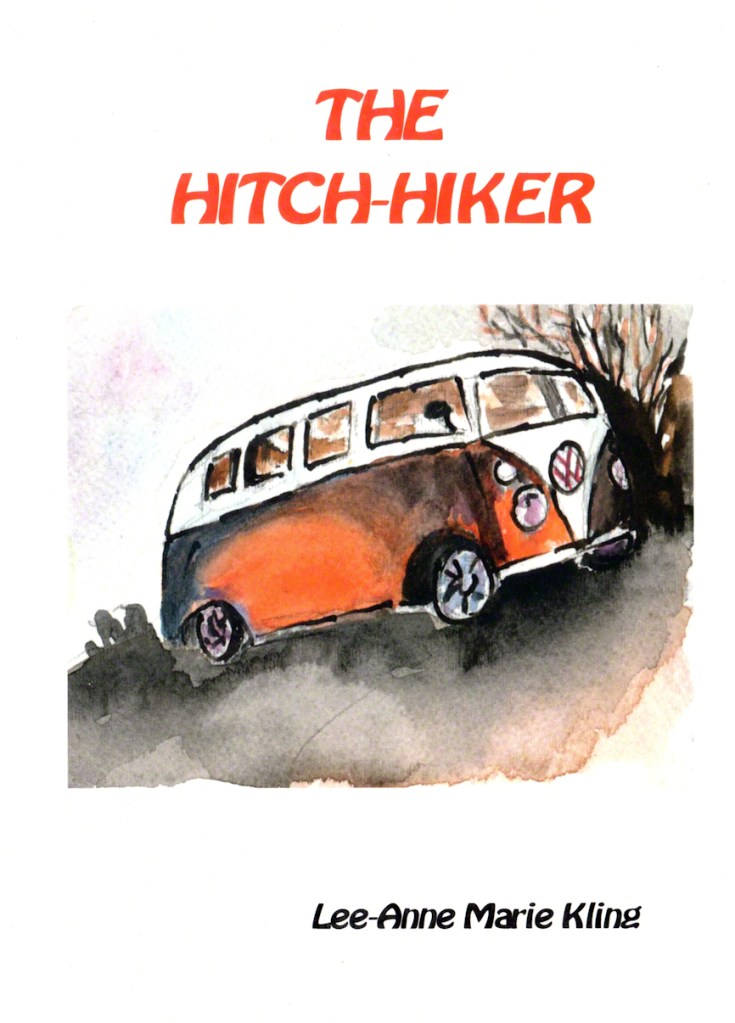
So, I published The Hitch-hiker (a novella) and Mission of the Unwilling(novel), on Amazon. Check them out. You can download them for the cost of a cup of coffee and find out what mischief Boris gets up to.
[Photo 1: The Hitch-Hiker (c) L.M. Kling 2015]
After publishing, having a little launch in our South Aussie pre-Christmas summer sweltering in 40 degrees Celsius, then a DIY advertising with bookmarks, flyers and emails, I decided to do research on how other Indi-authors built up their e-book kingdoms. There must be a secret method for digging up the buried gold of success in sales.
[Photo 2: Mission of the Unwilling (c) L.M. Kling 2015]
I discovered a mine of information lighting up my computer screen. I also discovered a precious nugget in an old Australian Artist Magazine—stand-out quality. In today’s language, I assume that means “brand”.
So, when at our SALA exhibition launch, a friend told me they knew which paintings were mine, that I had a unique style, I thanked them. I was on the right track with my “brand”.
But my books? Well, there’s Boris…albeit swamped by millions of other characters on Amazon.
Then, I discovered a gem—blogging. Not in the way I anticipated, though. I was optimistic. With my blogging presence, out there, I expected sales to rise and hundreds of instant visitors to my blogsite. My works were brilliant, right?
My posts drowned under the deluge of millions of other posts, tweets, Facebook pages, and other more successful blogs. For weeks, I remained South Australia’s best kept secret. Even my mum couldn’t find me—not even with my help on her computer.
Fellow writers at my writers’ group suggested I needed to post articles more frequently, get those WWW- “neural”-pathways (Algorithms) working by increasing traffic. Still, the site remained as lively as a cemetery.
Over time, I gathered a band of followers: friends, family, colleagues from church, writers’ and art group. Interest ensued—all Australian—no likes.
Undeterred, I wrote and published posts once or twice a week. Writing, my therapy. The articles available for free, my gift to the world. I prayed that there’d be others out there who’d find my words, and consider them useful, inspirational, amusing.
Week by week, comments and likes (mostly from mum) trickled in. Then, a comment from someone I didn’t know…and a visitor from the United States. Oh, what joy!
A friend encouraged me. I’d improved since they first started reading my blogs. Yes, writing is a craft; the discipline and practice refined my skill to communicate.
I read posts from other bloggers. I liked the posts that resonated with me. I knew I must start commenting. Friends who had websites and blogs said that’s how you make your presence known in the blogging community. I usually read WordPress articles late at night and was concerned my comments would come across as sleep garbled. Eventually, I plucked up the courage to comment. My first comment was about cats.
Each month, slow and steady, the number of followers, likes and visitors grew. My site on WordPress, the first place I visit each day when I open my computer. What countries have visited today? Check the emails. Who has liked me? Who’s following? I visit their sites and see what gems of writing, stories, photos, or paintings they have.
My world has opened; I read stories from every continent…and my stories shared around the globe.
Photo 3: Screenshot, My Stats for the Year (c) L.M. Kling 2024
The treasure I found by entering the world of bloggers, is not the gold I collect in my bank account for my own kingdom from my own works, but the cities of gold we share collectively as writers and artists. We put our stories out there and celebrate each other’s works.
So, a heart-felt thank you for all you who have followed, liked and visited my humble site—and thank you all for your stories, insights, artwork and photography.
Photo 4: Screenshot, visitors from all over the world (c) L.M. Kling 2024
So, if you’ve started up a blog/website and are waiting for it to be noticed, don’t give up. Keep writing, reading, commenting, liking and following and watch your readership grow.
It’s my opinion a good opening line isn’t essential for your story or novel, but it won’t do it any harm.
My critique group decided to revisit the essentials of writing as a way of everyone learning from the same page and improving our collective efforts at finding the right words for our various projects.
First topic – opening lines.
I realised that when I read a novel I don’t get put off by the opening line hence my opinion that a good opening line is not essential is from my personal experience. However, I love books written in third person in past tense so if the first line has an omniscient POV and is written in the present tense I tend to put it back on the library shelf.
So, what makes a good opening line?
I googled the above question and found some great information.
The Literary Hub presented an article by Allegra Hyde.
A good opening line “should capture your characters voice, it should carry your style, and it should be relevant and meaningful enough to engage your readers and entice them to read onto the next line.” An, “elegantly balanced dose of clarity and curiosity.”
However, it should not be “so heavy that it weighs on you or so literary that it chases away or confuses the reader.”
Allegra also suggests that the opening lines clarity should provide a sense of time, place, character and plot. The curiosity can involve the element of tragedy, conflict, mystery that fuels your story.
Suggest a short clear sentence that grabs the readers attention.
Use verbs correctly and adjectives sparingly.
Use words that add weight.
It doesn’t have to be loud; subtlety can be effective.
After doing this research I decided that for me a good opening line:
Is a short sentence where every word has weight and substance.
Intrigues the reader
Clarifies if the novel is written in first person, third person or omniscient.
Provides the tone of the book
Pulls the reader into the situation
Infuses them with curiosity about what comes next.
I then found some examples of opening lines I loved:(you can’t beat the classics)
Albert Camus – “Mother died today.”
Jane Austen – “It is a truth universally acknowledged, that a single man in possession of a good fortune, must be in want of a wife.” (apparently the most famous opening line ever)
Charles Dickens – “Marley was dead: to begin with.” (love this one)
So, putting the new knowledge into our own writing I have selected to test out some ideas for my new romantic short story Honeygate.
He stood at the back of the hall his face shrouded by a deep hoodie. (Does capture the tone of the story but too descriptive with no hook)
Magical, menacing mesmerising. (Fuels the curiosity but doesn’t provide any clarity about who’s talking or the situation)
I couldn’t see his face but his gaze stole my well-rehearsed words and left me floundering. (clearly defines the characters point of view, raises curiosity, puts it into a context and suggests the potential conflict between the protagonists)
Just doing this exercise has raised my awareness of the importance of an opening line and given me some directions so I can play around with various types of lines and find the best one.
What I found particularly helpful is that using a first-person POV would work well for this story. My heroine has felt the impact of the hero’s gaze and is discombobulated enough to forget her speech she can have the stage from here on and tell us her story from her perspective.
“Don’t tell me the moon is shining. Show me the glint of light on broken glass.”
–Anton Chekhov
The pictures in an exhibition do not come with a detailed written description. You don’t get paragraphs telling the viewer what the subject matter is, what colours are used and why, what time of day the painting depicts the theme, composition or the medium used. The pictures show all that information. The little accompanying tag tells you the essentials—title, medium, artist name and price. That’s all you need.
In creative writing we use both showing and telling. But what does showing mean? What is telling? How do you differentiate when to show and when to tell? It can be tricky to sort it out, but these are my ideas.
Telling enables the author to provide quick, factual information. It may be important, but you don’t need to go into the information in any depth. It can move a story along efficiently. It’s like the painting tag, brief, factual but essential information. Telling may move the reader to another time, another place, mention the weather, comment on a relationship but it is briefly mentioned. Nothing is happening in the time or place that requires delving into the character or the story.
Telling examples: Twenty years later she found herself back in Rome.
It was a hot night.
He got married twice before he met the love of his life.
Showing is like painting a picture. It gets the reader to look deeply at a scene, often through the characters perspective, thoughts and dialogue. It delves into the character and situation and stirs the heart. It is slower and richer. Showing is the writer’s device to enter into the character, to use their senses, thoughts and emotions. It creates drama and provokes emotions and wonder in the reader.
Some examples:
Rome, the heat was cruel, the smell of dust and onions spiced the air. Nothing had changed in twenty years except there were more people on the streets and the noise of traffic roared in the background. Brenda sniffed, felt the baking, rough stone beneath her fingers. “Hello Rome, I’m back.” She laughed and remembered. I wonder if he’s still alive.
Heat wept from the night sky.
Robert’s heart actually pounded. He was too old for this. She looked like an angel her white hair long, lush and thick, her eyes deep pools of love. Her body strained towards him. I don’t deserve her. He turned to his son with a grin. “I should have bought a dog thirty years ago. Loyal, loving and much cheaper than two wives.”
The balance of showing and telling is something that I hadn’t considered prior to this blog. When you think of it, it should be easy. You show when you write an important dramatic scene but tell when you want to move your story to the next dramatic scene. But too much drama can be overwhelming while too much telling slows the story down and distances the reader.
You also must think about if you want the reader to be moved by what you are writing. Some subject matter is so dramatic it’s better to distance the reader by just telling events.
I’m currently working on a story which is about the very emotive subject of abortion. I’ve written it using more telling than showing and I think this works as it steps the reader back from what may cause distress or anger. The following paragraphs I hope illustrate my technique. The telling is in bold script.
Mavis finished feeding the baby, changed his wet nappy and swaddled him in his blanket. He looked at her with trusting dark blue eyes, his skin a golden colour his little fists fighting to get free of the blanket. But milk, comfort and gentle rocking made wakefulness futile. Mavis tucked him back into the cardboard box and pondered who to contact first.
Abandonment became a movement. The papers took sides. The right-wing journalists condemned the mothers of the children. The left -wing journalists blamed the right for life movement and evangelical churches. The airways rang with strident arguments and the police and social services complained of a lack of resources and put out regular appeals for more funding and foster carers.
“What’s happening to the babies, Caroline?” Mavis asked as she handed over another child from the front porch of an old Congregational Church. She now knew the names of many of the police officers, paramedics, nurses and social workers.
“Oh, Mavis” the woman’s eyes welled with tears. “We can’t get any more foster carers and the adoption process is, well it’s slow because they have to check everything before they can do a legal adoption. It’s a mess, and the entire system is overwhelmed. Lots of these babies have special needs and we can’t get them in with foster parents anyway. They couldn’t cope. We’ve had to open up orphanages and even that isn’t working. These babies need a mom and dad. They don’t do well if they don’t have cuddles and attention. It’s so sad.”
Mavis remembered seeing pictures of abandoned orphans in Russia or was it Romania? Remembered sunken sad eyes, skeletal bodies covered in sores. She felt her heart pound and her stomach clench. Her doctor said it was anxiety, but Mavis knew it for what it was, guilt. They had demanded the abolition of abortion and that was causing this horrible dilemma. They had saved the unborn, but the living children were suffering.
I hope this give other writers some ideas about showing and telling. I am considering doing the above exercise on my writing as another editing technique. It certainly makes you aware of when you are showing and when you are telling and what balance is required for the piece of writing.
Hope you get something out of this too.
The following references were used for this blog. They go into this topic in detail and provide fitting examples and explanations.
Jericho Writers – Show don’t Tell: What it means and why it matters – Henry Bingham (no date provided)
Writers write – How to master “Show don’t Tell” – Kyle A. Massa 2023
Pro-writing aid – “Show don’t tell” in Creative Writing – Sean Glatch 2022
A huge apology for being a day late posting this week’s blog. As Mary McDee says (often), “Technology, you can’t trust it.” She says this while spending the week chasing Dorper sheep (Goat-Sheep Cross), from the neighbour’s yard back into her own. They are more stupid than actual sheep, much like she thinks computers are.
Anyway, ‘twas a computer crisis at Mrs. T’s (my mum), that sent the weekend into wobble-world. That with the default of chasing ancestors down familial rabbit holes, I have done little in the way of preparing an article to post, let alone any idea what to post on the chosen topic, World Building.
Then inspiration struck. At the proverbial last-minute. Why not do a spot of World Building from one of my developing novels? Why not, indeed!
I searched around for a worthy template—one that was interesting, not too many questions (just enough for the exercise) and one that was memorable. I didn’t have to look far on the World Wide Web, to find this little beauty: GRAPES.
“G” for Geography
“R” for Religion
“A” for Achievements
“P” for Politics
“E” for Economics
“S” for social Structure
There’s even a colourful chart with two or three questions under each heading to help with the process, courtesy of Amanda Schlindwein. Thank you, Amanda, for posting this helpful model which you can see if you click on the link to her website.
So, here goes. I will use the book that I have been posting serially on Wattpad, Diamonds in the Caveas my world building muse. (I won’t be addressing every question in the GRAPE help. The post would end up being too long, otherwise.)
Geography
How does the region’s climate and placement affect the characters in your story? The village of Luthertal on Pilgrim Planet (approximately 20 light years from earth) suffers extremes of temperature and weather conditions because of orbiting two suns. After emigrating from Eastern Europe from the 19th century, where climate was more stable, they find the change confronting, confusing, hard on their stamina and they become angry. They need to vent their anger and frustration. As a primarily farming community, the droughts, fires and floods that fail their crops, and kill their livestock, cause them to seek someone to blame. Hence a perfect storm for parties of evil intent to stir up the idea of witch hunts.
Religion
What do your characters believe in?
One God and the founder of European Protestantism, Martin Luther. But they, being Wends, are synchronistic, never having relinquished the superstitions, magic and healing practices from their “heathen” ancestors. So, there’s this conundrum; a person who fails to attend church each Sunday is called a “heathen”, but it’s okay to believe that breaking a wishbone of cooked chicken and the person getting the larger portion can make a wish. Or a character must trust in God to heal them, and the church prays for them, but it’s acceptable to treat the sick with herbal remedies as according to the long tradition of apothecary. I might digress here that my two-times great grandfather came from the region of Lusatia (which is where the Wends come from). Before he became a doctor he studied, at Herrnhut, the base of the Moravian Brethren, (so we’re talking seriously Christian here), the medicinal art of apothecary. Maybe some Lutherans would’ve had a problem with that, but we’re talking about a particular community, the Wends or Sorbs. So, writing from my own family history experience, which is partially Wend, I can see this community of Luthertal being more open to magic and the supernatural. One day I might write on these supernatural experiences that my family and relatives have experienced.
Achievements
What has this civilisation created that has withstood the test of time?
As mentioned above, being an agricultural community, the Wends are robust and healthy. They have their Wendish culture of dress and traditions. They are remembered as an industrious people, but also as a deeply religious God-fearing people. In fact, they feared God so much they escaped the persecution and oppressive norms put upon their religious practices that they planned to emigrate to South Australia. Unfortunately, an evil alien called, Boris who pretended to be God’s ambassador, led them astray and transported them to the Pilgrim Planet with plans to enslave them and breed an army from them.
Politics
Who controls the society and how do they control it?
Although in Diamonds in the Cave the Wendish community are emerging from the ruthless fascist control of Boris, having been saved from his clutches by the good guys Intergalactic Space Force (IGSF), in my previous book, The Lost World of the Wends, they are still politically and structurally fragile and finding their way. They have reverted to the ways of old where the Burgermeister runs the village and decisions are made by all villagers gathering in the church. The Wend community is by this time a theocracy. However, Boris still has his influence with a couple of his agents hiding in plain sight in the village. These agents are stirring up the Wend community to seek out witches and burn them.
Economics
What is considered valuable? And how are products bought and sold?
Apart from food and the products from farming used to be self-sustaining, as was the custom back in Eastern Europe in the mid-nineteenth century, mining minerals and ore for power and energy for space travel is taking off. Mutants who have been freed from slavery under Boris have been brought in to help develop the village building houses and mining in the local mountain range of Mount Martin. The Wend villagers begin to regard the mutants with suspicion and they become targets for witch-burnings.
The currency that the Wend community use are “pfennig” (pennies) and thalers, like what they used in Saxony in the mid-nineteenth century. Products are bought and sold at market which is open every day except Sunday. Sunday is the Lord’s day, a day of rest.
Social Structure
Who are the most important people?
The Burgermeister (Herr Biar), the pastor and the doctor (Dr. Zwar), who in Diamonds in the Cave is the pastor. Prestige is shown by the assets the high-status ones have. The doctor owns a Mercedes. Herr Biar has a beautiful, large brick house and large farm.
Least important people?
The mutants, old single women (Gertrude) and women who don’t fit in the community (the female heroine, Minna). They are the prime targets for witch-burnings.
***
That’s all for my little exercise for starters. I found it helpful to clarify my ideas for the world in which my characters live in Diamonds in the Cave.
Have a go yourself using the GRAPE template or click on the links below to try one of the other templates that looked useful.
Let us know how you go? Or if you have found a template that works for you, send us a link.
It’s been one of those months busy, busy, busy. I was asked to write a blog about world building and failed miserably. That’s how it is with me and the idea and how to of world building. While in my first blog on the subject, now titled “Before World Building” I floated into dreaming and imagination, I did not realise that for most people in the world in which I live that airy fairy imagination doesn’t cut the muster. For them it’s the details and secret rules that only a Fantasy role playing gamemaster has access to. I’m not a game master.
My one foray into fantasy role playing ended badly, another epic fail, where, despite it being “free form” I had no idea how to operate in this peculiar world that the “game master” had constructed. It had rules and I was constantly breaking those rules.
The first thing about World Building is it’s about rules. Like if you have a game. You have the boundaries or field of that game. The field looks a certain way like the stage or land in which you story is set. For example, you may have goal posts if it’s a football game. The field will have green grass with markings. And so on. Then in the game the players are dressed in team colours and have roles like goal kicker and goal defence. Just like in your story, your characters dress a certain way, have roles and personalities. The game has of course rules that the players must follow, just as in you story the village or land will have laws, culture mores and religious practices they must follow.
So, you can see that it’s advisable to think about these “rules” for the world in which your character lives and into which your reader will vicariously enter. In the world the reader enters, if the world is believable, the reader suspends disbelief and immerses themselves in that world. I should mention here that Mary McDee has written a yet-to-be published children’s story “Chaos in the Kingdom” which has a land which she has mapped out, and there were specific rules of language that the characters must obey. And in my own Sci-fi books, I spent decades researching Astronomy, space travel, physics, UAPs (formerly UFO’s), alien first contact and abductions to make my story of Minna’s alien abduction by Boris believable.
This then is the premise of how to create a world. To be frank. I have no idea how I land on creating my worlds. I brainstorm. Research. Write notes. Do character profiles. The story develops and I write it. In the process, the world forms around the story. This, I’m finding works well in the world we know—our contemporary world. For the Science Fiction or Fantasy genre, since the worlds are alien to our general human world view, the writer needs to delve into greater detail to make the world cohesive, consistent and believable for the reader. Tolkien’s last uncompleted work before he died was The Silmarillion which as I understand was his notes building a fantasy world. It’s a decent sized book. As for me, I spent over thirty years planning, researching, world-building and writing my first book, Mission of the Unwilling.
Now, on that line of thought, about conveying the details of the world in your story, there is a danger for the author to become bogged down in too much information to describe their fantasy world. Have you ever read a book which spends three quarters of the story on developing the world in which the characters live? I have. Victor Hugo’s The Hunchback of Notre Dame. I laboured through three hundred pages of the book describing every square inch of Paris, before I reached the interesting story part. I dare say, the novel served me well when we did visit Paris a second time in 2014. Victor was just following the “rules” of world building…And playwrights and movie makers of the Hunchback of Notre Dame plays and movies were eternally grateful.
Not sure if I tackled such a 300-page info-dump, I could have Victor Hugo’s success. One of the world building articles I read advised against overloading the reader with detail.
On another note, about being OCD about detail, is that it can stall the writing of the work or story. I remember one of my first attempts to draft a novel. I was 18 and had this idea for a fantasy romance. Like any obedient aspiring author, I asked my playwright uncle for advice. Build the world, he advised. Do a story map. Make a diagram or graph of the characters and their relationship with each other. So, I did. Spent all summer building the world and the storyline never happened. Those pages now languish, buried in a cupboard somewhere…covered in dust.
Yet, what is the essence of World Building? How is it done? I believe that central to the art of it is creating. Creating a world or stage in which the characters physically live, move about and interact with. Creating a past from which the characters come and what has made them who they are. Creating rules, norms, boundaries, habits, means of communication, and attitudes that defines the characters as a race or type of being. Creating the mechanics of how stuff works in this world, either by peculiar or unique physics, chemistry, biologically or even dimensionally (are they two dimensional? Or six dimensional?). Creating a world view. Creating a conflict. Creating the people or beings who live in this world.
You may have noticed I have used the world “creating”. To create, I believe begins with imagination. Which is why I still think that whatever world a writer is developing, imagination is the key. The stories that resonate most with us, books like Tolkien’s classic Lord of the Rings, it’s because the world they create is unique and memorable and the reader wants to enter it and stay in there.
But, just in case I haven’t nailed it, because I’ve been general, and creatively waffly, here’s what my AI guru has to say about World Building:
World building is a crucial element in creating immersive and believable settings in a novel, especially in genres like fantasy and science fiction. Here are the main elements of world building:
Geography: This includes the physical layout of the world, such as continents, oceans, mountains, and climate. It sets the stage for the environment in which the characters live.
History: A world’s past can shape its present, so detailing historical events, wars, discoveries, and cultural shifts is important.
Culture: This encompasses the arts, customs, traditions, and social norms of the societies within the world. It also includes language, religion, and societal structures.
Politics and Government: The types of governance, political relations, and power dynamics between different groups and nations within the world.
Economy: How the world’s inhabitants sustain themselves, including trade, currency, industry, and technology.
Magic System (if applicable): If the novel includes magical elements, defining the rules, limitations, and effects of magic is essential.
Flora and Fauna: The creatures and plants that inhabit the world can add depth and wonder to the setting.
Rules and Laws: The physical and metaphysical laws that govern the world. This could include gravity, time, or even the possibility of traveling faster than light.
Conflict: The central conflicts that drive the narrative can be deeply tied to the world’s structure, such as scarce resources, ancient feuds, or clashing ideologies.
Characters: While not a direct part of world building, characters should be shaped by the world they live in, reflecting its values and complexities.
Effective world building creates a rich backdrop that supports the story and characters, making the novel’s universe as compelling as the plot itself. Remember, consistency is key in making your world believable and engaging for the readers.
For further reading to demystify the world building process, here are four links to posts which tackle the topic. They have done a much better job than I ever will on the topic.
Some time ago we told you the sad story of friends of ours caught up by a so-called “vanity publisher”. When their work was accepted (with a great deal of enthusiasm!) by this publisher, they were over the moon. Slowly, however, joy turned to frustration and financial loss to the tune of more than $30,000-oo. With nothing more to show for it all than only one single copy of their book they were hugely ashamed and embarrassed – not at all surprising as they are very savvy and have always dealt with life in a business-like way.
Fortunately, this bitter experience has not killed the urge to write. But it could well have done so.
However, we have become aware of the fact that, as well as this vanity publishing racket, there are a number of other matters connected with writing that are causing a degree of confusion among those of us who dream and scribble and dream some more.
The two words we want to deal with today are “printing” and “publishing”. They are not the same and they are not inter-changeable. Let me repeat that so you get the message –
THEY ARE NOTINTER-CHANGEABLE
Printing is something you can do yourself. All you need is a laptop; a ream of plain paper; a printer attached to your laptop; card for a cover and a good strong stapler or comb binding machine. Your magnum opus won’t look all that professional, of course, but it will be printed. If you require a better-looking job, you can source a printing business, make an appointment to discuss the details of exactly how you want your book to look; how many copies you would like and how much it will cost. End of story.
You may have ordered only a few copies to give away, in which case you pay up; collect; distribute and (hopefully!) bathe in the glow of all the congratulatory comments. End of story. On with the next.
On the other hand, you may have ordered a hundred copies with a view to selling them. Have you decided on a marketing plan? How do you intend to publicise your book so eager buyers will be aware that it is available for sale? Do you have a list of bookshops that might be willing to stock your deathless prose?
If you decided to jump on this bandwagon, you have now become a publisher. Congratulations!! I really hope you succeed and make at least enough money to cover your costs and maybe have a celebratory dinner as well.
Bottom line: publishers are businesspeople whose essential business is to produce books, market them and make a profit. They do not author books although some do occasionally commission a book on a particular topic from an author they know and believe in. Once they have found a book they consider marketable, the author is offered a contract. After this is signed the publisher works hard to ensure a profitable outcome; hard work that involves, among other things, editing, proofreading, printing and marketing – and that printing is done by a printing firm; a separate business.
Publishers are not printers and printers are NOT publishers. Not a case of “never the twain shall meet”. Far from it. Much more a case of mutual dependence as each cannot function without the other. Think of it as complementary co-existence.
Modern marketing is an amazing process. As more people use the internet to find out information about all sorts of things it’s not surprising that buying books is now subject to the same internet marketing strategies of so many other products.
I’ll give you an example from real life. My oven was in desperate need of a clean and especially the glass door. Before the internet I would have phoned my mum or a friend and asked, “How do you clean your glass oven door?” These days I google “How do I clean my glass oven door?” and I get lots of useful and useless answers and many adverts telling me that this particular oven cleaner is perfect for the job.
My original search did not get the product I needed. So, I refine my search and add “How to clean a glass oven door when it’s encrusted with fat?” And then I get more specific products and information. I may also add another keyword “How do I clean my encrusted oven door with an environmentally friendly product?”
The keywords in my search are: clean, glass oven door, encrusted fat, environmentally friendly.
Keywords are what people type into the Google, or alternative search engines. As I explained in my previous blog for marketing it helps to understand how search engines work. Key words are essential.
But, you ask, how does this effect authors?
There are millions of books online in so many genres. And within each genre there are sub categories of genre so key words become important words and/or phrases for readers to find the right book for them on Amazon and other platforms.
Try googling Romance books. You will get a list of different types of romance books. I selected Dark Romance books and got another list of keywords, hottest, extremely dark, possessive dark, dark kidnapping. Select one of these and you will finally get a selection of books in just the right genre sub-category you crave. So, before they get to your cover, blurb and reviews readers will find your book from the millions of other using key words.
Try a few different categories just for practice. I tried Fantasy novels and chose with dragons. I then selected romantic fantasy novels with dragons and finally you get to a list of books that fit close to what I was seeking. That list of books is where you want your novel to appear so it can compete with the others. After coming up on the list your cover and blurb will then win the sale.
Authors can select their keywords when they upload their book on Amazon and other platforms. It is part of the process for getting your book available as an e-book or print version. Before you start it is wise to research what keywords will get your book noticed.
Google keyword selection and you will find a number of websites that provide authors with the best key words for your novel. There are forums (Kindle forum, Reddit) lists of genres (Marie Cole) and my favourite from Draft2digital Specific Genres Literature and Fiction.
But can you change your keywords after you have published your book? The answer is Yes.
Keywords are classed as metadata so can be changed for free. (Unlike actual changes to your book cover or inner material which might incur a fee for changes) Just go to your publishing site and edit the novel metadata and review your keywords. Both Kindle Direct and Draft2digital allow changes to metadata but do check the term and conditions carefully yourself.
I’ve found this foray into keywords enlightening indeed (as one of my Regency romance protagonists would proclaim). I will be doing further research and perhaps update the keywords I so blindly selected when loading my books. Modern marketing is complex. I hope that this blog helps you navigate some of its complexities and increase your chances of your novel being found on-line.
Having a website is a great idea for authors. It allows them to showcase their books and builds relationships with readers. You can sell your books on-line through links to your book publisher. You can write blogs or newsletters for distribution, provide information about your life and writing career, advertise future releases and connect to social media. You can advertise author events and book signings. It is a marketing tool with a personal focus and while it can be tricky to set up it gave me a lot of satisfaction having a website. But mine hasn’t performed and languishes unread. Time to make some changes.
But where do you begin? There are millions of author websites in existence, and they all are competing for attention and sales. So how do you get your website noticed? Let’s find out.
Let’s start with the biggie, SEARCH ENGINE OPTIMISATION – SEO
When I want to research a topic, I fire up Google and then work out what information I want. For example: I want to find out about SEOs. So, I type in “what is a SEO?”
(Some popular alternatives to Google are DuckDuckGo, Bing, Yahoo but there are over 1500 others to choose from including one called Dogpile?)
The response to my search is overwhelming. I initially got a very long and complicated one sentence explanation which didn’t make much sense. I then scrolled down to 76 (enough, there were more) companies giving explanations about SEOs. There were also several You-tube videos available with lovely people wanting me to find out visually what SEO’s are all about. They all invited me to click on their website and swallowed up in their advertising and sign up for expensive services to improve my website’s SEO.
I scrolled down to Wikipedia. I love Wikipedia and regularly donate when they put out requests. Yes, I know it’s not perfect but it’s a great first stop that can provide you with good information and directions for further research.
Wikipedia defines SEO as the “Process of improving the quality and quantity of website traffic to a website or web page from search engines.”
Okay, what do I, as an Australian author need to improve my website’s SEO. Well, the Key Words are Australian and author. These narrow down my search to what is relevant to me. I Google again and get another long list of companies and individuals who want me to look at their websites and sign me up for their services.
I chose three web sites to explore:
Australian Writers Centre – it looked professional and offered a course on SEOs.
Jin and Co. Caught my eye with the proclamation “Two simple steps for authors to found in Google with SEO.
Amazon SEO for authors.
I chose the Australian Writers Centre because it looked professional. The tag “Two Simple steps…” caught my attention as it offered a quick and simple solution. I chose Amazon because they are a big brand and should know what they are talking about.
So, these services and companies drew me in with their presentation, that includes their titles, their choice of words to advertise themselves and their brand name. It is these factors that draw readers and potential customers. It is these factors that you must address to improve your own website.
The other big consideration is, Do I want to pay for a SEO improvement service or do it myself?
There are information websites for free. These are referred to as “organic” or “natural” traffic and is hard to find amidst the other monetarised websites. Many YouTube videos fall into this category, as does Wikipedia. I also found a Business.gov.au website and looked at Wix and LinkedIn sites for free information.
The second, and more prolific websites available are called direct traffic, which is really advertising. Advertising on-line includes emails (think Spam) Banner advertising where an advert decorates the bottom of a page. Pop – ups jump out at you at unexpected times, some webpages encourage you to join in a chat with a robot. The aim of these services is to get your money, which is fair enough if they provide a good service and you can afford them. All these websites are geared to draw you in and some of them make it difficult to escape from their greedy clutches. Ever found yourself in a website without a log out or delete button and you keep on going around and around looking for a X.
All these multiple forms of websites are guided by Algorithms.
Algorithms have been around since 2500BC in Babylonia. They are formulas that take complex date from a variety of sources and make it more user friendly.
In modern times algorithms are programmed by computers to work out what words and sentences are popular and gain the attention of browsers. They do this primarily through keywords, and getting the right key words, the name and the visual presentation of the site. It’s what draws attention to your website and, the books that you hope to sell.
Website marketing is a huge area to research and understand. I have found just this first step edifying. Watch out for more blogs on this complex topic.
References used in this Blog:
Wikipedia
LinkedIn SEO – 6 steps to optimise your profile.
Wix – Free SEO tutorials
Australian Government – Business.gov.au – Improve your search engine rankings.