In our Wednesday Writers’ Group, we have been refining our techniques by learning to be economical with our words. It’s so easy to slip into unnecessary repetition and belabouring our points. The 100-word challenge helps us writers to prune our words to the absolute minimum and make each word count.
In doing this exercise myself recently, I was forced to examine what facts were necessary, and how much I can rely on the readers’ intelligence to “get” the story. Often, we underestimate our readers and thus repeat and go into minute detail that bogs down the story, causing our readers to become bored and not turn the page.
So, here’s my 100-word challenge, fresh from my memoir collection. It may not be perfect, but it is 100-words.
***
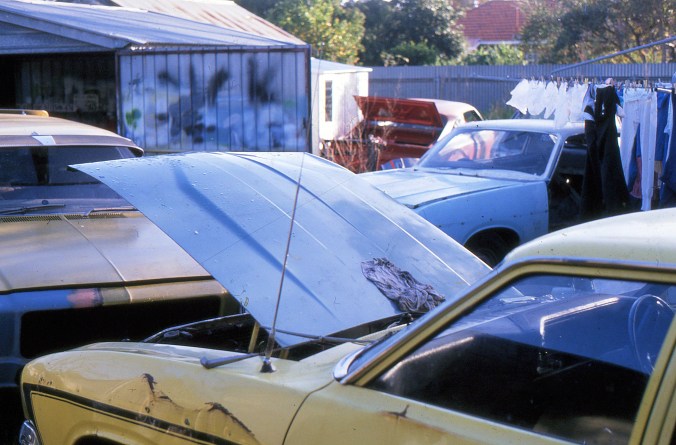
[Intro: Rick, my brother, loved resurrecting car wrecks. The backyard shed became his workshop, and the local wreckers his go-to.]
The “Yota”
A fossick in the car-graveyard yielded the broken shell of a Toyota. Rick revived it. He spray-painted it green.
‘Can’t miss the frog-car,’ I’d say.
One Sunday morning, Mum and Dad needed a car to drive to church.
Without permission, they drove the roaring ‘Yota down the driveway.
I slept in.
Minutes later, the ‘Yota roared back up the drive.
Doors slammed.
Mum cussed.
I scrambled out of bed. Mum never swears.
‘What happened?’ I asked.
‘The police picked us up and defected the car,’ Dad said.
‘That’s what happens for taking the car without permission,’ I replied.
The new year is traditionally a time to try something different, change old habits or get organised. So many times, I’ve made resolutions on New Year’s Eve and forgotten them a week later.
Age is a wise teacher. This year I will make one sound resolution. I will meticulously assess the challenge envisaged having learned to be circumspect, prudent and wary of unguarded and reckless promises.
I will become a wordsmith.
Changes to my writing must not be as fleeting as a summer day but soar like mountains; my tenacity only worn away by seasons of foul weather. (Well, maybe the odd earthquake too.)
Words are like rainbows; they need to contain pure colours and fascinating hues as the colours blend at the edges. Like rainbows they must conform to a set of rules in terms of the colour spectrum, but they can soar, be broken and finish or start in peculiar places. Words, like rainbows can be fleeting, lovely to behold but quickly forgotten as clouds cover the sun. But then some words achieve immortality and stand up to centuries of use and misuse.
“To be or not to be, that is the question.” ~ William Shakespeare, Hamlet, 1601.
What words will you craft in 2026?
I hope you find your own challenge for the forthcoming year. Enjoy writing, whatever it may be. Enjoy reading and have fun.
No two writers will ever write the same; unless they copy each other’s work.
As we write our history emerges. Our birthplace and early childhood lay down the roots of our language, the words we use and how we say them. Education hones our writing skills, providing the rudiments of spelling, grammar, clarity and brevity. The extent of our education is reflected in our vocabulary, knowledge and understanding.
Life, with all it’s trauma, joys, grief and love add a layer of personal experiences that shines light on, or clouds, our perceptions.
Writers of fiction take the written word further. In ignorance or awe, they craft words into edifying entertaining stories. They create worlds in time and place with characters who are as unique and exceptional as real people. The process is magical.
Style is the author’s choice that allows their personal history to shine through the story. The summation of a singular life; bent by beliefs, passions, opinions, encounters and events.
Style is a matter of establishing the mood of the story, the best tense to tell the story, what word choices capture the emotions, which character can tell the story in the most effective way.
Style can come down to sentence length, grammar and spelling. Dialogue can add history and dialect with a character’s utterances which shape their relationships and place in society.
Style can be manipulated by writers to provide rhythm and metre.
Style can be transparent and easy to read, enhancing a strong story. Dense prose may hide the story behind word smithing or complications that may entrance or offend.
Purple prose, too much of everything, isn’t recommended.
But what about the reader?
I liken literature to the composition of music.
Some composers write for the entertainment of their listeners. They want to transport the listener on waves of sound that draw out emotions and memories. Good music can bring tears, stir resolve or just provide a wonderous relaxation. Music can move people from the humdrum to the fantastic, and it is pure entertainment.
Some composers, especially those before technological devices, wrote music for players of musical instruments. Their compositions were to build skills, challenge and inspire. They incorporated complications and tests of dexterity, difficult techniques to build confidence and proficiency in fellow performers. They didn’t write for the entertainment of ordinary listeners.
But some composers both entertain listeners and challenge musicians. They achieve immortality.
But what about the reader?
As writers, like composers, we need to consider our audience. Are we writing to provide our readers with entertainment? A good story, easily read that delivers our ideas and characters simply and clearly. A bestseller, one among many, distracting, diverting and providing pleasure; for a short time.
Or are we writing to impress and challenge aspiring writers? To build the writing craft and stretch the boundaries of our fellow wordsmiths. Do we want to craft a style that may be dense and hard to read for the average reader? That needs re-reading. That stirs love or hate, or both in equal measure.
Well, I’ve got to the end of re-writing and structurally editing my third novel The Jamaican Heiress. It required two complete rewrites and a substantial structural edit which took me about eighteen months. It’s now a good story with a logical plot propelling stronger characters through a series of crises and culminates in a satisfying ending. I’m happy with the flow, time line, changing points of view and how it all hangs together. I’ve had feedback from two respected writing friends and made much needed changes to time lines, character arcs and motivations. Alpha readers are gold. Yay.
Big sigh. I’m feeling happy. But now it’s time to do the line/copy edits.
Should be a breeze. HA!
For my previous novels I used Pro Writing Aid to pick up overused words and phrases, (names and blushing references) repetitions, passive voice and my tendency to start every paragraph the same way. I then used a wonderful professional editor who tirelessly tidied up my prose and produced two readable books.
But having it done for you doesn’t help you to learn about the problems you have when you write. This novel I’ve decided to do the line/copy editing myself, as an exercise in strengthening my writing. This blog is about my process.
First step: Google search: What is the difference between line and copy editing?
There is heaps of information on Google and many useful videos on YouTube to check out. For a very quick rundown have a look at Alex Cattoni’s video “Copy Writing Tips: What’s the difference between Line and Copy Editing”. In short, she says: “Line editing crafts the story, Copy editing catches the errors.”
Second step: How many sweeps of the novel will I need to do and what do I look for in each sweep?
Again, I googled line editing and read several blogs and watched a few videos. I suggest spending a few hours combing through the plethora of information available and then come up with your own plan. I’m going for two, or possibly three sweeps (see step five)and then use Pro-writing Aid to pick up my remaining bad habits, then read it out aloud (or use the audio program on your computer) I will then re-read the entire manuscript and pass it on to my beta readers with trembling hands.
Step three: How do I do the line/copy edit?
The general consensus is to line edit a small piece of writing at a time. Could be a paragraph, a page or a scene but then go through your work looking for things like flow, word usage, passive voice, repetition, continuity, dialogue consistent to each character, adding/deleting description, telling and showing balance and point of view problems. The idea is to make every sentence clear to read, strong and efficient at conveying what you want to tell the readers without browbeating them.
Step four: Next sort out your process.
If you want to line edit on the computer, make sure you keep a copy of the first draft and line edit the new copy. I suggest you don’t name the copy the same as the original. I’ve got myself tied up in knots trying to find documents with similar sounding names, so put a date on your new file. You might want to try a program like Scrivener which helps sort multiple copies of a manuscript and allows colour coding too.
Other people like to print out the manuscript and edit on the printed page. Using different highlighters for different problems is something I’m going to give a try. So, red for errors, blue for word usage, pink for POV, purple for purple prose, green for continuity and yellow for “it’s just wrong”.
Step five: It makes sense that your first sweep looks at paragraphs and scenes and information to be added, deleted or changed completely. My first sweep will concentrate on:
Do I need to add/delete descriptions?
Have I used the senses?
Is the balance of show/tell good for pacing.
Continuity. Robert has blue eyes not brown!
Remove repetitions.
Is dialogue unique for each character? Think about tone as well as commonly used words or phrases.
Is each sentence clear and easy to read.
Is there any head hopping going on?
The second sweep will focus more on sentences and words and includes:
Over used words, descriptions or phrases.
Reduce filter words: she thought, he realized…
Change weak words to stronger words, he walked, to he paced/strode/shambled/limped.
Address passive voice in sentences.
Reduce adverbs.
Look at consistency of tense.
I’m new to this so I’m not sure this process will work. I will try it out for a few weeks, tweak it and experiment, then report back.
I have published two previous novels and have also had three short stories published. The feedback I’ve had from readers and editors has been positive so I will approach line/copy editing with some confidence. I do have faith that I can catch a lot of clangers, but I think it’s essential to have an editor or well-informed writing friend to catch what I miss. There are lots of problems that you as the writer don’t see.
I found the following articles helpful but there are many more on-line.
Our bushwalk included some city-slicker newchums. Crossing a wide plain between mountains, we noticed cows in the distance. They began wandering across to check us out. Newchums, trailing behind with heads down, slogging it out, were only half way across when we reached the fence.
Suddenly the newchums became aware of large creatures approaching. They walked faster; the cows came closer. Newchums trotted. So did the cows. Newchums ran. The cows, udders swinging, galloped alongside. We doubled up laughing.
Newchums, white faced and panicked, arrived safely, totally oblivious that your average dairy cows are peaceable animals. But curious as cats.
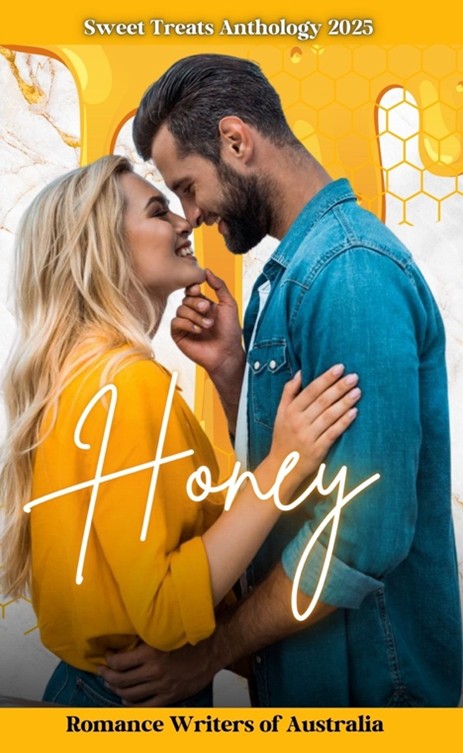
I’m pleased to announce that my story “Ant Honey Magic” has been short-listed in the Romance Writers of Australia Sweet TreatsAnthology for 2025.
The theme this year was Honey and required a sweet romance story of up to three thousand words. Romance Writers of Australia run a competition every year. The stories are judged and given scores and the top sixteen are selected for inclusion in the anthology.
I’m very pleased and proud to be included this year. The competition provides participants with excellent feedback and gives us a chance to get our work published along with some wonderful authors.
This is my second short story to be included in a Sweet Treats anthology. I also had a short story, “The Houdini Lollipop”, published in 2023.
Honey will be available on Amazon from mid-August 2025.
Here’s a post from the past on feedback, or more accurately, “On-line Reviews”; a vital part of refining our work and making our stories the best they can be.
Those On-Line Reviews
I like to celebrate. As a child, when I received full-marks for a spelling test, Dad rewarded me with a Kitchener Bun from the Fish ‘n Chip shop/Bakery which in the good ol’ days of my childhood was situated opposite Glenelg Primary School. A few years ago, now, when I used to drive my son his course in Magill, my mum and I treated ourselves to lunch at the local hotel.
Every so often, I check my Amazon account. I wipe off the virtual cobwebs of neglect, and dig deep in the files of my mind, retrieving the password to enter. I expect nothing much to have changed.
I’ve been busy with my blog and the rewards, small, though they are, compared to the rest of blogging world, but the steady trickle of views, likes and comments, satisfies me. Over the years, the number of followers has steadily grown.
Once long ago, now, I made a daring move, and posted my short story, Boris’ Choice—not for the faint-hearted or while one eats breakfast…After the post, I checked for results on Amazon with my War Against Boris Series books.
And…there were. Yes!
Then, I checked the reviews. Now, I don’t know how other writers have fared with reviews, but for many months since my books were published, I had received no reviews. Yes, I asked my readers to do the deed and tick the star-boxes and comment, with no results. Yes, they’d say, and the weeks went by and nothing. Were they just being polite? I have no illusions, and the reality is that art and literature are subjective—what one person likes another won’t.
Anyway, back to checking the reviews…I looked again at one of the countries one of my books sold. The page appeared different. A yellow bar, and a comment. Genuine feedback. Not a great appraisal, but an appraisal all the same. I knew the person responsible for this first-ever comment for my book but was not surprised at their response. I did wonder at the time how my novella would work for them—not well—just as I imagined when they informed me, they’d bought the book on Kindle. As I said before, Boris and his antics are well…not for everyone.
That being said, and for fear my works may be misunderstood, the over-riding theme of my stories are the classic fight of good against evil. How evil, like Boris, can creep into our lives. And when for whatever reason, usually when we maintain and enhance our self, and to avoid discomfort, we allow evil to stay. This evil, however subtle, will drive us to isolated places in our lives, much like Boris does in The Hitch-hiker; places we never wanted to go. I want young adults and people young at heart, to make choices and use their energy for goodness and to fight evil, so they can live a full life and also be an agent for good in their community and the world.
The track was steep and bumpy. It shook his bike, made braking hard on the sharp corners. His eyes watered, his heart thundered. He felt like laughing but had to focus. He’s hadn’t felt this scared since he fell off his first two-wheeler.
Teeth clenched, bones shaken as the bike bucked and slid over rocks. It was impossible to brake, too fast, too hard. The ground tore past, blurred by speed. Cold wind whipped tears into his eyes. Hands curled around the handlebars as if they could be a lifeline. Focus, focus, focus. Blood thundered in ears, sweat sprang and got whipped away. Laughter bubbled and was swallowed. Fear evoked the four-year-old’s memory. Falling, pain, blood and Dad saying. “Get back on. You can do this.”
Above are two attempts at describing the same event. In the first I’ve used pronouns, he, his, he felt. This is me as the writer intruding, describing the action. I’ve also said he felt scared, telling not showing the fear. This is third person subjective.
In the second I’ve got rid of the pronouns, added more sensory information to illustrate fear, added internal dialogue and provided a detailed memory. It required more words but gives a deeper experience for the reader. This is third person subjective deep point of view. (Also known as 3rd person limited or 3rd person close)
Using Deep Point of View (Deep PoV) is a writing style that has become increasingly popular in the past two to three decades. It is tricky to understand, and I’ve found requires a lot of study and practice. The idea is that you tell your story from the perspective of the character, that the story emerges through their experience which includes what they see, hear, feel, taste and smell. Add some thoughts, opinions and memories and then remove the narrator’s voice, (he felt, he thought, she wondered, she saw.)
Changing your natural writing style is challenging work but I think adopting deep PoV can make the writing zing and allows the reader to engage more closely with the characters. But do I need to use deep PoV all the time and for all my characters?
I write Historical novels set in the Regency era. The writing style of authors such as Jane Austin, Charlotte Bronte and Charles Dickens use third person, but the narrator is always popping in with observations and opinions. I want my own novels to reflect the writing style of the era in which they are set but I also like to adopt the modern deeper point of view. It’s a challenge.
Having done some reading into this complex topic I have come to a set of rules that work for me as a writer. It’s a work in progress; I am learning new things all the time and making adjustments, but I thought it might help people if I share my guidelines.
Use deep PoV for major characters. Minor characters don’t need deep PoV, but it could be fun to give the baddie a deep PoV.
Deep PoV can be exhausting. Use it sparingly for pivotal moments in your plot.
Start each scene with deep PoV.
Use deep PoV mostly in the first third of your book. Less is required as the pacing/suspense increases and the readers are hooked into the characters.
Don’t head hop between characters. One deep PoV per chapter or scene.
Use the character’s thoughts, actions, memories, opinions in both internal and spoken dialogue. Emotions are better conveyed by actions and dialogue than described. (show don’t tell)
Use the five senses to give readers a clear picture of the scene from the characters perspective.
Use vivid language (find more interesting words in your thesaurus) and active voice. (I use a soft-ware editing program to highlight passive voice for removal)
These are my recommendations. They will not suit everyone, and they are a work in progress. My idea is that I write the first draft of my novel/short story and select the character who will be the PoV character for the scene/chapter but not focus on creating the deep PoV until I’ve done a structural edit. I will then do an editing sweep looking at strengthening the sensory input, opinions, thoughts, memories and actions in strategic scenes in the book.
Points of view is a complex topic. I found the following articles and books helpful.
I also used Richard Bradburn’s book Self-Editing for Self-Publishers, Reen Publishing 2020
I’m still finding my way with PoV. I don’t head hop as much, but I can’t say that I am deeply conscious of using deep PoV as I write my first draft, but it’s an effective and powerful tool for introducing new characters. For me it works for one or two characters in a novel and is valuable to use in highly emotive, pivotal scenes. I do enjoy giving my character’s opinions and internal dialogue as it brings the reader closer to the character.
In 1986, all pumped up from a successful finish to my university degree, I began writing my “Great Australian Science Fiction” novel. I chose Science Fiction because I thought it would be easy to write.
Hah!
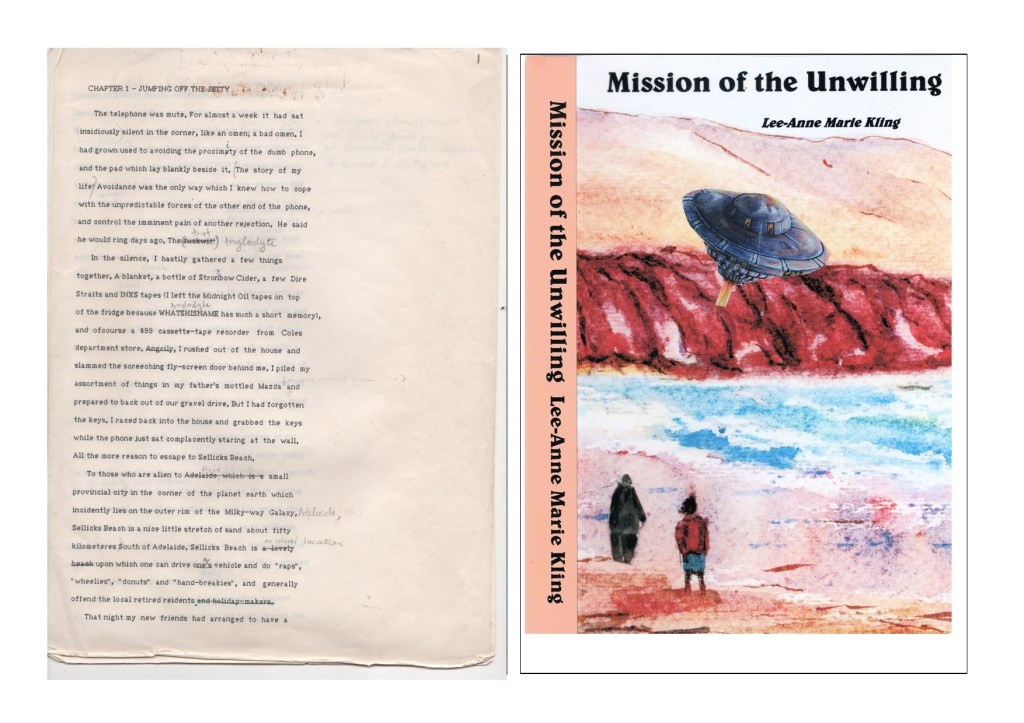
At every opportunity, I inflicted the latest chapter of this rough and raw work on my friends. Below are the first few paragraphs of the very first draft of “Mary’s Story”, which 30 years later would be Mission of the Unwilling, written in 1986. The reason the title changed? Well, frankly, my writing mentor at the time thought the title, “Mary’s Story” was a bit lame. So, the book title had to change to something that would grab the reader. As a result, the main character had a name change.
Here I am inflicting this piece that needs a great deal of TLC to polish it into shape, so you can see that I was just like any other hopeful author, making all the mistakes common to novice writers. Have a look and see what you would’ve changed to improve this piece.
Twenty years passed. The manuscript languished in the cupboard. Unfinished. I had progressed halfway through. Lost my way. Lost in space and time, you could say.
Then a spark, and an idea. The story changed and continued to its end. As technology had progressed from Commodore and floppy disks to Windows PC and CDs, I had to rewrite the whole novel. Not a bad move, actually.
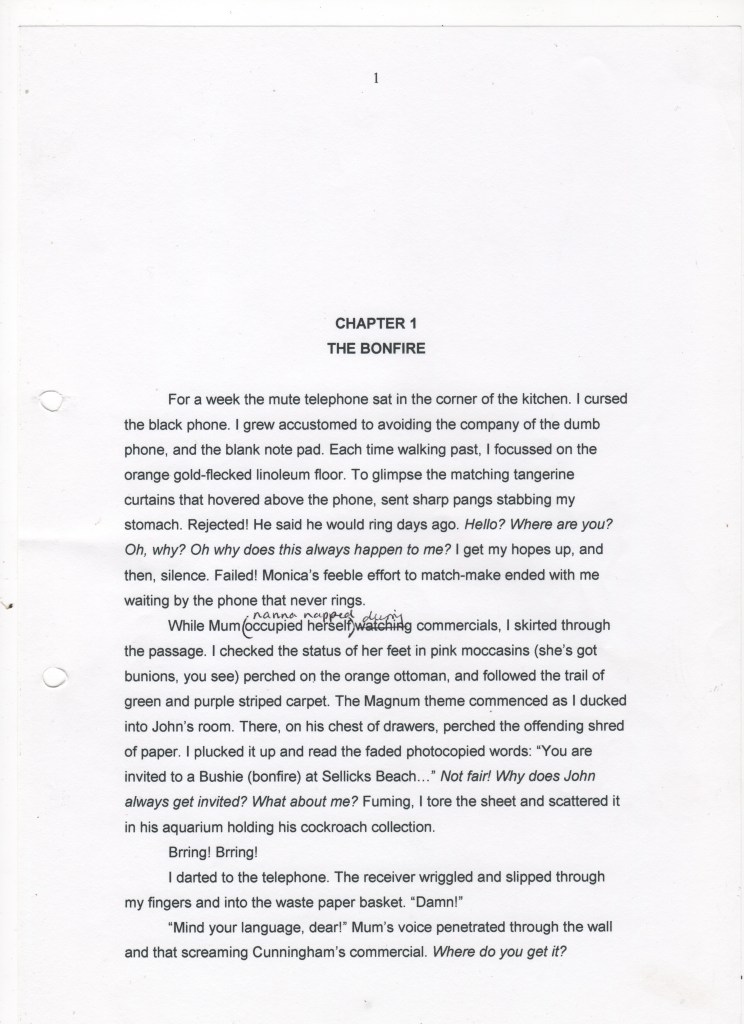
After printing off the reams of paper that made up the book, I took it to my uncle who was in the writerly business.
[2. Sample of MOU from 2008]
Suffice to say, he was not amused and gave feedback: Basic errors like no page numbers and glaring grammatical mistakes to using a ridiculous amount of speech attributions. It would seem that my years of motherhood had been detrimental to my writing craft. Bad habits in my writing had developed. He recommended joining a writers’ group.
Writing is a craft that requires honing skills and words to impact the reader in a positive way. Test readers, editors, fellow writers are essential to a manuscript developing from a rough draft to a polished piece ready for publishing. There is no shame in reworking or rewriting a story.
[3. Sample of MOU after reworking from writers’ group feedback, before my mentor gave her feedback]
I recall my writers’ group mentor saying that with feedback: listen to it, consider it and if it works for you, implement it. If not, put the suggestion aside. It’s your writing, it’s your voice.
You may see in the sample 4 and 5, that I took most of what my writing mentor advised. There were suggestions further on in their manuscript appraisal, that I didn’t agree with. One was the use of the expression “Man!” which they said wasn’t used in the 1980’s that it was only an expression that turned up in the 1990’s. I begged to differ, as I lived through the 1970’s and 1980’s as a teenager/young adult and behold, I remember the expression “Man!” being used; not just locally in Adelaide youth circles, but also on the television.
[4. Sample of mentor’s feedback]
My mentor stressed that we need to consider our readers. Who is our audience? What do you want your story to say to them? Is the story for entertainment? Or do you have a point to make? In the end, you won’t be sitting alongside them and being able to point to a word and say, “Sorry, I didn’t mean that—this is what I did mean.”
Our written work needs to stand on its own literal two feet and make sense to the reader without the author having to be the virtual translator, and thus committing the mortal writing “sin” of “author intrusion”. Author intrusion is when the author tells the reader how they should see, think and understand the narrative. For example, think of “author intrusion” like explaining the punchline of a joke.
[5. After many more drafts, and 30-years later—Mission of the Unwilling, those paragraphs as they were, published in 2015.]
The editing process never ends. More changes in 2022: A cover aligning with the War Against Boris Series, a new “preamble” chapter, more proof corrections and formatting done to make a second edition. check out Mission of the Unwilling as it looks now.
The final result is about refinement of the work: sentence tightening, word tweaking, word cutting and polishing the prose. All through revising and proof-reading.
Now I know you’re all hanging out for the nitty-gritty; the how do I make my writing good? Make it shine? How do I make my story clear and interesting for my readers?
For a start, invest in a good “How to Write” or “Grammar and Spelling” book. The reason we have and learn this language tool of grammar is to keep us all speaking and writing our particular language on the same page. It’s like a cake recipe. Follow the recipe, the cake bake is a success. It’s so that we understand each other. Adhering to the grammar and spelling rules helps readers understand what you have written. Not misunderstand. Of course, rules can be broken for effect, but you need to know the rules of your writing craft well to have the skill to know how to bend (or even break!!) them.
As I have mentioned in previous blogs, the World Wide Web is full of resources for writers. So, no need to “reinvent the wheel”. I have mentioned Microsoft Word Editor and Grammarly but there are other websites out there you can search for and find.
Our own Indie Scriptorium’s Mary McDee has some good grammar tips which you can look at. Click on the link here on her post on the Little But Important Words as an example.
I come back to the lesson I learnt from my dad: Keep It Simple.
Use basic sentences. Avoid purple prose. Use strong verbs and choose words that are understood by most readers. Be consistent.
After all, the aim of reading is for the reader to have an experience they find enjoyable and worth their time.








 Indie Scriptorium -- Self Publishing Collective