The new year is traditionally a time to try something different, change old habits or get organised. So many times, I’ve made resolutions on New Year’s Eve and forgotten them a week later.
Age is a wise teacher. This year I will make one sound resolution. I will meticulously assess the challenge envisaged having learned to be circumspect, prudent and wary of unguarded and reckless promises.
I will become a wordsmith.
Changes to my writing must not be as fleeting as a summer day but soar like mountains; my tenacity only worn away by seasons of foul weather. (Well, maybe the odd earthquake too.)
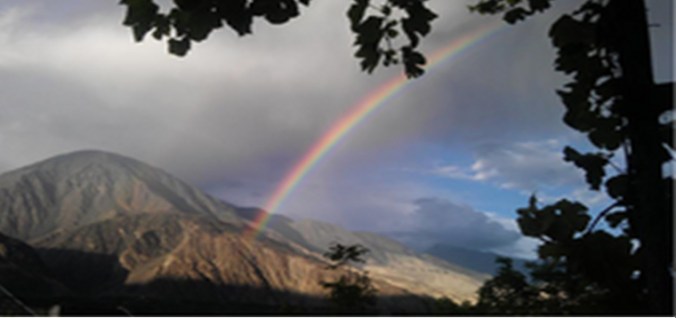
Words are like rainbows; they need to contain pure colours and fascinating hues as the colours blend at the edges. Like rainbows they must conform to a set of rules in terms of the colour spectrum, but they can soar, be broken and finish or start in peculiar places. Words, like rainbows can be fleeting, lovely to behold but quickly forgotten as clouds cover the sun. But then some words achieve immortality and stand up to centuries of use and misuse.
“To be or not to be, that is the question.” ~ William Shakespeare, Hamlet, 1601.
What words will you craft in 2026?
I hope you find your own challenge for the forthcoming year. Enjoy writing, whatever it may be. Enjoy reading and have fun.
Well, I’ve got to the end of re-writing and structurally editing my third novel The Jamaican Heiress. It required two complete rewrites and a substantial structural edit which took me about eighteen months. It’s now a good story with a logical plot propelling stronger characters through a series of crises and culminates in a satisfying ending. I’m happy with the flow, time line, changing points of view and how it all hangs together. I’ve had feedback from two respected writing friends and made much needed changes to time lines, character arcs and motivations. Alpha readers are gold. Yay.
Big sigh. I’m feeling happy. But now it’s time to do the line/copy edits.
Should be a breeze. HA!
For my previous novels I used Pro Writing Aid to pick up overused words and phrases, (names and blushing references) repetitions, passive voice and my tendency to start every paragraph the same way. I then used a wonderful professional editor who tirelessly tidied up my prose and produced two readable books.
But having it done for you doesn’t help you to learn about the problems you have when you write. This novel I’ve decided to do the line/copy editing myself, as an exercise in strengthening my writing. This blog is about my process.
First step: Google search: What is the difference between line and copy editing?
There is heaps of information on Google and many useful videos on YouTube to check out. For a very quick rundown have a look at Alex Cattoni’s video “Copy Writing Tips: What’s the difference between Line and Copy Editing”. In short, she says: “Line editing crafts the story, Copy editing catches the errors.”
Second step: How many sweeps of the novel will I need to do and what do I look for in each sweep?
Again, I googled line editing and read several blogs and watched a few videos. I suggest spending a few hours combing through the plethora of information available and then come up with your own plan. I’m going for two, or possibly three sweeps (see step five)and then use Pro-writing Aid to pick up my remaining bad habits, then read it out aloud (or use the audio program on your computer) I will then re-read the entire manuscript and pass it on to my beta readers with trembling hands.
Step three: How do I do the line/copy edit?
The general consensus is to line edit a small piece of writing at a time. Could be a paragraph, a page or a scene but then go through your work looking for things like flow, word usage, passive voice, repetition, continuity, dialogue consistent to each character, adding/deleting description, telling and showing balance and point of view problems. The idea is to make every sentence clear to read, strong and efficient at conveying what you want to tell the readers without browbeating them.
Step four: Next sort out your process.
If you want to line edit on the computer, make sure you keep a copy of the first draft and line edit the new copy. I suggest you don’t name the copy the same as the original. I’ve got myself tied up in knots trying to find documents with similar sounding names, so put a date on your new file. You might want to try a program like Scrivener which helps sort multiple copies of a manuscript and allows colour coding too.
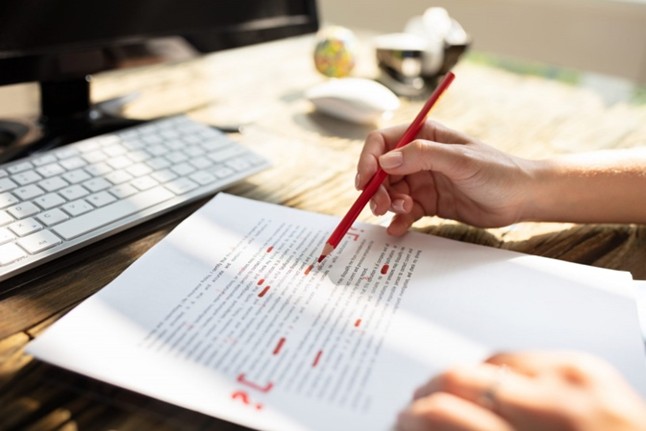
Other people like to print out the manuscript and edit on the printed page. Using different highlighters for different problems is something I’m going to give a try. So, red for errors, blue for word usage, pink for POV, purple for purple prose, green for continuity and yellow for “it’s just wrong”.
Step five: It makes sense that your first sweep looks at paragraphs and scenes and information to be added, deleted or changed completely. My first sweep will concentrate on:
Do I need to add/delete descriptions?
Have I used the senses?
Is the balance of show/tell good for pacing.
Continuity. Robert has blue eyes not brown!
Remove repetitions.
Is dialogue unique for each character? Think about tone as well as commonly used words or phrases.
Is each sentence clear and easy to read.
Is there any head hopping going on?
The second sweep will focus more on sentences and words and includes:
Over used words, descriptions or phrases.
Reduce filter words: she thought, he realized…
Change weak words to stronger words, he walked, to he paced/strode/shambled/limped.
Address passive voice in sentences.
Reduce adverbs.
Look at consistency of tense.
I’m new to this so I’m not sure this process will work. I will try it out for a few weeks, tweak it and experiment, then report back.
I have published two previous novels and have also had three short stories published. The feedback I’ve had from readers and editors has been positive so I will approach line/copy editing with some confidence. I do have faith that I can catch a lot of clangers, but I think it’s essential to have an editor or well-informed writing friend to catch what I miss. There are lots of problems that you as the writer don’t see.
I found the following articles helpful but there are many more on-line.
Our bushwalk included some city-slicker newchums. Crossing a wide plain between mountains, we noticed cows in the distance. They began wandering across to check us out. Newchums, trailing behind with heads down, slogging it out, were only half way across when we reached the fence.
Suddenly the newchums became aware of large creatures approaching. They walked faster; the cows came closer. Newchums trotted. So did the cows. Newchums ran. The cows, udders swinging, galloped alongside. We doubled up laughing.
Newchums, white faced and panicked, arrived safely, totally oblivious that your average dairy cows are peaceable animals. But curious as cats.
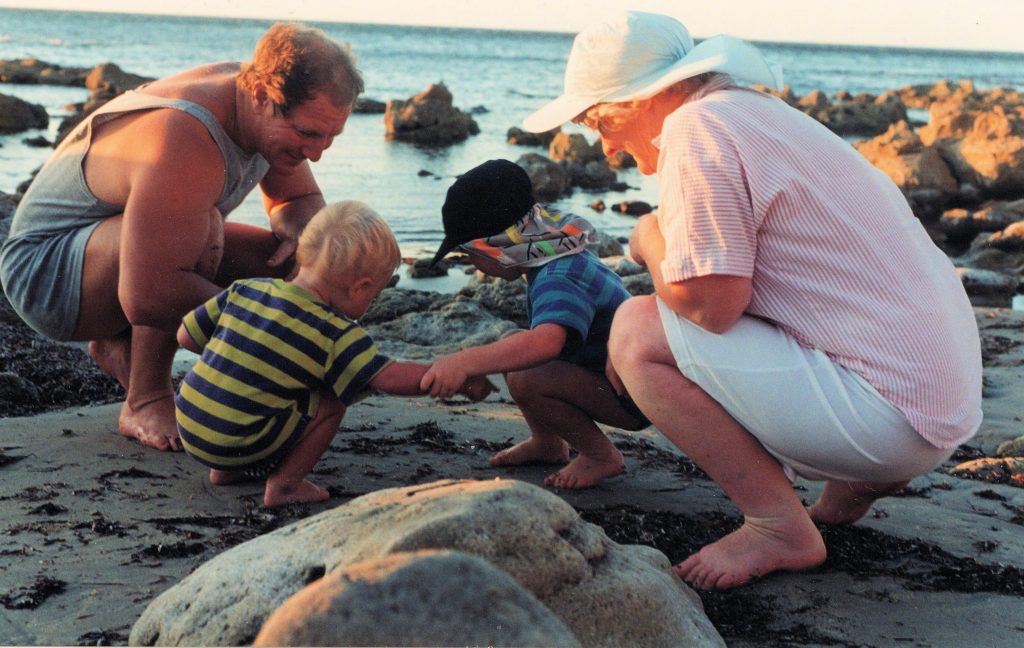
George had never been on a holiday in his life. Yet, here he was on a school camp, water swirling around his ankles as he stared at the wide expanse of ocean. Exploring some rocks, he peered into a rockpool, and saw something shimmering under wavy seaweed tendrils. He pulled it out, scattering some little crabs. Peeling the fronds off the thingamajig he saw that it was a disc with squiggles instead of words and a hole in the middle. ‘How strange,’ he thought, ‘what is it? Definitely not Australian.’ He was keen to know if he’d found a treasure.
For many of us, the word “swamp” doesn’t have much in the way of appealing connotations with its implications of boggy, muddy, and probably smelly too. Many a frustrated mother has applied the word to a child’s bedroom along with orders, “Clean it up! Or at least keep the door shut! Please!”
The Macquarie Dictionary tells us that a swamp is: “a piece or tract of wet spongy land; marshy ground; an area of still, often stagnant water, infit for cultivation”.
Nothing appealing there, is there?
Words are powerful. How we use them; the pictures we get in our head when hearing them are often beyond our conscious control—we hear, we respond (and at times react. Sometimes in quite unexpected ways!)
In the far South East of our state of South Australia, “swamp” has a vastly different meaning. Here the land is flat, seemingly as level as a tabletop. Apart from the many acreages that were cleared and planted with pines, the country is studded with magnificent, giant red gums: Eucalyptus Camaldulensis.
You could see this part of the world as upside down; a reverse of “normal” where usually so-called “flat land” is actually a series of low, rolling hills and shallow valleys. Here, mile after mile of the South East however, there is not a hill to be seen, not even a gentle rise. Instead of the “gentle rises” there are dips: downs rather than ups, huge shallow bowls in the land surface. As it is so flat there are no rivers of streams but in winter all those lower parts can function as drainage sumps. Again, due entirely to that word “sump”, a less that appealing picture.
The very earliest settlers must’ve found these vast stretches of winter water an impediment, their animals could well have trampled round and in and through creating bog holes while areas for cultivation and cropping were dictated by the sheets of water impeding their workaday world. To those folk, “swamp” would surely have been seen as appropriate.
Late settlers, however, learned to work around all the water. They learned to appreciate the myriad of water birds that flocked to their swamps. They saw beauty in all those clear, still sheets reflecting the giant gums so often standing alongside.
The children of these settlers had a magical childhood where they could catch tadpoles and tortoises; paddle around in homemade rafts; climb the nearby trees; construct cubbies; build boats; and, on a convenient bank, dig out dockyards for those boats.
This was also my childhood too and it was truly magical. Along with that magical childhood, I also learned how words can be used in a way that varies their meaning—there is much more to them than mere definitions in a dictionary.
“Lake” would be far more appropriate word for the magnificent sheets of water teeming with life that were an integral part of my younger years. But “swamp”, for South Easterners like us stuck.
Such is life!
Those of us who write, however, must always be careful with our words. We cannot assume our reader will interpret what we have written in the same way that we intend. And yet we mustn’t go into long, convoluted explanations—a sure and certain way to ensure we’ll have not readers! It is truly a balancing act demanding skill, awareness, and sensitivity.
Nobody has ever said that skillful writing, effective writing is, to put it colloquially, a walk in the park. It takes time, care. And consideration—lots of that! The rewards: the satisfaction; the sense of achievement outweigh the pain and frustration many times over though, don’t they?
Many, many years ago I read something that, as a writer, has haunted me ever since.
Those words painted a picture that stayed in my mind – it is only a simple picture but vivid and emotive; a picture I wish I had the skill to record with repaint.
The sun is low in the sky – morning or evening it matters not. I’m sitting by a lake surrounded by trees but nestled in a mountainous land. Far away, at the other end the mountains soar up in cliffs that come right to the edge of the lake. At one point a waterfall cascades in a maelstrom of spray.
However, in front of me, things are more peaceful. As the sun to my left is so low in the sky the trees are casting long shadows across the lake. A gentle breeze is disturbing the leaves causing those shadows to move while at the same time rippling the surface of the water so the shadows break up and re-form.
As I said, a simple picture: two short paragraphs; one hundred and nineteen words in all. I hope, with my word picture, I’ve been able to get you to see what I can see, feel a little of what I feel whenever I bring this to mind.
“So, what!!” I can hear you muttering. “Where are you going with all this waffle? What’s the point? And that title makes no sense at all!”
If I were you, I’d agree entirely. So let me explain. It was a mere seven words from a poem written about two hundred years ago by Alfred, Lord Tennyson; Englishman whose life spanned the eighteen hundreds (1809 – 1892). Those seven words? –
“The long light shakes across the lake.”
To be able to produce seven simple little words, all but one a single syllable and arrange them in such a way that they gave me a vivid picture was thrilling. I was awe struck. And humbled. This was what writing was all about! Would; could, I ever be able to attain a level of skill to match this??
The next line; (another seven words!) “And the wild cataract leaps in glory” fleshed things out; completed the picture. Wow!!
It’s my opinion a good opening line isn’t essential for your story or novel, but it won’t do it any harm.
My critique group decided to revisit the essentials of writing as a way of everyone learning from the same page and improving our collective efforts at finding the right words for our various projects.
First topic – opening lines.
I realised that when I read a novel I don’t get put off by the opening line hence my opinion that a good opening line is not essential is from my personal experience. However, I love books written in third person in past tense so if the first line has an omniscient POV and is written in the present tense I tend to put it back on the library shelf.
So, what makes a good opening line?
I googled the above question and found some great information.
The Literary Hub presented an article by Allegra Hyde.
A good opening line “should capture your characters voice, it should carry your style, and it should be relevant and meaningful enough to engage your readers and entice them to read onto the next line.” An, “elegantly balanced dose of clarity and curiosity.”
However, it should not be “so heavy that it weighs on you or so literary that it chases away or confuses the reader.”
Allegra also suggests that the opening lines clarity should provide a sense of time, place, character and plot. The curiosity can involve the element of tragedy, conflict, mystery that fuels your story.
Suggest a short clear sentence that grabs the readers attention.
Use verbs correctly and adjectives sparingly.
Use words that add weight.
It doesn’t have to be loud; subtlety can be effective.
After doing this research I decided that for me a good opening line:
Is a short sentence where every word has weight and substance.
Intrigues the reader
Clarifies if the novel is written in first person, third person or omniscient.
Provides the tone of the book
Pulls the reader into the situation
Infuses them with curiosity about what comes next.
I then found some examples of opening lines I loved:(you can’t beat the classics)
Albert Camus – “Mother died today.”
Jane Austen – “It is a truth universally acknowledged, that a single man in possession of a good fortune, must be in want of a wife.” (apparently the most famous opening line ever)
Charles Dickens – “Marley was dead: to begin with.” (love this one)
So, putting the new knowledge into our own writing I have selected to test out some ideas for my new romantic short story Honeygate.
He stood at the back of the hall his face shrouded by a deep hoodie. (Does capture the tone of the story but too descriptive with no hook)
Magical, menacing mesmerising. (Fuels the curiosity but doesn’t provide any clarity about who’s talking or the situation)
I couldn’t see his face but his gaze stole my well-rehearsed words and left me floundering. (clearly defines the characters point of view, raises curiosity, puts it into a context and suggests the potential conflict between the protagonists)
Just doing this exercise has raised my awareness of the importance of an opening line and given me some directions so I can play around with various types of lines and find the best one.
What I found particularly helpful is that using a first-person POV would work well for this story. My heroine has felt the impact of the hero’s gaze and is discombobulated enough to forget her speech she can have the stage from here on and tell us her story from her perspective.
“Don’t tell me the moon is shining. Show me the glint of light on broken glass.”
–Anton Chekhov
The pictures in an exhibition do not come with a detailed written description. You don’t get paragraphs telling the viewer what the subject matter is, what colours are used and why, what time of day the painting depicts the theme, composition or the medium used. The pictures show all that information. The little accompanying tag tells you the essentials—title, medium, artist name and price. That’s all you need.
In creative writing we use both showing and telling. But what does showing mean? What is telling? How do you differentiate when to show and when to tell? It can be tricky to sort it out, but these are my ideas.
Telling enables the author to provide quick, factual information. It may be important, but you don’t need to go into the information in any depth. It can move a story along efficiently. It’s like the painting tag, brief, factual but essential information. Telling may move the reader to another time, another place, mention the weather, comment on a relationship but it is briefly mentioned. Nothing is happening in the time or place that requires delving into the character or the story.
Telling examples: Twenty years later she found herself back in Rome.
It was a hot night.
He got married twice before he met the love of his life.
Showing is like painting a picture. It gets the reader to look deeply at a scene, often through the characters perspective, thoughts and dialogue. It delves into the character and situation and stirs the heart. It is slower and richer. Showing is the writer’s device to enter into the character, to use their senses, thoughts and emotions. It creates drama and provokes emotions and wonder in the reader.
Some examples:
Rome, the heat was cruel, the smell of dust and onions spiced the air. Nothing had changed in twenty years except there were more people on the streets and the noise of traffic roared in the background. Brenda sniffed, felt the baking, rough stone beneath her fingers. “Hello Rome, I’m back.” She laughed and remembered. I wonder if he’s still alive.
Heat wept from the night sky.
Robert’s heart actually pounded. He was too old for this. She looked like an angel her white hair long, lush and thick, her eyes deep pools of love. Her body strained towards him. I don’t deserve her. He turned to his son with a grin. “I should have bought a dog thirty years ago. Loyal, loving and much cheaper than two wives.”
The balance of showing and telling is something that I hadn’t considered prior to this blog. When you think of it, it should be easy. You show when you write an important dramatic scene but tell when you want to move your story to the next dramatic scene. But too much drama can be overwhelming while too much telling slows the story down and distances the reader.
You also must think about if you want the reader to be moved by what you are writing. Some subject matter is so dramatic it’s better to distance the reader by just telling events.
I’m currently working on a story which is about the very emotive subject of abortion. I’ve written it using more telling than showing and I think this works as it steps the reader back from what may cause distress or anger. The following paragraphs I hope illustrate my technique. The telling is in bold script.
Mavis finished feeding the baby, changed his wet nappy and swaddled him in his blanket. He looked at her with trusting dark blue eyes, his skin a golden colour his little fists fighting to get free of the blanket. But milk, comfort and gentle rocking made wakefulness futile. Mavis tucked him back into the cardboard box and pondered who to contact first.
Abandonment became a movement. The papers took sides. The right-wing journalists condemned the mothers of the children. The left -wing journalists blamed the right for life movement and evangelical churches. The airways rang with strident arguments and the police and social services complained of a lack of resources and put out regular appeals for more funding and foster carers.
“What’s happening to the babies, Caroline?” Mavis asked as she handed over another child from the front porch of an old Congregational Church. She now knew the names of many of the police officers, paramedics, nurses and social workers.
“Oh, Mavis” the woman’s eyes welled with tears. “We can’t get any more foster carers and the adoption process is, well it’s slow because they have to check everything before they can do a legal adoption. It’s a mess, and the entire system is overwhelmed. Lots of these babies have special needs and we can’t get them in with foster parents anyway. They couldn’t cope. We’ve had to open up orphanages and even that isn’t working. These babies need a mom and dad. They don’t do well if they don’t have cuddles and attention. It’s so sad.”
Mavis remembered seeing pictures of abandoned orphans in Russia or was it Romania? Remembered sunken sad eyes, skeletal bodies covered in sores. She felt her heart pound and her stomach clench. Her doctor said it was anxiety, but Mavis knew it for what it was, guilt. They had demanded the abolition of abortion and that was causing this horrible dilemma. They had saved the unborn, but the living children were suffering.
I hope this give other writers some ideas about showing and telling. I am considering doing the above exercise on my writing as another editing technique. It certainly makes you aware of when you are showing and when you are telling and what balance is required for the piece of writing.
Hope you get something out of this too.
The following references were used for this blog. They go into this topic in detail and provide fitting examples and explanations.
Jericho Writers – Show don’t Tell: What it means and why it matters – Henry Bingham (no date provided)
Writers write – How to master “Show don’t Tell” – Kyle A. Massa 2023
Pro-writing aid – “Show don’t tell” in Creative Writing – Sean Glatch 2022
A huge apology for being a day late posting this week’s blog. As Mary McDee says (often), “Technology, you can’t trust it.” She says this while spending the week chasing Dorper sheep (Goat-Sheep Cross), from the neighbour’s yard back into her own. They are more stupid than actual sheep, much like she thinks computers are.
Anyway, ‘twas a computer crisis at Mrs. T’s (my mum), that sent the weekend into wobble-world. That with the default of chasing ancestors down familial rabbit holes, I have done little in the way of preparing an article to post, let alone any idea what to post on the chosen topic, World Building.
Then inspiration struck. At the proverbial last-minute. Why not do a spot of World Building from one of my developing novels? Why not, indeed!
I searched around for a worthy template—one that was interesting, not too many questions (just enough for the exercise) and one that was memorable. I didn’t have to look far on the World Wide Web, to find this little beauty: GRAPES.
“G” for Geography
“R” for Religion
“A” for Achievements
“P” for Politics
“E” for Economics
“S” for social Structure
There’s even a colourful chart with two or three questions under each heading to help with the process, courtesy of Amanda Schlindwein. Thank you, Amanda, for posting this helpful model which you can see if you click on the link to her website.
So, here goes. I will use the book that I have been posting serially on Wattpad, Diamonds in the Caveas my world building muse. (I won’t be addressing every question in the GRAPE help. The post would end up being too long, otherwise.)
Geography
How does the region’s climate and placement affect the characters in your story? The village of Luthertal on Pilgrim Planet (approximately 20 light years from earth) suffers extremes of temperature and weather conditions because of orbiting two suns. After emigrating from Eastern Europe from the 19th century, where climate was more stable, they find the change confronting, confusing, hard on their stamina and they become angry. They need to vent their anger and frustration. As a primarily farming community, the droughts, fires and floods that fail their crops, and kill their livestock, cause them to seek someone to blame. Hence a perfect storm for parties of evil intent to stir up the idea of witch hunts.
Religion
What do your characters believe in?
One God and the founder of European Protestantism, Martin Luther. But they, being Wends, are synchronistic, never having relinquished the superstitions, magic and healing practices from their “heathen” ancestors. So, there’s this conundrum; a person who fails to attend church each Sunday is called a “heathen”, but it’s okay to believe that breaking a wishbone of cooked chicken and the person getting the larger portion can make a wish. Or a character must trust in God to heal them, and the church prays for them, but it’s acceptable to treat the sick with herbal remedies as according to the long tradition of apothecary. I might digress here that my two-times great grandfather came from the region of Lusatia (which is where the Wends come from). Before he became a doctor he studied, at Herrnhut, the base of the Moravian Brethren, (so we’re talking seriously Christian here), the medicinal art of apothecary. Maybe some Lutherans would’ve had a problem with that, but we’re talking about a particular community, the Wends or Sorbs. So, writing from my own family history experience, which is partially Wend, I can see this community of Luthertal being more open to magic and the supernatural. One day I might write on these supernatural experiences that my family and relatives have experienced.
Achievements
What has this civilisation created that has withstood the test of time?
As mentioned above, being an agricultural community, the Wends are robust and healthy. They have their Wendish culture of dress and traditions. They are remembered as an industrious people, but also as a deeply religious God-fearing people. In fact, they feared God so much they escaped the persecution and oppressive norms put upon their religious practices that they planned to emigrate to South Australia. Unfortunately, an evil alien called, Boris who pretended to be God’s ambassador, led them astray and transported them to the Pilgrim Planet with plans to enslave them and breed an army from them.
Politics
Who controls the society and how do they control it?
Although in Diamonds in the Cave the Wendish community are emerging from the ruthless fascist control of Boris, having been saved from his clutches by the good guys Intergalactic Space Force (IGSF), in my previous book, The Lost World of the Wends, they are still politically and structurally fragile and finding their way. They have reverted to the ways of old where the Burgermeister runs the village and decisions are made by all villagers gathering in the church. The Wend community is by this time a theocracy. However, Boris still has his influence with a couple of his agents hiding in plain sight in the village. These agents are stirring up the Wend community to seek out witches and burn them.
Economics
What is considered valuable? And how are products bought and sold?
Apart from food and the products from farming used to be self-sustaining, as was the custom back in Eastern Europe in the mid-nineteenth century, mining minerals and ore for power and energy for space travel is taking off. Mutants who have been freed from slavery under Boris have been brought in to help develop the village building houses and mining in the local mountain range of Mount Martin. The Wend villagers begin to regard the mutants with suspicion and they become targets for witch-burnings.
The currency that the Wend community use are “pfennig” (pennies) and thalers, like what they used in Saxony in the mid-nineteenth century. Products are bought and sold at market which is open every day except Sunday. Sunday is the Lord’s day, a day of rest.
Social Structure
Who are the most important people?
The Burgermeister (Herr Biar), the pastor and the doctor (Dr. Zwar), who in Diamonds in the Cave is the pastor. Prestige is shown by the assets the high-status ones have. The doctor owns a Mercedes. Herr Biar has a beautiful, large brick house and large farm.
Least important people?
The mutants, old single women (Gertrude) and women who don’t fit in the community (the female heroine, Minna). They are the prime targets for witch-burnings.
***
That’s all for my little exercise for starters. I found it helpful to clarify my ideas for the world in which my characters live in Diamonds in the Cave.
Have a go yourself using the GRAPE template or click on the links below to try one of the other templates that looked useful.
Let us know how you go? Or if you have found a template that works for you, send us a link.





 Indie Scriptorium -- Self Publishing Collective