Back in January I found out about an upcoming competition. With regular life in suspension and a bit of time on my hands I thought – “Give it a go. Why not? Nothing to lose.” One was required to write a memoir – couple of thousand words and a cash prize. Beyond the address for submission there were no more details.
But what exactly is a memoir? As a keen member of a local camera club, I’ve had photographs disqualified as “out of category” or “didn’t meet the brief”. I didn’t fancy putting time and effort into a couple of thousand words to have them peremptorily discarded in such a cavalier fashion. Obviously, memory is involved. Is it just autobiography or is there some twist I’m not aware of? Bit of research seemed to be in order.
The first dictionary I consulted (fairly simple; from my schooldays) told me it was “an autobiography; a reminder”. I had a sneaking feeling that for this writing competition there was a bit more to it than that. So, off to my great big two volume Shorter Oxford to discover that this word has been in use for centuries. Way back then, half a millennia ago, it simply meant “a note; a memorandum; a record – often an official one”.
A couple of hundred years later it had morphed into something much closer in meaning to our twenty first century perception – “a record of events or history from personal knowledge or from special sources of information”. All connected to memory and autobiography but with a bit of a twist as well in that interviewing then writing an account of someone else’s memories seemed to be in order too. Right then though I was more concerned with my own personal recollections of my own life.
My very earliest memory is of a big wooden table in the middle of a dim room. I was sitting in my highchair at one end of the table; to my left, a door standing ajar; a window next to it and beyond the verandah the gentle slope of a sunlit, golden hillside. I was aware of the rest of the house to my right, behind me and away across the table in the far wall, there was another window with, next to it, in the corner a wood stove, shrouded in shadow. However, my attention was caught by movement outside on the hillside. It was a rabbit or more probably a hare, lolloping across; stopping to nibble or look around before continuing its leisurely progress. The Easter Bunny! I was filled with immense excitement.
Now, so many, many decades later, I have no idea whether that was my own idea or whether my parents had suggested it. I was four months past my second birthday; the memory and the magic of it still clear and vivid.
My memories of a happy childhood are not at all a story continuing through the years but a series of pictures, many pictures randomly stamped on a blank canvas, like vignetted photos: crystal clear but with blurred edges. The competition? The time on my hands somehow evaporated. Life last January has also become a blur.
Have a Happy and Blessed Easter. As it is the Easter weekend and in keeping with our months of memoir, a story of my Easter break in 1986, camping in the Gammon Ranges with my father and future husband.
THE BIRTH OF “BUNYIP CHASM”—THE PAINTING
You need to loosen up with your painting,’ my art teacher said.
So, with a palette-knife, I did with my painting of Bunyip chasm.
Over the Easter break in 1986, Dad took my boyfriend (future husband) and me to the Gammon Ranges. Dad had gone there the previously with his photographer friend and he was keen to show us some of the scenic secrets these ranges held.
We bumped and rolled in Dad’s four-wheel drive Daihatsu down the track into the Gammon Ranges. We camped near Grindell’s Hut, backpackers’ accommodation. A murder-mystery from the early Twentieth Century involving the hut’s owner, spiced our discussion around the campfire that night. Then we set up a tent, for boyfriend, on the ground above the bank of the creek. I placed my bedding also above the creek under the stars. Dad opted for his “trillion-star” site underneath a river gum. No tent for him, either.
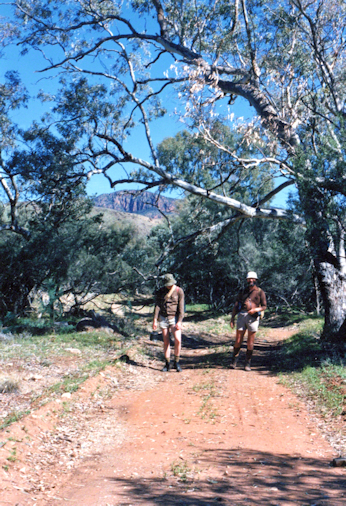
The next day Dad guided us along the Balcanoona creek bed shaded by native pines to Bunyip Chasm. After an hour or two of hobbling over rounded river stones, we arrived at a dead-end of high cliffs.
‘Come on, we better get back,’ Dad said and then started to hike back the way we came.
We trailed after Dad. Although native pine trees shaded our path, the hiking made me thirst for a waterhole in which to swim. I gazed up at the lacework of deep blue green against the sky and then, my boot caught on a rock. I stumbled. My ankle rolled and twisted.
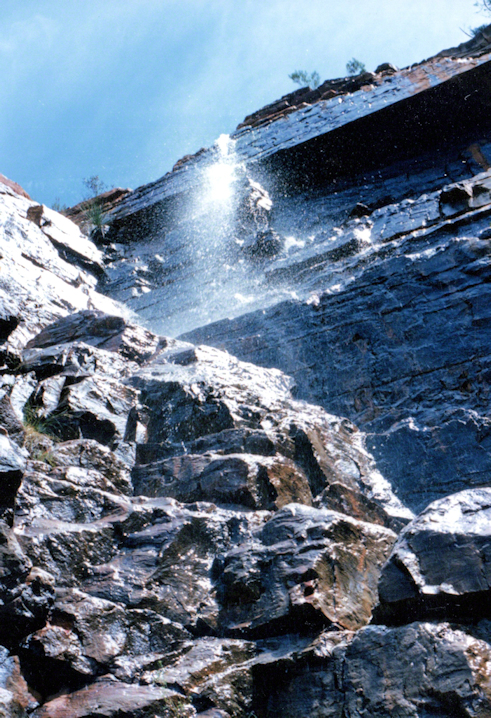
After about ten minutes, with my ankle still swollen and sore, I hobbled after the men. We climbed down a short waterfall and at the base, I looked back. The weathered trunk of an old gum tree leaned over the stream, three saplings basked in the late-afternoon sunlight against the sienna-coloured rocks, and clear water rushed and frothed over the cascading boulders and into pond mirroring the trees and rocks above.
‘Stop! Wait!’ I called to the men.
‘We have to keep on going,’ Dad said and disappeared into the distance.
Boyfriend waited while I aimed my camera at the perfect scene and snapped several shots.
Then holding hands, we hiked along the creek leading to our campsite and Dad.
‘I’m going to paint that little waterfall,’ I said.
We walked in silence, enjoying the scenery painted just for us—the waves of pale river stones, the dappled sunlight through the pines, and a soft breeze kissing our skin.
[In memory of my father Clement David Trudinger (13-1-1928—25-8-2012)]
Recently, my mother sent me an article about my paternal uncle. In it, he claimed to have ancestry extending back to Titus, a Greek convert to Christianity and the apostle Paul’s missionary companion. The author of the article took the claim with a grain of salt, saying, “Be that as it may …”
The article was written in the 1990s, way before we knew much about DNA. It was published when the internet was in its infancy and before research tools such as Wikipedia, and genealogical platforms such as Ancestry and My Heritage existed.
So, how did my uncle figure we were descendants of Titus?
Was it just a fanciful family history conclusion? Or did he have some access to secret information stored away in a library in Europe?
Many families have claims such as my uncle’s. It is what fuels family myths that are passed down from generation to generation, morphing and mutating from the original truth, much like Chinese whispers. So, here was the challenge. Did this claim have any truth?
Equipped with the knowledge that historical claims need to be backed up by proof, I began my family history journey using research tools to find the evidence.
We don’t even know if Titus had any descendants. And if he did, who were those descendants? An initial search in my Bible notes reveals that Titus is last mentioned as going east of Greece, into the Balkans. Yes, I have a percentage of Balkan ethnicity. But is that enough?
Next, I discussed this Titus theory of my uncle’s with my significant other, as you do. I find it useful to discuss my research with others and bounce ideas off each other. His first thought was the Roman Emperor Titus.
Now there’s a thought.
So, like a good amateur investigator, I spent some time tracing the noble line of the Orsini Family to which my father’s family is related. With the help of Wikipedia and My Heritage, I went back as far as I could. I am so thankful for Wikipedia, and My Heritage where information is shared and researchers are able to collaborate their findings.
But here I hit another snag. The article on the Orsini family in Wikipedia makes it abundantly clear that the Orsini’s would like to think they can trace their family back to Julius Caesar, but there is no solid proof. As stated in the Wikipedia post on the Orsini Family (note the clause “according to family legend”):
“According to their own family legend, the Orsini are descended from the Julio-Claudian dynasty of ancient Rome.”
It’s not looking good for my uncle’s claims. My digging into the deep past of my dad’s ancestors and connection to Titus has gone cold.
This rabbit hole of fancy, that is, thinking we are related to someone great in our past, got me thinking how in our quest to build up our identity, we often take mighty leaps of faith without much substantiation.
History Research 101 which I picked up from my friend Carol in University and also as a research officer way back in my youth, taught me that good research depends on primary sources.
What are primary sources?
In family history research these are: birth, death, marriage, immigration and census records for a start. Diary entries and letters are also useful primary sources, as they give the reader a rounded view of the individual’s time and place in history. Newspaper articles can be helpful but can be skewed by a journalist’s subjective point of view. Hence, news reports, magazine articles and books may be seen as a secondary source.
That being said, even what appears to be solid records can become rubbery when the ancestor or ancestors, themselves are not truthful.
Another example, again the noble line. Information abounds for these famous ones on the internet. (Bless these historical influencers of the past.) And for this brief foray into history research, they serve a good purpose in the need to dig for information, find the hard facts, and support the genealogical claims. Plus, so much is written about these people, they become real and fleshed-out so to speak. Also, no touchy relatives will get offended if I use these noble people as my example.
A few months after plugging away doing the family history thing of filling in the boxes on my family tree, an interesting match appeared. Charlotte de Luxembourg, a noblewoman from the mid-1400s. The name Luxembourg piqued my interest as it resonated to be a name connected with the French and English royal families. I followed the lead slowly tracing back to Henry I of England and Charlemagne.
Then I returned to the key ancestor upon which this claim to such distinguished ancestry hung. Charlotte de Luxembourg. What was her age? Her age seemed to be in dispute. Furthermore, in some genealogies, she was missing.
I needed to do more research.
Was she just some family history fancy?
I worked out through my internet research that she was most likely Pierre de Luxembourg’s illegitimate daughter. Most likely born before Pierre married Margarete de Savoi. However, according to a genealogist on another family history site called Geni, she could possibly be the daughter of Pierre’s brother, Charles, Bishop of Laon. Either way, to smooth over the family’s disgrace, Charlotte officially became Pierre and Margarete’s daughter; the details of her birthday fudged in the mists of time and covered up so that she remained marriageable.
After what appears to be a shaky start to life in nobility, all ended well for Charlotte. She married an esteemed knight, Phillipe Estavayer. He went up in status and the world was none the wiser of her suspect background. From the records of the knight’s will, which I found in my internet research, Charlotte was well-provided for and loved.
When I first shared these findings with my family, there were those who were sceptical. As a result, I have had to be extra thorough in my research and use every resource and piece of evidence to support my conclusions.
I’m still at the beginning of my family history odyssey. One day I hope the results of this research, my legacy, will be dependable, based on solid facts, and not just a vague myth that boosts the ego but has no substance.
Sources:Ritter, Eug. Mariage de Philippe d’Estavayer avec Charlotte de Louxembourg, en 1484. Revue historique vaudoise, Volume 30 (1922) ETH-Bibliothek Zürich, E-Periodica, https://www.e-periodica.c
Indie Scriptorium will cover the theme of memoir over the next few months. As we investigate all memoir-related topics, we will explore family history, historical writing, autobiographies, and more.
But, how does an aspiring family historian or memoir writer begin their journey?
For me, it began with years of gathering information. I have discovered that listening is the key to family history research. I needed to listen to my older relatives and collect their stories. Then I was able to build a picture of what life was like for them in generations past.
These are the first steps in my family history journey.
Stay tuned for more family history and memoir ideas in future blogs.
“When people talk, listen completely. Most people never listen.” ― Ernest Hemingway
Yesterday, I was perusing one of my dad’s old exercise books from way back, possibly the 1950’s. There, first page, neatly written in his handwriting, a poem. I had read this a few months back and didn’t think much of it. But yesterday, reading it again, it resonated with me about the beauty of God’s creation. Dad having taught at Hermannsburg Mission, Northern Territory in the 1950’s was particularly taken with the vibrant colours and striking formation of the land and mountains up there. He fell in love with the land and would make regular pilgrimages to the Centre, taking my brother and I, plus other family and friends, on safaris to explore his beloved part of the world.








 Indie Scriptorium -- Self Publishing Collective