An honest tale speeds best by being plainly told.
~ William Shakespeare (Richard III)
This season reminds me of resolutions to turn over a new leaf, maybe starting a novel that has been percolating over the past year, or years.
This is the year to get going, but how?
Here is a poem, a re-blog, by Mary McDee to encourage and inspire to write…
Feature Photo: Hologram (c) L.M. Kling 1984
I have been mulling over what stops us. What makes us stall from reaching our potential? Our potential to write that novel in our heads. Finish that story. Take up the challenge we are given and run with it to the end. Often, it’s the way we see ourselves. Our limitations. When faced with the challenge, our song is, “I can’t. I’m not good enough.” We reinforce our self concept with the chorus, “I failed that (insert challenge) at school.” Or “I was sacked when I did (that particular challenge)”. It got me thinking that when we define ourselves by our limitations, we work ourselves into a corner.
One fun activity that our Writers’ group found useful was the 100-word challenge. This little task helps fire up the creative juices, refine writing skills, and simply work around the limitations we writers put on ourselves.
Below is an example from my collection.

All afternoon, our backyard echoed with the hum of the cement-mixer, and intermittent scraping. Dad, armed with a trowel, smoothed the cement over an area pegged to become the back patio. Metre by metre, he pasted his way back.
Mum stood on the porch, and with hands on her hips, remarked, ‘And how are you going to get out of this one?’
In an ocean of soft cement, Dad looked around him, lost. ‘Er…um…I’ll work it out.’
Tracks back to the lawn-edge smoothed, Dad stood and admired his DIY job.
Next morning, paw-prints made their way to the rainwater tank.
© L.M. Kling 2019
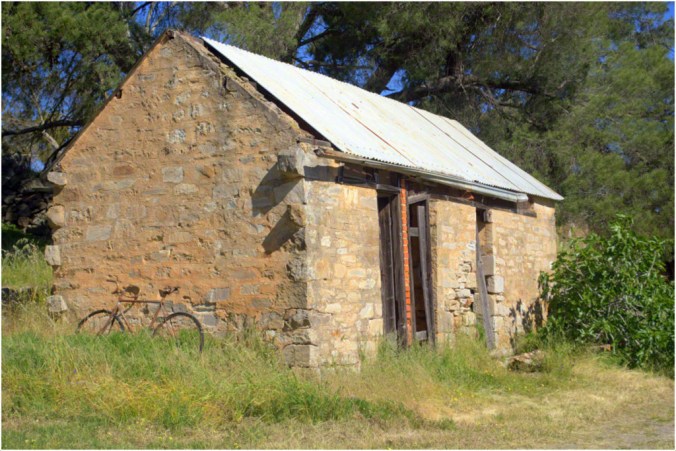
Feature Photo: Dad Concreting back Patio © M.E. Trudinger circa 1978
***
Have a go at the 100-word challenge.
If you like you can drop us a line with your creation.
We’d love to see what you come up with in the comment section.
Tackling the Challenge of Writing
Do you want to write? Wish you could write? Feel you have stories in your head that want to come out, stories you are sure others would enjoy? But you just don’t know where to start!
Many would-be writers seem to think that you must start at the beginning, work your way through the first chapter then the next and the next until you get to the end. Finito! Ready for publication!
This may be the way it is for some; but in my experience, very few. Very, very few. Such folk are rare birds indeed and quite possibly rare birds with a great deal of experience. The rest of us have to do things differently.
One way that is highly recommended and successfully used by many is to work out a plan; make notes for each chapter; shuffle things around a bit if it seems better that way; add or subtract incidents, characters, locations… Then, when you are happy with the big picture you’ve worked out, you can get writing. Many will begin at the beginning and proceed in an orderly manner, chapter by chapter. Others will find it more satisfactory; more useful to jump in the middle somewhere; write the easy bits (or maybe the harder bits!) first up. Doesn’t matter; all equally valid and ultimately successful. So go with what suits you.
I’ve always seen my “early-draft” writing as a sort of jigsaw puzzle – dozens of pieces (ideas) to be fitted together in such a way that they would eventually create a “picture” to be enjoyed or confronted or challenged by or…
As a kid I loved jigsaws; spent hours doing them and devised many different ways of tackling them. The easiest way was to separate out all the edge pieces; assemble the “frame” then fill in the middle. If I wanted a challenge, I’d divide the big heap into little heaps of similar colours and go from there. The ultimate challenge was to do the whole thing using all the pieces reversed, i.e. on a large tray or rectangular pan used for cooking slices or cakes and with the plain backing uppermost. When complete I’d carefully tip the whole lot out to check for success (or failure!).
Using the jigsaw analogy, my initial writing on scraps of paper; on the backs of envelopes or circular letters are the jigsaw pieces. Sometimes it might be great chunks of scribbled prose (or poetry). At other times just a sentence or two, a few words that seemed to sing; to sum up a situation, a feeling, an incident, a character… It’s all grist to the mill; grist that I will re-arrange, add to, change, scrap, enhance, re-locate, delete…
Whenever I begin with a nice, orderly, logical plan or outline I feel it’s like starting the jigsaw with the edge pieces; things flow and there is a comfortable feeling of achievement. Many times, however, I feel I’m wrestling with all the pieces upside down, the blank backs of the bits, no idea of the final picture.
I know my finished product has to have a beginning, a middle and an end. It must flow; have a logical sequence of events; maybe a crisis and resolution; drama, pathos, evince tears or laughter or… But this is the finished work; ready for a reader to enjoy. The completed jigsaw puzzle.
So, how do you tackle your writing? Are you hobbled by the belief that you must start at the beginning and laboriously work your way through in logical progression? Or do you always just jump in the deep end, flounder around, fed up and frustrated? Either way it is far too easy to decide this writing racket is all too hard; you’ve no talent; it’s not for you. Which is sad if you have ideas and stories in your head that you want to share, if you find words fascinating and putting them together in interesting ways a satisfying and fulfilling challenge.
When it comes to grammar and basic sentence structure there ARE rules that need to be obeyed. If you don’t know the rules or your knowledge of them is wobbly, you don’t need to see this as a major roadblock – there are plenty of people willing and able to help tidy up writing for those who see the rules of grammar as a bit of a handicap but don’t let this stop them getting their ideas down onto paper. These people are called editors, and all published authors value the contributions they make to the final success of their literary efforts. There is absolutely no humiliation or shame attached to using the services of an editor. Just make sure you get a kind, caring and, above all, knowledgeable one!!
BUT but, but.
There are no rules at all when it comes the actual writing bit itself. How, when where you do it is up to you; your own choice to suit you and your lifestyle. Do it your way; whatever feels right and comfortable for YOU. But do just grab a pen, pencil, bit of paper and write.
© Mary McDee 2024
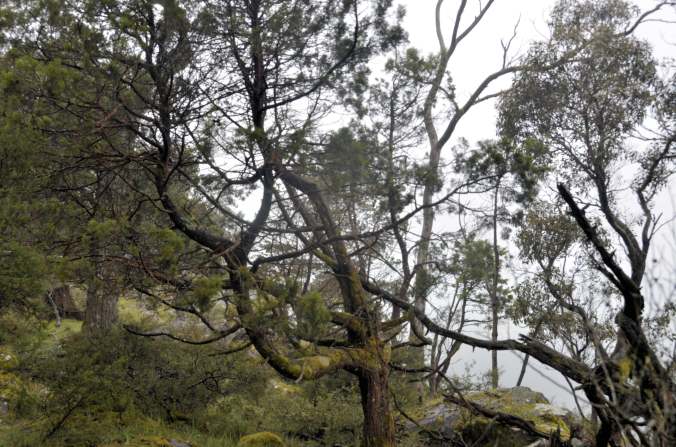
Feature Photo: Branches creating a puzzle © L.M. Kling 2023
Ever since time began
We’ve been telling tales
Entertaining others
With stories of people and perfidy
Friendship, revenge
Cowardice and bravery…
Imagination soars –
We can see those we create,
Hear their voices,
Eavesdrop their chatting.
We know them so well,
How they dress,
Where they live,
Who they love
Or hate….
What it is that they feel
And why…
When it was that the conflicts
They’re embroiled in began –
For a story must have conflict,
Conflict and resolution.
Ever since we could speak
We’ve been telling tales.
Yarning round campfires;
Huddled in caves
As storms howl;
Rain drowns our world
So we seek comfort,
Seek to pass time,
Seek to get into the mind
Of our mates,
We build shared memories
And forge a community.
Time passed.
Scratchings on stone became letters –
A letter for each sound that we spoke.
Those letters made words
So now we recorded our doings and thoughts,
Our buying and selling, Our songs and our stories…
(c) Mary McDee 2024
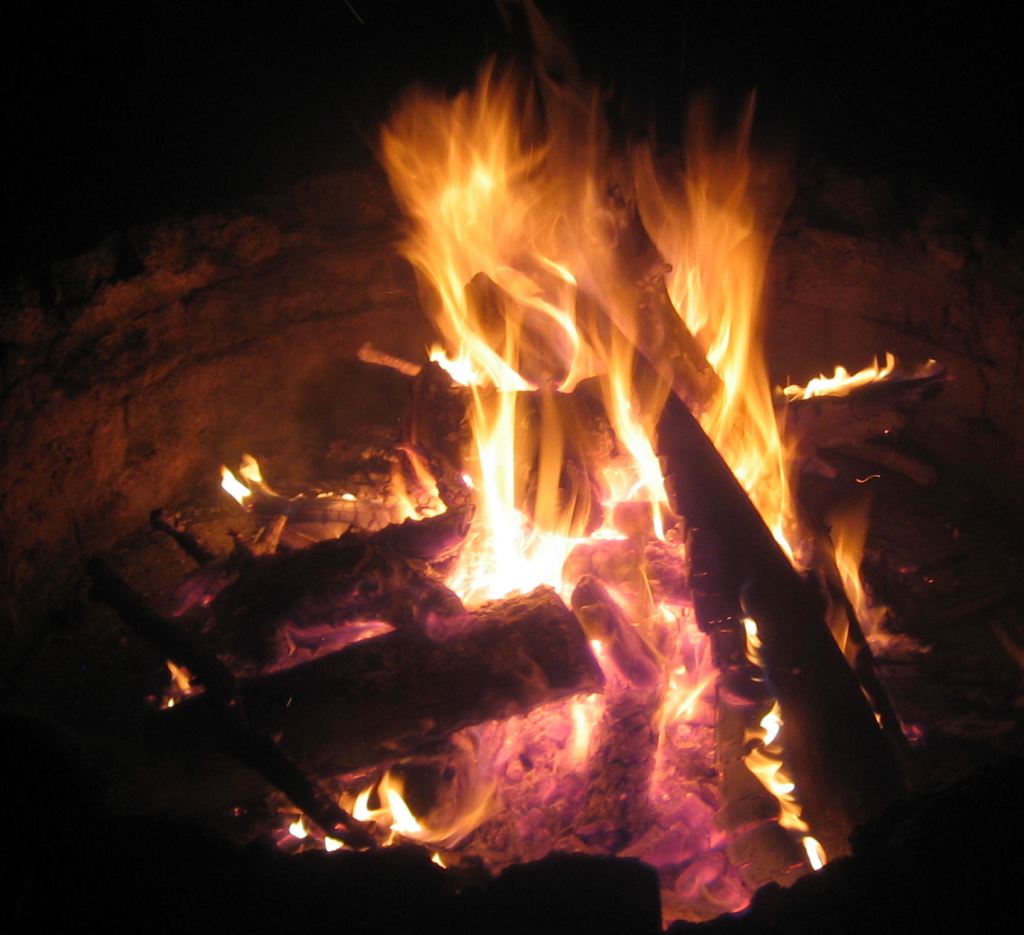
Feature Photo: Around the Campfire (c) L.M. Kling 2010
[New Year and for me at least a quieter time to reflect after a hectic end to 2023. Also a time when I have finally tackled the challenge of family history research. Almost thirty years ago, my auntie passed on the “mantel” of family historian. She also handed the box of research which she had done. For most of that time the box has been stored away in our closet, except for the early 2000’s when I took part in compiling my father’s mother’s family history. Then, after hitting brick walls in my research, back it went. Writing fiction was so much easier. And fun.
This last year, I have been working on a crime novel. Since a key part of the theme of this novel will include family history and using DNA to build ancestral family trees, out came the family history box again. You could say, I’m researching my novel by doing and experiencing. After only four weeks of exploring down the family history rabbit-hole, and believe me, it is a rabbit-hole, I’ve discovered tracing once’s ancestors requires methodical, critical brain power, and an OCD attention to detail…much like a detective, really. You wouldn’t believe how many of our ancestors have the same name but are different people.
I also have discovered that names, and dates of births, deaths and marriages get boring after a while. The family history books that stand out are the ones which give a brief, or not so brief, descriptions of people, their lives, personalities, interests and job.
On that note, I’m reminded of a blog I wrote way back in 2016 and how we are often defined and judged as a person by what job we do and how much we earn. So, below is that article which examines current day attitudes which may affect our motivation to become a writer.]
Census time!
As I filled the forms out online (two days after the due date—another story covered in the media), I had a Eureka moment.
I faced a dilemma regarding the work/employment section with questions: “What’s your main job?” and “How much do you earn?”
As an artist/writer I had a conflict of interest. I knew what the statisticians from Canberra were after. I understood by “your main work”, they meant “paid” work, or in my case, the work that paid the most dollars.
So, if I ticked my writing and proceeds from the novels I’ve published for which I’ve been paid a pittance, but on which I’ve spent the most time, the Australian Bureau of Statistics (ABS) would not be happy. In their estimation, work without the dollars attached to it, is not “work”.
If I put my Art, that is, painting, from which I earned a few hundred dollars in the last financial year, that also wouldn’t satisfy the ABS—even if I do sit down at Art Group and say, “I’m going to do some work now.” Besides, according to my accountant, my earnings from art is “hobby money” that goes back into painting supplies and equipment.
Well, then, that leaves the paper round. I inherited the paper-delivery-round from my son, who after he saved enough money for a computer, had no use for it. But I did. This “work” earns sufficient funds for a holiday every year or two. And I like the fresh air and exercise.
So I marked the paper-round as my main work even though I spend the least amount of time compared to painting and writing. How sad that my “work” according to the ABS is reduced to four hours a week delivering papers after having achieved a University degree.
[I might add here, that I no longer do this paper round. So, I am investing time into building up the Indie Scriptorium business and helping fellow writers in the process of publishing their books.]
The ABS will never know the other side of my life—my work of choice—the Arty Creative work, because there’s no money of any significance in it.
In our society, unless the “work” has dollar signs attached, it’s worth nothing.
So I mean to say, the whole spectrum of our culture, what makes our culture in fact, and enriches our lives: the writing, drama, music, art, doesn’t exist in the Australian story according to the ABS.
The reason? Artisans, be they writers, actors, artists, musicians and other creative people are not valued for their craft. To survive they must earn a wage—if they can find a job. How many of us “creators” are forced to choose between our craft, and food and shelter?
We become teachers, restaurant staff, cleaners, office workers, accountants or whatever while our passion to create becomes quenched by the need to survive. At the end of the workday, we are often too tired to create.
‘When we retire…’, we promise ourselves.
My Dad was an artist. He went to Art School after high school. He even sold a painting through the local newspaper as a young married man. However, he had a family to support, thus became a teacher, and his art was sidelined. ‘When I retire, I’ll get back to my art,’ Dad would say. He retired, but the paints and paper remained packed in a suitcase in the cupboard while he pursued his passion teaching and music.
Also, having come from a family of authors, he had dreams of writing a book, or maybe his memoir. Never happened.
I have inherited Dad’s 300gsm Arches paper, watercolours and brushes, and I feel that I’m carrying on the art tradition my Dad began. In the writing field, I am also carrying on the family legacy of authorship, albeit self-published, but published all the same.
So in the end, statistics are just statistics; they don’t tell the whole rich story. Statistics won’t reveal that the Fleurieu Peninsula (the area in which I live) has reportedly the highest percentage of writers and artists in Australia. Statistics only reveals the tip of the iceberg of artists and writers who have entered for the census information that they are a writer or artist because it’s their main source of income. However statistics will miss many other creators who do not put their craft as their main source of income.
For most of us creators, the line flung at us by well-meaning family and friends is: “Get a real job.”
Creating is not valued unless there’s a cost, and yet everyone wants to be entertained…often without cost.
The other side of the story those who push the “proper job line” don’t understand is that the rewards of creating for an artist, in the broad sense of the word, outweigh the monetary rewards one receives from the so-called “real work”.
© Lee-Anne Marie Kling 2016; updated 2024
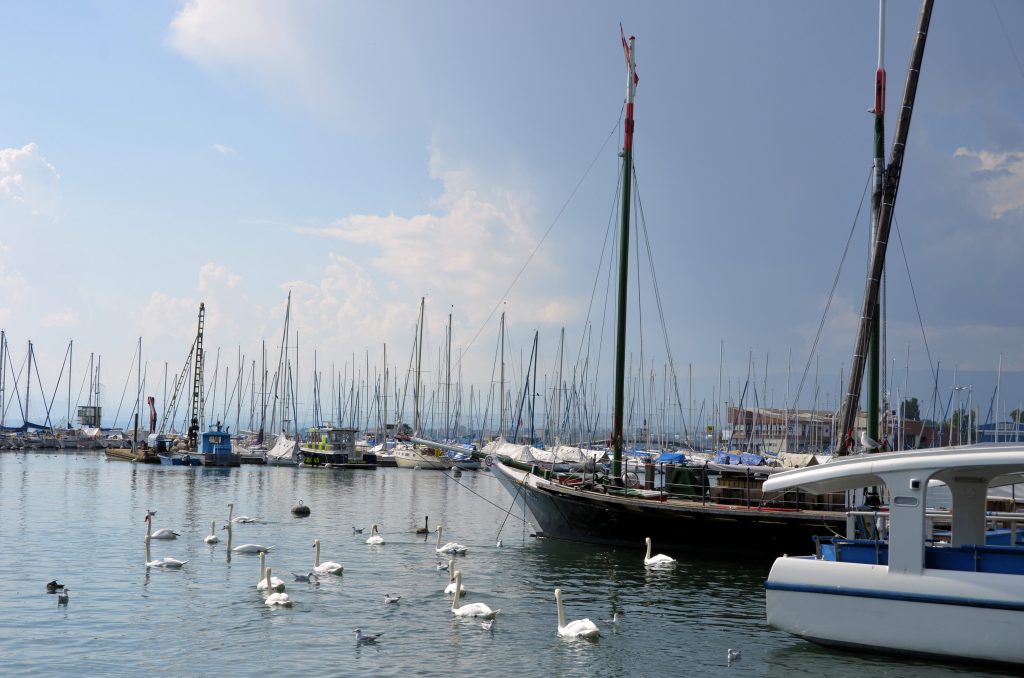
Feature Photo: One of my ancestral stamping grounds, and behind it, a riches to rags tale (but that’s a story for another time), Lake Geneva, Lausanne, Switzerland © L.M. Kling 2014

I’ve always been fortunate to have far more ideas for my fiction than I have time to write them into a story or novel. But some writers struggle to find an idea and inspiration. So how do you get inspiration and ideas for what to write? This was my experience.
My first novel was easy to plot and plan. I wanted to set the novel in the Regency era because of my love of Jane Austen and Georgette Heyer. Then, women had no rights and little education and I wanted to promote my ideas about feminism and equality in that era. A Suitable Bride emerged from these basic ideas. I asked what would an intelligent and sensible woman do to ensure she made the best choices to achieve a fulfilled and happy life in a world where woman had no legal rights and little education? The answer informed the storyline of A Suitable Bride. The love that grew between my protagonists against impossible odds gave me the conflict required and the happy ending fulfilled the romance genre.
Family and friends who experienced the sad loss of a baby or suffered infertility inspired my second book A Suitable Heir. Again, I set the novel in the Regency period to capture the additional difficulties of upper-class woman whose main purpose in life was to marry and produce an heir. I asked how would a woman in a society cope with infertility in this era. In addition, I incorporated the issues of depression and loss when a couple remains childless and the joy of having children after a difficult time conceiving.
I’m currently writing my third book, which began when I watched the sad and senseless death of George Floyd. It appalled me to witness his awful murder and made me think what could I do to counter such extreme racism. I returned to my favourite historical period and I learned about the British slavery trade and its aftermath. This became the focus of A Suitable Passion. My protagonists appear to be on the opposite side of the abolition of slavery movement, yet my heroine is coerced into a marriage of convenience with a man she cannot respect. This book has been the most difficult to plot and plan as it required considerable historical research about slavery in the British colonies, a romance and a happy ending. Two rewrites later I am still attempting to incorporate an engaging story with a fascinating but sad history. I’m not sure I will achieve the right balance but love the challenge.
So, my inspiration for novels comes from social issues and themes, which I then incorporate into a favourite historical time to create fictional characters and storylines. I find inspiration for short stories harder but thinking back these are some spurs that have helped me to create my short stories.
An important step in the creative process is to ask what if or how would? What if that hero in the paper later regretted his actions? What if that murderer wasn’t caught? What if that woman I overheard left her husband? How would a barren wife cope with a demanding husband in the 1800s. How would an abolitionist cope when her family are slave owners.
So, select a topic, make whatever changes you like and ask what if, how would and get writing.
Cheers Elsie
Elsie King©2023
Photo from Apple stock images.
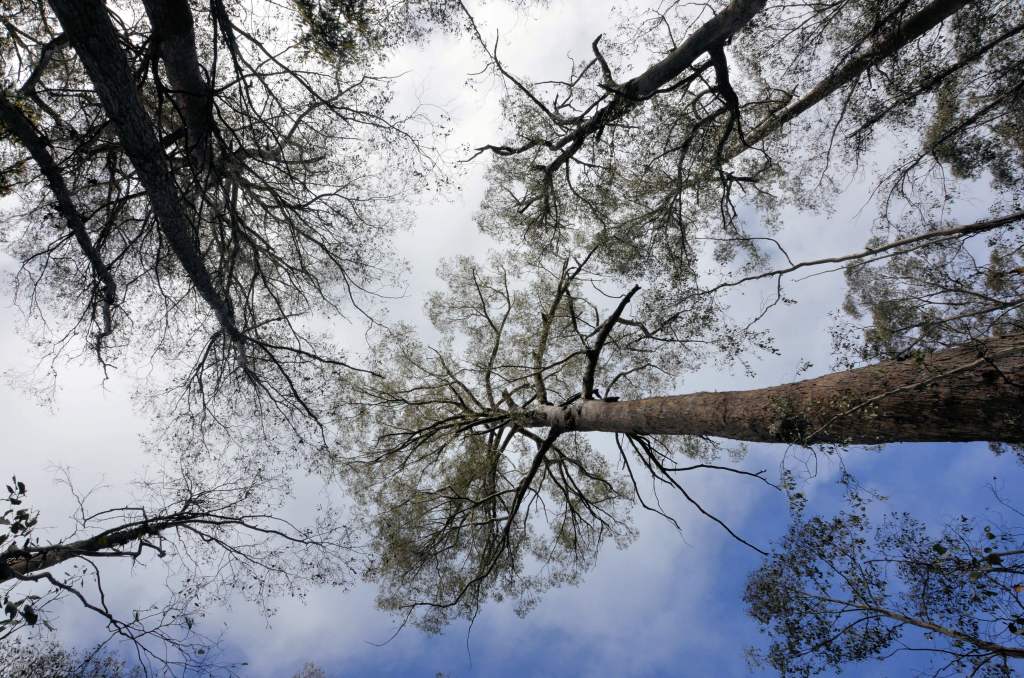

Feature photo: Tassie Trees Lake St. Clair, Tasmania © L.M. Kling 2016
After a long hot week—the first “heatwave” since 2019, I sat at my computer, blank for blogging inspiration. Finally, I discovered this little gem in my collection…

THROW AWAY THE CRITICAL PARENT IN YOUR HEAD
February, your New Years’ resolution, a not-so-distant memory, and you stare at the computer screen full of resolve. Time to start that great [nominate your country] novel. It’s a job, right? Hammer away on the keys eight hours a day. Right? You shift your weight in that padded, ergonomic office chair you bought for your project. Now what? Think!…
Check social media and the news. Pay a few bills. Back to your Word page, crack your knuckles and…time for a coffee. Get rid of that brain fog. Last week’s weather played havoc with your brain. Limber the old grey cells up with some solitaire. Or perhaps a quick crossword.
Back to the blank screen…and sigh!
You tap out a sentence. The first sentence, the hook. Must engage those millions of readers on Amazon, or that elusive publisher. You stop. Reread the sentence. Blah! It’s rubbish. You delete sentence.
You gaze out the window. Birds warble. The sky’s clear and blue. Maybe go outside with a paper and pen? There’s connection between you, the pen and paper. Outside, white paper on pad dazzles you. First sentence in black ink. What? Who’s going to want to read that?
An hour later, sun on your face and surrounded by scrunched up wads of paper, you nap. Nice with the sun on the back of your neck…and another morning of good writing-intentions wasted.
Brain Freeze and Platitudes
It strikes, anywhere, anytime. A work mate is leaving, or a friend is having a birthday. Some wise-guy buys a card and circulates it. Card arrives on your lap. You have two minutes to write some warm and witty sentiments. What do you do?
‘You’re a wordsmith, Lee-Anne, go on,’ my mum says.
But the clever words refuse to bubble to the surface of my brain. I locate the blank space where my wishes will go and then check out the preceding words of well-wishing. Pity, if I’m the first one to write this card.
I blame a relative of mine. Back as a teenager, I attended a funeral. The relative approached me and said, ‘I think you should go and comfort your aunty. But please don’t give her platitudes.’
Ever since, whenever I need to produce formal comfort or congratulations, that relative’s advice comes back to haunt me and all I can think of are platitudes.
It’s the “pink elephant” effect. When told not to think of “pink elephants”, what does our brain do? Yep, pink elephants in abundance.
So, when we stare at the blank screen or paper and remember our school days; our English teacher saying, ‘Don’t do this and that, and so on’, we sit there, frozen with our mental doors barred to the creative zone.
How do you get started? What works for you?
Some Suggestions
What works for me:
· First of all, and this is legitimate. Years ago, a writing mentor advised us. They said, ‘Pack up your critical parent that is in your mind, you know the one who’s never satisfied, no matter how hard you try? Yes, that’s right, tie them up, gag them, and wrap them up like an Egyptian mummy. Then, in your mind, take them to the jetty and throw them in the sea.’
· Then, have fun with your inner, natural child and with the story. You have permission not to put a jot on your computer screen or paper. Go outside, sit under a tree, or go for a walk. Imagine, daydream and if you wish, talk to yourself. This is the incubation phase.
· After cooking the ideas for however long it takes you to be ready, pick up a pen and paper, and go to your favourite place, and brainstorm. Probably a good idea to stay away from the computer and the temptation to check social media, news, or play solitaire. Well, I need to anyway.
· Find your characters, or should I say, allow them to find you. Do lots of reading. Also, observe others say in a coffee shop, beach, on the street, and even on television. You may find some interesting characters out there. You may be surprised at how these characters reveal themselves to you and even become your imaginary friends. Just like when we were children. Some people I know, okay, I confess, me, have created characters out of people I have known—usually a blend of a couple of people I know, from way back in my past, I mean.
· Imagine having a drink with those characters or going for a walk with them. Ask them questions as you would a new friend. Warning: I do find this dangerous as I soon have a story, or at least a back-story.
· Then put your character together in a restaurant, playing ten-pin bowling or going on a road trip. Now the ideas will flow, the story will flow and as the Borg in Star Trek say, “Resistance is Futile”.
· Finally, write the story. It’s your first draft. Your mind’s critical parent is at the bottom of the sea, so allow your inner natural child to have free reign. Write as you’d tell the story to a friend on a camping trip or a child. Get the words down. I emphasise, it’s a first draft, you have permission to make mistakes while the ideas flow. Editing will and does come later.
· Another suggestion: why stick to writing? If drawing, storyboard, or voice-recording works for you, do that. It’s your story. It’s your “child”.
Try this:
Create an oral story. You may do this as a game with friends, around the table as a family, or with your writers’ group. One person begins the story with two or three sentences. The next person continues the story and so on around the group, until the last person concludes the story.
For example:
Gnomes, they appeared everywhere; all over the seaside town of Glenelg. They popped up in odd places. Gnomes, stuck up poles, perched on tree branches, and even balancing rather precariously on television antennas….
In the Zone Challenge: Write your continuation of this oral story. Or create your own to share. You are invited to send us a link in our comments section.
© Lee-Anne Marie Kling 2017; updated 2023
Feature Photo: Gnome under our lemon tree that took 15 years to get started © L.M. Kling 2013

Take the first step in faith. You don’t have to see the whole staircase. Just take the first step. Martin Luther King,
Feature Photo: Courtesy Pexel.com
Quote of the Week – First Step — Mrs T
With the first day of 2023, comes resolutions…Maybe to start writing the book you have inside you. Here’s a quote from Martin Luther King found on Mrs T’s blog.
Thank you, Mrs. T
 Indie Scriptorium -- Self Publishing Collective