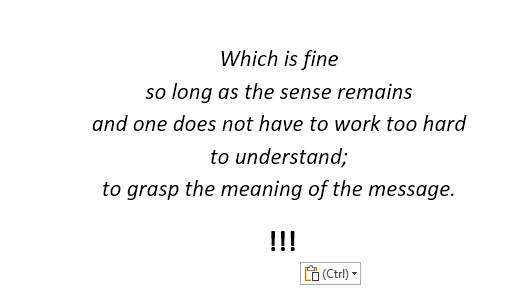
A while ago we gave you a blog about apostrophes and the two apparently different jobs they do. In actual fact, however, their jobs are not so very different as both uses indicate something has been left out thus effectively shortening the statement – a thing we tend to do when talking. Which is fine so long as the sense remains and one does not have to work too hard to understand; to grasp the meaning of the message.
Back then we concentrated on the apostrophe of possession (AKA the apostrophe of ownership or belonging) and gave you the example of how a string of apostrophised words can make perfect sense with the little nonsense story of “Jan and Her Gran”.
The other use of the apostrophe (also known as a “raised comma” but in grammatical circles is referred to as the “apostrophe of contraction”) is, in a sense, simpler as it reflects what we all do when talking: run words together so that two or three sound like one. This means that, when writing, we omit a letter (or letters) along with the space between the words.
I’ve become aware for several years of a move to dump apostrophes all together as the correct use of them is seen as too hard; confusing; not necessary; writing would be simpler…; too many people don’t know how to use them…
If they are taught well all these objections are virtually non-existent. In my experience as a school-marm all my working life I know that pretty well every eight or nine year old can learn to use them appropriately.
What fascinates me is the effect ditching the apostrophe of contraction could well have on our reading of such words as he’ll, she’ll, we’ll, she’d, we’d, can’t, won’t, I’ll. Pause a moment and consider each of these minus its apostrophe.
Reading written English can be a challenge at the best of times due to a number of factors I won’t go into here. So why on earth make it harder than it need be? Surely what we really need is simple, effective teaching that explains things clearly.
Just in case you had a bit of trouble visualising the effect of omitting the apostrophe on the short list I gave you above:
Admittedly, this last is not commonly used these days. But, according to my big, fat, two volume Shorter(!!) Oxford Dictionary there are no less than ten separate, distinct meanings for “cant” varying from “dispose of by auction” and “jargonistic” through “bold, brisk, lively, hearty” to “push or pitch sideways”… Just to list but a few of those ten!!
To recap what I said in the beginning about making changes to the language:
“You should serialise your books,” a friend said, showing me her latest e-reader. “Once you have finished the book, you can publish it. That’s what some of the authors I read do.”
And my friend reads constantly. You could say she’s attached to her e-reader.
Voila! Kindle Vella popped up as an option.
I looked into this enterprising option.
No go. Unless you live in the USA.
A suggestion at the bottom of the website I had been researching about Kindle Vella suggested a story platform called Wattpad. Wattpad seemed to embrace all those of the universe left out of the US Kindle Vella orbit.
Looked promising.
Further investigation revealed Wattpad was one of the top platforms for reading and writing stories. Millions of stories free. Writers could upload their stories, chapter by chapter, week by week in serial form. An added bonus was that they had an opportunity to receive feedback from their readers.
To me it looked like one big world-wide writers’ group.
Wattpad touted that its Artificial Intelligence (AI) searches with its algorithms, finding books of promise which it then highlights to readers. So, rather than rely on a bunch of readers to raise your story’s profile, as the rest of the World Wide Web does, Wattpad’s “robot” agents do the job.
They, I mean, I guess it’s their AI, will act as an “agent” and Wattpad puts out the “carrot” for aspiring authors that their book may be picked up by major publishing houses and film makers.
Right, let’s get to it.
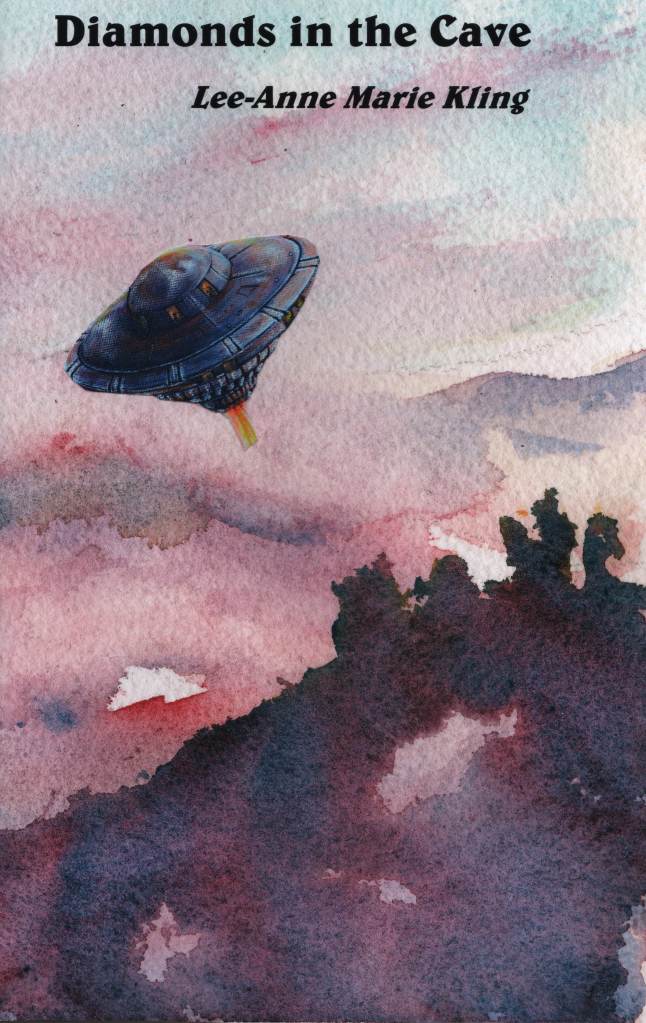
Full of hopefulness and anticipation for some Beta readers, I launched the first chapter of my novel Diamonds in the Cave on Wattpad. Not sure about the AI but decided to try out the platform as a test case. After all, there seemed to be a healthy cohort of readership for Sci-fi.
Oops! Downsides.
On further investigation, I discovered that Wattpad is geared towards Millennials and Gen Z’s. Upside if you are in that cohort. But if you are not…well…um…
Suddenly, I felt like an old chook trying to sneak into a trendy (or whatever word my children use) nightclub.
Faced with this dilemma, I asked my younger musician son, if I could sneak in using his identity. No, not a good idea. I was afraid that Wattpad might have AI bouncers, who, upon seeing my ancient, in their terms, age, would kick me off the platform.
I applied and that didn’t happen. I was comforted to read that Margaret Attwood is on Wattpad. I will be following her.
Success, of sorts
So, this “old chook”, me, has entered the realm of Wattpad, under the guise of Tessa Trudinger. Funny story about that. When I tried to register under my real name, they, the AI refused to accept me. Hence, I resorted to my maiden name, “Trudinger” and they received me with much enthusiasm saying, “Welcome Home, Trudinger”. Perhaps Trudinger is a hip name in Wattpad world. Fortunately, I had already assigned my nom de plume, Tessa Trudinger, to my detective series which I am currently working on.
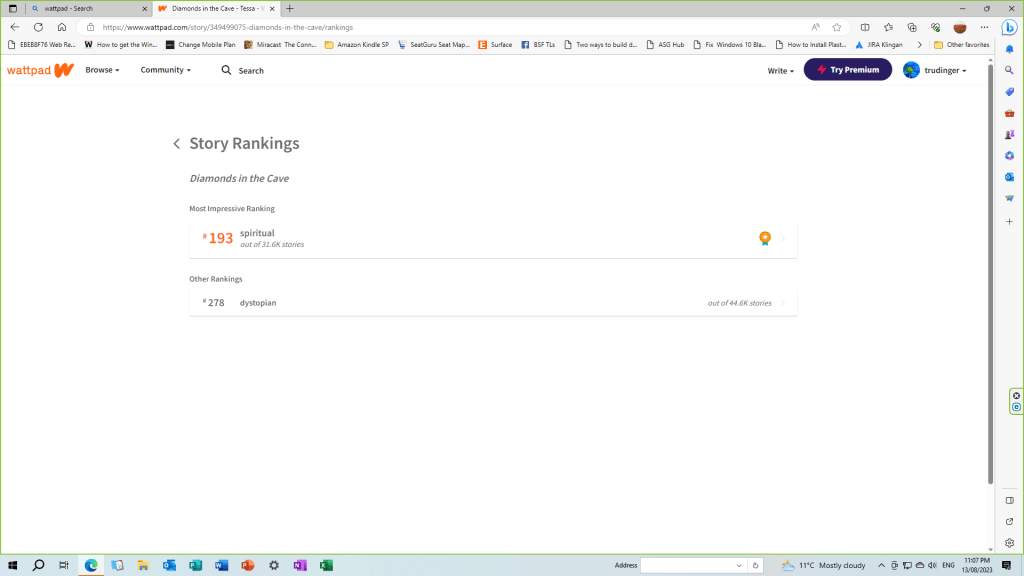
Anyway, a few days in, and the first chapter of Diamonds in the Cave steadily gained attention. Wattpad AI was pleased and awarded it the ranking #193 out of 31.6K in “Spiritual”. And something like #278 out of 44.6K in Dystopian. Two days later the story was still in the top 600 in those two categories.
*[Photo 2: Oh, joy! The statistics on Wattpad]
From there, things went south.
As I said, I’m looking for Beta readers and feedback to improve my story. No comments have appeared on Wattpad. One WordPress reader gave me encouraging feedback, saying I write beautifully. Another reader who has followed me, my friend actually, gave feedback face to face. She suggested that I need more of a “hook” in the first paragraph and that it must be rewritten.
Upon that advice, I rejigged the first paragraph, bringing elements of what the story promises to deliver—a combination of chocolate laced with time/space transporting microbes and the fearful Wend community, driven to witch hunts.
May have to eat more chocolates and play around with the first para some more in the future…
As for navigating the Wattpad website, I’m still getting used to the way Wattpad works. Uploading the story is simple enough; much like I do on WordPress. Copy and paste what I have already written on a Word document. An important strategy as I read in reviews about Wattpad taht quite a number of writers have lost their work by relying solely on Wattpad. One note, though, make sure track changes are off and not showing, or they show through on Wattpad. Messy.
I also found the story notes app provided useful in consolidating characters, the story and pitch. It made me think about my protagonist, Minna, and ensure her character remains consistent and yet grows in maturity and depth. I used the “logline” that I was asked to construct (had to be less than 150 characters), as a lead into Diamonds in the Cave on my WordPress blog.
Reading tips
I began reading a couple of stories on Wattpad. However, I discovered, when I tried to go back to them, they had vanished. Solution: apart from writing down the author’s name and book title on a separate piece of paper, I found that I could follow the authors, and put their books into my “Library” on Wattpad.
Another problem with reading in Wattpad—no bookmarks. Again, trusty old pen and paper come to the rescue. In this respect Kindle is far superior. It has bookmarks.
When I work out how to give Wattpad feedback, I will suggest that they programme some in. I checked the box volunteering to be a “Beta-user”.
This is my story of my journey into Wattpad, so far. Check out Diamonds in the Cave on Wattpad, and please do give some constructive feedback. I don’t mind if you post your comments on WordPress, Facebook, or on Wattpad.
You may need to join up on Wattpad to read, follow or comment on stories there. Not such a scary thing, I’ve done it. Just think of the millions of free stories begging for attention.
Maybe, like my friend, then, the e-reader will always be by your side.
Self-publishing a book is a wonderful goal but it certainly isn’t the end of the road. The book does not get into the hands of readers without marketing.
So, how do you get your book noticed, bought and read?
I read somewhere that the best form of marketing is to write the next book. That makes a lot of sense to me as the release of the second book, anthology or short story draws attention to what you have written before.
The business of marketing can take up a lot of time and attention and it’s difficult to get through all the steps you need to market your work and still have time for the joy of writing the next book/story.
This blog will explain my strategy for my own modest marketing plan:
What is your goal?
If you are like me my primary goal was to have a novel published. I don’t need a liveable income from writing. I don’t expect to be a best seller and if I cover some of my expenses I will be happy. So, my marketing strategy was modest and relied on word of mouth and the generosity of friends and family to buy my book and spread the word. If you have given up your day job and have the rent or mortgage due, you will need a much more vigorous marketing plan.
The basic essentials that I used are:
Business cards with an e-mail address and web site address. You can add your phone numbers and address if you choose.
A website that is connected to your social media accounts and where you can post covers of your books and have links to the sites that sell your book. Then tell everyone possible that you have a website and ask them to visit.
Do regular blogs on your web site and post to social media.
Organise a launch party. My release coincided with a big birthday so I invited guests and asked that, in lieu of presents they buy a copy of my book. I then ordered 35 author copies of the book and sold them to friends and family. I sold 34 books with promises of online orders too.
I’m a member of Romance Writers of Australia so will take five copies of my books to the 2023 Sydney conference and put them on the Indie table for sale along with my business cards and a free card (A giveaway displaying my artwork)
I have advertised my novel on the RWA website and in their magazine Hearts Talk.
I paint as well as write so put my business cards of the back of my paintings
Copies of my paintings have been made into cards and my website address is on the back of the card next to the copyright.
Indie Scriptorium web site also advertises my books. I and my fellow members write regular blogs about the self-publishing process. We have a small but increasing following and go world-wide. My website is linked to the Indie Scriptorium website.
Indie Scriptorium will launch a book of our accumulated blogs about self-publishing as well as an anthology of writing, poems, artwork and photograph early next year. Our individual novels and books will be included in this launch.
My fellow writers in IS plan to get a display table of art, cards, books and other advertising at local craft markets.
I intend to contact local writers groups and offer to give an information session about the process of self-publishing my book. Hopefully sell a few books too.
That’s the plan for now. I intend to review my sales strategy from time to time but now I’m going to start writing my third novel.
Further to my comments a few blogs ago re rhythm in poetry there are a couple of points I feel could do with clarification:
Rhythm is dependent NOT upon words but on the syllables that make up those words. While a word is at times only a single syllable (e.g.cat/dog/plant/then/through/thought…) many have two or more syllables (i.e. are multi-syllabic).
However, looking at that list of single-syllable words above it is obvious that the number of letters in a written word has little or nothing to do with the matter. Syllables are based on the number of sounds rather than the number of letters used to represent those sounds in the written form of the language.
All spoken language consists of two sorts of sounds: vowels and consonants; the vowels themselves come in two sorts: short and long. In English there are six short vowels – the middle sounds in pat/pet/pit/pot/putt/put. All the rest (14 in all) are long. To name but a few for example: the middle sounds in pool/paid/peel/pout/pipe/part/pert/port/pose.
The consonants on the other hand (25 in all) are the first one or two and the last sounds in all the examples above – apart from “through” where the last sound is “oo” (as in “soon”). Quite clearly, spelling in our written language and the sounds of the spoken language seem to bear little relationship to each other. But in saying that I’m teaching my grandma to suck eggs; aren’t I? Regardless of the fact that it is syllables and therefore the sounds of those syllables that are critical to rhythm I won’t go into all the intricacies here as it distracts from what I need to say about rhythm in poetry.
If the rhythm doesn’t “sing” properly when you read your poem aloud it is the syllables you must consider: maybe change a three or four syllable word to one of two or three (or vice versa) or remove a word; or add another; or repeat a word or a whole line or… Maybe you need to change a short vowel for a long one (or again, vice versa!).
The permutations can be seemingly endless. Just keep playing with it until it feels right when you read it aloud. Remember: poetry is music using words instead of notes and, like music, is meant to be performed. We miss much of the joy of poetry if we simply skim the words on the page; eyes only.
Secondly, prose marches across the page, words side by side like an army, ranks of soldiers filling the space. Poetry is more like a company of dancers, short lines, long lines, single words, spaces, positions on the page…
By simply changing the length of lines in a poem you can change the mood entirely. By way of example consider two versions of the A.A. Milne poem “Happiness”:
These 16 short lines give a beautiful, clear picture of John’s joy as he stomps around; jumping in puddles; splish, splashing in the rain. No words detailing any of this. But no words needed. Now read aloud those same words arranged differently:
How did that feel to you? Much slower; much more thoughtful is how it seems to me; almost as if he’s looking at his wet weather gear and wondering if it’s worthwhile going to the bother of putting it all on just to go out in the rain. Wouldn’t it be better to stay inside by the fire and read a book?
By the by, in the second, longer, more discursive version I found myself saying “has” instead of “had” as I was reading it. A small point indeed. But this is a lot of what poetry is about – small points can have a big impact!!
And another small point with a big impact: all the capital letters in the original provide emphasis plus; an emphasis that adds to the mental picture of a small boy stomping around, splashing in puddles, having a joyously wonderful time and to hell with the rest…
Do you too feel that it adds to the whole thing in a way that mere words alone could not possibly do?
The process of formatting and uploading a book using publishing platforms is complex and time consuming. Give yourself plenty of time, a comfortable workstation, snacks, drinks and learn some mindful breathing. You will need all of these things to stay sane. *
As discussed on my last blog there are a lot of online publishers out there so do your homework and work out where you want to place your book. I decided to use Draft2digital as they offered a free formatting program that looked good and they distributed to a wide variety of bookstores. I also decided to publish with Amazon as they have the biggest world market and higher royalties.
From my experience I would suggest the following steps.
Get your book cover in a downloadable PDF format for your e-book and a complete cover for your paperback. These need to be ready and fit the criteria of whichever platform you choose. I used the services of a graphic designer Kate Smallwood (https://www.deviouscat.com.au) but as stated in my previous blog on covers you can do your own cover or buy a ready-made, but unique pre-made cover
In Australia we buy ISBNs from Thorpe-Bowker. You will need time to set up your account and go through the questionnaire giving the details of your book. I bought a block of ten ISBNs for $80AUD and had to register as a new publisher cost $50AUD + GST. Total cost $143AUD. You will need a separate ISBN for each format of your book. Draft2digital and Amazon will provide you with a free ISBN, but I chose to have my own. When you get your numbers make sure you record them and keep them in a safe place. I did a table which set out the ISBN, the title of the book, book format and dates of publication as it helped me sort out which ISBN went with which copy of the book.
Once you have an ISBN you can register your book with the National Library of Australia. This is a legal requirement and again you will need some time to fill out the online forms. You only need to register one format of your book.
Do a final format of your word manuscript. Make sure that chapters are obvious and separated from text by paragraph spacing and clearly set out scene breaks. I used the formatting show/hide device on the home page of word. (Looks like a backward P) This clearly shows your spacing and page breaks. Ensure that all chapters and scene breaks have consistent spacing. This will make it easier to load your book onto the publishing platform.
Draft2digital – You will need to start an account with them, provide banking details and fill out a USA tax form. These are all available in the account section. Draft2digital also have a range of You-tube videos. The masterclass tutorials are excellent and they provide a lot of advice on the website.
Draft2digital have an automated system that will download an author bio, dedication page, copyright page, list of contents as well as the blurb for the back cover. I tried these out but found the information was basic and not in my style. I chose to add my own internal pages along with my manuscript and didn’t have too many problems with the download.
Once downloaded onto the platform it’s a matter of working through the steps for each format (E-book, Print book, Hardcover or Audio book). Step 1 allows you to upload your manuscript. You will probably do this multiple times as you cannot edit once your manuscript is in the system. You will need to edit and then reload the file. Step 1 will also ask you for a Description- this is actually the information that goes on your back cover such as a blurb so have this ready. You can also choose your release, and pre-release date but do this carefully as it is essential to have your book ready to go by the release date. Step 2 is the layout where you decide if you want Draft2digital to add your internal pages or you do it yourself. I found it easier to use my own pages but try out their system and see if it suits you. It also gives you a list of your chapters. If they don’t match your manuscript you will need to check on the formatting of your uploaded file and make amendments. Step 3 is the Preview, the fun bit where you can play with a variety of internal finishes which decorate your chapters and scene breaks. I was very happy with their selection of styles. After you select your style you will need to check each page of your novel carefully to ensure that everything is exactly as you want it. Changes can be made after you publish but can cost money. Step 4 is to publish. You can choose which platforms your book will go to and the prices of your book. You can change the prices for different countries and see what royalties you can expect. Once published you can order a proof copy which is exciting. The proof copy can take a few days to weeks to arrive and mine cost me $43AUD dollars but it arrived within four days. Carefully read the proof copy and if possible, get a friend or editor to go through it. Give yourself plenty of time to check and double check your book before publishing.
Draft2digital also allow you to use their formatting for free and download a copy of your formatted book to use on other platforms. A very generous offer for authors which needs acknowledging.
If you also decide to go with Amazon you need to create an account in Kindle Create. The process is similar to Draft2digital. Check out the terms and conditions from Amazon carefully. If you select Kindle Direct you must be exclusive to Amazon for 90 days but it is a good way to get your book read. Amazon is the biggest online publisher and it is worthwhile to use their service as they also provide a proof copy at a cheaper price.
Once you have published your book you will receive a Universal Book Link from Draft2digital and an Amazon URL. These are important links that you use when you start marketing your books. The Amazon URL is tricky to find but I used a You-tube video and finally worked it out. Copy and save these book links to a secure folder where you can access them easily. They can go onto social media and be added to web sites.
As I said at the beginning of this post, the process of getting a book ready for publishing is long and hard. I found the actual publishing difficult and sometimes confusing. I was lucky to have the help of Lee-Anne Kling from Indie Scriptorium who has published multiple books and spent many hours holding my hand and giving advice. I went through the process to find out for myself how difficult it is for someone who is not tech savvy and struggles with computer programs. I did it with a lot of help so it is doable. I hope my experience is helpful to other authors who want to do it for themselves.
The Trials and Tribulations of Making a Print Copy—My Recent Journey with Amazon
That little tool, “Create a paperback” beckons. Sounds enticing, doesn’t it?
You’ve launched your e-book, perhaps on Kindle, as I did, and then you notice the offer to make your “baby” into something tangible, a paperback.
One reason you might be tempted, is that many of your friends say they want something tangible, a hard copy of your book; they don’t do e-books.
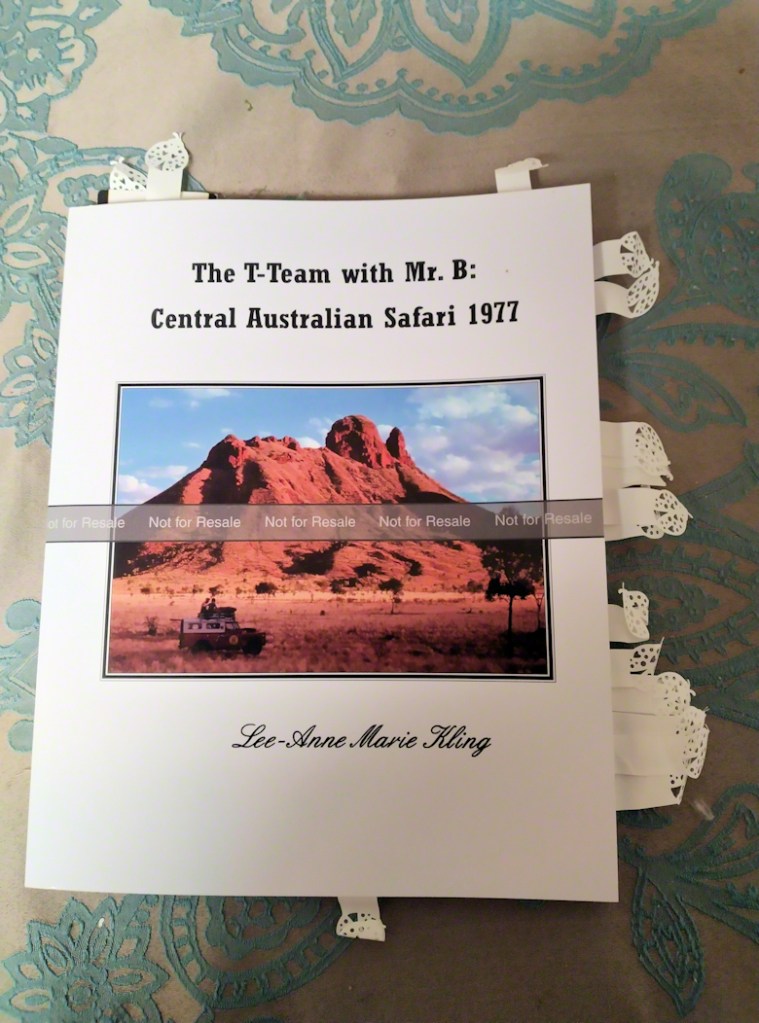
Hence, after my latest e-book, the T-Team with Mr. B went live, I set about the process of making a print book through Amazon. Since my travel memoirs are designed to be a “coffee table” book with entertaining travel stories and colour photos, the page size is not the standard novel format (5”x7” or 6”x9”), but slightly larger at 8”x10”. You’ll notice that I am using Imperial measurements rather than metric. And here lies the problem as an Australian indie author. Just as certain International space programmes can be brought down by the Imperial vs metric discrepancy, so can designing your print copy of your book fall foul of what I’m calling the Imperial computer programme used by Amazon. It seems I fall in this trap every time I attempt to make a print copy of my latest book.
You see, the Microsoft publisher programme I use to design the book cover is in metric. I looked at ways to convert it to Imperial, but such secrets remain a mystery to me. Instead, I use the “Inches to Centimetres” converter found on the internet. This I did and created my book cover which is (8”x10”) x 2, for front and back cover, plus .35” for the spine. In metric that is 20.32cm x 2 plus .9cm for spine.
So far, so good.
Once I inserted the pictures, title and blurb for the back, I then saved the file in Publisher. Then I converted the publisher file to PDF.
Looking good…
With my body/text/manuscript file formatted (for 8”x10”) and also converted to PDF, I was ready to begin the process of making a print book on Amazon. Click on “Create paperback” and follow the prompts. Make sure all required fields are filled in. Then upload the body/text file and cover. Before proceeding to pricing, which is the next page, it is important to launch previewer and check book for errors. Errors will be highlighted.
This is where my attempt at creating a print book came undone. The manuscript was fine, no problems, but the powers that be (computer programme and people who check) had issue with my cover. Each time I loaded it up, “error” in bold red letters glared at me. I uploaded it several times, each time adjusting the cover so that all images and lettering, especially related to the spine, fit in the designated parameters. After about five attempts, the manuscript and cover were accepted, and I ordered a “proof copy”.
Although Amazon quoted ten days for the proof to arrive, it came in three days.
The important thing to remember with proofs is that they are there for a reason. Take time to thoroughly check the proof, not just the cover and how it looks, but on the inside. Seeing work in print helps discover errors and typos. Just because someone proofread your manuscript beforehand, doesn’t make it immune from typos that have been missed. I found a whole heap of Mr B’s that should have been Mr. B.
After addressing the typos and errors in my proof, I set about uploading my manuscript, once again. My cover also had an issue; one of those infernal Mr B’s. I corrected the typo which required another visit to Publisher. That was my mistake.
Satisfied that my cover and manuscript were the best they could possibly be, I uploaded the work for Amazon’s perusal. They were happy with the manuscript, but not at all happy with the cover. In the process of adding just one tiny little dot after Mr, I’d inadvertently used the wrong sized cover size. Worse, I had saved over the “approved” cover from the proof.
Twenty uploads later, I was still no near the elusive approval for my cover. Even when all the images and text were neatly inside the red rimmed parameters. Again and again, the same error message plagued my cover’s existence: “Your expected cover size is 16.602 x 10.250, your submitted file is 16.599×10.000.”
I began writing down my progress, or lack of it.
Eventually I worked out that the wording was my stumbling block and discovered that “submitted” is the “variable”, meaning it can be changed, but “expected” is the constant, meaning it can’t be changed. I decided to go back to my publisher files and make both the “submitted” and the “expected” files match in size. (16.602”x 10.250” or in metric: 42.169×26.035cm) I found a ready-made “paper size” that matched the “expected” and slotted my cover made into a JPEG into the page.
And…it worked!
Elsie King was comforted by the fact that it took me all Tuesday to work this out. When we came to do her historical romance, A Suitable Heir, we nailed it in one go.
We are both looking forward to receiving our print copies in the mail in the next week.
Do you write poetry? Do you wish you could write poetry but are not sure how to go about it? And just what is poetry anyway; what is it that makes it different from ordinary prose?
It might help if we start with a definition. The Macquarie Dictionary tells us that poetry is:
1. A literary work in metrical form.
2. The art of rhythmical composition, written or spoken, for exciting pleasure by beautiful, imaginative or elevated thoughts.
There are two phrases in there that are the nub of the matter: “metrical form” and “rhythmical composition” both of which seem more applicable to music than to stringing words together (which is, after all, what we do when we’re writing). But this is as it should be for poetry and music have a lot in common – not only rhythm and metre but performance.
As far as music is concerned this is obvious. As far as poetry is concerned however many of us don’t realise that it is meant to be either recited or read aloud in such a way that one can feel the rhythm; a rhythm that can be quite subtle; a rhythm that can change to reflect a change of mood… But a rhythm that must be there.
In order to achieve this we have to, at times, adjust or deviate from the conventional rules we must adhere to when writing prose in order to maintain the rhythm and/or produce a desired effect. There are many ways to do this: by omitting a word like ”a” or “the”; repeating a word or words; using a word with a different number of syllables; using a word with a different sound e.g. changing a short vowel to a long one or vice versa…
Breaking the rules in this way is called poetic license and is perfectly acceptable when writing poetry – so long as it is done carefully and with good reason.
By way of example consider and compare the first (abandoned!) version of one of the verses from the poem “I want to be a writer but how do I do it?” that we blogged recently.
When I read this aloud to myself it didn’t “sing” right; it sounded clunky, clumsy and the reading didn’t flow easily. So it was “back to the drawing board” and I wound up with:
Much better, easier to read, flowed well to my mind. However, on re-reading since then I realise “precise” at the end of line 3 should be ditched, done away with, not necessary… Read it aloud both ways for yourself and see what you think re that word; those seven letters.
As with all writing – a work in progress!
By the way; poetry can rhyme; in fact rhymes often add a dimension and a level of enjoyment that would be lost in some poems. But rhyme is not the essential pre-requisite that rhythm is. Non-rhyming poetry is known as blank verse and is a legitimate form of writing; produced by such skilled practitioners as Milton (“Paradise Lost”) and Shakespeare.
In Adelaide we live in the driest state in the driest continent. (Inhabited, I mean.) Technically, Antarctica receives the least amount of rain, but, it is not exactly inhabited except for several hundred scientists from various countries.
Analytics
Anyway, back to dry, old Adelaide. There have been times when rain is scarce, and in some parts of the state of South Australia, past the Goyder line, rainfall per year averages less than 200 millimetres. Hence, when there is rain on our fair city, there are a number of us in the population who like to measure how much rain we have had. So far, this last month, since I bought a rain gauge, we have received 60 millimetres. Great times for our farmers.
You could look at “analytics” as you would a rain gauge, especially if you are an indie author.
Reports
Perhaps you have a book on the Amazon virtual shelves. You venture from the safe and comfortable “bookshelf” page and click on the ominous “Reports”.
If you had done this when you first published your book, you may have been delighted to see the graph sprouting columns/bars or a line rising above the base indicating you have made some sales. Naturally, you would have sold your book to friends and family to generate these sales.
*[Screen Shot 1: Amazon Reports—Bar chart of sales]*[Screen shot 2: Amazon Reports—Line chart of sales]
But then, a few weeks along, or months, and that graph has flatlined. Sigh! That line, as flat as the proverbial Australian desert and dry as an empty rain gauge in that desert. You have entered the “Goyder” zone of sales. You wonder what has gone wrong. Is it them? Or is it me? you ask.
In my experience, when the book sales flatline, nothing picks it up like a free promotion. Yes, you guessed it, giveaways. For example, Amazon allows free promotion for each book every three months. Free means no royalties, but is a cheap and easy way to advertise your book. People like free giveaways; they are like seagulls after chips. There’s nothing like that fuzzy feeling that someone out there has considered your book worthy to download to their Kindle to read…sometime…hopefully. Another upside is that your book’s ranking increases. 1st is tops, most popular, whereas 15 000 000th is not so…well, you get the picture.
***
*[Screen shot 3: Ranking]
***
The downside of free promotion is that probably the readers download your book but never get around to reading it. They collect all the freebies, because they are free. Also, if readers download your free promotion book and actually get to read it, they can’t actually review it, either by rating it, or comment.
Comments and Ratings
There’s a belief out there in Indie publishing world that positive comments and five-star ratings beget sales, which gives birth to a higher ranking. A higher ranking on the virtual bookshelf produces more sales. For this reason, and to discourage “vote-stacking” by big-name or not-so-big-name but savvy publishers who use their computer algorithms and fake identities to generate comments and ratings, Amazon has strict criteria for who gets to rate and comment. Let’s just say an episode of a popular ’90’s sitcom concerning soup and the person dolling out the soup, comes to mind. So, if you are fortunate enough to get some comments and ratings, thank your random unrelated reader for taking the time to appreciate your book and share their feedback about your work.
I encourage you who read our Indie Scriptorium team’s current and future books, to share your helpful and positive feedback of our books on the Indie Scriptorium website. Or you might like to visit our personal websites, to share your thoughts on our work.
Feedback is Feedback
Although you may not get much feedback on your Platform of choice book page, analytics of how the sales are faring, can help you track how your book promotion is tracking. Remember that once you release your book for publication, you need to promote your book and advertise. A book doesn’t sell itself.
The analytics may indicate your in a sales-drought. Flatline. Nothing happening. Don’t be discouraged. Be proactive. Look at ways you can promote your book. Advertising, free-promotion, taking advantage of the resources available, and consistently give your book a plug on your blog or social media platform.
On the other hand, hooray! You’ve had some sales. Make the most of the higher ranking, and as the farmers do when they have good rain, they plant seeds. Again, hook more readers through your blog posts or invest in more advertising.
Special Priority Programmes (like Amazon’s KENP)
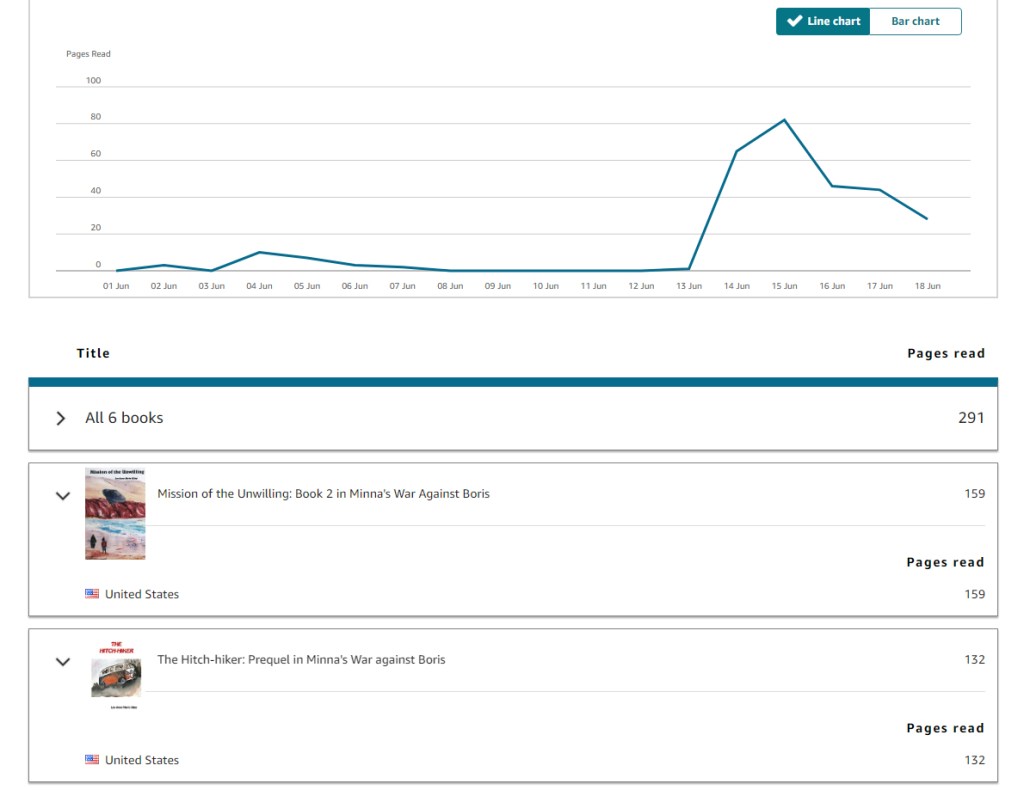
KENP—Kindle Edition Normalized Pages, is a programme exclusive to Amazon. If you opt for this programme you need to be exclusive to Amazon and not use other platforms to sell the kindle-version of your book. In this programme, a reader, who is a Prime member, meaning that they subscribe to Amazon for certain benefits such as Kindle Lending Library, can read any book in the programme for free. The advantage is that the author gets paid for every page the reader reads.
To see how your book is tracking on KENP, you can click on the KENP button on your report page and check out how many pages have been read. The Amazon report page will indicate if any KENP pages have been read.
*[Screen shot 4: KENP pages count]
What I have discovered recently is that as someone reads on KENP, the ranking of the chosen book improves, meaning potentially more readers, more sales.
Main Takeaway
What I hope you have gleaned from this gazing into analytics is that reporting on your sales may look scary. It may look discouraging if there are not many sales. But what I encourage you to do is have a go, click on your chosen platform’s “Reports” or “Analytics”, explore and get familiar with the graphs and information. Regularly check out how your book is faring in sales-world. I mean, a farmer regularly checks the rain gauge, the barometer and soil samples to improve productivity. The same is true of an author. Analytics is a tool. Use it.
It’s a wonderful feeling when you finally have your book written, edited, proof read and formatted and covered with a beautiful dust jacket or e-book cover. Now is the time to upload your book to a publishing platform but which one is the best for you?
There are many authors who do not want or need to sell their books online. Writers of local history, a memoir or an anthology of short stories put together by a writers’ group may choose to distribute their work without using online publishers. So, the first option would be to find a local printer and negotiate a number of copies and price. Mary McDee will explore this option in depth in a later blog.
Below I have listed the publishers that I have decided to consider when I publish my books. You can upload to as many or few publishers that you choose as they are not exclusive.
Amazon Kindle Direct Publishing (KDP) – This is the most popular platform to get authors into print. They are free and fast at getting your book available to readers. They have world-wide distribution and royalties are around the 70% mark. You will need to have an Amazon account so you can use the service. Amazon will publish e-books (to read on a computer, tablet or Kindle reader) paperbacks and even hardcover books. These can be ordered by the author for distribution or they supply a print on demand (POD) service which means a customer sees your book online and orders a copy which is then paid for (includes postage) and sent directly to the customer’s address. Amazon provide a plethora of tutorials and videos all of which appear to be user friendly. The process of uploading to KDP is meant to be easy but as of yet I haven’t tried it out. I will certainly be doing a blog about my experience in the near future. Amazon have a printing facility in Australia.
Google Play Books – this publishing platform is similar to Amazon but only does e-books. They have a Partner Centre for authors and you will need to open an account. An advantage of publishing on Google Play Books is that they have a recommendations system that makes it easier for readers to find your books using Google searches.
Barnes and Noble is another publisher who allows you to order e-books, paperbacks and hardcover books. It offers 70% royalties and is similar to other publishers.
Draft2Digital is a different type of publisher called an aggregator. They distribute your books to other booksellers. They have recently started to distribute print book on demand but not in all areas. It is well worth exploring the advantages of using Draft2Digital. They also offer a free and easy to use formatting service which I will explore in a future blog. The royalties for Draft2Digital are lower than publishing directly with other retailers.
Ingram Spark is another aggregator and they have a wide network of distribution to places like schools, libraries and retail chains. They excel at paperback and hardcovers, and you can use Ingram Spark in tandem with other retailers like Amazon. The royalties are less and they used to have a setup fee of $49 dollars but this has been waived since 1st May 2023. They also offer free revisions for a set period of time.
There are a number of other publishing services available for authors. It is important to be wary of publishers who demand fees for their services and always look carefully at any contracts especially relating to copyright.
Having a few different platforms presenting your books is referred to as Going Wide. This distributes your book to as wide a range of readers as possible. There are no restrictions to publishing on several different platforms at the same time. However, there are restrictions to using the same ISBN on different book formats. You have to have a different ISBN for a paperback, audio and hardback but you don’t need a ISBN for an e-book.
If you use Amazon and opt for Kindle Unlimited you have to be exclusive to Amazon. This is a service that allows readers to pay a monthly fee to be able to download any number of books they want. Authors benefit by getting paid by the pages read rather than the purchase of the entire book. You can opt to have your book exclusively on Kindle direct for a set contract time of 90 days or leave it there indefinitely.
I have provided an overview of the different publishing options. I recommend that authors explore the advantages and disadvantages of several sites and also seek more information on-line.






 Indie Scriptorium -- Self Publishing Collective