Do you write poetry? Do you wish you could write poetry but are not sure how to go about it? And just what is poetry anyway; what is it that makes it different from ordinary prose?
It might help if we start with a definition. The Macquarie Dictionary tells us that poetry is:
1. A literary work in metrical form.
2. The art of rhythmical composition, written or spoken, for exciting pleasure by beautiful, imaginative or elevated thoughts.
There are two phrases in there that are the nub of the matter: “metrical form” and “rhythmical composition” both of which seem more applicable to music than to stringing words together (which is, after all, what we do when we’re writing). But this is as it should be for poetry and music have a lot in common – not only rhythm and metre but performance.
As far as music is concerned this is obvious. As far as poetry is concerned however many of us don’t realise that it is meant to be either recited or read aloud in such a way that one can feel the rhythm; a rhythm that can be quite subtle; a rhythm that can change to reflect a change of mood… But a rhythm that must be there.
In order to achieve this we have to, at times, adjust or deviate from the conventional rules we must adhere to when writing prose in order to maintain the rhythm and/or produce a desired effect. There are many ways to do this: by omitting a word like ”a” or “the”; repeating a word or words; using a word with a different number of syllables; using a word with a different sound e.g. changing a short vowel to a long one or vice versa…
Breaking the rules in this way is called poetic license and is perfectly acceptable when writing poetry – so long as it is done carefully and with good reason.
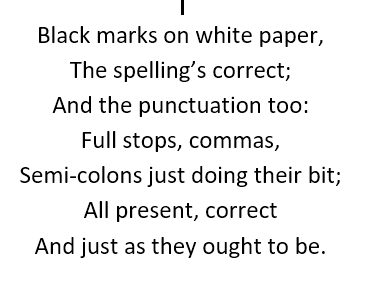
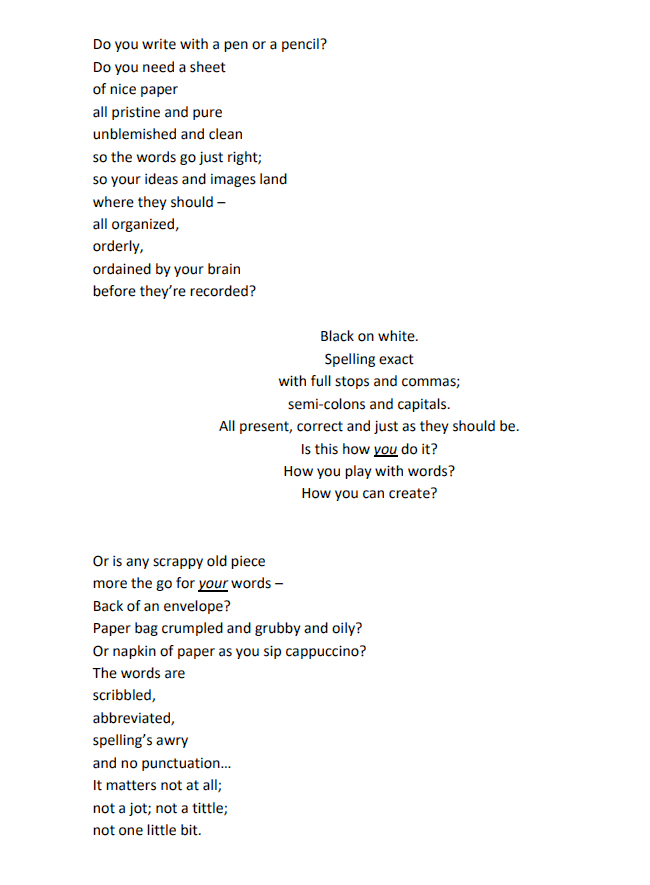
By way of example consider and compare the first (abandoned!) version of one of the verses from the poem “I want to be a writer but how do I do it?” that we blogged recently.
When I read this aloud to myself it didn’t “sing” right; it sounded clunky, clumsy and the reading didn’t flow easily. So it was “back to the drawing board” and I wound up with:
Much better, easier to read, flowed well to my mind. However, on re-reading since then I realise “precise” at the end of line 3 should be ditched, done away with, not necessary… Read it aloud both ways for yourself and see what you think re that word; those seven letters.
As with all writing – a work in progress!
By the way; poetry can rhyme; in fact rhymes often add a dimension and a level of enjoyment that would be lost in some poems. But rhyme is not the essential pre-requisite that rhythm is. Non-rhyming poetry is known as blank verse and is a legitimate form of writing; produced by such skilled practitioners as Milton (“Paradise Lost”) and Shakespeare.
In Adelaide we live in the driest state in the driest continent. (Inhabited, I mean.) Technically, Antarctica receives the least amount of rain, but, it is not exactly inhabited except for several hundred scientists from various countries.
Analytics
Anyway, back to dry, old Adelaide. There have been times when rain is scarce, and in some parts of the state of South Australia, past the Goyder line, rainfall per year averages less than 200 millimetres. Hence, when there is rain on our fair city, there are a number of us in the population who like to measure how much rain we have had. So far, this last month, since I bought a rain gauge, we have received 60 millimetres. Great times for our farmers.
You could look at “analytics” as you would a rain gauge, especially if you are an indie author.
Reports
Perhaps you have a book on the Amazon virtual shelves. You venture from the safe and comfortable “bookshelf” page and click on the ominous “Reports”.
If you had done this when you first published your book, you may have been delighted to see the graph sprouting columns/bars or a line rising above the base indicating you have made some sales. Naturally, you would have sold your book to friends and family to generate these sales.
*[Screen Shot 1: Amazon Reports—Bar chart of sales]*[Screen shot 2: Amazon Reports—Line chart of sales]
But then, a few weeks along, or months, and that graph has flatlined. Sigh! That line, as flat as the proverbial Australian desert and dry as an empty rain gauge in that desert. You have entered the “Goyder” zone of sales. You wonder what has gone wrong. Is it them? Or is it me? you ask.
In my experience, when the book sales flatline, nothing picks it up like a free promotion. Yes, you guessed it, giveaways. For example, Amazon allows free promotion for each book every three months. Free means no royalties, but is a cheap and easy way to advertise your book. People like free giveaways; they are like seagulls after chips. There’s nothing like that fuzzy feeling that someone out there has considered your book worthy to download to their Kindle to read…sometime…hopefully. Another upside is that your book’s ranking increases. 1st is tops, most popular, whereas 15 000 000th is not so…well, you get the picture.
***
*[Screen shot 3: Ranking]
***
The downside of free promotion is that probably the readers download your book but never get around to reading it. They collect all the freebies, because they are free. Also, if readers download your free promotion book and actually get to read it, they can’t actually review it, either by rating it, or comment.
Comments and Ratings
There’s a belief out there in Indie publishing world that positive comments and five-star ratings beget sales, which gives birth to a higher ranking. A higher ranking on the virtual bookshelf produces more sales. For this reason, and to discourage “vote-stacking” by big-name or not-so-big-name but savvy publishers who use their computer algorithms and fake identities to generate comments and ratings, Amazon has strict criteria for who gets to rate and comment. Let’s just say an episode of a popular ’90’s sitcom concerning soup and the person dolling out the soup, comes to mind. So, if you are fortunate enough to get some comments and ratings, thank your random unrelated reader for taking the time to appreciate your book and share their feedback about your work.
I encourage you who read our Indie Scriptorium team’s current and future books, to share your helpful and positive feedback of our books on the Indie Scriptorium website. Or you might like to visit our personal websites, to share your thoughts on our work.
Feedback is Feedback
Although you may not get much feedback on your Platform of choice book page, analytics of how the sales are faring, can help you track how your book promotion is tracking. Remember that once you release your book for publication, you need to promote your book and advertise. A book doesn’t sell itself.
The analytics may indicate your in a sales-drought. Flatline. Nothing happening. Don’t be discouraged. Be proactive. Look at ways you can promote your book. Advertising, free-promotion, taking advantage of the resources available, and consistently give your book a plug on your blog or social media platform.
On the other hand, hooray! You’ve had some sales. Make the most of the higher ranking, and as the farmers do when they have good rain, they plant seeds. Again, hook more readers through your blog posts or invest in more advertising.
Special Priority Programmes (like Amazon’s KENP)
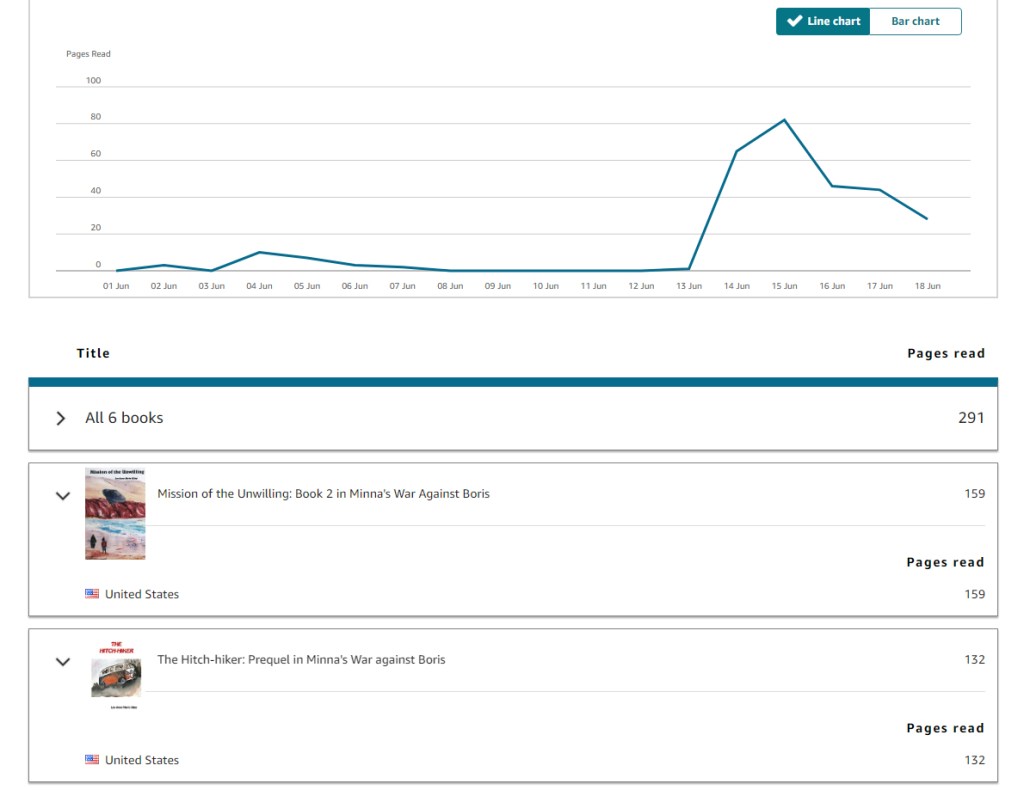
KENP—Kindle Edition Normalized Pages, is a programme exclusive to Amazon. If you opt for this programme you need to be exclusive to Amazon and not use other platforms to sell the kindle-version of your book. In this programme, a reader, who is a Prime member, meaning that they subscribe to Amazon for certain benefits such as Kindle Lending Library, can read any book in the programme for free. The advantage is that the author gets paid for every page the reader reads.
To see how your book is tracking on KENP, you can click on the KENP button on your report page and check out how many pages have been read. The Amazon report page will indicate if any KENP pages have been read.
*[Screen shot 4: KENP pages count]
What I have discovered recently is that as someone reads on KENP, the ranking of the chosen book improves, meaning potentially more readers, more sales.
Main Takeaway
What I hope you have gleaned from this gazing into analytics is that reporting on your sales may look scary. It may look discouraging if there are not many sales. But what I encourage you to do is have a go, click on your chosen platform’s “Reports” or “Analytics”, explore and get familiar with the graphs and information. Regularly check out how your book is faring in sales-world. I mean, a farmer regularly checks the rain gauge, the barometer and soil samples to improve productivity. The same is true of an author. Analytics is a tool. Use it.
It’s a wonderful feeling when you finally have your book written, edited, proof read and formatted and covered with a beautiful dust jacket or e-book cover. Now is the time to upload your book to a publishing platform but which one is the best for you?
There are many authors who do not want or need to sell their books online. Writers of local history, a memoir or an anthology of short stories put together by a writers’ group may choose to distribute their work without using online publishers. So, the first option would be to find a local printer and negotiate a number of copies and price. Mary McDee will explore this option in depth in a later blog.
Below I have listed the publishers that I have decided to consider when I publish my books. You can upload to as many or few publishers that you choose as they are not exclusive.
Amazon Kindle Direct Publishing (KDP) – This is the most popular platform to get authors into print. They are free and fast at getting your book available to readers. They have world-wide distribution and royalties are around the 70% mark. You will need to have an Amazon account so you can use the service. Amazon will publish e-books (to read on a computer, tablet or Kindle reader) paperbacks and even hardcover books. These can be ordered by the author for distribution or they supply a print on demand (POD) service which means a customer sees your book online and orders a copy which is then paid for (includes postage) and sent directly to the customer’s address. Amazon provide a plethora of tutorials and videos all of which appear to be user friendly. The process of uploading to KDP is meant to be easy but as of yet I haven’t tried it out. I will certainly be doing a blog about my experience in the near future. Amazon have a printing facility in Australia.
Google Play Books – this publishing platform is similar to Amazon but only does e-books. They have a Partner Centre for authors and you will need to open an account. An advantage of publishing on Google Play Books is that they have a recommendations system that makes it easier for readers to find your books using Google searches.
Barnes and Noble is another publisher who allows you to order e-books, paperbacks and hardcover books. It offers 70% royalties and is similar to other publishers.
Draft2Digital is a different type of publisher called an aggregator. They distribute your books to other booksellers. They have recently started to distribute print book on demand but not in all areas. It is well worth exploring the advantages of using Draft2Digital. They also offer a free and easy to use formatting service which I will explore in a future blog. The royalties for Draft2Digital are lower than publishing directly with other retailers.
Ingram Spark is another aggregator and they have a wide network of distribution to places like schools, libraries and retail chains. They excel at paperback and hardcovers, and you can use Ingram Spark in tandem with other retailers like Amazon. The royalties are less and they used to have a setup fee of $49 dollars but this has been waived since 1st May 2023. They also offer free revisions for a set period of time.
There are a number of other publishing services available for authors. It is important to be wary of publishers who demand fees for their services and always look carefully at any contracts especially relating to copyright.
Having a few different platforms presenting your books is referred to as Going Wide. This distributes your book to as wide a range of readers as possible. There are no restrictions to publishing on several different platforms at the same time. However, there are restrictions to using the same ISBN on different book formats. You have to have a different ISBN for a paperback, audio and hardback but you don’t need a ISBN for an e-book.
If you use Amazon and opt for Kindle Unlimited you have to be exclusive to Amazon. This is a service that allows readers to pay a monthly fee to be able to download any number of books they want. Authors benefit by getting paid by the pages read rather than the purchase of the entire book. You can opt to have your book exclusively on Kindle direct for a set contract time of 90 days or leave it there indefinitely.
I have provided an overview of the different publishing options. I recommend that authors explore the advantages and disadvantages of several sites and also seek more information on-line.
So, you’ve written your book, edited and polished it. It’s ready for the world to see. But how do you get your book out there, so that the world can see it? Rather than repeat the wisdom of many writers and bloggers who have come before me, I will summarise the avenues of publicity from my experience and research over the years. For more information, you can click on the links provided throughout this post.
Library—You may want money for your labour of blood, sweat and words, but your local library is a good place to start for making your book, if it is a hard copy, visible. There’s something about local authors and people who are interested in reading the world created by someone who lives in their community. If you are part of a writers’ group who meet in a local library, the library is only too happy to receive one of your books to put on their shelves.
In Australia we have Australian Library Services, an organisation who distribute books to libraries throughout Australia. One point to keep in mind when submitting your book to ALS, ensure that the quality of the printing is good, as a poorer quality book will not last the distance in the rigours of repeated borrowing.
Another point to keep in mind in Australia is that you are required to submit or register your book with your State Library and National Library. In the old days you had to trek into town to your State Library and deliver the book to them personally. Nowadays the National Library of Australia (NLA) has a website where you are able to upload your book for registration. I was interested to discover that NLA has been developing an online digital publication tool Trove where a treasure of historical and recent publications can be found. Another avenue where someone finds your book.
2. Family and Friends—never underestimate the value of family and friends to benefit from your book. Make the most of gatherings with loved ones or social outings to share your recent accomplishment (your book) in the hope that they will buy a copy. If not, your book maybe a handy gift for birthdays and Christmas.
3. Bookshops—Mainline bookshops and even small boutique ones can be a teeny bit snobby when it comes to accepting Indie-produced books for their shelves. Mostly, these sacred shelves are reserved for the books from traditional publishers. But, it’s worth a try. I had a friend who travelled down this footpath with her book and with perseverance and her gift of salespersonship, she was able to get the vendors of some big booksellers to stock her book. Even made some sales. She said the downside of having her books in the bookshops is that it can take some months for the books to sell, so no profit until they do. Added to that was that some bookshops sold the book and “forgot” to pay her.
4. Writers’ Fellowships or Genre Group such as Australian Society of Authors, or Romance Writers of Australia can provide support for your work and an avenue and ready audience to receive/buy your work. After all, if you are part of a Writers’ Group, they, who have helped you produce the book will only be too willing to receive a copy (probably free as they helped you, didn’t they). That being said, they have family and friends who may like a copy too and pay for it.
5. Online Publishing Platforms: eg. Goodreads, Smashwords, Amazon—I personally have published my books through Amazon. As the biggest online retailer, and the fact that I found uploading the book to Kindle and also the facility to have my books printed, made it a no-brainer for me. One thing to say, when publishing your book, you need to be patient and careful to read the proof copy to prevent typos and glitches from being published. Take the process slowly, don’t rush or panic. Engage the help of a friend if you feel wobbly about the whole computer-technical side of Indie publishing through a digital platform.
A website, Your Publishing Guide, has extra information that may help you choose which and how many platforms to use.
6.Blogging/Website offering your book as a PDF or link to your book—When I began my Indie publishing venture, a younger, more tech-savvy friend advised that I should have developed my blog or website months before publishing my first two books. They said that my book sales would have been better if I had had a “following”. Eight years down the track, so to speak, and with over five hundred followers, not sure if that’s true, but, hey, every little bit helps. And, every so often, I make a sale.
7. Word of mouth (always keep your “business card” handy…and a box of your books in your car)—most of my hard-copy books have been sold this way. People ask, “What do you do?” I answer, “I’m a writer.” Next I’m telling them about my book and offering my business card, and a copy of my latest book. And they buy the book.
8. Coffee Shops—often you see in coffee shops books in a little pile or on a shelf for customers to read when they are sipping their drink. Just the other week, Mary McDee and I spied a locally produced book on the shelf of our favourite café. Gave me an idea to offer one of my books to add to the pile.
I might add here, since it is more community than library, that it does no harm to add your book to the collection of books offered in a community library. You know, those book boxes that have popped up all over the suburbs on footpaths or next to community centres and the like.
9. Markets and Fairs—if you have more than one book on offer, or you collude with one or two friends who have published books, hiring a stall or table at a market or fair might work for you. My experience was that the sales were not forthcoming. At fairs, people are looking for cheap homemade and second-hand items, not brand-new books. Also, you need to cover the cost of the hire of the stall or table. Never-the less might be worth a try. I’d reckon that if you had a regular stall at a market, and had other creations to sell like art, cards, craft, clothes even, you may have more success selling your books.
10. Clubs as a guest speaker —ie Probus, U3A, church, Rotary. When you write and publish your book, this is what you sign up for. If you published through a traditional publisher, they would expect you to deliver on this sort of publicity. Most of my books have been sold through book launches (at church) and being a guest speaker.
11. Online Promotional Services —ie ISBN, Amazon advertising. I’ve noticed that the ISBN agency are regularly sending information and advice to me through email on how to promote my books. When you register your book with the ISBN agency, they require you to give a synopsis of the work and provide the book cover and blurb. Same with any sort of advertising. Ensure that your synopsis, blurb and cover attract the reader by being eye-catching and engaging. For some helps you can read Elsie King’s posts on “Publishing tips—Writing a Standout Synopsis” and her recent post on “Publishing Pointers—The Book Cover”.
12. Social networks —ie Facebook, Twitter, Instagram. All I can say about this is that it’s yet another way to lead potential readers to your book. The main advice I have read over the years of blogging, is that you need to stick to one platform and not get all tangled up with dozens of social media platforms. Go with the one that works best for you and then link the other platforms to that one. I have stuck with WordPress as it is a safe place and well regulated to keep out the likes of Trolls and Spammers. Then I have set up the links to Facebook, although I had to become an administrator of a new Facebook page. I had links to Twitter, but it never really went anywhere, and now has flown the coop.
I might mention here that I have an Author page on Amazon. Not sure about other people’s experiences, but I have found the page basic with very little scope for editing mistakes made by me. For example, it insists on calling me “Mrs. Lee-Anne”. Really? Bit strange in the 21st century.
***
One thing I have learnt from my publishing adventure, is that I have made discoveries and have grown along the way. I have received some feedback that I need to spoon-feed my audience with a step-by-step guide on how to…whatever the topic is. However, in the words of a teacher friend of mine, “We learn by doing, not just hearing.” Besides, there are many step-by-step guides out there on the web and I doubt another one by me would make much difference for the tech-challenged. So, for all who have yet to launch into the world of publishing your book and distributing it, the best way of getting your book out there is by being bold and doing just that: have a go and get your book out there.
[As mentioned in my recent blogpost on Tru-Kling Creations, May is our family’s party month. So, I figured Indie Scriptorium needed a break from “Publishing Pointers” and I’d give the readers (and my party-self) a little break and discuss the art of storytelling for a change.]
STRANGER THAN…
Bizarre tales: Road trips gone wrong, planes vanish, people disappear, and bodies turn up packed in suitcases…the type of stories that inspire movies or perhaps novels. Or do they? At times, real life events seem so unreal that if we were to publish a novel about it, our audience would slam it as not believable. Yet as news, people absorb it like sugar, craving more; the more absurd, the more they devour it.
A part of us enjoys the fantasy, the off-centre. It’s as if we want more to life than what is. I reckon my family’s no different. While driving on the way to Magill, Mum, my son and I discussed the latest bizarre news story of a road trip gone awry, the Kadaicha man and how my alien character Boris might be involved in the evil in the world. You can read what mischief and mayhem Boris gets up to in my novel Mission of the Unwilling, The Lost World of the Wends and novella, The Hitch-hiker, both available on Amazon.
My friend who has read all in the War Against Boris series, remarked that when a certain plane went missing in 2014, she was sure Boris was behind it.
And back to the news, the search for alien life-forms continues. Subterranean liquid beneath the surface of Mars has made scientists hopeful of alien life—bacteria at least. It’s news. We want to know, do aliens, sentient beings from worlds other than Earth, exist? Or are we, as humans, alone in the universe? Are we God’s unique creation? Or one of many of God’s image in the universe? Does it really matter? Why is it so important we want to know?
My novels are science-fiction fantasy and there will be some out there who roll their eyes and sigh, “Not interested”. I know, most people I meet like their murder mysteries and romance novels. But there are some, more than I expected, who have a fascination for adventure exploring the universe and other worlds, where anything is possible.
The reason I started with science fiction back in my youth was the result of certain people I’ve met and certain issues I faced. Oh, how I wished I could have written all the issues involving such characters back then. But no, I was told, I can’t. I’d upset such tender egos if I were to write about my experiences relating to bullying, harassment, women’s rights, relationships, attitudes and values of the time. We’re talking ‘70s and ‘80’s here. Still, unless such issues are discussed, how can they be resolved?
But, how could I present these issues for discussion? My solution, write these stories in fiction, science fiction. In the world of outer space and stellar travel, I could convey stories of the issues facing our world, and in my life. With some metaphorical distance, I put these issues on the virtual table, open a dialogue and minds to grow and change.
Our lives, our worlds are bubbles. We live within these bubbles of the world we know. The bubble of our worldview and attitudes filter the way we see the world, how we interpret what we see, how we form our values and our narrative.
No one wants their bubbles burst. It’s the reason we don’t really listen to another’s point of view. Really listening means confronting another’s world-view—a world alien to our own. We’d rather shut the other person down, treat them as the “other”, the enemy, than have our bubble burst.
Fantasy and fiction allow us to safely enter other worlds, explore other attitudes and values, expand our worlds and grow. And although we fear the bubble bursting, we crave the more, what exists outside our bubble. How often haven’t we said, after reading or hearing a way-out story on the news, ‘I never knew how the other half lived.’
Aliens are all around us. They are the “others” and their stories. When we really listen and enter another’s world, the world and stories they offer are limitless. Everyone has a story. Connecting with others, face to face, through literature, through the internet, through the arts, opens us to grow as individuals and collectively.
It’s creativity that connects us as a community. Through art we share the world as we see it. Music interprets the themes and emotions of the heart. In writing, we interpret life through words. Our stories involve characters, people—whether in a fantasy world, spaceship, a town or home, or a road trip—people clashing, colliding, interacting and learning to blend in acceptance and unity.
The story of our lives and relationships is a journey where we rejoice what we have in common and learn to celebrate our differences. Through this process, we may discover that reality is stranger than our craziest imaginings. Better still, we come to the realisation that it’s not sameness that unites us but embracing our differences.
In my last blog, I suggested that getting a professional illustrator or buying a ready-made book cover is the way to go for most writers. Purchasing a cover, you like and fits with your genre, can be easy and time effective and doesn’t cost too much.
If you can work with a graphic designer or illustrator, it will cost more but may be worth the money to get a cover that attracts readers and markets your book. A good illustrator can provide images of your characters and this may be super important if you have imaginary beasts and extra-terrestrials you want to introduce to your readers visually.
I wanted a book cover that used my original artwork and reflected the Regency era as well as the genre. I looked at many websites offering pre-made covers and couldn’t find a template that was anywhere close to what I wanted.
I played in Canva and Microsoft Word and came up with a few ideas but found the process time consuming and sometimes frustrating. I also don’t have the technical skills to get the quality of the image right. To purchase programs like Photoshop is expensive and just wasn’t worth it for a few covers. So, I have now engaged a graphic designer to help me achieve the cover I envisage.
However, if you want to try to do your own cover design and have the time to play, I will provide some basic exercises that will lead you in the right direction.
Working in Microsoft Word
The word program is not an easy option but is doable if you have the time and energy to fiddle. It does often mean that you will disappear down a rabbit hole and emerge much later with a cover design, or not.
Step 1: Open a blank document. (Go to your tool bar and select “File”, then select “Blank Document) Choose custom size that best suits your book size.
[Screen shot 1: Selecting a blank document]
Step 2: Select “Layout” in your tool bar and put in some margins that reflect the size of the cover you want. I suggest a standard size such as 15cm x 23cm (6 x 9 inches) You can decide on your own margins by clicking the arrow besides the margins diagram and scrolling down to custom margins and then setting the margins to best suit your cover size.
[Screen shot 2: selecting Layout]
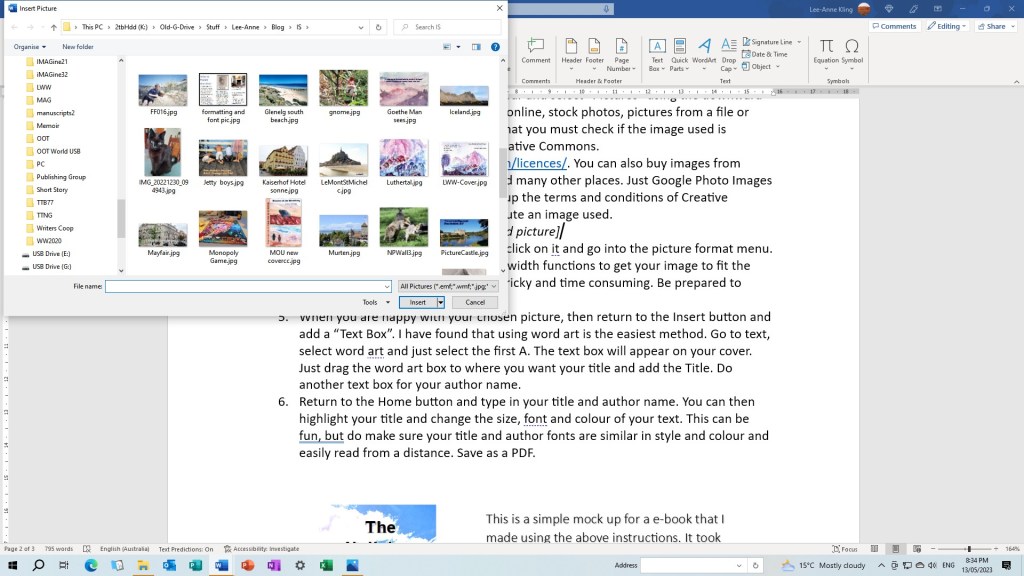
Step 3: Click your mouse on “Insert” in tool bar and select “Pictures” using the downward arrow. You can select an image from online, stock photos, pictures from a file or from your photos. Please be aware that you must check if the image used is copyrighted. I select photos from Creative Commons. http://creativecommons.org.au/learn/licences/. You can also buy images from places like Shutterstock, Pinterest and many other places. Just Google Photo Images to buy, or similar. It is worth looking up the terms and conditions of Creative Commons licences and how to attribute an image used.
[Screen shot 3: Inserting your selected picture]
Step 4: Once you have selected your image, click on it and go into the picture format menu. You can use the crop and height and width functions to get your image to fit the size of your front cover. This can be tricky and time consuming. Be prepared to experiment and learn as you go.
[Screen shot 4: Formatting your picture]
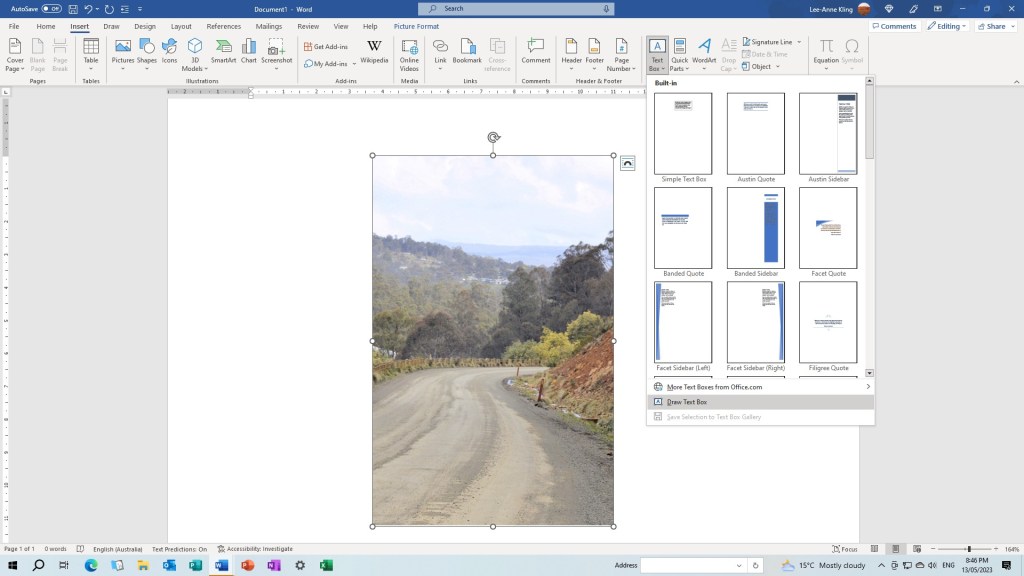
Step 5: When you are happy with your chosen picture, then return to the Insert button and add a “Text Box”. I have found that using word art is the easiest method. Go to text, select word art and just select the first A. The text box will appear on your cover. Just drag the word art box to where you want your title and add the Title. Do another text box for your author name.
[Screen shot 5: Text Box]
Step 6: Return to the Home button and type in your title and author name. You can then highlight your title and change the size, font and colour of your text. This can be fun, but do make sure your title and author fonts are similar in style and colour and easily read from a distance. Save as a PDF.
This is a simple mockup for an e-book that I made using the above instructions. It took several hours to complete. There are a host of videos on You Tube which give more detailed instructions that I would recommend you look at. To complete a paperback cover with a back cover and spine you will need to do further research.
There are many programs on YouTube that will demonstrate a more sophisticated, and possibly easier ways of designing a book cover. Good luck, I’m going to a professional.
Recently I was chatting to a fellow writer who told me that years ago she’d had a book accepted and published by one of the big-name publishers. It was a textbook in her field of expertise and intended for teachers. She’d been thrilled; it sold well and she’d been paid her share of the profits. All good.
That was many years ago and her book has been long out of print but, now retired she continues to write; is deep into a novel and a leader in her writer’s group. When she mentioned the name of the publisher I was particularly interested as I too had once been offered a contract on a book for teachers that I was in the throes of writing. This was many years ago but, unlike her, I refused to sign the contract I was offered.
“Why on earth not?” You might well ask.
Ever since I learned to read I’ve been bewitched by print; always had my nose in a book; accused of “even reads Weetbix packets” … So I read that contract carefully and got my knickers in a knot over two of the items hidden away in all the legal verbiage: copyright ownership and payment if there happened to be the need for a second edition.
As far as the first of those two went; the big-name publisher would own the copyright if I signed that contract. No way! All those words, the book I’d been labouring over was my precious baby. Nobody else was going to own it; have control; do what they wanted with it.
Regarding the payment issue: the contract stated I was to receive 10% of the sales price. Fine. I knew that was more or less the going rate, standard procedure. But then it went on to say I’d only get seven and a half percent if there happened to be a second edition. This made no sense to me. Surely a second edition would be easier, simpler and cheaper to produce as all the set-up stuff would be in place so it would be nothing more than a reprint.
At the time I was inexperienced and totally unaware that most contracts are negotiable. So I simply clenched my jaw; dug my heels in; squashed my feelings (thrilled, validated…) and wrote a polite note of refusal – no reason given. Which was stupid, I know now. But back 8then I had no-one to help or advise me.
Ever since I’ve checked to see who owns the copyright of any book that comes my way! As a by-the-by; the copyright of virtually every book produced by that big name publisher is owned by them. Which means the author has probably been duped due to a combination of excitement and trust (i.e. ‘trust’ being lack of knowledge re the importance of checking).
We are always told “Buyer Beware”. And the same applies to contracts – if you are ever lucky enough to be offered one.
When asked to write on this topic, I thought, What am I going to say that is new and enlightening? Another “reinventing the wheel” moment was creeping up on me and I seriously considered deferring the topic for a later date.
Glad I didn’t.
After some research, mostly on the trusty internet, I discovered some gems of information that I never knew before or had forgotten. Or is it a case of changing trends?
I first published, indie-style, back in 2015 through CreateSpace. After diligently doing my research on formatting and fonts for producing a hopefully professional quality print book, and then following the advice given on CreateSpace, I converted my Word document to PDF and uploaded it to the scrutiny of CreateSpace. After a week of uploading several more corrected copies of my book, getting the margins, formatting right and ridding the document of that mysterious phenomena, embedded text, finally “they” were happy and congratulated me on successfully publishing my book.
Ah, those were the days.
Since then, CreateSpace has been taken over by Amazon. Which is fine. Amazon also has plenty of advice and a step-by-step process to make the whole ordeal of uploading one’s precious work for publishing a pleasant experience.
So, asked to do fonts and formatting and I thought, Simple; for formatting, use template provided by Amazon, or whoever one chooses to go with to print one’s books, and select a popular and familiar font that is reader-easy. How hard is that?
When I began the research, I began to understand why. In the eight years since I published The Hitch-hikerand Mission of the Unwilling, changes in how to present one’s body of work had crept in.
So, thus enlightened, here are…
10 new, and maybe not so new, facts I have learnt about fonts and formatting:
The body text of your print book should be in a serif font. A serif font has little flourishes or links at the base of the character that make the words easier to read. New Times Roman is an example of a Serif font.
Headings or captions—San Serif, “san” meaning “without”. So without the little bits at the bottom of the letter that make the words easier to read in a body of text. But they make good headings or captions. Calibri is an example of a San Serif font.
Some fonts are under licence, and you have to pay for that license if your book is going to print. Even some fonts offered by Microsoft Word were not exempt from having to pay the price of print. And here I’d been using my favourite font with abandon. A font that was recommended by CreateSpace back in 2015. On further investigation about fonts offered by Microsoft word, I found Microsoft’s explanation for the use of fonts. In the Microsoft Website it states:
Fonts that come with Publisher do not have license restrictions, which means they can be embedded in your publication and printed anywhere. Fonts that do not come with Publisher, however, might be restricted.
Well, that’s good to know. After all, we pay a yearly subscription for Microsoft Office, so there should be some benefits.
4. Popular font “Garamond” has been around since the 16th Century and was invented by Claude Garamond who was a Parisian engraver.
5. Avoid downloading free fonts. You might end up downloading a virus.
6. Your font is recommended to be 12pt in size. Well, that’s news to me. Way back in 2015, the recommended size of font was 11pt. Are readers’ eyes needing a larger font?
7. Line spacing is recommended now to be 1.5 spacing. I must confess that a little more space between the lines is easier on the eye. Now, with my novella, The Hitch-hiker, I formatted with double spacing and I felt that the book looked like it was aimed at junior high school level. However, with my other books, I had the normal 1 space to minimise the number of pages. More pages in a book, more the book costs.
8. A popular print book size is 15cm wide x 23cm tall. That’s with the book closed. When put into print form on the page, the spread of the two pages side by side is 30cm across. However, there are options for variation. Your professional printer or publishing platform should provide you with the options. For breathing space, set your margins to 2.5cm on all sides. I remember reading a very popular fantasy book bought from a well-known bookstore. The margins in that book were too narrow. After reading for hours, I suffered cramp in my thumb after pressing the spine to hold the book open to read this very thick book. So, be kind to your readers and don’t give them thick-book-narrow-margin thumb. Again, your printer/publishing platform should have parameters for you to follow. They might even provide a template into which you can copy and paste the body of your text.
9. For fiction writing, indent paragraphs by 1cm. For non-fiction, paragraphs can be divided by one line space. Check other books in your genre to see what the formatting conventions are and follow suit.
10. Don’t forget to insert page numbers. No need to number the title page, though. Odd numbers are on the right hand page, and even numbers on the left.
What do you know, once I get started, I virtually can keep on going. However, there’s plenty of information offered on the internet, or in books on the subject. Below I have listed references I have found useful to help you on your way to publishing your book/s.
Wishing you all the best as you tackle this next stage in indie publishing.
Think of the book cover as your best marketing tool.
Imagine a potential reader is browsing the shelves or a table at your local bookseller. They love historical romance and they browse to find their favourite authors. None there, so then they browse for similar books to try out. It is the cover that will attract this reader, so it has to be right.
The book cover is the full wrap-around. It includes the title, artwork and author’s name. The Spine provides the title and author and the back includes the blurb, the ISBN and publishing details.
What makes an excellent cover?
It should scream out the genre through the use of design photos, images and art.
Display the title and author in a striking but easy-to-read font and style.
It must be beautiful and use colours that reflect the contents.
The design should grab attention, be unique, but also contain elements that are popular in the genre. It pays to do the research.
Can you make your own cover?
Most self-publishing groups recommend you hire a professional to design your cover, especially if you are not an artist or a technical wizard using a computer. I suggest you save up some money and pay a professional.
Finding a designer is a matter of a few easy searches on Google using the keywords, “book cover designs” and there will appear a long list of companies offering to make a wonderful book cover just for you. The prices vary a lot and can be anywhere between $500 and $800 dollars.
You can also buy book covers that are pre-made. If you add something like “Paranormal Romance book cover” in your Google search, you will find an array of potential designs where you just add your title and the author’s name to a pre-made design.
Pre-made designs include the front cover, back cover and spine, and each design is unique. Browse the designs and choose one that suits your book, and this may be a simple and cost-effective way for you to cover your book. Remember that you will need your back cover blurb, ISBN, reviews and whatever author information you wish to include. The costs of using a pre-made is cheaper than having your cover made up from scratch. The average price for an e-book and a print edition is between $100 – $300, but there is a lot of variation.
If you want something unique, contact a graphic designer and/or illustrator. What’s the difference, you ask? A graphic designer uses licensed stock photos and images. An illustrator will create your cover design using your characters and ideas from your book.
But what if you want to be the designer? You may have a specific design that is not on offer anywhere, or you want to have full artistic control over your book. Perhaps it is a matter of cost. Be warned that designing a book cover for self-publishing requires time to master the elements of book cover designs and technical skills. Not for the faint-hearted, but yes, it is doable. More on this next time.
Places to look for more information: Reedsy.com>book-cover-art -, Canva for design templates. Elite Authors, Paper and Sage Book Cover design. Explore their websites as they have some interesting and informative articles.









 Indie Scriptorium -- Self Publishing Collective