I recently had the pleasure of attending an author talk given by Australian rural crime writer, Fleur McDonald. My friend, who is an avid fan of Fleur, booked tickets then invited me along.
I’ve only been to a few author talks at Adelaide Writer’s week but this was a local event at the Hallett Cove Civic Centre and Fleur is a South Australian born writer, so I was happy to attend.
As an emerging author, I also wanted to get some ideas about how to plan an event. You never know I might get invited to talk about my own writing experience some day.
Local author Nina D. Campbell interviewed Fleur. and this worked well. They covered a lot of interesting topics. Much of the talk centred around Fleur’s life as a mother, farmer and aviator. She also touched on her history as a writer, her research, writing processes and delved into a few of her characters. It was a funny and entertaining presentation which was thoroughly enjoyed by the audience, including me.
The organisation of the event was excellent with a comfortable venue, free wine or soft drinks, lots of promotional banners, a local bookstore selling the books and of course book signings. It was a superb night.
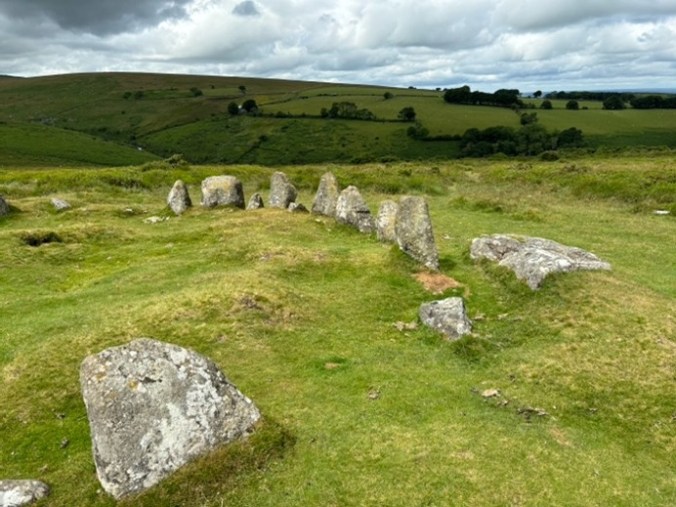
Why is it there? What was the meaning? Who raised the stones? Why? All of these questions foster ideas for a story, poem, an opening scene or a theme for a novel.
Then practice painting this picture with words. Describe the colours, the view, the atmosphere created by the clouds and light. Put a character in there and give them a dilemma.
Add a suitable quote from William Shakespeare:
“And this our life, exempt from public haunt,
Find tongues in trees, books in the running brooks,
Back in January I found out about an upcoming competition. With regular life in suspension and a bit of time on my hands I thought – “Give it a go. Why not? Nothing to lose.” One was required to write a memoir – couple of thousand words and a cash prize. Beyond the address for submission there were no more details.
But what exactly is a memoir? As a keen member of a local camera club, I’ve had photographs disqualified as “out of category” or “didn’t meet the brief”. I didn’t fancy putting time and effort into a couple of thousand words to have them peremptorily discarded in such a cavalier fashion. Obviously, memory is involved. Is it just autobiography or is there some twist I’m not aware of? Bit of research seemed to be in order.
The first dictionary I consulted (fairly simple; from my schooldays) told me it was “an autobiography; a reminder”. I had a sneaking feeling that for this writing competition there was a bit more to it than that. So, off to my great big two volume Shorter Oxford to discover that this word has been in use for centuries. Way back then, half a millennia ago, it simply meant “a note; a memorandum; a record – often an official one”.
A couple of hundred years later it had morphed into something much closer in meaning to our twenty first century perception – “a record of events or history from personal knowledge or from special sources of information”. All connected to memory and autobiography but with a bit of a twist as well in that interviewing then writing an account of someone else’s memories seemed to be in order too. Right then though I was more concerned with my own personal recollections of my own life.
My very earliest memory is of a big wooden table in the middle of a dim room. I was sitting in my highchair at one end of the table; to my left, a door standing ajar; a window next to it and beyond the verandah the gentle slope of a sunlit, golden hillside. I was aware of the rest of the house to my right, behind me and away across the table in the far wall, there was another window with, next to it, in the corner a wood stove, shrouded in shadow. However, my attention was caught by movement outside on the hillside. It was a rabbit or more probably a hare, lolloping across; stopping to nibble or look around before continuing its leisurely progress. The Easter Bunny! I was filled with immense excitement.
Now, so many, many decades later, I have no idea whether that was my own idea or whether my parents had suggested it. I was four months past my second birthday; the memory and the magic of it still clear and vivid.
My memories of a happy childhood are not at all a story continuing through the years but a series of pictures, many pictures randomly stamped on a blank canvas, like vignetted photos: crystal clear but with blurred edges. The competition? The time on my hands somehow evaporated. Life last January has also become a blur.
“Life is too short to stuff a mushroom.” Shirley Conran.
I want to welcome Berenice to Indie Scriptorium and congratulate her on her wonderful blog about procrastination. The problem of procrastination is something I don’t struggle with very often. My nemesis is overcommitment and that can have the same consequences as procrastination.
I am currently writing my fourth novel, editing my third novel, have provided manuscript feedback for several fellow writers and foolishly decided to go back to university to complete a Bachelor of Letters in Creative Writing. I can cope, it is doable, I can study and write.
I tried for five weeks and realised it was definitely not doable. The university course was exciting and stimulating but I’ve discovered a novel length work requires a singular commitment.
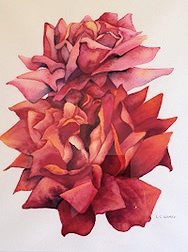
Writing a novel for me requires both writing and time to let your conscious and sub-conscious brain work out plot holes, motivations and what your characters will do and say next. It is as complex as drawing up roses and then getting all the petals formed, coloured and shaded to complete a satisfying painting. The university topics were fabulous distractions and something had to go.
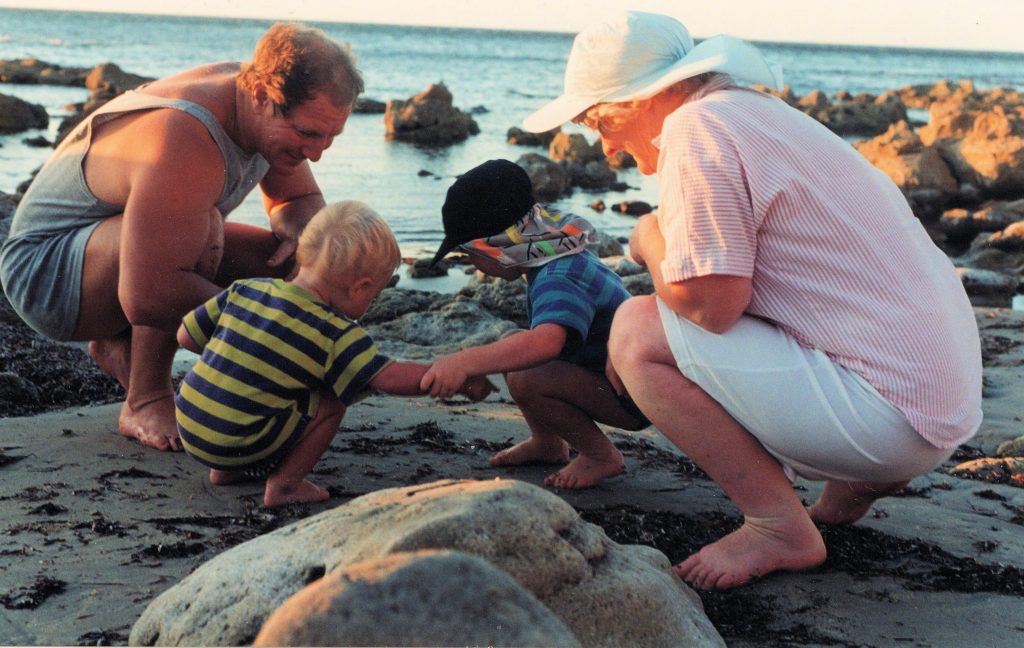
George had never been on a holiday in his life. Yet, here he was on a school camp, water swirling around his ankles as he stared at the wide expanse of ocean. Exploring some rocks, he peered into a rockpool, and saw something shimmering under wavy seaweed tendrils. He pulled it out, scattering some little crabs. Peeling the fronds off the thingamajig he saw that it was a disc with squiggles instead of words and a hole in the middle. ‘How strange,’ he thought, ‘what is it? Definitely not Australian.’ He was keen to know if he’d found a treasure.
Have a Happy and Blessed Easter. As it is the Easter weekend and in keeping with our months of memoir, a story of my Easter break in 1986, camping in the Gammon Ranges with my father and future husband.
THE BIRTH OF “BUNYIP CHASM”—THE PAINTING
You need to loosen up with your painting,’ my art teacher said.
So, with a palette-knife, I did with my painting of Bunyip chasm.
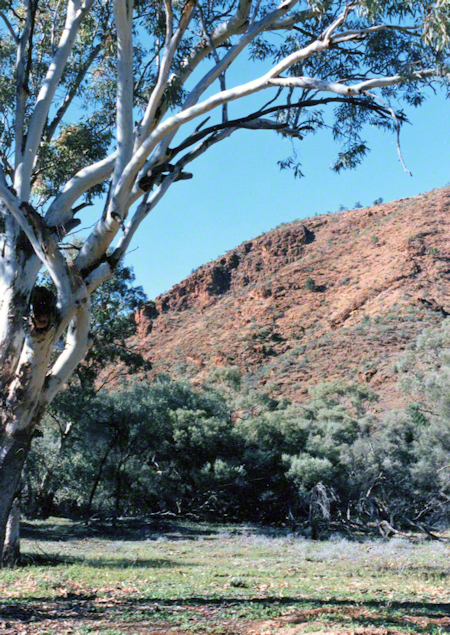
Over the Easter break in 1986, Dad took my boyfriend (future husband) and me to the Gammon Ranges. Dad had gone there the previously with his photographer friend and he was keen to show us some of the scenic secrets these ranges held.
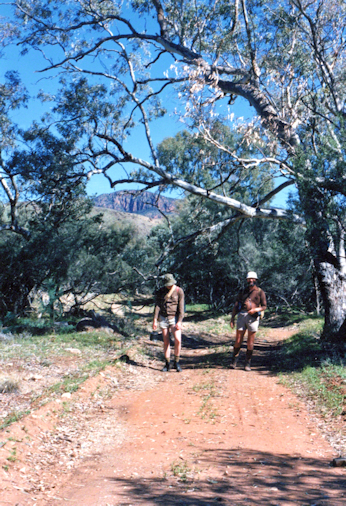
We bumped and rolled in Dad’s four-wheel drive Daihatsu down the track into the Gammon Ranges. We camped near Grindell’s Hut, backpackers’ accommodation. A murder-mystery from the early Twentieth Century involving the hut’s owner, spiced our discussion around the campfire that night. Then we set up a tent, for boyfriend, on the ground above the bank of the creek. I placed my bedding also above the creek under the stars. Dad opted for his “trillion-star” site underneath a river gum. No tent for him, either.
The next day Dad guided us along the Balcanoona creek bed shaded by native pines to Bunyip Chasm. After an hour or two of hobbling over rounded river stones, we arrived at a dead-end of high cliffs.
‘Come on, we better get back,’ Dad said and then started to hike back the way we came.
We trailed after Dad. Although native pine trees shaded our path, the hiking made me thirst for a waterhole in which to swim. I gazed up at the lacework of deep blue green against the sky and then, my boot caught on a rock. I stumbled. My ankle rolled and twisted.
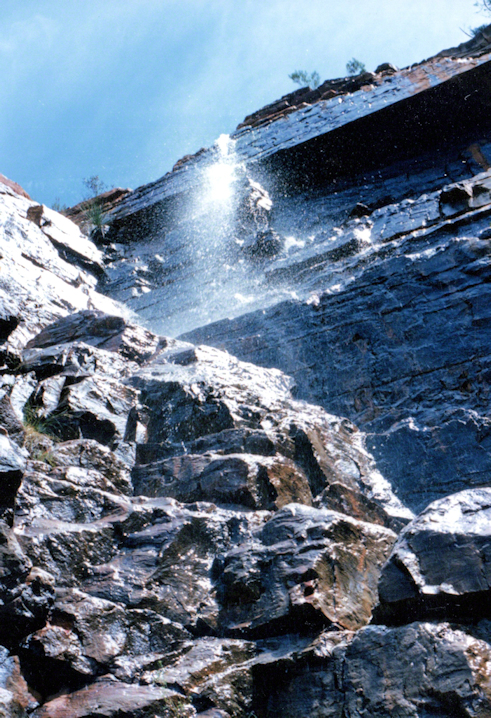
After about ten minutes, with my ankle still swollen and sore, I hobbled after the men. We climbed down a short waterfall and at the base, I looked back. The weathered trunk of an old gum tree leaned over the stream, three saplings basked in the late-afternoon sunlight against the sienna-coloured rocks, and clear water rushed and frothed over the cascading boulders and into pond mirroring the trees and rocks above.
‘Stop! Wait!’ I called to the men.
‘We have to keep on going,’ Dad said and disappeared into the distance.
Boyfriend waited while I aimed my camera at the perfect scene and snapped several shots.
Then holding hands, we hiked along the creek leading to our campsite and Dad.
‘I’m going to paint that little waterfall,’ I said.
We walked in silence, enjoying the scenery painted just for us—the waves of pale river stones, the dappled sunlight through the pines, and a soft breeze kissing our skin.
[In memory of my father Clement David Trudinger (13-1-1928—25-8-2012)]









 Indie Scriptorium -- Self Publishing Collective