From Draft to Print
In 1986, all pumped up from a successful finish to my university degree, I began writing my “Great Australian Science Fiction” novel. I chose Science Fiction because I thought it would be easy to write.
Hah!
At every opportunity, I inflicted the latest chapter of this rough and raw work on my friends.
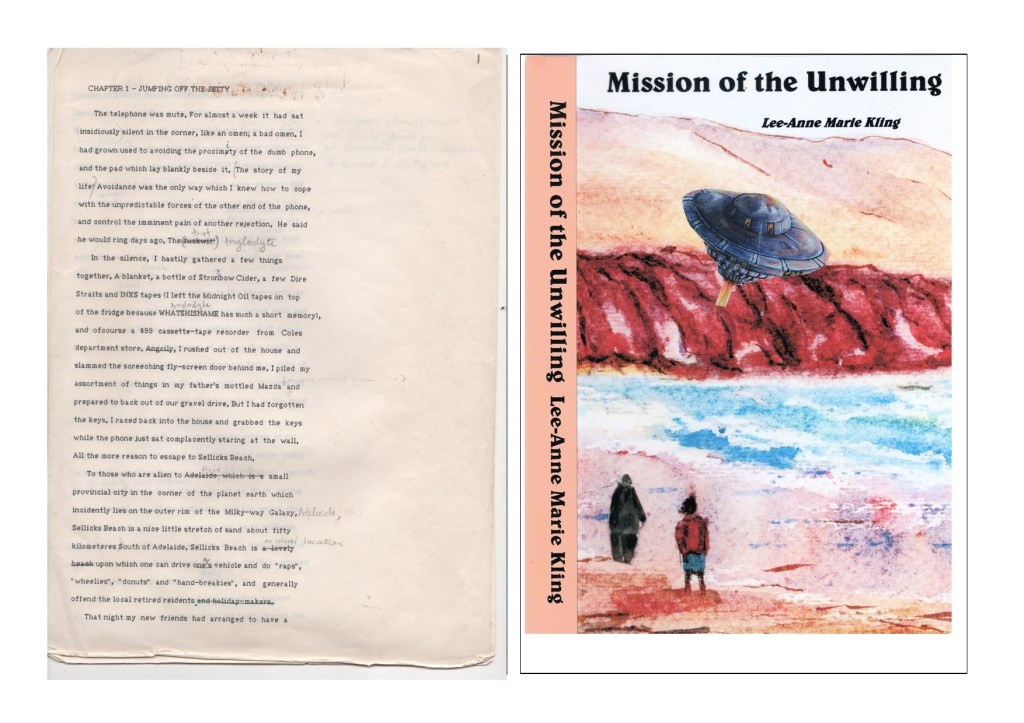
Below are the first few paragraphs of the very first draft of “Mary’s Story”, which 30 years later would be Mission of the Unwilling, written in 1986. The reason the title changed? Well, frankly, my writing mentor at the time thought the title, “Mary’s Story” was a bit lame. So, the book title had to change to something that would grab the reader. As a result, the main character had a name change.

Here I am inflicting this piece that needs a great deal of TLC to polish it into shape, so you can see that I was just like any other hopeful author, making all the mistakes common to novice writers. Have a look and see what you would’ve changed to improve this piece.
Twenty years passed. The manuscript languished in the cupboard. Unfinished. I had progressed halfway through. Lost my way. Lost in space and time, you could say.
Then a spark, and an idea. The story changed and continued to its end. As technology had progressed from Commodore and floppy disks to Windows PC and CDs, I had to rewrite the whole novel. Not a bad move, actually.
After printing off the reams of paper that made up the book, I took it to my uncle who was in the writerly business.

Suffice to say, he was not amused and gave feedback: Basic errors like no page numbers and glaring grammatical mistakes to using a ridiculous amount of speech attributions. It would seem that my years of motherhood had been detrimental to my writing craft. Bad habits in my writing had developed. He recommended joining a writers’ group.
Writing is a craft that requires honing skills and words to impact the reader in a positive way. Test readers, editors, fellow writers are essential to a manuscript developing from a rough draft to a polished piece ready for publishing. There is no shame in reworking or rewriting a story.
I recall my writers’ group mentor saying that with feedback: listen to it, consider it and if it works for you, implement it. If not, put the suggestion aside. It’s your writing, it’s your voice.
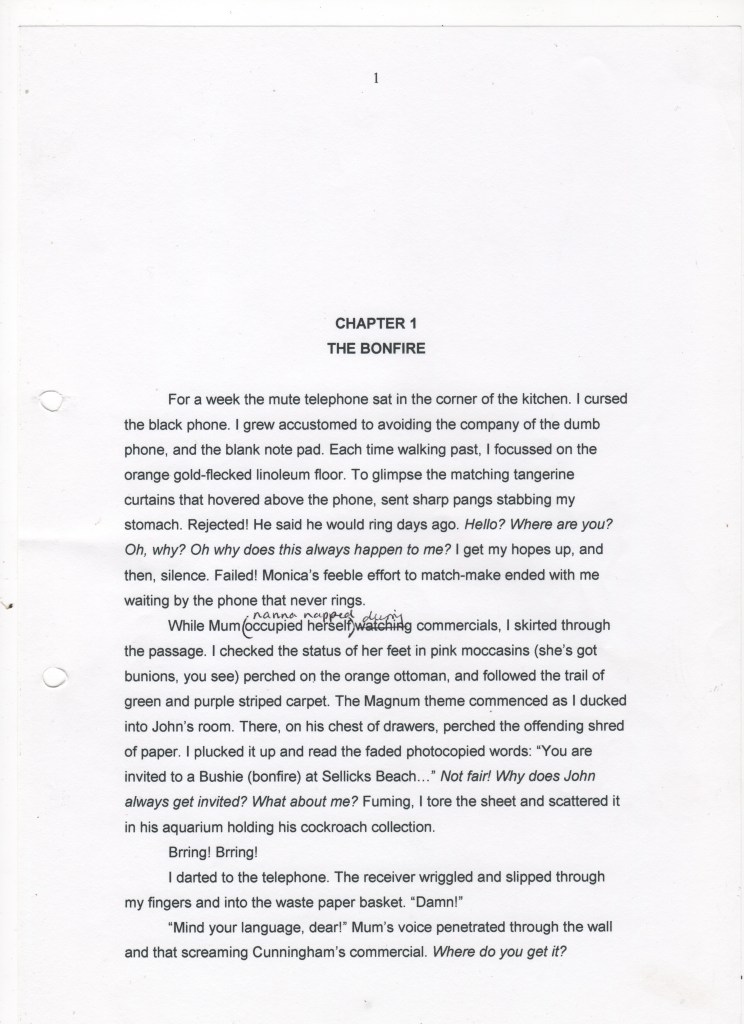
You may see in the sample 4 and 5, that I took most of what my writing mentor advised. There were suggestions further on in their manuscript appraisal, that I didn’t agree with. One was the use of the expression “Man!” which they said wasn’t used in the 1980’s that it was only an expression that turned up in the 1990’s. I begged to differ, as I lived through the 1970’s and 1980’s as a teenager/young adult and behold, I remember the expression “Man!” being used; not just locally in Adelaide youth circles, but also on the television.

[4. Sample of mentor’s feedback]
My mentor stressed that we need to consider our readers. Who is our audience? What do you want your story to say to them? Is the story for entertainment? Or do you have a point to make? In the end, you won’t be sitting alongside them and being able to point to a word and say, “Sorry, I didn’t mean that—this is what I did mean.”
Our written work needs to stand on its own literal two feet and make sense to the reader without the author having to be the virtual translator, and thus committing the mortal writing “sin” of “author intrusion”. Author intrusion is when the author tells the reader how they should see, think and understand the narrative. For example, think of “author intrusion” like explaining the punchline of a joke.

[5. After many more drafts, and 30-years later—Mission of the Unwilling, those paragraphs as they were, published in 2015.]
The editing process never ends. More changes in 2022: A cover aligning with the War Against Boris Series, a new “preamble” chapter, more proof corrections and formatting done to make a second edition. check out Mission of the Unwilling as it looks now.
The final result is about refinement of the work: sentence tightening, word tweaking, word cutting and polishing the prose. All through revising and proof-reading.
Now I know you’re all hanging out for the nitty-gritty; the how do I make my writing good? Make it shine? How do I make my story clear and interesting for my readers?
For a start, invest in a good “How to Write” or “Grammar and Spelling” book. The reason we have and learn this language tool of grammar is to keep us all speaking and writing our particular language on the same page. It’s like a cake recipe. Follow the recipe, the cake bake is a success. It’s so that we understand each other. Adhering to the grammar and spelling rules helps readers understand what you have written. Not misunderstand. Of course, rules can be broken for effect, but you need to know the rules of your writing craft well to have the skill to know how to bend (or even break!!) them.
As I have mentioned in previous blogs, the World Wide Web is full of resources for writers. So, no need to “reinvent the wheel”. I have mentioned Microsoft Word Editor and Grammarly but there are other websites out there you can search for and find.
Our own Indie Scriptorium’s Mary McDee has some good grammar tips which you can look at. Click on the link here on her post on the Little But Important Words as an example.
I come back to the lesson I learnt from my dad: Keep It Simple.
Use basic sentences. Avoid purple prose. Use strong verbs and choose words that are understood by most readers. Be consistent.
After all, the aim of reading is for the reader to have an experience they find enjoyable and worth their time.
© Lee-Anne Marie Kling 2024
Feature Photo: First draft of manuscript and the final Mission of the Unwilling Cover



 Indie Scriptorium -- Self Publishing Collective