Points of View in Story-telling
This blog was planned to discuss Deep Point of View (PoV). However, as I went through the previous blogs published by Indie Scriptorium, I realised we had omitted to talk about points of view in general. I decided to do a quick catch up on this important topic for writers.
Point of View in writing identifies who is telling the story. There are three main points of view to choose from: first person, third person and omniscient. The second person point of view can be used but is rare in fiction.
Discussions about PoV’s can be complex and difficult to get your head around so I will try to keep it clear and simple.
- First person point of view – the story is written through the perspective of one character at a time and follows own their experience with everything else unknown to the reader. It is dominated by: I did, I saw, I thought, I felt etc. In most novels it follows only one protagonist but some books do have multiple first-person points of view. This PoV is mainly used for character development based stories and allows the reader to have an intimate relationship with the protagonists. It can limit the writer by its narrow focus but provides intimacy and immediacy. Applied to a frog it may read thus:
I surfaced into a dull, grey day. The water is cold. My stomach is empty so I look to the sky for an available fly but there are none. I am hungry, cold and lonely. - Third person PoV is a popular choice for novelists and there are a range of options which provide an author with a choice of perspectives.
Third person limited (sometimes called Deep PoV) is when the author writes as if from the inside of the character. Everything is filtered through that character’s senses, thoughts, feelings, experiences and opinions. It is useful to use when you want to focus on one character as they confront the dramatic elements of your plot.
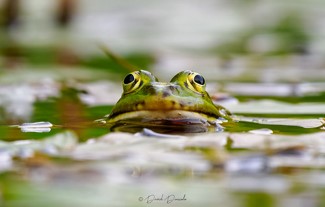
The frog surfaced and felt the cold breeze. It looked around for flies and felt its hunger. There were no sounds of other frogs. It was alone. Third person remote is when the character is described as if from a point away from the character. This style is more useful when you want to focus on the plot and have multiple characters. The frog stuck it’s head out of the water. It looked around for flies but there were none. It went hungry. - Omniscient – or “God view”, in that the story is told by someone who knows and sees everything. It was a popular way of telling a story in the past. Think of Charles Dickens or Jane Austen where the author’s opinions and reflections are important in the telling of the story. Frogs are tailless amphibians, cold blooded and mostly carnivorous with a diet of insects. They live in small groups on both land and water. The frog illustrated has typical bulging eye and appears to be looking for food.
Many writers tend to select the PoV that they find most comfortable for both reading and writing. I love books written from the third person PoV and struggle with first person PoV. So, when I started writing I naturally wrote in third person.
There are also trends in acceptable writing conventions. Historically the omniscient PoV was popular but in modern times first and third person PoV novels are most common. In recent times many people strongly advocate for the third person limited PoV as it engages the reader with the characters and makes the writing zing. In fact, some editors and judges of competition see anything but Deep PoV as poor writing. This has become a rule that deserves a separate blog, so stay tuned.
There are lots of good articles on line with further information about PoV. I found
Complete Guide to Different Types on Point of View: Examples of Point of View in Writing provided examples and exercises. https://www.masterclass.com/articles/complete-guide-to-point-of-view-in-writing-definitions-and-examples
Also look at the Jericho writers blog, Points of View in Fiction Writing by Harry Bingham. https://jerichowriters.com/points-of-view-in-fiction-writing-with-plenty-of-examples/
For a comprehensive discussion about PoV I suggest, Self-Editing for Self-Publishers by Richard Bradburn ©2020 Reen Publishing. (pages 315-335)
Cheers Elsie
Elsie King © 2024
Feature Photo: Frog © This Photo by Unknown Author is licensed under CC BY-NC-ND
 Indie Scriptorium -- Self Publishing Collective