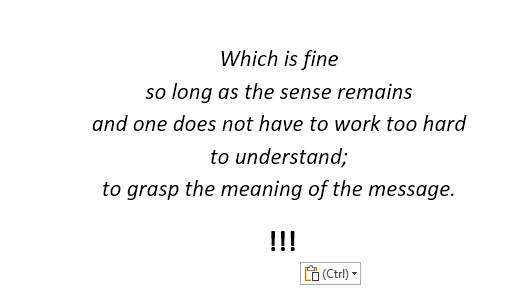
A while ago we gave you a blog about apostrophes and the two apparently different jobs they do. In actual fact, however, their jobs are not so very different as both uses indicate something has been left out thus effectively shortening the statement – a thing we tend to do when talking. Which is fine so long as the sense remains and one does not have to work too hard to understand; to grasp the meaning of the message.
Back then we concentrated on the apostrophe of possession (AKA the apostrophe of ownership or belonging) and gave you the example of how a string of apostrophised words can make perfect sense with the little nonsense story of “Jan and Her Gran”.
The other use of the apostrophe (also known as a “raised comma” but in grammatical circles is referred to as the “apostrophe of contraction”) is, in a sense, simpler as it reflects what we all do when talking: run words together so that two or three sound like one. This means that, when writing, we omit a letter (or letters) along with the space between the words.
I’ve become aware for several years of a move to dump apostrophes all together as the correct use of them is seen as too hard; confusing; not necessary; writing would be simpler…; too many people don’t know how to use them…
If they are taught well all these objections are virtually non-existent. In my experience as a school-marm all my working life I know that pretty well every eight or nine year old can learn to use them appropriately.
What fascinates me is the effect ditching the apostrophe of contraction could well have on our reading of such words as he’ll, she’ll, we’ll, she’d, we’d, can’t, won’t, I’ll. Pause a moment and consider each of these minus its apostrophe.
Reading written English can be a challenge at the best of times due to a number of factors I won’t go into here. So why on earth make it harder than it need be? Surely what we really need is simple, effective teaching that explains things clearly.
Just in case you had a bit of trouble visualising the effect of omitting the apostrophe on the short list I gave you above:
Admittedly, this last is not commonly used these days. But, according to my big, fat, two volume Shorter(!!) Oxford Dictionary there are no less than ten separate, distinct meanings for “cant” varying from “dispose of by auction” and “jargonistic” through “bold, brisk, lively, hearty” to “push or pitch sideways”… Just to list but a few of those ten!!
To recap what I said in the beginning about making changes to the language:
Self-publishing a book is a wonderful goal but it certainly isn’t the end of the road. The book does not get into the hands of readers without marketing.
So, how do you get your book noticed, bought and read?
I read somewhere that the best form of marketing is to write the next book. That makes a lot of sense to me as the release of the second book, anthology or short story draws attention to what you have written before.
The business of marketing can take up a lot of time and attention and it’s difficult to get through all the steps you need to market your work and still have time for the joy of writing the next book/story.
This blog will explain my strategy for my own modest marketing plan:
What is your goal?
If you are like me my primary goal was to have a novel published. I don’t need a liveable income from writing. I don’t expect to be a best seller and if I cover some of my expenses I will be happy. So, my marketing strategy was modest and relied on word of mouth and the generosity of friends and family to buy my book and spread the word. If you have given up your day job and have the rent or mortgage due, you will need a much more vigorous marketing plan.
The basic essentials that I used are:
Business cards with an e-mail address and web site address. You can add your phone numbers and address if you choose.
A website that is connected to your social media accounts and where you can post covers of your books and have links to the sites that sell your book. Then tell everyone possible that you have a website and ask them to visit.
Do regular blogs on your web site and post to social media.
Organise a launch party. My release coincided with a big birthday so I invited guests and asked that, in lieu of presents they buy a copy of my book. I then ordered 35 author copies of the book and sold them to friends and family. I sold 34 books with promises of online orders too.
I’m a member of Romance Writers of Australia so will take five copies of my books to the 2023 Sydney conference and put them on the Indie table for sale along with my business cards and a free card (A giveaway displaying my artwork)
I have advertised my novel on the RWA website and in their magazine Hearts Talk.
I paint as well as write so put my business cards of the back of my paintings
Copies of my paintings have been made into cards and my website address is on the back of the card next to the copyright.
Indie Scriptorium web site also advertises my books. I and my fellow members write regular blogs about the self-publishing process. We have a small but increasing following and go world-wide. My website is linked to the Indie Scriptorium website.
Indie Scriptorium will launch a book of our accumulated blogs about self-publishing as well as an anthology of writing, poems, artwork and photograph early next year. Our individual novels and books will be included in this launch.
My fellow writers in IS plan to get a display table of art, cards, books and other advertising at local craft markets.
I intend to contact local writers groups and offer to give an information session about the process of self-publishing my book. Hopefully sell a few books too.
That’s the plan for now. I intend to review my sales strategy from time to time but now I’m going to start writing my third novel.
Further to my comments a few blogs ago re rhythm in poetry there are a couple of points I feel could do with clarification:
Rhythm is dependent NOT upon words but on the syllables that make up those words. While a word is at times only a single syllable (e.g.cat/dog/plant/then/through/thought…) many have two or more syllables (i.e. are multi-syllabic).
However, looking at that list of single-syllable words above it is obvious that the number of letters in a written word has little or nothing to do with the matter. Syllables are based on the number of sounds rather than the number of letters used to represent those sounds in the written form of the language.
All spoken language consists of two sorts of sounds: vowels and consonants; the vowels themselves come in two sorts: short and long. In English there are six short vowels – the middle sounds in pat/pet/pit/pot/putt/put. All the rest (14 in all) are long. To name but a few for example: the middle sounds in pool/paid/peel/pout/pipe/part/pert/port/pose.
The consonants on the other hand (25 in all) are the first one or two and the last sounds in all the examples above – apart from “through” where the last sound is “oo” (as in “soon”). Quite clearly, spelling in our written language and the sounds of the spoken language seem to bear little relationship to each other. But in saying that I’m teaching my grandma to suck eggs; aren’t I? Regardless of the fact that it is syllables and therefore the sounds of those syllables that are critical to rhythm I won’t go into all the intricacies here as it distracts from what I need to say about rhythm in poetry.
If the rhythm doesn’t “sing” properly when you read your poem aloud it is the syllables you must consider: maybe change a three or four syllable word to one of two or three (or vice versa) or remove a word; or add another; or repeat a word or a whole line or… Maybe you need to change a short vowel for a long one (or again, vice versa!).
The permutations can be seemingly endless. Just keep playing with it until it feels right when you read it aloud. Remember: poetry is music using words instead of notes and, like music, is meant to be performed. We miss much of the joy of poetry if we simply skim the words on the page; eyes only.
Secondly, prose marches across the page, words side by side like an army, ranks of soldiers filling the space. Poetry is more like a company of dancers, short lines, long lines, single words, spaces, positions on the page…
By simply changing the length of lines in a poem you can change the mood entirely. By way of example consider two versions of the A.A. Milne poem “Happiness”:
These 16 short lines give a beautiful, clear picture of John’s joy as he stomps around; jumping in puddles; splish, splashing in the rain. No words detailing any of this. But no words needed. Now read aloud those same words arranged differently:
How did that feel to you? Much slower; much more thoughtful is how it seems to me; almost as if he’s looking at his wet weather gear and wondering if it’s worthwhile going to the bother of putting it all on just to go out in the rain. Wouldn’t it be better to stay inside by the fire and read a book?
By the by, in the second, longer, more discursive version I found myself saying “has” instead of “had” as I was reading it. A small point indeed. But this is a lot of what poetry is about – small points can have a big impact!!
And another small point with a big impact: all the capital letters in the original provide emphasis plus; an emphasis that adds to the mental picture of a small boy stomping around, splashing in puddles, having a joyously wonderful time and to hell with the rest…
Do you too feel that it adds to the whole thing in a way that mere words alone could not possibly do?
The Trials and Tribulations of Making a Print Copy—My Recent Journey with Amazon
That little tool, “Create a paperback” beckons. Sounds enticing, doesn’t it?
You’ve launched your e-book, perhaps on Kindle, as I did, and then you notice the offer to make your “baby” into something tangible, a paperback.
One reason you might be tempted, is that many of your friends say they want something tangible, a hard copy of your book; they don’t do e-books.
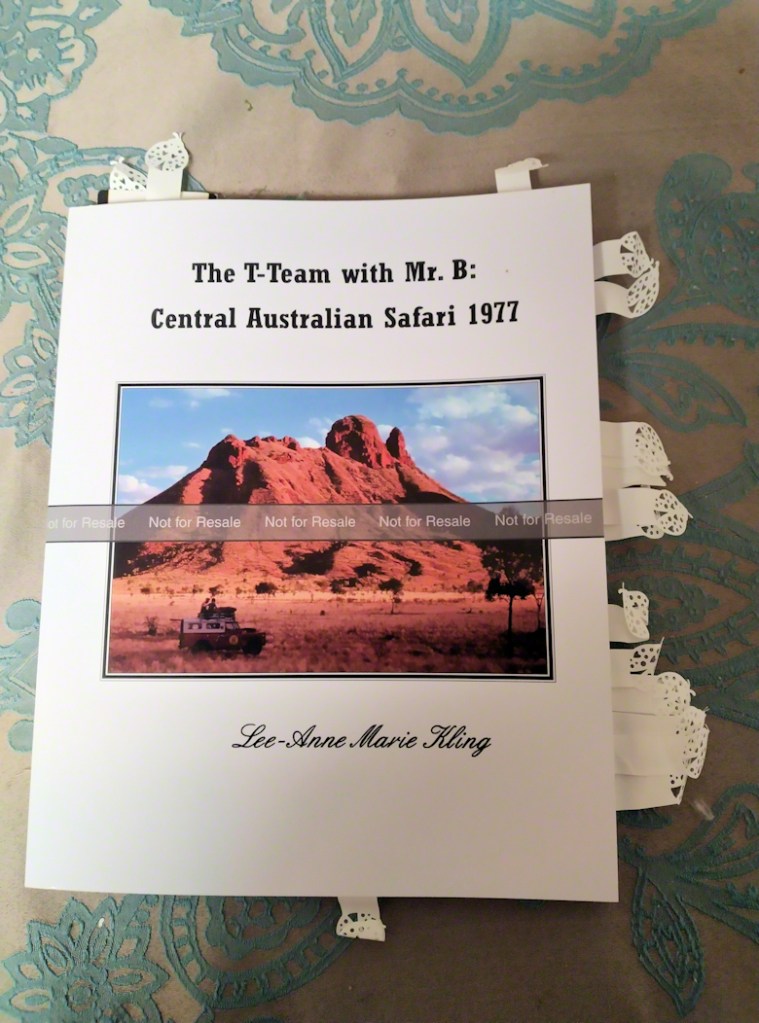
Hence, after my latest e-book, the T-Team with Mr. B went live, I set about the process of making a print book through Amazon. Since my travel memoirs are designed to be a “coffee table” book with entertaining travel stories and colour photos, the page size is not the standard novel format (5”x7” or 6”x9”), but slightly larger at 8”x10”. You’ll notice that I am using Imperial measurements rather than metric. And here lies the problem as an Australian indie author. Just as certain International space programmes can be brought down by the Imperial vs metric discrepancy, so can designing your print copy of your book fall foul of what I’m calling the Imperial computer programme used by Amazon. It seems I fall in this trap every time I attempt to make a print copy of my latest book.
You see, the Microsoft publisher programme I use to design the book cover is in metric. I looked at ways to convert it to Imperial, but such secrets remain a mystery to me. Instead, I use the “Inches to Centimetres” converter found on the internet. This I did and created my book cover which is (8”x10”) x 2, for front and back cover, plus .35” for the spine. In metric that is 20.32cm x 2 plus .9cm for spine.
So far, so good.
Once I inserted the pictures, title and blurb for the back, I then saved the file in Publisher. Then I converted the publisher file to PDF.
Looking good…
With my body/text/manuscript file formatted (for 8”x10”) and also converted to PDF, I was ready to begin the process of making a print book on Amazon. Click on “Create paperback” and follow the prompts. Make sure all required fields are filled in. Then upload the body/text file and cover. Before proceeding to pricing, which is the next page, it is important to launch previewer and check book for errors. Errors will be highlighted.
This is where my attempt at creating a print book came undone. The manuscript was fine, no problems, but the powers that be (computer programme and people who check) had issue with my cover. Each time I loaded it up, “error” in bold red letters glared at me. I uploaded it several times, each time adjusting the cover so that all images and lettering, especially related to the spine, fit in the designated parameters. After about five attempts, the manuscript and cover were accepted, and I ordered a “proof copy”.
Although Amazon quoted ten days for the proof to arrive, it came in three days.
The important thing to remember with proofs is that they are there for a reason. Take time to thoroughly check the proof, not just the cover and how it looks, but on the inside. Seeing work in print helps discover errors and typos. Just because someone proofread your manuscript beforehand, doesn’t make it immune from typos that have been missed. I found a whole heap of Mr B’s that should have been Mr. B.
After addressing the typos and errors in my proof, I set about uploading my manuscript, once again. My cover also had an issue; one of those infernal Mr B’s. I corrected the typo which required another visit to Publisher. That was my mistake.
Satisfied that my cover and manuscript were the best they could possibly be, I uploaded the work for Amazon’s perusal. They were happy with the manuscript, but not at all happy with the cover. In the process of adding just one tiny little dot after Mr, I’d inadvertently used the wrong sized cover size. Worse, I had saved over the “approved” cover from the proof.
Twenty uploads later, I was still no near the elusive approval for my cover. Even when all the images and text were neatly inside the red rimmed parameters. Again and again, the same error message plagued my cover’s existence: “Your expected cover size is 16.602 x 10.250, your submitted file is 16.599×10.000.”
I began writing down my progress, or lack of it.
Eventually I worked out that the wording was my stumbling block and discovered that “submitted” is the “variable”, meaning it can be changed, but “expected” is the constant, meaning it can’t be changed. I decided to go back to my publisher files and make both the “submitted” and the “expected” files match in size. (16.602”x 10.250” or in metric: 42.169×26.035cm) I found a ready-made “paper size” that matched the “expected” and slotted my cover made into a JPEG into the page.
And…it worked!
Elsie King was comforted by the fact that it took me all Tuesday to work this out. When we came to do her historical romance, A Suitable Heir, we nailed it in one go.
We are both looking forward to receiving our print copies in the mail in the next week.
We, at Indie Scriptorium are celebrating this week. Two of the group, Elsie King and I, have published our works as e-books.
Elsie’s historical romance, A Suitable Heir is available now on an array of platforms, Elsie having used the “Draft2Digital” platform to promote her novel.
Below is a post from my blogsite written way back in 2016 when I published my first two books which details my journey from self-publishing to promoting and advertising through blogging.
BURIED GOLD
People spend their lives building their own kingdoms. As artists or writers, success is determined by how far our name-brand is spread over the “Empire” of the internet, world, community, and how much “gold” (money) we’ve amassed through the sale of our product.
When I first started exhibiting my paintings, friends, family, and fellow artists asked, ‘Have you sold?’ and ‘How many paintings have you sold?’
The fact that I had sold made me an authentic artist.
Same can be true as an author of two self-published works of fiction. Again, like a broken record, those interested asked, ‘How many books have you sold?’
Answer, ‘Er, um…not that many.’
Then the implication I should have gone through the traditional route of getting a publisher.
Yup, maybe, probably…still deciding if I’ll do that with future books, especially the travel ones that have many colour photos on glossy pages—the coffee-table variety. Not sure how I’d go…I mean, I’m not an unpublished “virgin” since I’ve gone ahead and self-published on Amazon. I got impatient, afraid I’d be left on the shelf with a pile of rejection letters, and my novel manuscripts languishing as a PDF-file on my computer hard-drive (the hard copies stored in a box in my closet).
So, I published The Hitch-hiker(a novella) and Mission of the Unwilling(novel), on Amazon October 2015. Check them out. You can download them for the cost of a cup of coffee and find out what mischief Boris gets up to.
After publishing, having a little launch in our South Aussie pre-Christmas summer sweltering in 40 degrees Celsius, then a DIY advertising with bookmarks, flyers and emails, I decided to do some research on how other Indi-authors built up their e-book kingdoms. There must be a secret method for digging up the buried gold of success in sales.
A mine of information was brought to light my computer screen. I also discovered a precious nugget in an old Australian Artist Magazine—stand-out quality. In today’s language, I assume that means “brand”.
So, when at our SALA exhibition launch, a friend told me they knew which paintings were mine, that I had a unique style, I thanked them. I was on the right track with my “brand”.
But my books? Well, there’s Boris…albeit swamped by millions of other characters on Amazon.
Then, I discovered a gem—blogging. Not in the way I anticipated, though. I had high hopes. With my blogging presence, out there, I expected sales to rise and hundreds of instant visitors to my blog-site. My works were brilliant, right?
My posts drowned under the deluge of millions of other posts, tweets, Facebook pages, and other more successful blogs. For weeks, I remained South Australia’s best kept secret. Even my mum couldn’t find me—not even with my help on her computer.
Fellow writers at my writers’ group suggested I needed to post articles more frequently, get those WWW-“neural”-pathways working by increasing traffic. In other words, Algorithms. Still, the site remained as lively as a cemetery.
Over time, I gathered a band of followers: friends, family, colleagues from church, writers’ and art group. Some interest ensued—all Australian—no likes.
Undeterred, I wrote and published posts once or twice a week. Writing, my therapy. The articles available for free, my gift to the world. I prayed that there’d be others out there who’d find my words, and consider them useful, inspirational, amusing.
Week by week, comments and likes (mostly from mum) trickled in. Then, a comment from someone I didn’t know…and a visitor from the United States. Oh, what joy!
A friend encouraged me. I’d improved since they first started reading my blogs. Yes, writing is a craft; the discipline and practice refined my skill to communicate.
I read posts from other bloggers. I liked the posts that resonated with me. I knew I must start commenting. Friends who had websites and blogs said that’s how you make your presence known in the blogging community. I usually read WordPress articles late at night and was concerned my comments would come across as sleep-garbled. Eventually, I plucked up the courage to comment. I think my first comment was about cats.
Each month, slow and steady, the number of followers, likes and visitors grew. My site on WordPress, the first place I visit each day when I open my computer. What countries have visited today? Check the emails. Who has liked me? Who’s following? Then, off I go and visit their sites and see what gems of writing, stories, photos, or paintings they have.
My world has opened—stories from every continent…and my stories shared around the globe.
The treasure I found by entering the world of bloggers, is not the gold I collect in my bank account (which is a few cents or dollars every month or so) for my own kingdom from my own works, but the cities of gold we share collectively as writers and artists. We put our stories out there and celebrate each other’s works.
So, a heart-felt thank you for all you who have followed, liked and visited my humble site—and thank you all for your stories, insights, artwork and photography.
Formatting is getting your manuscript ready for a publisher to go to print. If you are going with a traditional publisher, it is still advisable to format your manuscript, so it is set out like a book, made easy to read to stand out from the slush crowd.
I have outlined the various formatting programs available to try.
Word Formatting
I have used Word to format two novels and a short story for competitions with Romance Writers of Australia. I found the process was time consuming and you have to be pedantic but I, and many authors use Word to format their books.
Below is a list of requirements that were required for a story in the RWA anthology.
My experience showed that consistency is essential. I have listed the main points.
Have a consistent font and size.
Make sure your computer is set for Australian English or whatever region you choose.
Make sure your quotation marks are consistent. Either all single or all double.
Em dash — and ellipsis … don’t have full stops after them and need to be consistent.
Use italics for inner thoughts throughout.
Either don’t use or use full stops for salutations throughout. Mr. or Mr but not a mix of both.
Have consistent spacing between lines.
Use centred scene breaks. You can use *** or ~*~ but check on the requirements of the publishing platform.
Use one or two spaces between sentences throughout your manuscript.
Use the find and replace function to check on things like spacing at the end of a paragraph or mistakes in your typing. Select the entire manuscript and go to home/replace and type ^p in the find field, then type ^ p in the replace field and click on replace all. It will let you know if there are any changes.
Delete all tab indents. Select the entire manuscript and go to Layout, Paragraph, Tabs and change the default tab stop to 0cm and click on clear all and select OK.
Then indent all paragraphs to a set amount, usually 0.5cm for novels. Do not use tabs or the space bar as this can cause problems with downloading your document.
Check that your line breaks are consistent by highlighting the document and then use the find and replace window. In Find enter ^l (lowercase L) and click on replace all. (^ is found in the functions key on the keyboard)
I found formatting with Word was doable but required time and careful instructions to make it work. There are other options.
Kindle Create
Kindle Direct Publishing provide a free program, Kindle Create to assist indie authors upload to KDP (Amazon). They have a tutorial which allows you to play with Jane Austen’s Pride and Prejudice and learn how to use the program. Download and install the tool and then you can practice. You need a cover to use this program and they also advise you use an index to make navigating the manuscript easier for the reader.
Draft2Digital
As discussed in a previous blog Draft2digital is a publisher who can distribute your books to many book stores online. They will publish your e-book and paperback and they also offer a free book formatting service and they don’t insist that you use them as the distributer. They also have good tutorials so you can try out the program before you download your own book. Unfortunately, they also need a completed cover. (I used a draft cover)
You will need an account with D2d. It’s important to fill out everything in your account, particularly the tax form and payment system. You can review your bio page and edit it in account.
Uploading your manuscript into the formatting program is tricky. D2d can do your meta data such as dedications, copyright page and others, but it might not be what you want. Also be sure to put your release date in advance unless you intend to publish immediately.
Before downloading your word MS document to D2d make sure all your spacing for chapter headings, scene breaks and other inclusions are consistent. This helps with the formatting download.
You cannot edit once D2d downloads the MS. If you need to make changes you have to edit the word MS and then upload it to D2d again. I did this multiple times until I got the formatting right. It’s tricky.
Vellum and Atticus
These formatting programs are very popular with indie authors as they are easy to use. They are not a cheap option. Vellum, which is only for MAC users will cost about $380 in Australian dollars ($250 US) while Atticus is for Android PC’s and is about ($150 US).
It is probably worth buying if you intend to publish many books.
Good Luck – I will discuss the download and publishing in my next blog.
Do you write poetry? Do you wish you could write poetry but are not sure how to go about it? And just what is poetry anyway; what is it that makes it different from ordinary prose?
It might help if we start with a definition. The Macquarie Dictionary tells us that poetry is:
1. A literary work in metrical form.
2. The art of rhythmical composition, written or spoken, for exciting pleasure by beautiful, imaginative or elevated thoughts.
There are two phrases in there that are the nub of the matter: “metrical form” and “rhythmical composition” both of which seem more applicable to music than to stringing words together (which is, after all, what we do when we’re writing). But this is as it should be for poetry and music have a lot in common – not only rhythm and metre but performance.
As far as music is concerned this is obvious. As far as poetry is concerned however many of us don’t realise that it is meant to be either recited or read aloud in such a way that one can feel the rhythm; a rhythm that can be quite subtle; a rhythm that can change to reflect a change of mood… But a rhythm that must be there.
In order to achieve this we have to, at times, adjust or deviate from the conventional rules we must adhere to when writing prose in order to maintain the rhythm and/or produce a desired effect. There are many ways to do this: by omitting a word like ”a” or “the”; repeating a word or words; using a word with a different number of syllables; using a word with a different sound e.g. changing a short vowel to a long one or vice versa…
Breaking the rules in this way is called poetic license and is perfectly acceptable when writing poetry – so long as it is done carefully and with good reason.
By way of example consider and compare the first (abandoned!) version of one of the verses from the poem “I want to be a writer but how do I do it?” that we blogged recently.
When I read this aloud to myself it didn’t “sing” right; it sounded clunky, clumsy and the reading didn’t flow easily. So it was “back to the drawing board” and I wound up with:
Much better, easier to read, flowed well to my mind. However, on re-reading since then I realise “precise” at the end of line 3 should be ditched, done away with, not necessary… Read it aloud both ways for yourself and see what you think re that word; those seven letters.
As with all writing – a work in progress!
By the way; poetry can rhyme; in fact rhymes often add a dimension and a level of enjoyment that would be lost in some poems. But rhyme is not the essential pre-requisite that rhythm is. Non-rhyming poetry is known as blank verse and is a legitimate form of writing; produced by such skilled practitioners as Milton (“Paradise Lost”) and Shakespeare.
It’s a wonderful feeling when you finally have your book written, edited, proof read and formatted and covered with a beautiful dust jacket or e-book cover. Now is the time to upload your book to a publishing platform but which one is the best for you?
There are many authors who do not want or need to sell their books online. Writers of local history, a memoir or an anthology of short stories put together by a writers’ group may choose to distribute their work without using online publishers. So, the first option would be to find a local printer and negotiate a number of copies and price. Mary McDee will explore this option in depth in a later blog.
Below I have listed the publishers that I have decided to consider when I publish my books. You can upload to as many or few publishers that you choose as they are not exclusive.
Amazon Kindle Direct Publishing (KDP) – This is the most popular platform to get authors into print. They are free and fast at getting your book available to readers. They have world-wide distribution and royalties are around the 70% mark. You will need to have an Amazon account so you can use the service. Amazon will publish e-books (to read on a computer, tablet or Kindle reader) paperbacks and even hardcover books. These can be ordered by the author for distribution or they supply a print on demand (POD) service which means a customer sees your book online and orders a copy which is then paid for (includes postage) and sent directly to the customer’s address. Amazon provide a plethora of tutorials and videos all of which appear to be user friendly. The process of uploading to KDP is meant to be easy but as of yet I haven’t tried it out. I will certainly be doing a blog about my experience in the near future. Amazon have a printing facility in Australia.
Google Play Books – this publishing platform is similar to Amazon but only does e-books. They have a Partner Centre for authors and you will need to open an account. An advantage of publishing on Google Play Books is that they have a recommendations system that makes it easier for readers to find your books using Google searches.
Barnes and Noble is another publisher who allows you to order e-books, paperbacks and hardcover books. It offers 70% royalties and is similar to other publishers.
Draft2Digital is a different type of publisher called an aggregator. They distribute your books to other booksellers. They have recently started to distribute print book on demand but not in all areas. It is well worth exploring the advantages of using Draft2Digital. They also offer a free and easy to use formatting service which I will explore in a future blog. The royalties for Draft2Digital are lower than publishing directly with other retailers.
Ingram Spark is another aggregator and they have a wide network of distribution to places like schools, libraries and retail chains. They excel at paperback and hardcovers, and you can use Ingram Spark in tandem with other retailers like Amazon. The royalties are less and they used to have a setup fee of $49 dollars but this has been waived since 1st May 2023. They also offer free revisions for a set period of time.
There are a number of other publishing services available for authors. It is important to be wary of publishers who demand fees for their services and always look carefully at any contracts especially relating to copyright.
Having a few different platforms presenting your books is referred to as Going Wide. This distributes your book to as wide a range of readers as possible. There are no restrictions to publishing on several different platforms at the same time. However, there are restrictions to using the same ISBN on different book formats. You have to have a different ISBN for a paperback, audio and hardback but you don’t need a ISBN for an e-book.
If you use Amazon and opt for Kindle Unlimited you have to be exclusive to Amazon. This is a service that allows readers to pay a monthly fee to be able to download any number of books they want. Authors benefit by getting paid by the pages read rather than the purchase of the entire book. You can opt to have your book exclusively on Kindle direct for a set contract time of 90 days or leave it there indefinitely.
I have provided an overview of the different publishing options. I recommend that authors explore the advantages and disadvantages of several sites and also seek more information on-line.







 Indie Scriptorium -- Self Publishing Collective