In my blog a couple of weeks ago I included the sentence:
“Reading written English can be a challenge at the best of times due to a number of factors I won’t go into here.”
Very true! And I won’t go into them here; now. However, I thought you might enjoy an account of when I came unstuck once upon a time not so long ago, an incident that set me thinking long and hard.
My adventure came about as I was travelling on a local train. Mid-afternoon; almost the only passenger; sitting about halfway along the carriage; relaxed, happy, content, mind wandering… What could possibly go wrong?
My eyes lit on a sign at the far end of the carriage and I was instantly brought back to full awareness of my surroundings. That sign on that end wall of a public transport amenity made no sense; no sense at all.
Why on earth would anyone want to display a sign that read “CREATING OATS” in a railway carriage???
I pondered the matter for a while then read it more carefully and realised that that sign was actually “CHEATING GETS YOU NOWHERE” – it was composed in such a way that those four words made a neat square; two words on the first line; the last two on the second line. Additionally, the font used (all in capitals!) along with the tight spacing made the “H” in CHEATING look like an “R” and the “GE” looked like “OA” when it caught my wandering eye from where I was sitting some distance away.
I shook my head and contemplated the matter. Now you need to know that I am an avid reader and have been since the age of six; one of those folks who read Weetbix packets; who won’t go anywhere without having a book for those moments that drag without something to read.
I know our brains tend to do funny things at times. It is all too easy to get into a mess due to misunderstanding and/or misperception – often due to a fancy font; a confusing layout; a tricky,” invented” spelling designed to be eye-catching. What hope does a newbie to the system have?
I have the experience to think, “What the…?” when something doesn’t make sense. So, I look again – and more carefully.
But what of those with less experience and/or awareness? Maybe a small child still coming to grips with all the intricacies of our written language; battling to learn to read? Or maybe someone new to Australia who has come from a land where the writing system does not use our alphabet e.g. China or an Arabic country?
It would be all too easy to remain confused, convinced either that the world is bonkers or (much more likely) that they themselves are not up to scratch.
Tragically, this last conclusion is what far too many of our littlies decide about themselves when they arrive at school bright eyed and bushy tailed; eager to master all this reading stuff only to find that it makes little or no sense to them. So they decide that they themselves have to be no good; dumb bunnies; stupid…
For a number, this assessment of themselves becomes buried in their subconscious, a crippling, lifelong, totally unnecessary disability.
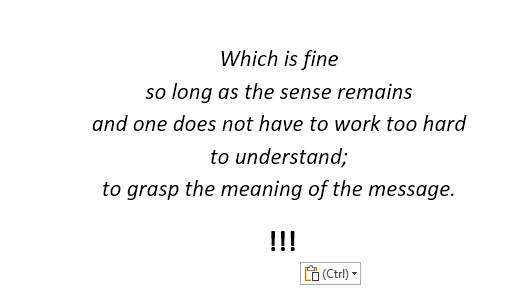
A while ago we gave you a blog about apostrophes and the two apparently different jobs they do. In actual fact, however, their jobs are not so very different as both uses indicate something has been left out thus effectively shortening the statement – a thing we tend to do when talking. Which is fine so long as the sense remains and one does not have to work too hard to understand; to grasp the meaning of the message.
Back then we concentrated on the apostrophe of possession (AKA the apostrophe of ownership or belonging) and gave you the example of how a string of apostrophised words can make perfect sense with the little nonsense story of “Jan and Her Gran”.
The other use of the apostrophe (also known as a “raised comma” but in grammatical circles is referred to as the “apostrophe of contraction”) is, in a sense, simpler as it reflects what we all do when talking: run words together so that two or three sound like one. This means that, when writing, we omit a letter (or letters) along with the space between the words.
I’ve become aware for several years of a move to dump apostrophes all together as the correct use of them is seen as too hard; confusing; not necessary; writing would be simpler…; too many people don’t know how to use them…
If they are taught well all these objections are virtually non-existent. In my experience as a school-marm all my working life I know that pretty well every eight or nine year old can learn to use them appropriately.
What fascinates me is the effect ditching the apostrophe of contraction could well have on our reading of such words as he’ll, she’ll, we’ll, she’d, we’d, can’t, won’t, I’ll. Pause a moment and consider each of these minus its apostrophe.
Reading written English can be a challenge at the best of times due to a number of factors I won’t go into here. So why on earth make it harder than it need be? Surely what we really need is simple, effective teaching that explains things clearly.
Just in case you had a bit of trouble visualising the effect of omitting the apostrophe on the short list I gave you above:
Admittedly, this last is not commonly used these days. But, according to my big, fat, two volume Shorter(!!) Oxford Dictionary there are no less than ten separate, distinct meanings for “cant” varying from “dispose of by auction” and “jargonistic” through “bold, brisk, lively, hearty” to “push or pitch sideways”… Just to list but a few of those ten!!
To recap what I said in the beginning about making changes to the language:
“You should serialise your books,” a friend said, showing me her latest e-reader. “Once you have finished the book, you can publish it. That’s what some of the authors I read do.”
And my friend reads constantly. You could say she’s attached to her e-reader.
Voila! Kindle Vella popped up as an option.
I looked into this enterprising option.
No go. Unless you live in the USA.
A suggestion at the bottom of the website I had been researching about Kindle Vella suggested a story platform called Wattpad. Wattpad seemed to embrace all those of the universe left out of the US Kindle Vella orbit.
Looked promising.
Further investigation revealed Wattpad was one of the top platforms for reading and writing stories. Millions of stories free. Writers could upload their stories, chapter by chapter, week by week in serial form. An added bonus was that they had an opportunity to receive feedback from their readers.
To me it looked like one big world-wide writers’ group.
Wattpad touted that its Artificial Intelligence (AI) searches with its algorithms, finding books of promise which it then highlights to readers. So, rather than rely on a bunch of readers to raise your story’s profile, as the rest of the World Wide Web does, Wattpad’s “robot” agents do the job.
They, I mean, I guess it’s their AI, will act as an “agent” and Wattpad puts out the “carrot” for aspiring authors that their book may be picked up by major publishing houses and film makers.
Right, let’s get to it.
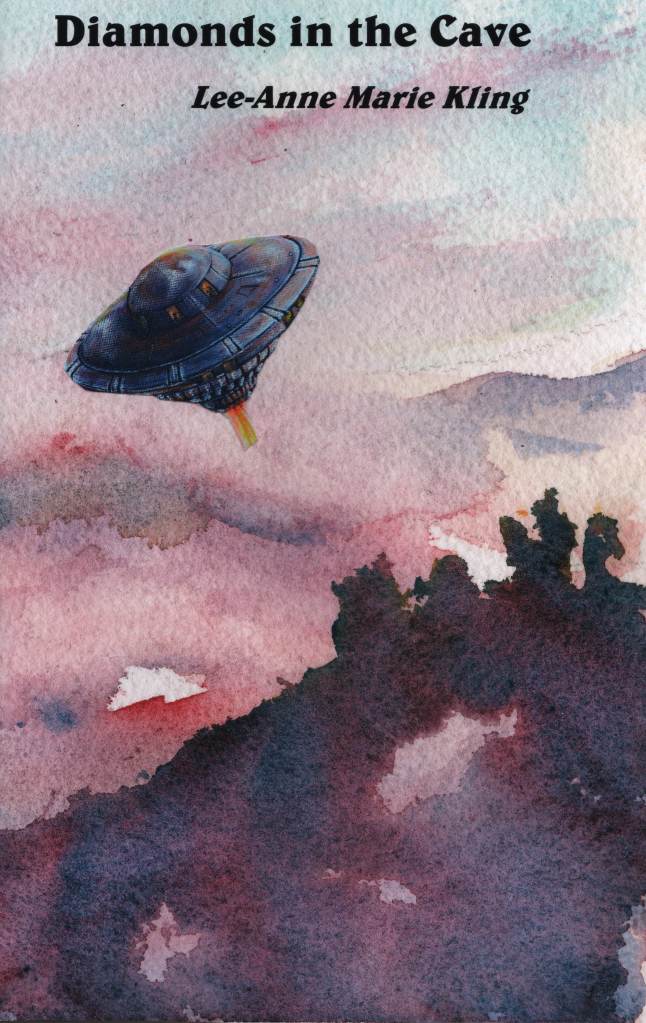
Full of hopefulness and anticipation for some Beta readers, I launched the first chapter of my novel Diamonds in the Cave on Wattpad. Not sure about the AI but decided to try out the platform as a test case. After all, there seemed to be a healthy cohort of readership for Sci-fi.
Oops! Downsides.
On further investigation, I discovered that Wattpad is geared towards Millennials and Gen Z’s. Upside if you are in that cohort. But if you are not…well…um…
Suddenly, I felt like an old chook trying to sneak into a trendy (or whatever word my children use) nightclub.
Faced with this dilemma, I asked my younger musician son, if I could sneak in using his identity. No, not a good idea. I was afraid that Wattpad might have AI bouncers, who, upon seeing my ancient, in their terms, age, would kick me off the platform.
I applied and that didn’t happen. I was comforted to read that Margaret Attwood is on Wattpad. I will be following her.
Success, of sorts
So, this “old chook”, me, has entered the realm of Wattpad, under the guise of Tessa Trudinger. Funny story about that. When I tried to register under my real name, they, the AI refused to accept me. Hence, I resorted to my maiden name, “Trudinger” and they received me with much enthusiasm saying, “Welcome Home, Trudinger”. Perhaps Trudinger is a hip name in Wattpad world. Fortunately, I had already assigned my nom de plume, Tessa Trudinger, to my detective series which I am currently working on.
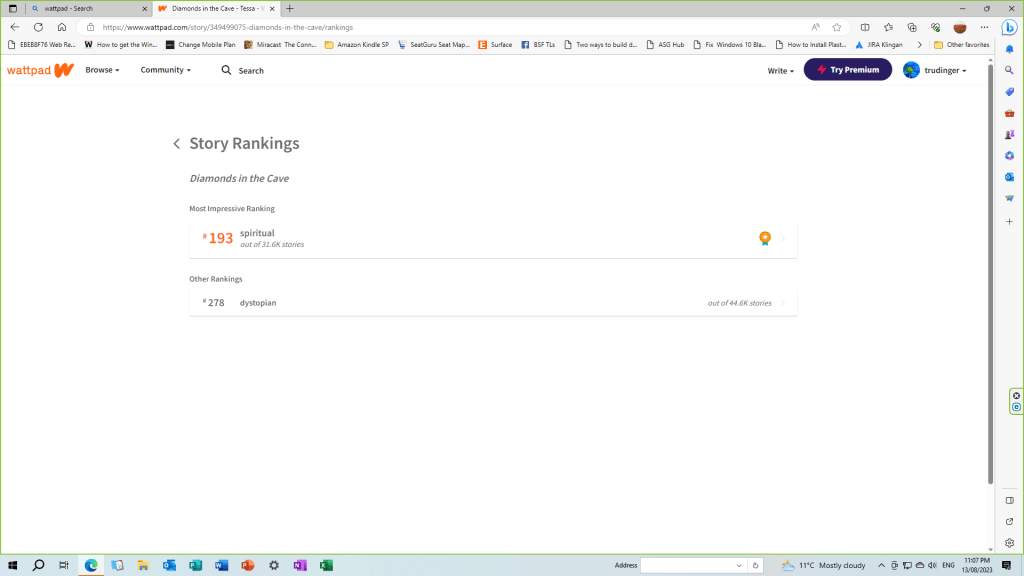
Anyway, a few days in, and the first chapter of Diamonds in the Cave steadily gained attention. Wattpad AI was pleased and awarded it the ranking #193 out of 31.6K in “Spiritual”. And something like #278 out of 44.6K in Dystopian. Two days later the story was still in the top 600 in those two categories.
*[Photo 2: Oh, joy! The statistics on Wattpad]
From there, things went south.
As I said, I’m looking for Beta readers and feedback to improve my story. No comments have appeared on Wattpad. One WordPress reader gave me encouraging feedback, saying I write beautifully. Another reader who has followed me, my friend actually, gave feedback face to face. She suggested that I need more of a “hook” in the first paragraph and that it must be rewritten.
Upon that advice, I rejigged the first paragraph, bringing elements of what the story promises to deliver—a combination of chocolate laced with time/space transporting microbes and the fearful Wend community, driven to witch hunts.
May have to eat more chocolates and play around with the first para some more in the future…
As for navigating the Wattpad website, I’m still getting used to the way Wattpad works. Uploading the story is simple enough; much like I do on WordPress. Copy and paste what I have already written on a Word document. An important strategy as I read in reviews about Wattpad taht quite a number of writers have lost their work by relying solely on Wattpad. One note, though, make sure track changes are off and not showing, or they show through on Wattpad. Messy.
I also found the story notes app provided useful in consolidating characters, the story and pitch. It made me think about my protagonist, Minna, and ensure her character remains consistent and yet grows in maturity and depth. I used the “logline” that I was asked to construct (had to be less than 150 characters), as a lead into Diamonds in the Cave on my WordPress blog.
Reading tips
I began reading a couple of stories on Wattpad. However, I discovered, when I tried to go back to them, they had vanished. Solution: apart from writing down the author’s name and book title on a separate piece of paper, I found that I could follow the authors, and put their books into my “Library” on Wattpad.
Another problem with reading in Wattpad—no bookmarks. Again, trusty old pen and paper come to the rescue. In this respect Kindle is far superior. It has bookmarks.
When I work out how to give Wattpad feedback, I will suggest that they programme some in. I checked the box volunteering to be a “Beta-user”.
This is my story of my journey into Wattpad, so far. Check out Diamonds in the Cave on Wattpad, and please do give some constructive feedback. I don’t mind if you post your comments on WordPress, Facebook, or on Wattpad.
You may need to join up on Wattpad to read, follow or comment on stories there. Not such a scary thing, I’ve done it. Just think of the millions of free stories begging for attention.
Maybe, like my friend, then, the e-reader will always be by your side.
Further to my comments a few blogs ago re rhythm in poetry there are a couple of points I feel could do with clarification:
Rhythm is dependent NOT upon words but on the syllables that make up those words. While a word is at times only a single syllable (e.g.cat/dog/plant/then/through/thought…) many have two or more syllables (i.e. are multi-syllabic).
However, looking at that list of single-syllable words above it is obvious that the number of letters in a written word has little or nothing to do with the matter. Syllables are based on the number of sounds rather than the number of letters used to represent those sounds in the written form of the language.
All spoken language consists of two sorts of sounds: vowels and consonants; the vowels themselves come in two sorts: short and long. In English there are six short vowels – the middle sounds in pat/pet/pit/pot/putt/put. All the rest (14 in all) are long. To name but a few for example: the middle sounds in pool/paid/peel/pout/pipe/part/pert/port/pose.
The consonants on the other hand (25 in all) are the first one or two and the last sounds in all the examples above – apart from “through” where the last sound is “oo” (as in “soon”). Quite clearly, spelling in our written language and the sounds of the spoken language seem to bear little relationship to each other. But in saying that I’m teaching my grandma to suck eggs; aren’t I? Regardless of the fact that it is syllables and therefore the sounds of those syllables that are critical to rhythm I won’t go into all the intricacies here as it distracts from what I need to say about rhythm in poetry.
If the rhythm doesn’t “sing” properly when you read your poem aloud it is the syllables you must consider: maybe change a three or four syllable word to one of two or three (or vice versa) or remove a word; or add another; or repeat a word or a whole line or… Maybe you need to change a short vowel for a long one (or again, vice versa!).
The permutations can be seemingly endless. Just keep playing with it until it feels right when you read it aloud. Remember: poetry is music using words instead of notes and, like music, is meant to be performed. We miss much of the joy of poetry if we simply skim the words on the page; eyes only.
Secondly, prose marches across the page, words side by side like an army, ranks of soldiers filling the space. Poetry is more like a company of dancers, short lines, long lines, single words, spaces, positions on the page…
By simply changing the length of lines in a poem you can change the mood entirely. By way of example consider two versions of the A.A. Milne poem “Happiness”:
These 16 short lines give a beautiful, clear picture of John’s joy as he stomps around; jumping in puddles; splish, splashing in the rain. No words detailing any of this. But no words needed. Now read aloud those same words arranged differently:
How did that feel to you? Much slower; much more thoughtful is how it seems to me; almost as if he’s looking at his wet weather gear and wondering if it’s worthwhile going to the bother of putting it all on just to go out in the rain. Wouldn’t it be better to stay inside by the fire and read a book?
By the by, in the second, longer, more discursive version I found myself saying “has” instead of “had” as I was reading it. A small point indeed. But this is a lot of what poetry is about – small points can have a big impact!!
And another small point with a big impact: all the capital letters in the original provide emphasis plus; an emphasis that adds to the mental picture of a small boy stomping around, splashing in puddles, having a joyously wonderful time and to hell with the rest…
Do you too feel that it adds to the whole thing in a way that mere words alone could not possibly do?
Do you write poetry? Do you wish you could write poetry but are not sure how to go about it? And just what is poetry anyway; what is it that makes it different from ordinary prose?
It might help if we start with a definition. The Macquarie Dictionary tells us that poetry is:
1. A literary work in metrical form.
2. The art of rhythmical composition, written or spoken, for exciting pleasure by beautiful, imaginative or elevated thoughts.
There are two phrases in there that are the nub of the matter: “metrical form” and “rhythmical composition” both of which seem more applicable to music than to stringing words together (which is, after all, what we do when we’re writing). But this is as it should be for poetry and music have a lot in common – not only rhythm and metre but performance.
As far as music is concerned this is obvious. As far as poetry is concerned however many of us don’t realise that it is meant to be either recited or read aloud in such a way that one can feel the rhythm; a rhythm that can be quite subtle; a rhythm that can change to reflect a change of mood… But a rhythm that must be there.
In order to achieve this we have to, at times, adjust or deviate from the conventional rules we must adhere to when writing prose in order to maintain the rhythm and/or produce a desired effect. There are many ways to do this: by omitting a word like ”a” or “the”; repeating a word or words; using a word with a different number of syllables; using a word with a different sound e.g. changing a short vowel to a long one or vice versa…
Breaking the rules in this way is called poetic license and is perfectly acceptable when writing poetry – so long as it is done carefully and with good reason.
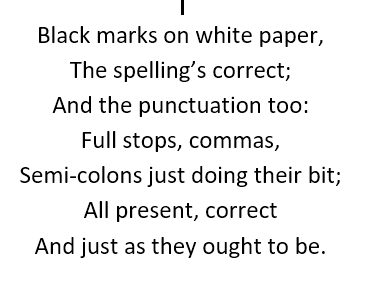
By way of example consider and compare the first (abandoned!) version of one of the verses from the poem “I want to be a writer but how do I do it?” that we blogged recently.
When I read this aloud to myself it didn’t “sing” right; it sounded clunky, clumsy and the reading didn’t flow easily. So it was “back to the drawing board” and I wound up with:
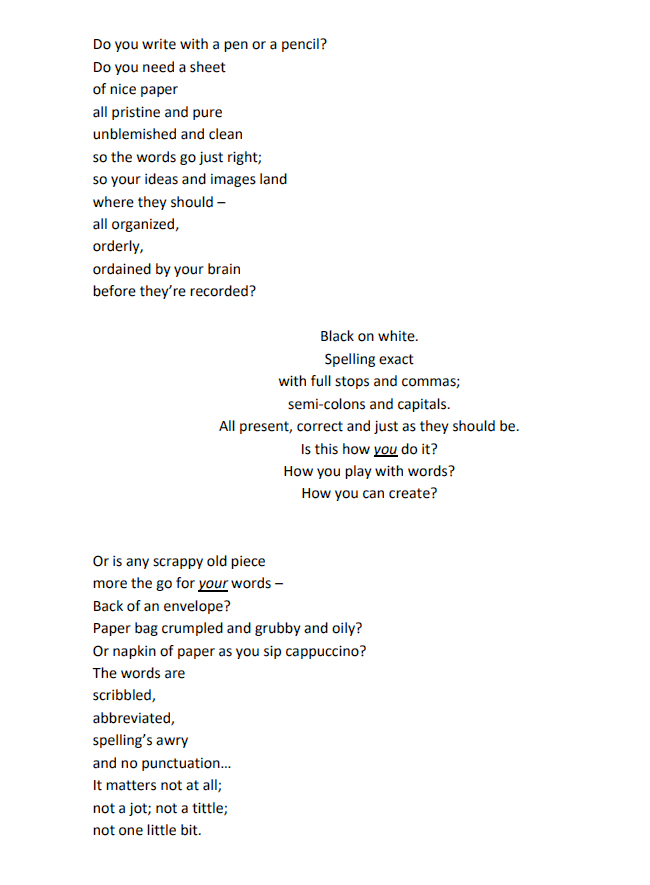
Much better, easier to read, flowed well to my mind. However, on re-reading since then I realise “precise” at the end of line 3 should be ditched, done away with, not necessary… Read it aloud both ways for yourself and see what you think re that word; those seven letters.
As with all writing – a work in progress!
By the way; poetry can rhyme; in fact rhymes often add a dimension and a level of enjoyment that would be lost in some poems. But rhyme is not the essential pre-requisite that rhythm is. Non-rhyming poetry is known as blank verse and is a legitimate form of writing; produced by such skilled practitioners as Milton (“Paradise Lost”) and Shakespeare.
[As mentioned in my recent blogpost on Tru-Kling Creations, May is our family’s party month. So, I figured Indie Scriptorium needed a break from “Publishing Pointers” and I’d give the readers (and my party-self) a little break and discuss the art of storytelling for a change.]
STRANGER THAN…
Bizarre tales: Road trips gone wrong, planes vanish, people disappear, and bodies turn up packed in suitcases…the type of stories that inspire movies or perhaps novels. Or do they? At times, real life events seem so unreal that if we were to publish a novel about it, our audience would slam it as not believable. Yet as news, people absorb it like sugar, craving more; the more absurd, the more they devour it.
A part of us enjoys the fantasy, the off-centre. It’s as if we want more to life than what is. I reckon my family’s no different. While driving on the way to Magill, Mum, my son and I discussed the latest bizarre news story of a road trip gone awry, the Kadaicha man and how my alien character Boris might be involved in the evil in the world. You can read what mischief and mayhem Boris gets up to in my novel Mission of the Unwilling, The Lost World of the Wends and novella, The Hitch-hiker, both available on Amazon.
My friend who has read all in the War Against Boris series, remarked that when a certain plane went missing in 2014, she was sure Boris was behind it.
And back to the news, the search for alien life-forms continues. Subterranean liquid beneath the surface of Mars has made scientists hopeful of alien life—bacteria at least. It’s news. We want to know, do aliens, sentient beings from worlds other than Earth, exist? Or are we, as humans, alone in the universe? Are we God’s unique creation? Or one of many of God’s image in the universe? Does it really matter? Why is it so important we want to know?
My novels are science-fiction fantasy and there will be some out there who roll their eyes and sigh, “Not interested”. I know, most people I meet like their murder mysteries and romance novels. But there are some, more than I expected, who have a fascination for adventure exploring the universe and other worlds, where anything is possible.
The reason I started with science fiction back in my youth was the result of certain people I’ve met and certain issues I faced. Oh, how I wished I could have written all the issues involving such characters back then. But no, I was told, I can’t. I’d upset such tender egos if I were to write about my experiences relating to bullying, harassment, women’s rights, relationships, attitudes and values of the time. We’re talking ‘70s and ‘80’s here. Still, unless such issues are discussed, how can they be resolved?
But, how could I present these issues for discussion? My solution, write these stories in fiction, science fiction. In the world of outer space and stellar travel, I could convey stories of the issues facing our world, and in my life. With some metaphorical distance, I put these issues on the virtual table, open a dialogue and minds to grow and change.
Our lives, our worlds are bubbles. We live within these bubbles of the world we know. The bubble of our worldview and attitudes filter the way we see the world, how we interpret what we see, how we form our values and our narrative.
No one wants their bubbles burst. It’s the reason we don’t really listen to another’s point of view. Really listening means confronting another’s world-view—a world alien to our own. We’d rather shut the other person down, treat them as the “other”, the enemy, than have our bubble burst.
Fantasy and fiction allow us to safely enter other worlds, explore other attitudes and values, expand our worlds and grow. And although we fear the bubble bursting, we crave the more, what exists outside our bubble. How often haven’t we said, after reading or hearing a way-out story on the news, ‘I never knew how the other half lived.’
Aliens are all around us. They are the “others” and their stories. When we really listen and enter another’s world, the world and stories they offer are limitless. Everyone has a story. Connecting with others, face to face, through literature, through the internet, through the arts, opens us to grow as individuals and collectively.
It’s creativity that connects us as a community. Through art we share the world as we see it. Music interprets the themes and emotions of the heart. In writing, we interpret life through words. Our stories involve characters, people—whether in a fantasy world, spaceship, a town or home, or a road trip—people clashing, colliding, interacting and learning to blend in acceptance and unity.
The story of our lives and relationships is a journey where we rejoice what we have in common and learn to celebrate our differences. Through this process, we may discover that reality is stranger than our craziest imaginings. Better still, we come to the realisation that it’s not sameness that unites us but embracing our differences.
Recently I was chatting to a fellow writer who told me that years ago she’d had a book accepted and published by one of the big-name publishers. It was a textbook in her field of expertise and intended for teachers. She’d been thrilled; it sold well and she’d been paid her share of the profits. All good.
That was many years ago and her book has been long out of print but, now retired she continues to write; is deep into a novel and a leader in her writer’s group. When she mentioned the name of the publisher I was particularly interested as I too had once been offered a contract on a book for teachers that I was in the throes of writing. This was many years ago but, unlike her, I refused to sign the contract I was offered.
“Why on earth not?” You might well ask.
Ever since I learned to read I’ve been bewitched by print; always had my nose in a book; accused of “even reads Weetbix packets” … So I read that contract carefully and got my knickers in a knot over two of the items hidden away in all the legal verbiage: copyright ownership and payment if there happened to be the need for a second edition.
As far as the first of those two went; the big-name publisher would own the copyright if I signed that contract. No way! All those words, the book I’d been labouring over was my precious baby. Nobody else was going to own it; have control; do what they wanted with it.
Regarding the payment issue: the contract stated I was to receive 10% of the sales price. Fine. I knew that was more or less the going rate, standard procedure. But then it went on to say I’d only get seven and a half percent if there happened to be a second edition. This made no sense to me. Surely a second edition would be easier, simpler and cheaper to produce as all the set-up stuff would be in place so it would be nothing more than a reprint.
At the time I was inexperienced and totally unaware that most contracts are negotiable. So I simply clenched my jaw; dug my heels in; squashed my feelings (thrilled, validated…) and wrote a polite note of refusal – no reason given. Which was stupid, I know now. But back 8then I had no-one to help or advise me.
Ever since I’ve checked to see who owns the copyright of any book that comes my way! As a by-the-by; the copyright of virtually every book produced by that big name publisher is owned by them. Which means the author has probably been duped due to a combination of excitement and trust (i.e. ‘trust’ being lack of knowledge re the importance of checking).
We are always told “Buyer Beware”. And the same applies to contracts – if you are ever lucky enough to be offered one.
We’ve told you about vanity publishers – the smooth-talking rogues who take your money and give you little or nothing in return. Keep right away from them, however desperate you are to have your precious work published. They are bad news; really, really bad news.
We’ve told you about the legit, big-name publishers who will give you a contract, provide editorial advice and pay you based on sales of your book. These people are in business; the point of business is to make a profit so they will (very sensibly!) only accept for publication work which they can be pretty sure will help their bottom line – making money. I don’t wish to discourage you, but unknown newbies probably have a better chance of winning the lottery. By all means give it a go. But with eyes wide open.
Which leaves us with the third option: self-publishing. This is a perfectly respectable road to travel which many have, very successfully, done so already. As with most things in life there can be pitfalls however.
There are essentially two alternative ways to go if you choose to embark on a self-publishing venture. The first is the publishing platform route such as Amazon of which I have no experience. In a future blog, Lee-Anne intends to discuss this option as she has practical knowledge.
The other way is to handle the whole business yourself using a local printer. There are a great many steps between completed manuscript and final product. So let’s get down to business.
Editing. You MUST have your work checked by a competent person not closely involved with your work; someone with a dispassionate, clear-eyed view; someone who is able to judge writing critically; someone with a nit-picking eye for detail. Above all someone who is kind.
I’m sure you will have gone over and over your words; changing, omitting, adding, clarifying… The sad fact of the matter is that none of us has a completely discriminating approach to our own work as we are both emotionally involved with those words and phrases and also “see what we expect to see”. This last is a psychological reality we all need to accept.
Editors question factual allusions; check for consistency of names, events, places, relationships… as well as the overall “tone” of the writing. They look at the big pic as well as smaller details.
Many people confuse editing and proofreading. The two are quite different: this last deals with spelling, grammar, typos, layout etc. in short, the general appearance and readability of the finished work. Editing and proofreading could be seen as bookends: editing is the first step after completing your manuscript; proofreading the last before the final print run that yields you a box of books ready for sale.
You should ideally engage the services of a professional editor and be prepared to pay for his/her time, expertise and advice. By and large a friend or relative who is an avid reader or a high school English teacher will not cut the mustard, however keen such a person is to help you out. Use them as a reader/commentator; value their input but do not confuse them with an editor!
Next you have to decide on such details as size and format for your book (portrait or landscape)* font and font size; back cover blurb; ISBN; the “reverse title” page information. We will give you specific details re each of these in future blogs.
Then it is off to your selected printer – again, specific details in a future blog. By rights, you should be given a dummy copy (Proof) to check out and proofread before giving the final O.K. This checking step is critical, (point of no return, as it were!) so do it carefully. Please.
Now you can order the number of copies you think you can sell and know you can pay for.
Finally, finally you pay the printer; receive a box (or boxes!) of books and gloat over them. You have achieved your dream to see your work published; your name (or chosen “nom-de-plume”) adorning the cover. Wow!!
However, there is still one last step; for some of us the most difficult of all: sales. This involves publicity, distribution, record keeping. Again, more in a future blog.
Good luck. Have fun. And get stuck into creating your next book.
*Note:
“portrait” format means the vertical is longer than the horizontal, taller more than wide. “landscape” format means the reverse (width is more than the height)and is usually reserved for picture books, with or without text.
So, you’ve written a short story, an essay, a non-fiction book, a memoir, or a novel. You’ve done the plotting, the research, created worlds and words and honed it to a very fine piece of writing. You’ve used Beta readers, editors, proof-readers, formatters and designed a wonderful cover and a tight blurb and finished it with an author bio. It’s ready to publish, and that’s so very exciting but scary too.
Putting a manuscript out for publishing, no matter if you use a traditional or hybrid publisher or go totally Indie, it is your work, and you are responsible for how it is received in the wider world.
Legal considerations
Before publishing, it may be a good idea to think about what you have written. We all know the pitfalls of plagiarism, making sure all the ideas and words are yours alone. If not, then other contributions must be acknowledged fully and honestly, preferably in the authors’ note or in a bibliography. If you refer to actual events and people, you have to be one hundred percent accurate or risk the ire of your knowledgeable readers. The adage, think about every reader as an expert and an editor is sound advice.
If you change historical dates and timelines, fudge a fact for the sake of a better story, make sure you fess up to this in your author notes. It’s acceptable but acknowledge changes to the public record and why you made the changes.
The legal issues to consider before publishing include copyright, permissions to use another person’s image or writing, and defamation. The Australian Society of Authors and the Australian Copyright Council have information sheets that you can download.
Defamation laws were amended recently, the same laws now apply to all Australian states. The act of defamation involves making false statements, either written or verbal, that damage a person’s reputation. Make sure your written piece is accurate and the truth. A person who believes you have damaged their reputation can sue and the outcome may be costly. If you include real people in your written piece, maybe get it checked out for a legal appraisal.
In addition, you have a legal obligation to make a National Library of Australia deposit of your published book, but an ISBN is not mandatory but highly recommended. Indie Scriptorium will have more information on ISBNs in a later blog.
Moral considerations
As an author, it is imperative to consider how your work, fiction or non-fiction, impact on your readers. You may include scenes of violence, rape, incest, murder and other challenging tropes but have you considered how a vulnerable reader could be disturbed by your storyline. I’m not advocating censorship, but as writers, it makes sense to reflect on how readers may be affected when they read about the violence and distress of your characters. You may need to ask, is it essential to the plot or gratuitous violence? Can you write a scene without graphic descriptions but leave the reader with an impression of the damage wreaked by your protagonist? You need to consider if your storyline can justify or inform deviant behaviour or increase racial and sexual vilification. If a book or scene is overtly graphic and potentially disturbing, consider a warning that the content may cause distress for some readers. Include it in the blurb. I presume that some warnings may intrigue some readers and encourage sales.
Sensitivity readers are in the news at present because of the controversy over re writing the Roald Dahl books, but they are a useful type of editor to use if your book involves some contentious issues. For example, if you are writing a book which includes references to indigenous people, then a sensitivity reader can provide expert information about the accuracy and consequences of your work. Again, it is not about censorship, but it is about consideration and empathy and ensuring that your work will not cause distress.
Writing cannot all be all pleasant subjects and happy endings but consider the legal and moral pitfalls to avoid. The best antidote is to get honest feedback from other writers, editors, beta readers and whoever else will read your manuscript. And kill your darling’s if you need to–but not with too much gratuitous violence.








 Indie Scriptorium -- Self Publishing Collective