In our Wednesday Writers’ Group, we have been refining our techniques by learning to be economical with our words. It’s so easy to slip into unnecessary repetition and belabouring our points. The 100-word challenge helps us writers to prune our words to the absolute minimum and make each word count.
In doing this exercise myself recently, I was forced to examine what facts were necessary, and how much I can rely on the readers’ intelligence to “get” the story. Often, we underestimate our readers and thus repeat and go into minute detail that bogs down the story, causing our readers to become bored and not turn the page.
So, here’s my 100-word challenge, fresh from my memoir collection. It may not be perfect, but it is 100-words.
***
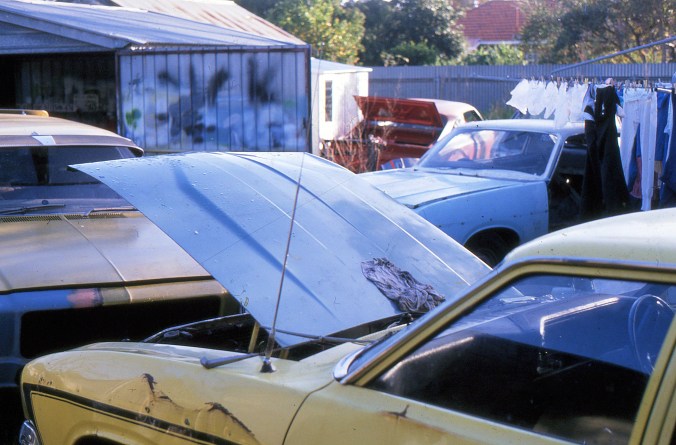
[Intro: Rick, my brother, loved resurrecting car wrecks. The backyard shed became his workshop, and the local wreckers his go-to.]
The “Yota”
A fossick in the car-graveyard yielded the broken shell of a Toyota. Rick revived it. He spray-painted it green.
‘Can’t miss the frog-car,’ I’d say.
One Sunday morning, Mum and Dad needed a car to drive to church.
Without permission, they drove the roaring ‘Yota down the driveway.
I slept in.
Minutes later, the ‘Yota roared back up the drive.
Doors slammed.
Mum cussed.
I scrambled out of bed. Mum never swears.
‘What happened?’ I asked.
‘The police picked us up and defected the car,’ Dad said.
‘That’s what happens for taking the car without permission,’ I replied.
Well, I’ve got to the end of re-writing and structurally editing my third novel The Jamaican Heiress. It required two complete rewrites and a substantial structural edit which took me about eighteen months. It’s now a good story with a logical plot propelling stronger characters through a series of crises and culminates in a satisfying ending. I’m happy with the flow, time line, changing points of view and how it all hangs together. I’ve had feedback from two respected writing friends and made much needed changes to time lines, character arcs and motivations. Alpha readers are gold. Yay.
Big sigh. I’m feeling happy. But now it’s time to do the line/copy edits.
Should be a breeze. HA!
For my previous novels I used Pro Writing Aid to pick up overused words and phrases, (names and blushing references) repetitions, passive voice and my tendency to start every paragraph the same way. I then used a wonderful professional editor who tirelessly tidied up my prose and produced two readable books.
But having it done for you doesn’t help you to learn about the problems you have when you write. This novel I’ve decided to do the line/copy editing myself, as an exercise in strengthening my writing. This blog is about my process.
First step: Google search: What is the difference between line and copy editing?
There is heaps of information on Google and many useful videos on YouTube to check out. For a very quick rundown have a look at Alex Cattoni’s video “Copy Writing Tips: What’s the difference between Line and Copy Editing”. In short, she says: “Line editing crafts the story, Copy editing catches the errors.”
Second step: How many sweeps of the novel will I need to do and what do I look for in each sweep?
Again, I googled line editing and read several blogs and watched a few videos. I suggest spending a few hours combing through the plethora of information available and then come up with your own plan. I’m going for two, or possibly three sweeps (see step five)and then use Pro-writing Aid to pick up my remaining bad habits, then read it out aloud (or use the audio program on your computer) I will then re-read the entire manuscript and pass it on to my beta readers with trembling hands.
Step three: How do I do the line/copy edit?
The general consensus is to line edit a small piece of writing at a time. Could be a paragraph, a page or a scene but then go through your work looking for things like flow, word usage, passive voice, repetition, continuity, dialogue consistent to each character, adding/deleting description, telling and showing balance and point of view problems. The idea is to make every sentence clear to read, strong and efficient at conveying what you want to tell the readers without browbeating them.
Step four: Next sort out your process.
If you want to line edit on the computer, make sure you keep a copy of the first draft and line edit the new copy. I suggest you don’t name the copy the same as the original. I’ve got myself tied up in knots trying to find documents with similar sounding names, so put a date on your new file. You might want to try a program like Scrivener which helps sort multiple copies of a manuscript and allows colour coding too.
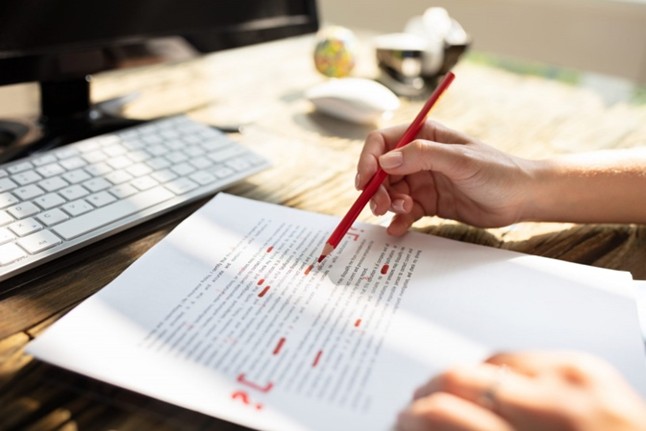
Other people like to print out the manuscript and edit on the printed page. Using different highlighters for different problems is something I’m going to give a try. So, red for errors, blue for word usage, pink for POV, purple for purple prose, green for continuity and yellow for “it’s just wrong”.
Step five: It makes sense that your first sweep looks at paragraphs and scenes and information to be added, deleted or changed completely. My first sweep will concentrate on:
Do I need to add/delete descriptions?
Have I used the senses?
Is the balance of show/tell good for pacing.
Continuity. Robert has blue eyes not brown!
Remove repetitions.
Is dialogue unique for each character? Think about tone as well as commonly used words or phrases.
Is each sentence clear and easy to read.
Is there any head hopping going on?
The second sweep will focus more on sentences and words and includes:
Over used words, descriptions or phrases.
Reduce filter words: she thought, he realized…
Change weak words to stronger words, he walked, to he paced/strode/shambled/limped.
Address passive voice in sentences.
Reduce adverbs.
Look at consistency of tense.
I’m new to this so I’m not sure this process will work. I will try it out for a few weeks, tweak it and experiment, then report back.
I have published two previous novels and have also had three short stories published. The feedback I’ve had from readers and editors has been positive so I will approach line/copy editing with some confidence. I do have faith that I can catch a lot of clangers, but I think it’s essential to have an editor or well-informed writing friend to catch what I miss. There are lots of problems that you as the writer don’t see.
I found the following articles helpful but there are many more on-line.
Here’s a post from the past on feedback, or more accurately, “On-line Reviews”; a vital part of refining our work and making our stories the best they can be.
Those On-Line Reviews
I like to celebrate. As a child, when I received full-marks for a spelling test, Dad rewarded me with a Kitchener Bun from the Fish ‘n Chip shop/Bakery which in the good ol’ days of my childhood was situated opposite Glenelg Primary School. A few years ago, now, when I used to drive my son his course in Magill, my mum and I treated ourselves to lunch at the local hotel.
Every so often, I check my Amazon account. I wipe off the virtual cobwebs of neglect, and dig deep in the files of my mind, retrieving the password to enter. I expect nothing much to have changed.
I’ve been busy with my blog and the rewards, small, though they are, compared to the rest of blogging world, but the steady trickle of views, likes and comments, satisfies me. Over the years, the number of followers has steadily grown.
Once long ago, now, I made a daring move, and posted my short story, Boris’ Choice—not for the faint-hearted or while one eats breakfast…After the post, I checked for results on Amazon with my War Against Boris Series books.
And…there were. Yes!
Then, I checked the reviews. Now, I don’t know how other writers have fared with reviews, but for many months since my books were published, I had received no reviews. Yes, I asked my readers to do the deed and tick the star-boxes and comment, with no results. Yes, they’d say, and the weeks went by and nothing. Were they just being polite? I have no illusions, and the reality is that art and literature are subjective—what one person likes another won’t.
Anyway, back to checking the reviews…I looked again at one of the countries one of my books sold. The page appeared different. A yellow bar, and a comment. Genuine feedback. Not a great appraisal, but an appraisal all the same. I knew the person responsible for this first-ever comment for my book but was not surprised at their response. I did wonder at the time how my novella would work for them—not well—just as I imagined when they informed me, they’d bought the book on Kindle. As I said before, Boris and his antics are well…not for everyone.
That being said, and for fear my works may be misunderstood, the over-riding theme of my stories are the classic fight of good against evil. How evil, like Boris, can creep into our lives. And when for whatever reason, usually when we maintain and enhance our self, and to avoid discomfort, we allow evil to stay. This evil, however subtle, will drive us to isolated places in our lives, much like Boris does in The Hitch-hiker; places we never wanted to go. I want young adults and people young at heart, to make choices and use their energy for goodness and to fight evil, so they can live a full life and also be an agent for good in their community and the world.
It’s a wonderful compliment, as an author, to being invited to make a presentation to a book club. But what makes for a good, entertaining presentation?
I was invited to a book club last year to talk about my first published novel, A Suitable Heir.
It was a great evening with a lovely group of ladies and I had a lot of fun but I wasn’t properly prepared and it made me wonder if I could have done better. My second invitation was from a member of one of the writing groups I attend and they had a specific agenda. Time to do some research to improve my book club presentation.
An article by Bookish raises a topic that must be seriously considered when accepting an invitation to present to a book club: Do you need to be a part of the book discussion? Book clubs by their nature allow members to openly say what they think of the book. Some readers will love a book and some won’t but having the author present during the review could either suppress the opinions of some members or be confrontational for the author. It becomes important to discuss with the co-ordinator what the book club wants. If it’s to have a robust, critical review of the book the author needs to be prepared for positive and negative evaluations. Alternatively, you can ask that the discussion of the book occurs before or after the author presentation. https://bookish.netgalley.com/book-club/11/2022/do-dont-author-visit-book-club-invite-how-to/
So, what do you talk about in a presentation? Here’s a list of areas to consider in your presentation plan:
For the novel: • First say, ‘Thank you for the invitation’. • Introduce yourself, your pen name (if appropriate) and the book title. • Talk about what inspired you to write the novel. Where did the idea come from? • Discuss the genre and setting. • What are the themes of the book? • Discuss the characters. • What was the initial question and conflict? • Research and world building. • Specific questions from the audience.
About you as a writer: • My writing history. • My writing process. • Why I write. • My strengths and weaknesses as a writer. • Plotting or “pantsing” (writing by the “seat of one’s pants”, such as making up the story as you go along)? • The editing process. • Publishing options. • Where to next.
It would be a good idea to discuss with the book club co-ordinator what format is acceptable and then write and practice the presentation. Supply some marketing material (bookmarks and cards) and make sure you have copies of the book to sign and sell.
A friend once told me: “Reading a novel is like eating cake. If you start reading something expecting “chocolate cake” but instead have “vanilla”, you feel cheated.”
Such is a reader’s experience when they pick up your book or download it as an e-book. They have certain expectations of the story from looking at the title and cover, reading the blurb, and glancing at page 100 (yes, that’s a thing).
However, the writing and language of the prose within can make or break the book’s success. If the writing is not up to standard, that is, it’s hard to understand, and a slog to read, then, you have lost your reader’s interest, I’m afraid to say.
In this blog I’ll stick to the “nuts and bolts” of what makes a piece of writing readable. That is, the language used, and writing conventions.
We may think that we have to wow the reader with clever phrases and words put all together like we are painting a fancy picture. This type of writing is called “purple prose”. Many writers have been there, believe me. Anyway, I don’t know about you, but I have.
Thirty-something years ago, I wrote about climbing Mt. Giles with my dad, brother and cousins. I did just that trying to convey the magic of the MacDonnell Ranges and the beauty of the Central Australian landscape. I gave my offering to Dad. His feedback: too much “purple prose”. That “purple” piece has been binned, so, here’s an example from the Reedsywebsite and their blog on “purple prose”:
“The mahogany-haired adolescent girl glanced fleetingly at her rugged paramour, a crystalline sparkle in her eyes as she gazed, enraptured, upon his countenance. It was filled with an expression as enigmatic as receding shadows in the night. She pondered whether it would behoove her to request that she continue to follow him on his noble mission…”¬~Reedsy(What Is Purple Prose? Writing 101: Definition, Tips, and Examples)
The Lesson: Keep it simple. Write as you speak. I should have known, as this is what I’d been instructing my English students at the time. Stick to strong verbs (doing words) and nouns (things, places, people). But avoid, if possible, too many adjectives (words used to describe nouns) and adverbs (words describing verbs, usually ending in -ly). Again, the Reedsy blog mentioned above has examples of how to simplify and strengthen your writing. As an exercise of simplification from the Reedsyexample above, I have rewritten the first phrase as: “The girl glanced at him…”
The Aim is to have a piece of writing that is easy to read, easy to understand, and to be a rewarding and growing experience—not a waste of time or hours your reader, if they persevere with your work, will never get back.
The reason the language we speak and write has rules and conventions is for the sake of the reader. We want our stories to be understood, don’t we? Like a recipe for a cake, or road rules for driving, spelling and grammar norms help readers understand and enjoy what the writer has written.
To help with keeping my grammar and spelling in line, one of the tools I use is Microsoft Word Editor to refine my writing. Check “Editor” out if you have Microsoft Word.
Another internet tool is “Grammarly”. I downloaded and took the “Grammarly” test with one of my chapters from a detective novel I have been working on The Culvert. I found the exercise helpful in highlighting where my grammar needs correction. “Grammarly” offers a limited free service, but for a more in-depth check, a subscription is required. For some writers, “Grammarly” might be just the editing tool they have been searching for.
Simply put, the best ideas for a story may be wasted unread if the writing is not easy to read for the reader. Remember, write as you speak, and keep it simple.
My stories begin long before I put pen to paper or print words on a screen. They start in my head. Dreaming. Often with a dream. Or a vision. Or a “what if”. Or a memory.
My latest novel venture into crime fiction, began with a dream. Then developed with a “what if” and some memory thrown in. Fourteen years ago, my mum and I would discuss what if a child were given up for adoption, traced their birth parents and the reunion wasn’t the rosy one imagined it would be for the child. We had a certain character in mind when musing this situation. This person had their life together and would see their former “mistake” as an intrusion and something they’d rather forget.
Around this time, I had a dream about finding a body under a bridge. It was so vivid that I drafted a short story about the “experience”. I read out the story at writers’ group and received both honest feedback and harsh criticism for my efforts. The story was filed away.
Years went by and the ideas of the story percolated. Meanwhile I concentrated on my Sci-fi “War on Boris” series and the “Intrepid T-Team Travel Memoir” series. I travelled with my family and got on with life. In the background, I mulled over the characters and the world in which my Under the Bridge characters lived. I allowed the characters to move about and interact in the world of my imagination. I realised that I could marry the idea of an adoption reunion gone wrong with the body found under the bridge.
As ideas and situations emerged, I shared them with my mum and others. Along the way I began research into the issues around my crime fiction story. I familiarised myself with the genre. Read books and newspaper articles, watched crime shows, and listened to podcasts. All this absorption of information helped with the percolation process.
Five years ago, I sat down with pen and paper and began planning. After writing a sentence encapsulating the main idea of the book, I fleshed out the characters on paper. By this time in writers group, we had been given a sheet of paper that had set out how to write a character profile. I found this helpful in describing what my characters looked like, their main motivation and desires, their habits, personality, backstory and even fears. As I did this, the characters began to interact with each other, and the story began to take shape.
I decided to set Under the Bridge, being my first crime novel, in a place in which I was familiar. My home town, Adelaide. After all, the city has much going for it, and could be equated with “Midsommer” in the British Midsommer Murder series. It does have the reputation for the strangest and grizzliest of crimes—the Beaumont children (never solved), the Family murders, the Truro murders, and the bodies in the barrel murders, just to name a few. Come to think about it, I don’t know how I’ve managed to survive in Adelaide.
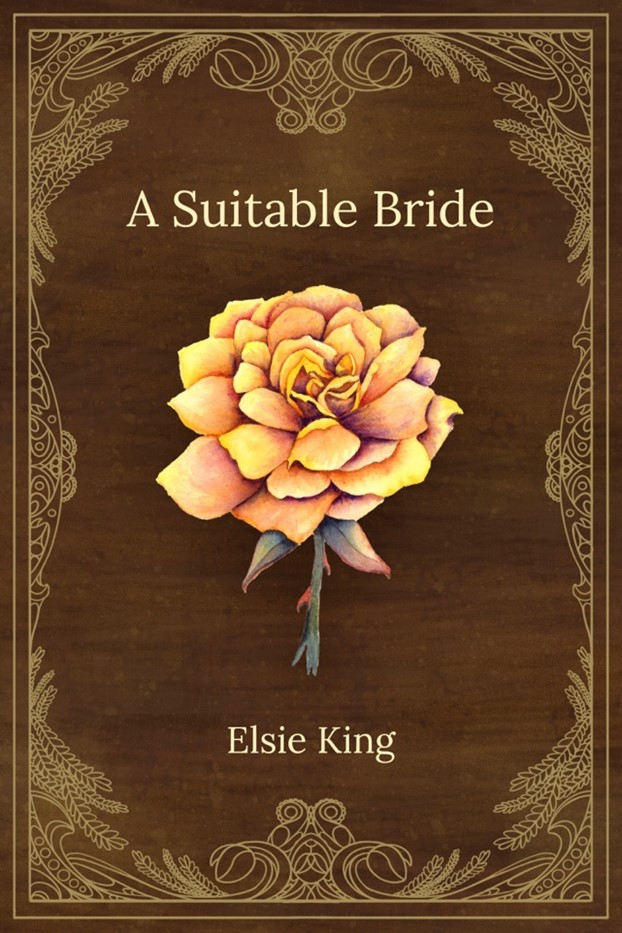
Into this I spent time planning the story line, timeline and chapters. Last year I wrote a synopsis and shared it with my Indie Scriptorium big-picture editing friend, Elsie King. She loved the premise, but gave helpful feedback on developing the characters more, giving them depth.
So back to the process of percolating, dreaming, visioning and having conversations with my characters in the shower…And research. As I have mentioned previously, part of that research has been delving into my family history. Although, in doing so, I have opened a Pandora’s Box of more stories that have started to percolate. Watch this space…We have so far: riches to rags (more than once), destitute to convict to doctor, missing on the Russian Front (or is he?), and mistreated orphans (sounds like another Dickens tale only this time it’s Dutch). I hope to write up short stories of these ancestors over time and after sufficient research and again, percolation.
Back to Under the Bridge, I then began to plot the chapters and timeline of the story. But I will deal with this part of the World-building process in Part 2.
I’ve never really understood or considered tropes when I write something. I find it easier to write with a theme in mind. But Tropes are apparently important enough in the romance genre to provide the theme for the Romance Writers of Australia conference 2024. Time to do some research.
The Collins Pocket English Dictionary defines a Trope as ‘a figure of speech.’
The Collins National Dictionary is more extensive. It defines Trope as ‘a word or phrase used metaphorically.’
Roget’s Thesaurus of English Words and Phrases links Tropes with metaphors. And a metaphor is a way of describing one thing with a phrase that describes something else.
Examples: Courage – a heart of a lion
Love – the light of my life
Lazy – a couch potato.
A look at Wikipedia (bless them) says that the word Trope has undergone “a semantic change” and is now used as a rhetorical (persuasive) device in creative works.
So, to summarise: A trope used to be a figure of speech but has morphed into a commonly used metaphorical device in genres of rhetorical creative fiction. In simple terms they are the themes that readers want to have in a novel.
Some common romance tropes are:
Happy ever after
Lovers torn apart, fight to get back together
Forbidden love
Love triangles
Enemies to lovers
Amnesia
I have a secret
Some historical novel tropes are:
Marriages of convenience
Dual timelines
Political/social upheavals
Actual historical figures
Protagonists ahead of their time.
Research driven plots.
Fantasy tropes may include:
Good versus evil
Quests
Magic
Mythological species
Time travel
The list of tropes can be extensive for each genre but from what I’ve read it’s important that the trope is subtle, that it emerges with the story or it can become a dreaded cliché. These are tropes used so often they become a bit of a joke. Think of the dreaded Bodice ripper.
I hope you found my exploration of tropes useful. I have discovered that I definitely like happy endings, most of my characters are ahead of their time and some engage in marriages of convenience. I also like to use historical research to describe political and social upheavals.
And these tropes put me firmly into my genre; historical novels with a touch of romance.
My photo is of the black sand beach in Iceland made famous in Game of Thrones. Yet another example where an image can be used as a literary trope.
Now I have to work out what costume I’ll wear at the RWA conference that will clearly define a romantic trope.
If I had my way, I’d ban alphabet books for all pre-schoolers. Ideally no child should see an alphabet book until it’s at least eight years old and had learnt to write and read. And as for the Alphabet Song!! Grrrr! But we’ll come to that later.
“Why on earth?” I hear you say. Or are you quietly thinking to yourself, “Poor thing, she’s finally lost it”? Or (somewhat more kindly) “Years and years of teaching small children has got to her. Stress, you know.”
Au contraire. It’s the years and years of teaching all those children who came to school singing the Alphabet Song; minds stuffed full of alphabet books with their pages and pages of pretty pics; confident of their ability to master all this reading and writing stuff… Then they get as confused as all get up.
Confused? you say. How come? Isn’t the alphabet the basis of our written language? Yes indeed – but only in a way.
You see the letters of the alphabet are symbols; mere squiggles if you like; that we use to represent the sounds of our spoken language. It’s a code, but sadly, not a straight-forward one for a number of reasons.
Aeons ago, when mankind first sought a way to record information that did not rely on memory (and therefore personal contact) they drew pictures on whatever came to hand using whatever they had that worked. Over time the pictures became stylised until eventually some bright spark got fed up with the labour involved in learning the meaning of thousands of picture-symbols. Whoever it was, they were obviously a radical and an original thinker with particularly good hearing ability in the way of auditory discrimination. He/she realised that it was only a small number of different sounds that were put together in a myriad of diverse ways to make up all the words used by his/her community.
Yes, I know – a flight of fancy. We’ll never really know for sure how it happened, and I seriously doubt if it was that simple. Rather than a single bright spark, I’m sure it was more a process of refinement over dozens of decades with contributions from many as well as adoption by neighbours who adjusted, adapted, added to, subtracted from… to suit their own situation and language.
And this is still happening today – we add words; we invent new ones; we drop ones we see as no longer useful, pretentious, or “bad” or we change the meaning… When I was young and went to a beaut party where I’d had a lot of good, clean fun with laughter, friends, food (really yummy food, that is!) I usually reported that “We’d had a gay old time.” No longer would I dream of saying such a thing. Back in Elizabethan times (the Francis Drake/Walter Raleigh ones, that is) “nice” was a far from complimentary word. Only two, of but many examples.
Anyway, back to my entry point: banning books for babies (alphabet books, that is), if you’ll remember.
Rather than learning the alphabet, it is much more important for little children to learn to differentiate the sounds we use to make up the words we use to communicate with others. Once they can do that, it is an easy matter to learn an appropriate symbol (squiggle!) to match each one. At which point they can write. And reading will follow on. Simple.
Sadly, not so simple because our alphabet is full of glitchy bits: some letters can be used for more than one sound; several letters are used for the same sound; some letters in some words do not represent any sound at all (blame history for that one because they once did). Additionally, we don’t have enough letters to represent all the sounds we use so we solve that problem by putting two together (e.g.: ch/sh/th).
Another problem with these books for babies is that they always partner the two forms of the same letter (upper case/lower case) side by side along with the picture it “illustrates”. This gives the impression that the two forms of that letter are interchangeable which is not so – not at all. Capitals (upper case) should only ever be used when there is extra information to be conveyed.
You’ll notice I put “illustrates” in quotes. This is because one of my pet hates is that so many pictures have little connection with the actual beginning sound of the letter they are meant to represent. To use egg/ostrich/cat is OK. But eagle or eight/owl or orchestra/ chair or centipede is quite definitely NOT. Books using such as these are concentrating on the names of the letters and letter names are no help at all when learning to write and read. They are more a source of confusion and, therefore, frustration.
Reciting the alphabet, singing the song (which means we’ve learned the names of the letters in a particular order) is a handy skill but one we only need when called upon to search for information in written material arranged alphabetically – which no child will need to do until it is able to read competently. To make things worse, the middle bit of the Alphabet Song gets run together, coming out as a single word (elemenopee) so many children think of it as needing only one single letter to represent it. Which is very confusing for them.
To wind up: my biggest hate of all; my absolute bete noir? Alphabet books that have come to us from the USA. The reason: over there what we on this side of the Pacific call a ‘bucket’ they refer to as a “pail”. Which, because a small child’s vision often does not fully stabilise until seven or eight years of age, can lead to awful confusion between p and b for our littlies. This lack of stabilisation can take the form of visual reversals, both side to side or top to bottom, resulting in, for instance, ‘was’ for ‘saw’ or ‘p’ for ‘b’ (or vice versa).
Over Christmas break, I was asked to read through and critique a friend’s murder/mystery novel. It was a historical novel set in a South Australian location. I had previously got the gist of the storyline from the author’s presentation to the critique group we both attend.
LE the author provided me with a proof copy of her novel. This is a brilliant idea and has inspired me to produce a proof version of my next novel for my beta readers and reviewers. The beauty of a proof copy is that you read the novel as if it is a completed novel but you can scribble comments and use a red pen on the proof. Getting a proof copy through a self-publishing platform or a local printer is usually low cost so you can get several copies for your critique readers. The author can then amend the downloaded novel on whatever platform is used and release the edited final version.
I got a proof copy of my first novel from Draft2Digital and believe the cost was $40+ dollars. Proofs through Amazon are cheaper. It would be a good idea to do some research prior to getting a proof copy printed.
LE also provided a questionnaire for her critique readers. Another really sensible option that gets you the feedback you want. The questionnaire covered:
Title feedback
Plot clarity.
Setting place and time
Interest engagement
Character engagement
Dialogue suiting each character
Character arcs for the main protagonists
Pacing
Word usage and wordiness/repetition
Consistent POV
Show and tell
Tone/style of writing suit the period
Amount of description vs action
Satisfying ending
Overall readability and clarity
Additional feedback
In addition, I would have asked if the cover and blurb accurately reflect the content and engage the readers’ interest.
LE’s questionnaire mostly covers the type of feedback one would get from a structural edit. This may also be called a manuscript appraisal. It is the bones of the novel and generally doesn’t include items such as spelling, grammar and punctuation but that depends on the person doing the critique what, and how much they choose to focus on. The structural edit focuses on the plot, pacing and if the characters engage with the reader. It is about ensuring the book is interesting enough for the reader to get to the end with a satisfied smile.
A line or copy edit usually covers correct word usage, research accuracy, time lines, un-necessary repetition, consistency with names, places and descriptions. It also covers overuse of words or phrases, dialogue tags, too many adverbs, head hopping with POVs and grammar, punctuation and spelling. The copy edit makes your work more readable and easier to understand so you can get to the end with a satisfied smile.
The proof edit may pick up some of the above if they’ve slipped through the eagle eyes of the copy editor but usually focus on formatting, typos and glitches rather than major problems with the writing style. Some readers find glitches and typos really annoying but unfortunately they do sneak in even with novels that are traditionally published. Annoying but it shouldn’t be so pervasive that they stop your reader getting to the end with a satisfied smile.
I have read LE’s novel once through and made some initial comments but will read it again to focus on the structural elements requested in the feedback.
Being in a critique group provides me with a wonderful opportunity to really study my fellow writers’ work and makes me think through what a good novel is all about. I have found I’m getting better at picking up my own mistakes and my own work improves in this process.
It’s that time of year. In Australia, the end of the year signals groups winding up and the inevitable array of Christmas parties, exchanging of gifts and cards. In my writers’ groups we exchange cards, small presents and some give their latest book or manuscript to peruse. I’ll be guilty of doing that very thing this year, I hope. (Still in the process of editing my latest a detective novel, Fly on the Table.) Together with my fellow writers, I am looking for feedback. I’m hoping that over the holidays, my “test readers” will find the time and interest to read the manuscript. I want my novel to be the best it can possibly be.
But Feedback, that proverbial “elephant in the room” can be difficult for some readers to handle. So, here’s a revisit to an earlier blog. Check it out, I hope you find it useful.



 Indie Scriptorium -- Self Publishing Collective