Yesterday, I was perusing one of my dad’s old exercise books from way back, possibly the 1950’s. There, first page, neatly written in his handwriting, a poem. I had read this a few months back and didn’t think much of it. But yesterday, reading it again, it resonated with me about the beauty of God’s creation. Dad having taught at Hermannsburg Mission, Northern Territory in the 1950’s was particularly taken with the vibrant colours and striking formation of the land and mountains up there. He fell in love with the land and would make regular pilgrimages to the Centre, taking my brother and I, plus other family and friends, on safaris to explore his beloved part of the world.
If I had my way, I’d ban alphabet books for all pre-schoolers. Ideally no child should see an alphabet book until it’s at least eight years old and had learnt to write and read. And as for the Alphabet Song!! Grrrr! But we’ll come to that later.
“Why on earth?” I hear you say. Or are you quietly thinking to yourself, “Poor thing, she’s finally lost it”? Or (somewhat more kindly) “Years and years of teaching small children has got to her. Stress, you know.”
Au contraire. It’s the years and years of teaching all those children who came to school singing the Alphabet Song; minds stuffed full of alphabet books with their pages and pages of pretty pics; confident of their ability to master all this reading and writing stuff… Then they get as confused as all get up.
Confused? you say. How come? Isn’t the alphabet the basis of our written language? Yes indeed – but only in a way.
You see the letters of the alphabet are symbols; mere squiggles if you like; that we use to represent the sounds of our spoken language. It’s a code, but sadly, not a straight-forward one for a number of reasons.
Aeons ago, when mankind first sought a way to record information that did not rely on memory (and therefore personal contact) they drew pictures on whatever came to hand using whatever they had that worked. Over time the pictures became stylised until eventually some bright spark got fed up with the labour involved in learning the meaning of thousands of picture-symbols. Whoever it was, they were obviously a radical and an original thinker with particularly good hearing ability in the way of auditory discrimination. He/she realised that it was only a small number of different sounds that were put together in a myriad of diverse ways to make up all the words used by his/her community.
Yes, I know – a flight of fancy. We’ll never really know for sure how it happened, and I seriously doubt if it was that simple. Rather than a single bright spark, I’m sure it was more a process of refinement over dozens of decades with contributions from many as well as adoption by neighbours who adjusted, adapted, added to, subtracted from… to suit their own situation and language.
And this is still happening today – we add words; we invent new ones; we drop ones we see as no longer useful, pretentious, or “bad” or we change the meaning… When I was young and went to a beaut party where I’d had a lot of good, clean fun with laughter, friends, food (really yummy food, that is!) I usually reported that “We’d had a gay old time.” No longer would I dream of saying such a thing. Back in Elizabethan times (the Francis Drake/Walter Raleigh ones, that is) “nice” was a far from complimentary word. Only two, of but many examples.
Anyway, back to my entry point: banning books for babies (alphabet books, that is), if you’ll remember.
Rather than learning the alphabet, it is much more important for little children to learn to differentiate the sounds we use to make up the words we use to communicate with others. Once they can do that, it is an easy matter to learn an appropriate symbol (squiggle!) to match each one. At which point they can write. And reading will follow on. Simple.
Sadly, not so simple because our alphabet is full of glitchy bits: some letters can be used for more than one sound; several letters are used for the same sound; some letters in some words do not represent any sound at all (blame history for that one because they once did). Additionally, we don’t have enough letters to represent all the sounds we use so we solve that problem by putting two together (e.g.: ch/sh/th).
Another problem with these books for babies is that they always partner the two forms of the same letter (upper case/lower case) side by side along with the picture it “illustrates”. This gives the impression that the two forms of that letter are interchangeable which is not so – not at all. Capitals (upper case) should only ever be used when there is extra information to be conveyed.
You’ll notice I put “illustrates” in quotes. This is because one of my pet hates is that so many pictures have little connection with the actual beginning sound of the letter they are meant to represent. To use egg/ostrich/cat is OK. But eagle or eight/owl or orchestra/ chair or centipede is quite definitely NOT. Books using such as these are concentrating on the names of the letters and letter names are no help at all when learning to write and read. They are more a source of confusion and, therefore, frustration.
Reciting the alphabet, singing the song (which means we’ve learned the names of the letters in a particular order) is a handy skill but one we only need when called upon to search for information in written material arranged alphabetically – which no child will need to do until it is able to read competently. To make things worse, the middle bit of the Alphabet Song gets run together, coming out as a single word (elemenopee) so many children think of it as needing only one single letter to represent it. Which is very confusing for them.
To wind up: my biggest hate of all; my absolute bete noir? Alphabet books that have come to us from the USA. The reason: over there what we on this side of the Pacific call a ‘bucket’ they refer to as a “pail”. Which, because a small child’s vision often does not fully stabilise until seven or eight years of age, can lead to awful confusion between p and b for our littlies. This lack of stabilisation can take the form of visual reversals, both side to side or top to bottom, resulting in, for instance, ‘was’ for ‘saw’ or ‘p’ for ‘b’ (or vice versa).
[New Year and for me at least a quieter time to reflect after a hectic end to 2023. Also a time when I have finally tackled the challenge of family history research. Almost thirty years ago, my auntie passed on the “mantel” of family historian. She also handed the box of research which she had done. For most of that time the box has been stored away in our closet, except for the early 2000’s when I took part in compiling my father’s mother’s family history. Then, after hitting brick walls in my research, back it went. Writing fiction was so much easier. And fun.
This last year, I have been working on a crime novel. Since a key part of the theme of this novel will include family history and using DNA to build ancestral family trees, out came the family history box again. You could say, I’m researching my novel by doing and experiencing. After only four weeks of exploring down the family history rabbit-hole, and believe me, it is a rabbit-hole, I’ve discovered tracing once’s ancestors requires methodical, critical brain power, and an OCD attention to detail…much like a detective, really. You wouldn’t believe how many of our ancestors have the same name but are different people.
I also have discovered that names, and dates of births, deaths and marriages get boring after a while. The family history books that stand out are the ones which give a brief, or not so brief, descriptions of people, their lives, personalities, interests and job.
On that note, I’m reminded of a blog I wrote way back in 2016 and how we are often defined and judged as a person by what job we do and how much we earn. So, below is that article which examines current day attitudes which may affect our motivation to become a writer.]
Census time!
As I filled the forms out online (two days after the due date—another story covered in the media), I had a Eureka moment.
I faced a dilemma regarding the work/employment section with questions: “What’s your main job?” and “How much do you earn?”
As an artist/writer I had a conflict of interest. I knew what the statisticians from Canberra were after. I understood by “your main work”, they meant “paid” work, or in my case, the work that paid the most dollars.
So, if I ticked my writing and proceeds from the novels I’ve published for which I’ve been paid a pittance, but on which I’ve spent the most time, the Australian Bureau of Statistics (ABS) would not be happy. In their estimation, work without the dollars attached to it, is not “work”.
If I put my Art, that is, painting, from which I earned a few hundred dollars in the last financial year, that also wouldn’t satisfy the ABS—even if I do sit down at Art Group and say, “I’m going to do some work now.” Besides, according to my accountant, my earnings from art is “hobby money” that goes back into painting supplies and equipment.
Well, then, that leaves the paper round. I inherited the paper-delivery-round from my son, who after he saved enough money for a computer, had no use for it. But I did. This “work” earns sufficient funds for a holiday every year or two. And I like the fresh air and exercise.
So I marked the paper-round as my main work even though I spend the least amount of time compared to painting and writing. How sad that my “work” according to the ABS is reduced to four hours a week delivering papers after having achieved a University degree.
[I might add here, that I no longer do this paper round. So, I am investing time into building up the Indie Scriptorium business and helping fellow writers in the process of publishing their books.]
The ABS will never know the other side of my life—my work of choice—the Arty Creative work, because there’s no money of any significance in it.
In our society, unless the “work” has dollar signs attached, it’s worth nothing.
So I mean to say, the whole spectrum of our culture, what makes our culture in fact, and enriches our lives: the writing, drama, music, art, doesn’t exist in the Australian story according to the ABS.
The reason? Artisans, be they writers, actors, artists, musicians and other creative people are not valued for their craft. To survive they must earn a wage—if they can find a job. How many of us “creators” are forced to choose between our craft, and food and shelter?
We become teachers, restaurant staff, cleaners, office workers, accountants or whatever while our passion to create becomes quenched by the need to survive. At the end of the workday, we are often too tired to create.
‘When we retire…’, we promise ourselves.
My Dad was an artist. He went to Art School after high school. He even sold a painting through the local newspaper as a young married man. However, he had a family to support, thus became a teacher, and his art was sidelined. ‘When I retire, I’ll get back to my art,’ Dad would say. He retired, but the paints and paper remained packed in a suitcase in the cupboard while he pursued his passion teaching and music.
Also, having come from a family of authors, he had dreams of writing a book, or maybe his memoir. Never happened.
I have inherited Dad’s 300gsm Arches paper, watercolours and brushes, and I feel that I’m carrying on the art tradition my Dad began. In the writing field, I am also carrying on the family legacy of authorship, albeit self-published, but published all the same.
So in the end, statistics are just statistics; they don’t tell the whole rich story. Statistics won’t reveal that the Fleurieu Peninsula (the area in which I live) has reportedly the highest percentage of writers and artists in Australia. Statistics only reveals the tip of the iceberg of artists and writers who have entered for the census information that they are a writer or artist because it’s their main source of income. However statistics will miss many other creators who do not put their craft as their main source of income.
For most of us creators, the line flung at us by well-meaning family and friends is: “Get a real job.”
Creating is not valued unless there’s a cost, and yet everyone wants to be entertained…often without cost.
The other side of the story those who push the “proper job line” don’t understand is that the rewards of creating for an artist, in the broad sense of the word, outweigh the monetary rewards one receives from the so-called “real work”.
I’ve always been fortunate to have far more ideas for my fiction than I have time to write them into a story or novel. But some writers struggle to find an idea and inspiration. So how do you get inspiration and ideas for what to write? This was my experience.
My first novel was easy to plot and plan. I wanted to set the novel in the Regency era because of my love of Jane Austen and Georgette Heyer. Then, women had no rights and little education and I wanted to promote my ideas about feminism and equality in that era. A Suitable Bride emerged from these basic ideas. I asked what would an intelligent and sensible woman do to ensure she made the best choices to achieve a fulfilled and happy life in a world where woman had no legal rights and little education? The answer informed the storyline of A Suitable Bride. The love that grew between my protagonists against impossible odds gave me the conflict required and the happy ending fulfilled the romance genre.
Family and friends who experienced the sad loss of a baby or suffered infertility inspired my second book A Suitable Heir. Again, I set the novel in the Regency period to capture the additional difficulties of upper-class woman whose main purpose in life was to marry and produce an heir. I asked how would a woman in a society cope with infertility in this era. In addition, I incorporated the issues of depression and loss when a couple remains childless and the joy of having children after a difficult time conceiving.
I’m currently writing my third book, which began when I watched the sad and senseless death of George Floyd. It appalled me to witness his awful murder and made me think what could I do to counter such extreme racism. I returned to my favourite historical period and I learned about the British slavery trade and its aftermath. This became the focus of A Suitable Passion. My protagonists appear to be on the opposite side of the abolition of slavery movement, yet my heroine is coerced into a marriage of convenience with a man she cannot respect. This book has been the most difficult to plot and plan as it required considerable historical research about slavery in the British colonies, a romance and a happy ending. Two rewrites later I am still attempting to incorporate an engaging story with a fascinating but sad history. I’m not sure I will achieve the right balance but love the challenge.
So, my inspiration for novels comes from social issues and themes, which I then incorporate into a favourite historical time to create fictional characters and storylines. I find inspiration for short stories harder but thinking back these are some spurs that have helped me to create my short stories.
Writer’s group exercises. Some of my best short stories started out as a topic for a 10-minute writing exercise at the Woodcroft Writer’s group. Everyone wrote a sentence from a book, poem, article or from our imagination on a scrap of paper and then fold them up and put them in a tin. Each week we’d pull out a sentence and it would inspire us to write on the given topic.
If you can’t attend a group, just grab a book, pick a paragraph or sentence and use that as inspiration.
Some flash fiction web-sites provide topics for short fiction.
Reading is also a significant source of inspiration. You may enjoy a particular genre or author. Ask yourself could I also write like Stephen King, Agatha Christie or Jane Austen and start planning.
You can read articles in newspapers and magazines about actual crimes, daring rescues, sad losses, politics, sport, celebrities and unusual events and use these as inspiration. Change the time, place and names and start writing.
Just overhearing a conversation can inspire a story. So, learn to listen to people talking around you. It will give you ideas and help you create authentic dialogue.
Competitions are a great way to get inspiration. The Romance Writers of Australia have three anthologies published a year each with a particular keyword and theme that inspires the entrants. There are a lot of writing competitions that provide entrants with a theme or keyword.
Photos, films, social media posts can all provide you with ideas.
Research an area of history that fascinates you. As you learn more about the time, you can discover real life people and events that will provide a fabulous story. You can take an event in one era and put it into another. Change the characters’ names, the country they live in and then write it up as fiction.
Your own family or personal experiences can inspire as many a memoir writer will tell you.
Keep a notebook of ideas, or have a desktop folder with writing ideas so when inspiration strikes you can put the idea away for later consideration.
An important step in the creative process is to ask what if or how would? What if that hero in the paper later regretted his actions? What if that murderer wasn’t caught? What if that woman I overheard left her husband? How would a barren wife cope with a demanding husband in the 1800s. How would an abolitionist cope when her family are slave owners.
So, select a topic, make whatever changes you like and ask what if, how would and get writing.
I’ve always thought of anthologies as books of short stories and poems put together by writers’ groups as a fun and interesting exercise. A way to get your work into a book format that can be sold at low cost to family and friends and maybe raise funds for the group or for a charity.
I recently entered a competition with the Romance Writers of Australia (RWA) and the prize was being included in the Sweet Treats anthology Lollipop. I was short listed and my story The Houdini Lollipop was included. It was fabulous encouragement, a learning experience and wonderful publicity. It was great to be published with other romance authors but the proceeds the anthology raised were used for the organisation.
Ebony contends, and with lots of evidence, that anthologies don’t only make money for the authors included, they can also be listed on best-sellers lists and get the attention and publicity that all authors need in order for their work to get into the hands of readers.
I won’t go through the steps Ebony suggests in her book, it would be better for readers to purchase her book and use it as a reference. But I will go through some of the advantages and disadvantages of the process and some things to consider when deciding to put together an anthology.
Before setting up an anthology you will need to consider what sort of anthology you want to produce. Anthologies can include short stories, novellas, poetry or even non-fiction articles but the first thing to think if you are putting the anthology into the marketplace is who is your targeted audience. Readers like anthologies with a consistent content, whether that’s all historical, crime, romance, fantasy science fiction or poetry. Ebony also suggests similar heat levels (sweet or erotic) and a consistent type of content. This makes advertising easier and you won’t shock a reader who expects an anthology full of sweet love stories and finds one or more stories with erotic or horror themes. A full study of what is popular and what is selling is important. Google ‘popular anthology books’ to get an idea of what is out there. The most important issue is that all the included writers must do their bit and contribute equally to the project. Ebony suggests a contract clearly stating the terms and obligations required.
Advantages
You can make money.
You will get your work published.
It may help you get your name into a new genre.
You have a given theme/subject.
Writing novellas and short stories can be easier than a full-length novel.
You can learn a lot about publishing and marketing in a group experience.
It could be fun.
Disadvantages
It does require good organisation.
You will need to ensure all members contribute their time equally even if their skills differ.
Contributors do have to “buy in” to the anthology, which means you pay to cover costs such as the cover design, formatting, marketing, advertising etc.
The organiser will have to work out the steps of producing the anthology and ensure they are carried out professionally.
Anthologies often take 2-3 years to put together.
The group may have to learn about taxes and royalties and sort out the finances before proceeding.
If you don’t want to organise your own anthology many are advertised on-line. Romance writers have an advantage as there is a dedicated Facebook group: Australian Romance Anthology Connection. Other genre’s may require some internet searches to find what is on offer.
Writers organisations also provide information about anthologies and many competitions will include your work in an anthology. Try browsing through the Writers SA website under competitions and opportunities, and have a look at other writers centres interstate or overseas.
When I first mooted (last century) to author a story of our adventure in Central Australia in 1977, Dad told me, “No! You’ll upset people.”
So, I waited decades, then wrote a private copy for my dad. Dad was appreciative but thought our safari adventures in 1981 would be more entertaining. Hence the creation of my travel memoir, Trekking with the T-Team: Central Australian Safari 1981.
The 1977 pilgrimage to the Centre languished in the draw for another decade, until enough time had passed to hopefully not offend people, and it had morphed into a historical travel “faction”; a story based on real events, some real people and others made up. In fact, before publishing my latest book, The T-Team with Mr. B: Central Australian Safari 1977, I included a disclaimer to that effect.
Why all the drama?
You see, as we know in life, an individual’s image of themselves, their reputation is important to them. Their reputation, social status, and what others think of them is vital for their survival and advancement in society.
With this in mind, you could wonder how accurate is history? Especially as individuals and cohorts of high status must maintain their reputations to keep that high status. I mean surely kings have never been murderers, leaders been despots, sports and movie icons immoral.
Have they?
I wonder…
Meanwhile, certain internet platforms are full of happy, well-adjusted individuals with thousands of friends.
Anyway, that being said, it’s not just these days that people have put their best face forward and hide their proverbial skeletons in cupboards. I confess that there are bony “proverbials” in our family history—locked away, key lost…
An elderly relative told me that I couldn’t put my missionary great-grandmother’s letters relating to her Caesarean birth experience in the Cameroon Africa in 1899 into the Lutheran Archives. Too personal, she said. Somehow, they are there now.
If my great-grandmother’s birth experience is too sensitive for some, imagine the real spicy skeletons that exist in families. Again, in our family, those fascinating stories have been leaked by enterprising characters who have written about them and published the works, these being limited publications such as family histories, part of a research study or as a theological study in one case. With the theological study book, we were told plainly, we were forbidden to read that book. Heaven help us if we developed sympathy for the good doctor with a problem with alcohol addiction. I read the book and found it fascinating and encouraging as it revealed in a very real and practical way, God’s love and grace for his broken people.
So, here I am thinking, just the type of stories the rest of the world would be interested in. Stories with grit, guts and depth. Stories that can change our thinking. Help grow us to be better people. Yet, because of an individual’s or community’s sensitivities and threat to their individual or collective reputations, these life-experiences remain ethereal, talked about in whispered tones around the dinner table after a few drinks, or when reminiscing the past with elderly relatives.
Well, that’s my family.
On the other side, there are writers who have no inhibitions when it comes to publishing juicy details on their family’s or friends’ misfortunes and unfortunate life-choices. They change the names, add spicy details of their own creation (just to give a little “kick”), and on they go to entertain their readership. Nothing like those skeletons to fire up the imagination. My eyes widen as one tells me about their friends or family they’ve included (without their knowledge) in the latest novel. I muse how common this modus operandi of writing is.
However, the rest of us, especially in Indie Scriptorium are sensitive to the feelings of family, friends and associates, and have shrouded our characters’ real-life identities in history, Science fiction, fantasy, as well as conglomerating them with several people we know while at the same time veiling the situations to disguise them. That way, no one gets offended or takes us to court…hopefully. As I mentioned, disclaimers about characters not resembling anyone in real life help.
So, I bring this missive to it’s conclusion, for now; our life’s journey, the people we meet, the people we from whom we are descended, the choices we make and the consequences that come from those choices, all enrich our lives and creativity with the stories they generate. And the skeletons in the cupboard also have stories to tell. In whatever way we decide to tell those secret spicy stories, whether as history or fiction, true characters or disguised ones, you never know, it may be those stories that will have influence for good and growth for the reader.
What do you think? Let us know in the comments below.
The lead up to publishing a novel is time and energy intensive. You have to arrange covers, edit, format and upload your manuscript. Then do more editing and formatting until you get it right. Then it needs proof reading, ordering author copies and working out pricing for multiple markets.
In addition to releasing my first novel I also had a short story released in the RWA Sweet Treats anthology. This required editing and publicising. It was a fantastic experience and a great way to learn about self-publishing. I will provide a blog about anthologies when I’m back from holidays.
I also went to the RWA conference in Sydney. A wonderful treat and great opportunity to learn about all things to do with writing romance. I will provide a blog later about the conference.
My current holiday involves a long trip with the caravan from Adelaide to Northern Queensland, my husband’s favourite holiday destination. So, we packed the van and my computer and took off through Woomera and Alice Springs and took a right at Three ways. Five days later we arrived at Julia Creek, Queensland and the holiday began.
Yes we are having a wonderful time but writing on holidays is harder then writing at home. Finding the time, balancing the computer on you knees, no internet and getting distracted by friendly travellers and the wonderful scenery means writing goals go out the window.
But why write if you are on holidays you might ask?
I’m writing a novel and when its flowing I don’t want to stop. It’s a fear of losing the plot. Of forgetting your characters and having to start up again. So, I write when I can. There are some advantages of being on holiday in the wilds of Queensland, you don’t get e-mails, messages and other distractions. However, you have to remember to charge up your computer and find a place to use the internet so you can post blogs. It’s tricky but doable.
“You should serialise your books,” a friend said, showing me her latest e-reader. “Once you have finished the book, you can publish it. That’s what some of the authors I read do.”
And my friend reads constantly. You could say she’s attached to her e-reader.
Voila! Kindle Vella popped up as an option.
I looked into this enterprising option.
No go. Unless you live in the USA.
A suggestion at the bottom of the website I had been researching about Kindle Vella suggested a story platform called Wattpad. Wattpad seemed to embrace all those of the universe left out of the US Kindle Vella orbit.
Looked promising.
Further investigation revealed Wattpad was one of the top platforms for reading and writing stories. Millions of stories free. Writers could upload their stories, chapter by chapter, week by week in serial form. An added bonus was that they had an opportunity to receive feedback from their readers.
To me it looked like one big world-wide writers’ group.
Wattpad touted that its Artificial Intelligence (AI) searches with its algorithms, finding books of promise which it then highlights to readers. So, rather than rely on a bunch of readers to raise your story’s profile, as the rest of the World Wide Web does, Wattpad’s “robot” agents do the job.
They, I mean, I guess it’s their AI, will act as an “agent” and Wattpad puts out the “carrot” for aspiring authors that their book may be picked up by major publishing houses and film makers.
Right, let’s get to it.
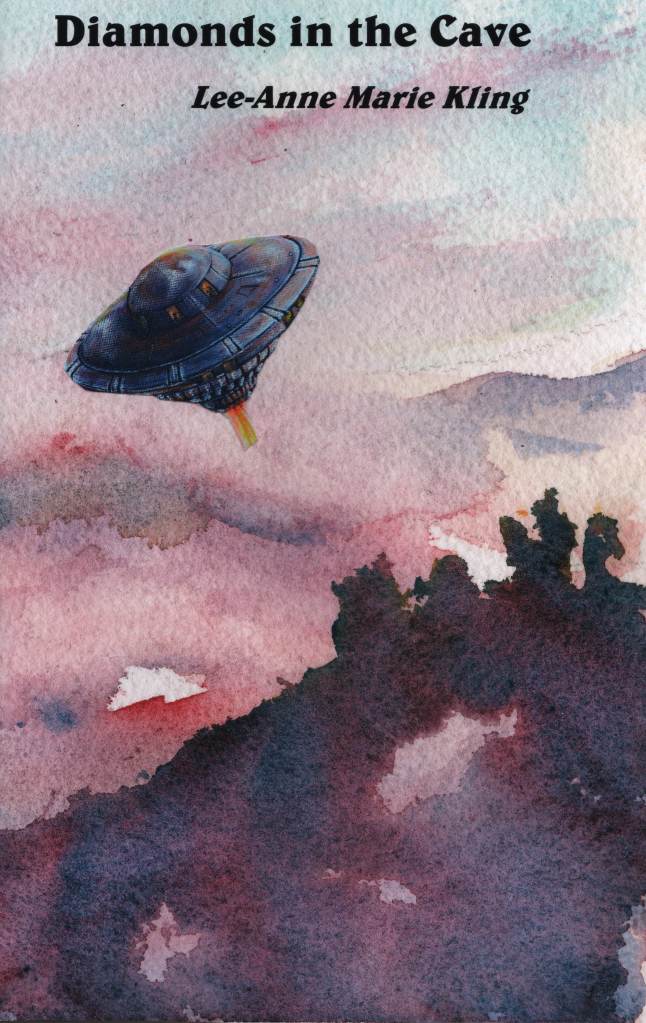
Full of hopefulness and anticipation for some Beta readers, I launched the first chapter of my novel Diamonds in the Cave on Wattpad. Not sure about the AI but decided to try out the platform as a test case. After all, there seemed to be a healthy cohort of readership for Sci-fi.
Oops! Downsides.
On further investigation, I discovered that Wattpad is geared towards Millennials and Gen Z’s. Upside if you are in that cohort. But if you are not…well…um…
Suddenly, I felt like an old chook trying to sneak into a trendy (or whatever word my children use) nightclub.
Faced with this dilemma, I asked my younger musician son, if I could sneak in using his identity. No, not a good idea. I was afraid that Wattpad might have AI bouncers, who, upon seeing my ancient, in their terms, age, would kick me off the platform.
I applied and that didn’t happen. I was comforted to read that Margaret Attwood is on Wattpad. I will be following her.
Success, of sorts
So, this “old chook”, me, has entered the realm of Wattpad, under the guise of Tessa Trudinger. Funny story about that. When I tried to register under my real name, they, the AI refused to accept me. Hence, I resorted to my maiden name, “Trudinger” and they received me with much enthusiasm saying, “Welcome Home, Trudinger”. Perhaps Trudinger is a hip name in Wattpad world. Fortunately, I had already assigned my nom de plume, Tessa Trudinger, to my detective series which I am currently working on.
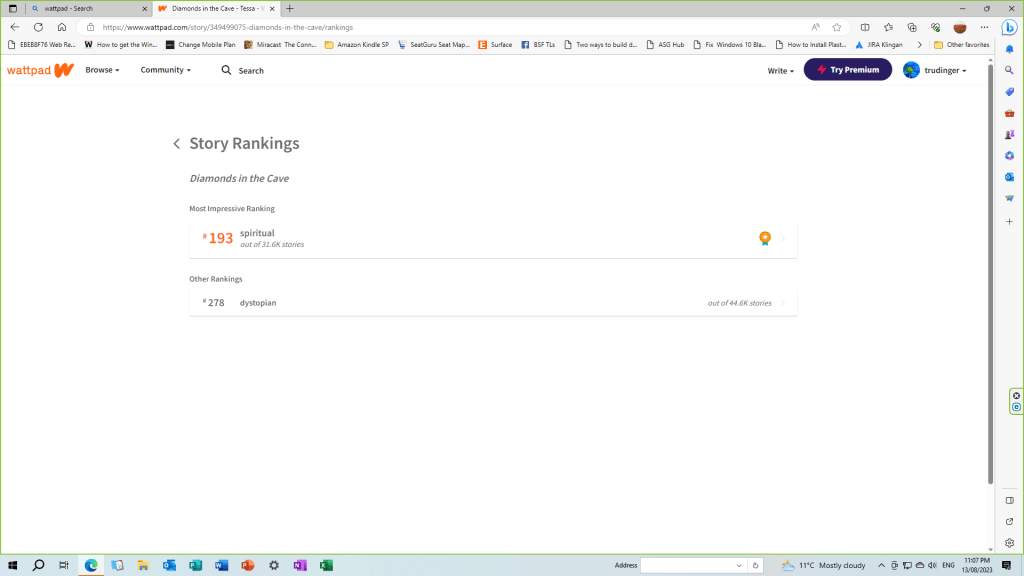
Anyway, a few days in, and the first chapter of Diamonds in the Cave steadily gained attention. Wattpad AI was pleased and awarded it the ranking #193 out of 31.6K in “Spiritual”. And something like #278 out of 44.6K in Dystopian. Two days later the story was still in the top 600 in those two categories.
*[Photo 2: Oh, joy! The statistics on Wattpad]
From there, things went south.
As I said, I’m looking for Beta readers and feedback to improve my story. No comments have appeared on Wattpad. One WordPress reader gave me encouraging feedback, saying I write beautifully. Another reader who has followed me, my friend actually, gave feedback face to face. She suggested that I need more of a “hook” in the first paragraph and that it must be rewritten.
Upon that advice, I rejigged the first paragraph, bringing elements of what the story promises to deliver—a combination of chocolate laced with time/space transporting microbes and the fearful Wend community, driven to witch hunts.
May have to eat more chocolates and play around with the first para some more in the future…
As for navigating the Wattpad website, I’m still getting used to the way Wattpad works. Uploading the story is simple enough; much like I do on WordPress. Copy and paste what I have already written on a Word document. An important strategy as I read in reviews about Wattpad taht quite a number of writers have lost their work by relying solely on Wattpad. One note, though, make sure track changes are off and not showing, or they show through on Wattpad. Messy.
I also found the story notes app provided useful in consolidating characters, the story and pitch. It made me think about my protagonist, Minna, and ensure her character remains consistent and yet grows in maturity and depth. I used the “logline” that I was asked to construct (had to be less than 150 characters), as a lead into Diamonds in the Cave on my WordPress blog.
Reading tips
I began reading a couple of stories on Wattpad. However, I discovered, when I tried to go back to them, they had vanished. Solution: apart from writing down the author’s name and book title on a separate piece of paper, I found that I could follow the authors, and put their books into my “Library” on Wattpad.
Another problem with reading in Wattpad—no bookmarks. Again, trusty old pen and paper come to the rescue. In this respect Kindle is far superior. It has bookmarks.
When I work out how to give Wattpad feedback, I will suggest that they programme some in. I checked the box volunteering to be a “Beta-user”.
This is my story of my journey into Wattpad, so far. Check out Diamonds in the Cave on Wattpad, and please do give some constructive feedback. I don’t mind if you post your comments on WordPress, Facebook, or on Wattpad.
You may need to join up on Wattpad to read, follow or comment on stories there. Not such a scary thing, I’ve done it. Just think of the millions of free stories begging for attention.
Maybe, like my friend, then, the e-reader will always be by your side.
So, you’ve written your book, edited and polished it. It’s ready for the world to see. But how do you get your book out there, so that the world can see it? Rather than repeat the wisdom of many writers and bloggers who have come before me, I will summarise the avenues of publicity from my experience and research over the years. For more information, you can click on the links provided throughout this post.
Library—You may want money for your labour of blood, sweat and words, but your local library is a good place to start for making your book, if it is a hard copy, visible. There’s something about local authors and people who are interested in reading the world created by someone who lives in their community. If you are part of a writers’ group who meet in a local library, the library is only too happy to receive one of your books to put on their shelves.
In Australia we have Australian Library Services, an organisation who distribute books to libraries throughout Australia. One point to keep in mind when submitting your book to ALS, ensure that the quality of the printing is good, as a poorer quality book will not last the distance in the rigours of repeated borrowing.
Another point to keep in mind in Australia is that you are required to submit or register your book with your State Library and National Library. In the old days you had to trek into town to your State Library and deliver the book to them personally. Nowadays the National Library of Australia (NLA) has a website where you are able to upload your book for registration. I was interested to discover that NLA has been developing an online digital publication tool Trove where a treasure of historical and recent publications can be found. Another avenue where someone finds your book.
2. Family and Friends—never underestimate the value of family and friends to benefit from your book. Make the most of gatherings with loved ones or social outings to share your recent accomplishment (your book) in the hope that they will buy a copy. If not, your book maybe a handy gift for birthdays and Christmas.
3. Bookshops—Mainline bookshops and even small boutique ones can be a teeny bit snobby when it comes to accepting Indie-produced books for their shelves. Mostly, these sacred shelves are reserved for the books from traditional publishers. But, it’s worth a try. I had a friend who travelled down this footpath with her book and with perseverance and her gift of salespersonship, she was able to get the vendors of some big booksellers to stock her book. Even made some sales. She said the downside of having her books in the bookshops is that it can take some months for the books to sell, so no profit until they do. Added to that was that some bookshops sold the book and “forgot” to pay her.
4. Writers’ Fellowships or Genre Group such as Australian Society of Authors, or Romance Writers of Australia can provide support for your work and an avenue and ready audience to receive/buy your work. After all, if you are part of a Writers’ Group, they, who have helped you produce the book will only be too willing to receive a copy (probably free as they helped you, didn’t they). That being said, they have family and friends who may like a copy too and pay for it.
5. Online Publishing Platforms: eg. Goodreads, Smashwords, Amazon—I personally have published my books through Amazon. As the biggest online retailer, and the fact that I found uploading the book to Kindle and also the facility to have my books printed, made it a no-brainer for me. One thing to say, when publishing your book, you need to be patient and careful to read the proof copy to prevent typos and glitches from being published. Take the process slowly, don’t rush or panic. Engage the help of a friend if you feel wobbly about the whole computer-technical side of Indie publishing through a digital platform.
A website, Your Publishing Guide, has extra information that may help you choose which and how many platforms to use.
6.Blogging/Website offering your book as a PDF or link to your book—When I began my Indie publishing venture, a younger, more tech-savvy friend advised that I should have developed my blog or website months before publishing my first two books. They said that my book sales would have been better if I had had a “following”. Eight years down the track, so to speak, and with over five hundred followers, not sure if that’s true, but, hey, every little bit helps. And, every so often, I make a sale.
7. Word of mouth (always keep your “business card” handy…and a box of your books in your car)—most of my hard-copy books have been sold this way. People ask, “What do you do?” I answer, “I’m a writer.” Next I’m telling them about my book and offering my business card, and a copy of my latest book. And they buy the book.
8. Coffee Shops—often you see in coffee shops books in a little pile or on a shelf for customers to read when they are sipping their drink. Just the other week, Mary McDee and I spied a locally produced book on the shelf of our favourite café. Gave me an idea to offer one of my books to add to the pile.
I might add here, since it is more community than library, that it does no harm to add your book to the collection of books offered in a community library. You know, those book boxes that have popped up all over the suburbs on footpaths or next to community centres and the like.
9. Markets and Fairs—if you have more than one book on offer, or you collude with one or two friends who have published books, hiring a stall or table at a market or fair might work for you. My experience was that the sales were not forthcoming. At fairs, people are looking for cheap homemade and second-hand items, not brand-new books. Also, you need to cover the cost of the hire of the stall or table. Never-the less might be worth a try. I’d reckon that if you had a regular stall at a market, and had other creations to sell like art, cards, craft, clothes even, you may have more success selling your books.
10. Clubs as a guest speaker —ie Probus, U3A, church, Rotary. When you write and publish your book, this is what you sign up for. If you published through a traditional publisher, they would expect you to deliver on this sort of publicity. Most of my books have been sold through book launches (at church) and being a guest speaker.
11. Online Promotional Services —ie ISBN, Amazon advertising. I’ve noticed that the ISBN agency are regularly sending information and advice to me through email on how to promote my books. When you register your book with the ISBN agency, they require you to give a synopsis of the work and provide the book cover and blurb. Same with any sort of advertising. Ensure that your synopsis, blurb and cover attract the reader by being eye-catching and engaging. For some helps you can read Elsie King’s posts on “Publishing tips—Writing a Standout Synopsis” and her recent post on “Publishing Pointers—The Book Cover”.
12. Social networks —ie Facebook, Twitter, Instagram. All I can say about this is that it’s yet another way to lead potential readers to your book. The main advice I have read over the years of blogging, is that you need to stick to one platform and not get all tangled up with dozens of social media platforms. Go with the one that works best for you and then link the other platforms to that one. I have stuck with WordPress as it is a safe place and well regulated to keep out the likes of Trolls and Spammers. Then I have set up the links to Facebook, although I had to become an administrator of a new Facebook page. I had links to Twitter, but it never really went anywhere, and now has flown the coop.
I might mention here that I have an Author page on Amazon. Not sure about other people’s experiences, but I have found the page basic with very little scope for editing mistakes made by me. For example, it insists on calling me “Mrs. Lee-Anne”. Really? Bit strange in the 21st century.
***
One thing I have learnt from my publishing adventure, is that I have made discoveries and have grown along the way. I have received some feedback that I need to spoon-feed my audience with a step-by-step guide on how to…whatever the topic is. However, in the words of a teacher friend of mine, “We learn by doing, not just hearing.” Besides, there are many step-by-step guides out there on the web and I doubt another one by me would make much difference for the tech-challenged. So, for all who have yet to launch into the world of publishing your book and distributing it, the best way of getting your book out there is by being bold and doing just that: have a go and get your book out there.







 Indie Scriptorium -- Self Publishing Collective