More Than Just Words
All my life, words have fascinated me – their meanings and double meanings, along with puns, jokes, and varied pronunciations. How we put them together for impact; to make poems or stories or paint pictures in a reader’s imagination is grist to my mill, floats my intellectual boat.
So choosing English as a major subject when I got to university was a no-brainer. And when I discovered that Linguistics was one of the third year options, I couldn’t wait to enrol.
Before this, High School Latin had opened my eyes to the fact that languages other than English have very different rules; can be structured differently; are often quite a different kettle of fish. This was amazing! Putting the verb at the end of the sentence? Changing the last syllable of the word instead of using one of the “little words” (e.g: to/for/by/with/from…) as those ancient Romans had done? Wow!!
All this opened up the wide world of translation and how tricky it can be to “get it right”; get the original author’s attitude and intentions across accurately; convey as many as possible, of the subtleties of the original.
Conversations with multi-cultural friends, some of whom were fluent speakers in not just two but several languages were frustrating as these people took all the differences for granted. None shared my passion for words; so they quickly found our “chats” boring. And me weird.
Consequently, I was forced to turn to books in my quest for enlightenment. The only books readily available that provided varied renditions of the original text was the Bible. So I go down all sorts of rabbit holes, spanning several centuries of translations in this adventure.
And after all that long-winded background bumph we come to the point of this blog; a blog designed for those of us who write. Finally I hear you say (if you are still with me, of course!!).
A couple of days ago I read and compared several accounts of the Last Supper; that final, pivotal meal before the crucifixion, that Jesus shared with his disciples; the meal which Judas walked out of to meet with the High Priests and betray him.
Several of the modern translations wound up their account with:
“So Judas left, going out into the night”.
Others (including the King James Version) rendered the same incident as:
“So Judas left. And it was night.”
Only a very small difference – a single sentence of eight letters versus two sentences of seven letters.
But it hit me like a bomb.
The strength and implicit emotion; the sense of impending doom, that that second sentence gave when contrasted with the first was palpable. The first was an accurate but matter-of-fact, almost journalistic rendition. The first, set alongside the heart-wrenching vividness of the second, was just ordinary writing in my eyes.
Of course you may not agree. We all see and interpret things very differently. Which is a good thing; makes life interesting!
When we speak we add to our words with both our voice and our facial expressions, as well as gesture, stance… There are a hundred and one ways of getting our meaning across as we become aware of responses from those to whom we are speaking. There is an immediacy in the spoken that is not available in the written. So we have to compensate.
As writers, we need to develop awareness of those aspects of writing that are more than merely putting words together. This is what divides great writing from the simply pedestrian. How those words are arranged, organized, juxtaposed one with the other is important. How our words are divided into sentences and punctuated can make a huge difference to how we get our message across to the reader. These are the things that make our writing truly impactful.
And isn’t this what we all want?
© Mary McDee 2024
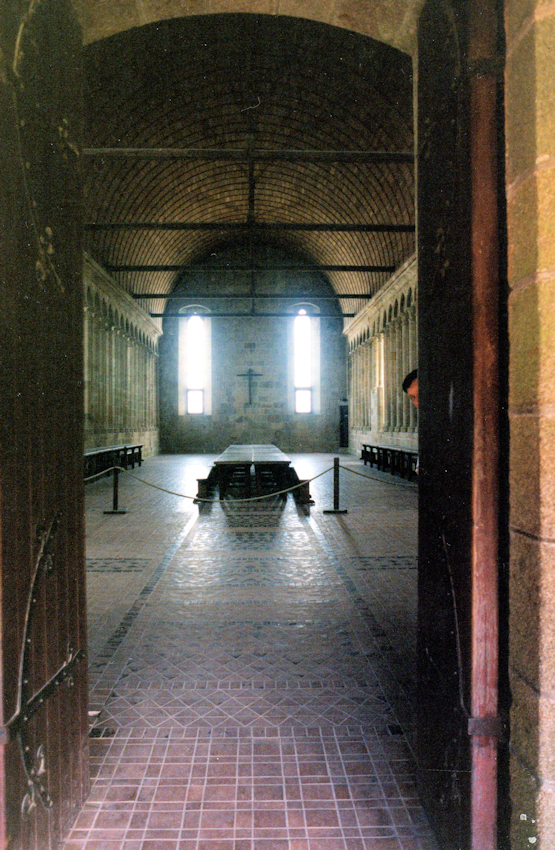
Feature photo: Le Mont St. Michel, Dining Room, a room reminiscent of Christ’s Last Supper © L.M. Kling 1998

 Indie Scriptorium -- Self Publishing Collective