We, at Indie Scriptorium met last week and reflected on our direction and purpose, especially in relation to our weekly blogs. Recently, I came across this post by fellow blogger, Anthony Robert, which to me, hits the spot when it comes to getting out there and increasing our presence.
marketing
Marketing on Websites–Improving Your SEO
Part One – Understanding how search engines work

Having a website is a great idea for authors. It allows them to showcase their books and builds relationships with readers. You can sell your books on-line through links to your book publisher. You can write blogs or newsletters for distribution, provide information about your life and writing career, advertise future releases and connect to social media. You can advertise author events and book signings. It is a marketing tool with a personal focus and while it can be tricky to set up it gave me a lot of satisfaction having a website. But mine hasn’t performed and languishes unread. Time to make some changes.
But where do you begin? There are millions of author websites in existence, and they all are competing for attention and sales. So how do you get your website noticed? Let’s find out.
Let’s start with the biggie, SEARCH ENGINE OPTIMISATION – SEO
When I want to research a topic, I fire up Google and then work out what information I want. For example: I want to find out about SEOs. So, I type in “what is a SEO?”
(Some popular alternatives to Google are DuckDuckGo, Bing, Yahoo but there are over 1500 others to choose from including one called Dogpile?)
The response to my search is overwhelming. I initially got a very long and complicated one sentence explanation which didn’t make much sense. I then scrolled down to 76 (enough, there were more) companies giving explanations about SEOs. There were also several You-tube videos available with lovely people wanting me to find out visually what SEO’s are all about. They all invited me to click on their website and swallowed up in their advertising and sign up for expensive services to improve my website’s SEO.
I scrolled down to Wikipedia. I love Wikipedia and regularly donate when they put out requests. Yes, I know it’s not perfect but it’s a great first stop that can provide you with good information and directions for further research.
Wikipedia defines SEO as the “Process of improving the quality and quantity of website traffic to a website or web page from search engines.”
Okay, what do I, as an Australian author need to improve my website’s SEO. Well, the Key Words are Australian and author. These narrow down my search to what is relevant to me. I Google again and get another long list of companies and individuals who want me to look at their websites and sign me up for their services.
I chose three web sites to explore:
- Australian Writers Centre – it looked professional and offered a course on SEOs.
- Jin and Co. Caught my eye with the proclamation “Two simple steps for authors to found in Google with SEO.
- Amazon SEO for authors.
I chose the Australian Writers Centre because it looked professional. The tag “Two Simple steps…” caught my attention as it offered a quick and simple solution. I chose Amazon because they are a big brand and should know what they are talking about.
So, these services and companies drew me in with their presentation, that includes their titles, their choice of words to advertise themselves and their brand name. It is these factors that draw readers and potential customers. It is these factors that you must address to improve your own website.
The other big consideration is, Do I want to pay for a SEO improvement service or do it myself?
There are information websites for free. These are referred to as “organic” or “natural” traffic and is hard to find amidst the other monetarised websites. Many YouTube videos fall into this category, as does Wikipedia. I also found a Business.gov.au website and looked at Wix and LinkedIn sites for free information.
The second, and more prolific websites available are called direct traffic, which is really advertising. Advertising on-line includes emails (think Spam) Banner advertising where an advert decorates the bottom of a page. Pop – ups jump out at you at unexpected times, some webpages encourage you to join in a chat with a robot. The aim of these services is to get your money, which is fair enough if they provide a good service and you can afford them. All these websites are geared to draw you in and some of them make it difficult to escape from their greedy clutches. Ever found yourself in a website without a log out or delete button and you keep on going around and around looking for a X.
All these multiple forms of websites are guided by Algorithms.
Algorithms have been around since 2500BC in Babylonia. They are formulas that take complex date from a variety of sources and make it more user friendly.
In modern times algorithms are programmed by computers to work out what words and sentences are popular and gain the attention of browsers. They do this primarily through keywords, and getting the right key words, the name and the visual presentation of the site. It’s what draws attention to your website and, the books that you hope to sell.
Website marketing is a huge area to research and understand. I have found just this first step edifying. Watch out for more blogs on this complex topic.
References used in this Blog:
- Wikipedia
- LinkedIn SEO – 6 steps to optimise your profile.
- Wix – Free SEO tutorials
- Australian Government – Business.gov.au – Improve your search engine rankings.
Cheers Elsie King©2024
Photo: Attributed to Stock photos
On Marketing–The 2nd Book
Marketing – My Second Novel
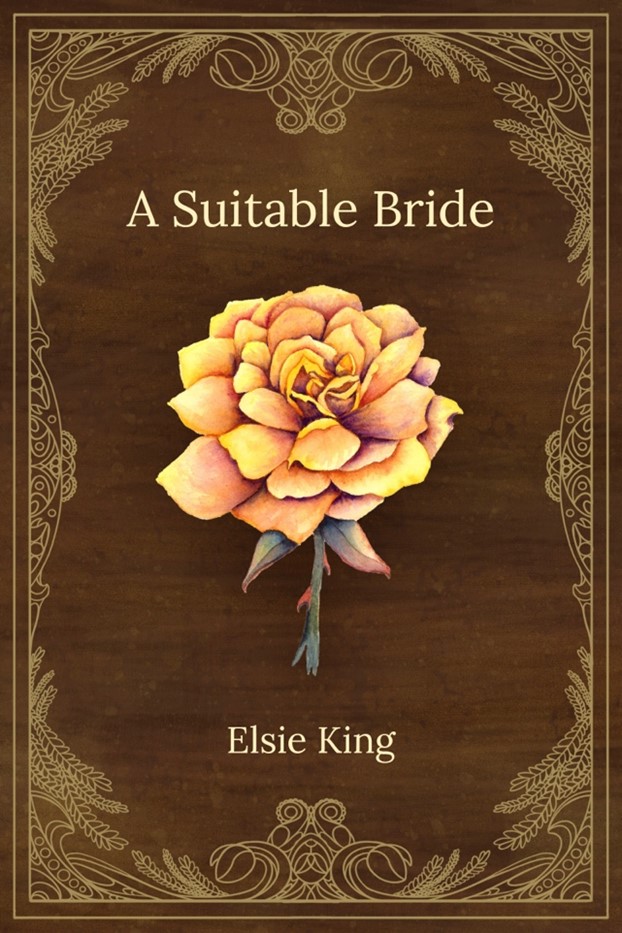
In a previous blog I mentioned that the best form of marketing is to write a second book. I’m about to test that theory and my second book A Suitable Bride is at the proof-reading stage with a release date hopefully soon. (I’m reluctant to name a date until the book has been fully edited as many things tend to intervene and I have to apologise for the delay.)
My first novel A Suitable Heir was marketed to family and friends, through the indie table at the Romance Writers of Australia Conference and on their magazine Hearts Talk. I sold some through my art group. We tried a local market with no success. I sold about fifty books through this process and was reasonably happy with the outcome but hopefully can increase sales for my next book.
My problem, and I think it is a problem for many writers, is that I don’t have the knowledge, inclination or time to devote to marketing. I admire those writers who have taken the plunge and got a large following of readers and are making a good living from their craft but marketing is not my forte. However, as a member of Indie Scriptorium I feel that I have an obligation to get some understanding of the various marketing techniques and report on my findings. I would love to find a book marketer who is able to market my novels for me at a reasonable cost but first I think it’s important to know what sort of marketing you want for your books.
Types of Marketing Services
- Getting the book ready for the market- includes cover design, blurb, the correct Search Engine optimisation (SEO), the best keywords for your book, an author bio and reviews of previous books and make the price competitive.
- Advertising – can include social media advertising, Amazon advertising, Goodreads and many other platforms
- Setting up an author website and learning how to use it effectively.
- Having marketing material, banners business cards, bookmarks etc.
- Getting an e-mail campaign started
- Doing author talks, book launches and making media releases
- Listing your book with online distributors such as Amazon, Booktopia and Book depository.
Each of these areas of marketing will need to be extensively researched and require a working knowledge of the various social media and web pages. There are lots of options in most categories. I will do the Google searches, look at countless You-tube videos and try to work out the sometimes-confusing web sites and social media platforms for my own edification and to inform IS followers.
The other option is to hire a book marketer. A quick google search for book marketers in Australia reveals lots of options that all want your e-mail address so they can bombard you with sales pitches for the rest of time. It’s also a matter of buyer beware as some of these book marketers are vanity publishers who promise a lot, take your money and deliver a shoddy product and leave you in the lurch. I will keep searching for book marketers who may provide a good service at a reasonable price and keep you informed.
Indie Scriptorium has provided some blogs about some marketing techniques. See our previous blogs on SEOs, cover designs, blurbs, websites but the above is a very large checklist and we still have a way to go.
I already have a website, business cards, reviews and I’m happy with my cover design, author bio and blurb for my second novel. I will be reviewing my SEO and making sure my keywords are the best for my novel.
My initial focus will be on my social media, look at Amazon and Facebook adverts and explore Goodreads and other book distribution services. Going local and using my existing contacts in Romance Writers of Australia, organising a book launch and networking with local writing and book clubs will also be in my plan. Hopefully I can share what has worked for me, and what didn’t. Stay tuned for more on marketing.
Cheers
Elsie King ©2024
Book cover © Kate Smallwood and L.C. Wong 2024
To Market, To Market, How Did We Fare?
Last Friday, Mary and I attended a party at a local Café that we patronise every Wednesday between Bible study and Writers’ Group. We go there for lunch and have started to get to know some of the regulars there as well as the manageress. She makes a delicious Black Forest Cake.
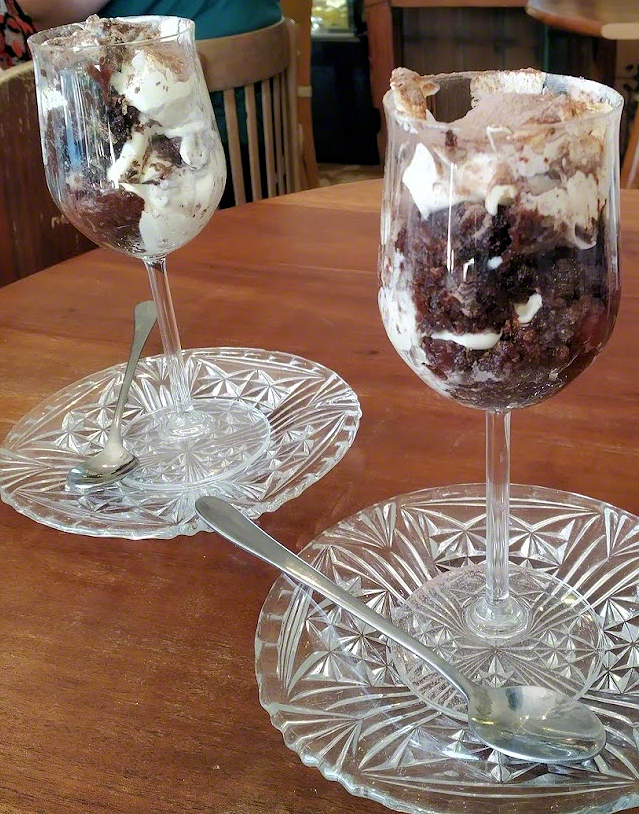
Anyway, on the way, I remarked, ‘Wow, it’s been a week already since the market.’
So, how did we go? You ask.
What you must understand is that the main stream media did its best to deter people from doing anything—apart from activating their fire-safety plan. Or second to that, heading to the nearest bunker and hunkering down waiting for the apocalyptic storm to pass.
As it turned out, the doom and gloom weather forecasters were out by a couple of days. Clouds shrouded Adelaide by mid-afternoon, even a few spots of rain. The fires never happened. The evening of the market turned into a balmy twenty-something degree Celsius, perfect for strolling in the market or enjoying Christmas festivities.
However, the damage by media had already been done and no one but a hardy few, ventured outside their homes to attend. In the end, traders traded amongst themselves. I bought a native orchid and a couple of Christmas cakes. Elsie bought my significant-zero-number birthday present, a handy art pouch that I can use when painting en plein air.
And finally, after no financial transaction action all evening on our stall, a neighbouring vendor bought one of my books, and Elsie’s great nephew one of my miniature paintings. Minutes before, we had sold one of Elsie’s cards while she was away from the table having a break.
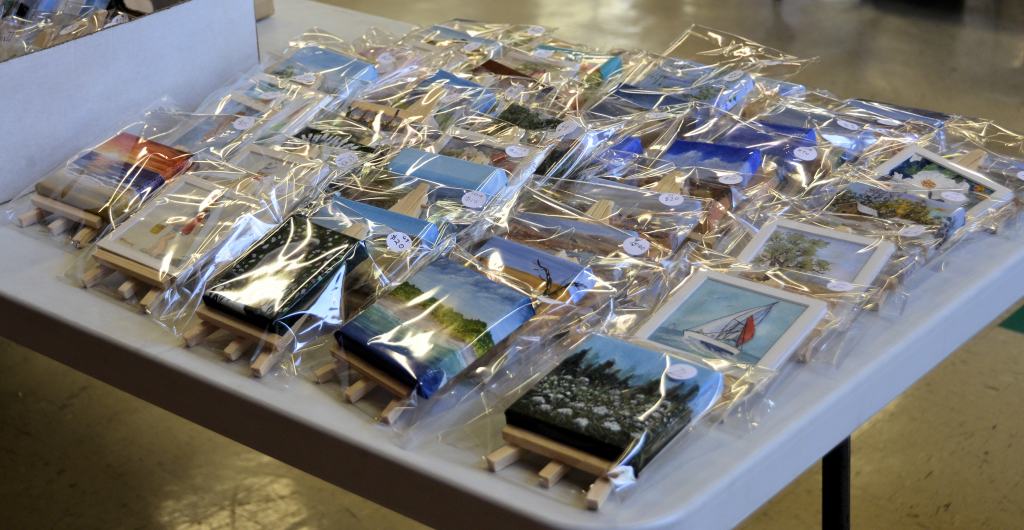
Disappointing? No, I don’t think so. I have come to believe that the market experience is more than just buying and selling goods. It’s about community. Building relationships. Being a regular reassuring presence. Being there to listen to people, to connect with people.
Now at times, during the evening, this connecting was difficult to do. We were situated right under the main entertainment; a couple of merry “Elves” singing Christmas songs. They were doing a jolly good job of it, drumming up that seasonal spirit—except that they sang to no one but the vendors most of the time. Where we were the music blared at top volume. When some hapless soul did enter the market and pass our stall, they sped around the tables, glancing only briefly at our books and artwork. Communication, even amongst us concluded in sign language and I resorted to sharing writing in my notebook; a kind of note-passing between friends.
When the music-makers took a break, we had opportunity to connect with potential buyers or people who just wanted someone to listen to what was going on in their world.
While packing up, one of the neighbouring vendors gave some advice; cards don’t sell, they said, and every time is different, so don’t give up. From the brief debrief we had, we decided that in the future, we’ll look at selling smaller paintings and trying to get a stall far, far away from the entertainment.
As for connection, the market is just one way for advertising Indie Scriptorium and our indie-published books. After years of going to this local café I mentioned Mary and I go to every Wednesday, I finally gave one of my books, The T-Team with Mr. B to the manageress to read as a Christmas present. The Lost World of the Wends was given to a young writer who also comes to this café, and also I gave away a bookmark advertising Indie Scriptorium.

Building the “brand”, the business by networking takes time, especially with the strident voice of professional media, but slowly but surely I feel, people are catching on and it’s happening for Indie Scriptorium.
A heart-felt thank you to all you faithful followers and newcomers to our Indie Scriptorium blog. Merry Christmas and we wish you a successful New Year in your endeavours.
Cheers, Lee-Anne Marie.
© Lee-Anne Marie Kling 2023
Feature Photo: Indie Scriptorium Team at the market © L.M. Kling 2023
To Market, To Market…
This Friday we, the members of Indie Scriptorium, will be selling our books, artwork and cards at the
Reynella Neighbourhood Centre Inc. Twilight Christmas Market.
164 South Road, Old Reynella
Friday 8 December 4 – 7pm
If you are in Adelaide, come and visit us there.
Not only will you be able to see the books and artwork which we have produced, we will be available to discuss with aspiring authors, such topics as: Helpful tips on becoming a writer, publishing your own book, and marketing options.
Hope to see you there,
Indie Scriptorium – a self-publishing collective.
© Lee-Anne Marie Kling 2023
Feature Photo: Christies market © L.M. Kling 2019
In the meantime, check out this blog from the recent past on ways to sell your book …
Marketing Makers–Pitching
Pitching your novel

Pitching can be defined as short verbal promotion of your book to a publisher or agent. The pitch can be face to face or on-line. It’s usually is between three and ten minutes. In some instances, the pitching appointment is a set time and you may need to alter your pitch to fit.
Elevator pitches are very quick and so named to capture the scenario of entering a lift with a popular publisher. You have just moments to convince them they need to accept your book for publication before the lift stops at the next floor. Pressure indeed.
The Australian Society or Authors and Romance Writers of Australia organise pitching sessions which get hopeful authors in front of people in the publishing industry. The ASA have courses for authors to learn all about pitching and also offer Literary Speed Dating sessions. The RWA offers pitching sessions as part of their annual conference.
But do you want or need to pitch your book to a publisher? Many writers decide to self-publish so don’t need to pitch their novel. However, if you would prefer to have your novel traditionally published, or you want an agent, then pitching is essential.
There is considerable information on line about how to formulate the perfect pitch. If you Google Author Pitching Formula a variety of web sites appear. I have done a pitch and used a formula but it went out the window in the actual interview. I would suggest doing the research and picking out the formula that suits you and your novel and construct it according to the time constraints of the publisher/agent.
At the minimum the pitch should cover:
- That the book you are pitching is completed, fully edited and formatted and ready for submission.
- The title (even if it’s a working title)
- Word count
- The specific genre and target audience
- A brief description of the main characters
- The conflict and resolution
- Why it’s different from anything else.
- With longer pitches you can include your author credentials and experience
- What target market you envisage for your book
- What books are similar to yours.
When you’ve written, re-written, practiced, timed and learnt your pitch off by heart take a course in deep breathing and mindfulness for anxiety and you’re ready to pitch.
Two articles from Romance Writers of Australia, Hearts Talk magazine provided some interesting and helpful ideas.
Rachel Sweasey The Importance of Pitching June 2023 suggests for Zoom pitching appointments
- Practice looking calm and happy prior to the pitch. Smile maintain eye contact.
- Be on time
- Be prepared
- Dress in the same style as your Author bio picture so the publisher/agent can put a face to your picture on your submission.
- Have answers to expected questions on post-it notes stuck to the edge of your screen to act as prompts if you dry up. This way you won’t have to shuffle through notes and can maintain focus on the interviewer.
Amy Hutton Pitch Perfect April 2023 suggests:
- Have a solid synopsis
- Learn the pitch by heart
- Make sure you know what a particular editor/agent is looking for before making a pitching appointment.
- Allow time at the end of the pitch for questions
- Have answers prepared about your character, themes, yourself and your writing history
- If you have time include courses, groups and workshops you’ve attend
- Also include your social media and marketing experience
Pitching is a difficult, nerve-wracking experience but it can get your book read rather than being left to languish at the bottom of a slush pile.
The art of pitching is different to presenting your book to potential readers. This is also a great skill to learn for both traditional and self-published authors. I will address author presentations in my next blog.
Good luck
Cheers
Elsie King © 2023
Photo attributed to Creative Commons 2023
It’s not Over… Now Comes the Marketing Plan

Self-publishing a book is a wonderful goal but it certainly isn’t the end of the road. The book does not get into the hands of readers without marketing.
So, how do you get your book noticed, bought and read?
I read somewhere that the best form of marketing is to write the next book. That makes a lot of sense to me as the release of the second book, anthology or short story draws attention to what you have written before.
The business of marketing can take up a lot of time and attention and it’s difficult to get through all the steps you need to market your work and still have time for the joy of writing the next book/story.
This blog will explain my strategy for my own modest marketing plan:
What is your goal?
If you are like me my primary goal was to have a novel published. I don’t need a liveable income from writing. I don’t expect to be a best seller and if I cover some of my expenses I will be happy. So, my marketing strategy was modest and relied on word of mouth and the generosity of friends and family to buy my book and spread the word. If you have given up your day job and have the rent or mortgage due, you will need a much more vigorous marketing plan.
The basic essentials that I used are:
- Business cards with an e-mail address and web site address. You can add your phone numbers and address if you choose.
- A website that is connected to your social media accounts and where you can post covers of your books and have links to the sites that sell your book. Then tell everyone possible that you have a website and ask them to visit.
- Do regular blogs on your web site and post to social media.
- Organise a launch party. My release coincided with a big birthday so I invited guests and asked that, in lieu of presents they buy a copy of my book. I then ordered 35 author copies of the book and sold them to friends and family. I sold 34 books with promises of online orders too.
- I’m a member of Romance Writers of Australia so will take five copies of my books to the 2023 Sydney conference and put them on the Indie table for sale along with my business cards and a free card (A giveaway displaying my artwork)
- I have advertised my novel on the RWA website and in their magazine Hearts Talk.
- I paint as well as write so put my business cards of the back of my paintings
- Copies of my paintings have been made into cards and my website address is on the back of the card next to the copyright.
- Indie Scriptorium web site also advertises my books. I and my fellow members write regular blogs about the self-publishing process. We have a small but increasing following and go world-wide. My website is linked to the Indie Scriptorium website.
- Indie Scriptorium will launch a book of our accumulated blogs about self-publishing as well as an anthology of writing, poems, artwork and photograph early next year. Our individual novels and books will be included in this launch.
- My fellow writers in IS plan to get a display table of art, cards, books and other advertising at local craft markets.
- I intend to contact local writers groups and offer to give an information session about the process of self-publishing my book. Hopefully sell a few books too.
That’s the plan for now. I intend to review my sales strategy from time to time but now I’m going to start writing my third novel.
Cheers Elsie King
©Elsie King 2023
Image attributed to Creative Commons 2023
Of Marketing and Monopoly
Marketing Books and Monopoly—My Journey around the Board

Recently, my brother introduced me to “Monopoly for Sore Losers”. Since, in my family I have the reputation from childhood, reinforced and maintained by those around me as a “sore loser”, I had to get it. As I played the game, I realised how much marketing and being a dominant player on the internet, is like Monopoly and Mr. Monopoly from the “Sore Loser” edition, like the “Best Sellers” on Amazon.
Now, about marketing, I’m not an expert by any means. But, since I began this indie-publishing journey back in late 2015, I have learnt what works for me.
This last summer, for me in Australia, I have been concentrating on the “housekeeping” side of marketing my books. Thus, my first, Mission of the Unwilling, had a makeover and re-released as a second edition. Then all four books cycled through their five-day free promotion on Amazon. Next I’m looking into paying some money for advertising.
It seems my marketing skills have a way to go in gaining a monopoly on Amazon shelves and being sold. You see, marketing and advertising one’s product, my books and artwork, takes time. The issue with time is that I’d rather be creating than slogging away pushing my product in an already saturated market.
When I started on this journey, I, like many a writer, thought that mine was the great (insert country) novel, that readers will be hanging out to get their hands on. The book would sell itself. It didn’t happen, as I dreamed.
A foray into the publishing world, and its history reveals an unexpected picture. Although amazing authors and brilliant books exist, and are sold in abundance world-wide, the literary world is full of mediocre tomes stacked on the shelves of bookshops and online distributers. Some are bestsellers.
How, is this so?
Answer, effective marketing. Often, especially with traditional publishing, the writers have a “platform”. Traditional publishing is a business and they go for the safe option—someone who is famous or becomes famous through their authored works. They bank on reader curiosity, who sells well, has a “brand” and longevity.
Needless to say, I didn’t have a “platform”. However, I have been developing a network and influence through my “blogsite” and Website, “Tru-Kling Creations”, and most recently this publishing collective, “Indie Scriptorium”.
The challenge with my blogsite when I first started was to make it visible. Way back in 2015, it was so buried by the competition, that I couldn’t even find it—even when I typed in the precise address.
After embarking on some more research, I discovered a phenomena called “algorithms”. To put it simply, think of Monopoly; the more properties you acquire, the more likely someone is to land on you.
In my blogsite’s case, the more visitors you get, the more visible your site becomes. The “Mr. Monopolies” of the cyberworld actually employ computer experts to manipulate the algorithms. That is how a mediocre book can become a bestseller.
So, how do we, the so called “Plebs” of the internet, compete with these “Mr. Monopolies”? How do we get our blog/webpage onto page 1? How can our masterpieces rise to the top like cream and become bestsellers like they ought to be?
Well, first make sure our books are the best they can be. Start with good editing and proofreading. Check out Indie Scriptorium’s posts on editing. Then once you and your test-readers are satisfied with your product, then the next step is marketing and advertising. This includes doing your research, figuring out who your audience is, and pitching to your potential readers.
As I wrote before, I found that blogging and setting up a webpage has worked for me. I now have over 550 followers of my blog. But it has taken time. I found that inviting friends and family to follow, visit and like my posts helped boost activity. This then led to a wider-worldwide audience. I persevered. I’m still in the game. Even though I am not like some bloggers who have thousands of followers, I am encouraged when I get visitors who come via the “Search Engine” as it means my blogs are visible.
It’s the same with our books and the competition from the big sellers, those Mr. Monopolies of the book world. True, the mediocre best sellers will have their time in the sun. But, it won’t last. Good literature, I believe will shine through in the end. I realise now, that my novels are not the great Australian work I had dreamed they were, but for some who have read them, they have found great enjoyment, and are asking, ‘When’s the next one coming out?’
© Lee-Anne Marie Kling 2023
Feature Photo: Product placement; another way of advertising (and it’s not just Monopoly) © L.M. Kling 2023
Marketing II–Website? Yes? or No?
Marketing 2–Do you really need a website?

I made it a goal to have a website by the end of this year. Achieving the goal is proving to be much more difficult and time intensive than expected.
The website builders are very keen to reassure that they can have a wonderful, professional looking website in a jiffy. That it’s an easy five, seven or ten-step process. That the website building is effortless and should take not much longer than 15 minutes, a couple of hours or a couple of days. It is all lies!
Building a website involves a stroll through an intuitive program, which guides you step by step to achieving your goal. They advise you get a template and just drag-and-drop things (from where I ask) replace their text and pictures with your own (but cannot tell you where the delete button is so you can get rid of the damned pictures.) Text boxes move, you get pushed into templates you never wanted and it’s very easy to delete hours of work for no apparent reason and it’s just hard work.
I’m halfway through building a site with WIX. I have a preconceived idea what I want my website to look like and am battling with a system that hates you having any creative innovations that don’t fit the bill. HELP.
Asking, do I really need a website makes quitting a viable option? But I want a website so I can put a web address on my business cards and attach them to my art and give them away to fellow writers and prospective readers. I want a web address on the back of my Christmas cards. I need a website for when I publish my books, organise an art exhibition or arrange a book launch. Web sites are important.
Ok, so I will persist and let you know how to find me on the web next year. Merry Christmas.
Elsie King ©2022
Picture from Creative Commons
Marketing–Building a Website

Marketing—Do you need a website?
So, you’ve finished, or nearly finished, your novel. It’s written, rewritten, edited probably at least five times, given to beta readers for feedback, critiqued by writing friends or in writing groups and taken up a large part of your life.
Whether it took you years or months, a novel is a major investment in time, energy, sweat and tears and when the manuscript is finished, you don’t want it to languish in a bottom drawer. It needs to be read.
Marketing is the hardest part of self-publishing. It’s estimated that there are over three million books on Amazon. They publish 50,000 books a month and they are the largest company for self-publishing authors in the world. They release a new book every five minutes. It’s a lot of competition. Your book has to be seen, talked about and hopefully bought in order for it to get ahead of the thousands of other books being published. Marketing is the way to get your book noticed.
Before coming up with your marketing plan, it may be helpful to consider what you want for your finished book.
- Do you want to make writing your career? Intend to write many books and earn enough money from sales to give up your day job. This means a commitment of long hours for the rest of your life. Writing will become a business and a passion, and you will need to build up your name to ensure you have lots of buyers for your products.
- You may enjoy writing fiction as a passion, an activity that gives you pleasure, and you want your books read by an audience. This is the category where I am. I want my books to be the best they can be, to achieve a professional standard, but I’m not dependent on an income. I don’t want to put pressure on myself to write what sells and have to achieve deadlines.
- The third type of writer may want to write their memoir or family history, or contribute a non-fiction book. These authors may have a smaller audience, although some biographies and memoirs sell well on the open market.
- Another author may write for purely personal reasons, using the medium of writing to express their creativity. Often these writers contribute to anthologies in writing groups or may have a body of work that they want a book to share with family and friends.
All of these authors can self-publish a brilliant book, but their goal for book distribution may differ from a professional writer.
Back to the question: Do you need a website? If you want your book read and consider writing more books in the future, a website is a good idea and is worth the effort to get one up and running.
A website in simple terms is your address on-line. It’s where people can find you by searching online for your name and what you do. For example: www. elsieking/author.com (not in operation yet). You can sell your books from the website, advertise books you are writing, you can tell your readers about your life, passions and ideas. A website may also be a blog or newsletter where you share your writing tips. The website lets you connect with your readers and get reviews.
A website can be a simple page with minimal details (a landing or home page) or a more complex beast with links to social media, e-mail marketing, newsletters and contacts with other authors.
I’m a newbie with websites. I know they can be expensive to have made for you, but much cheaper to make one of your own using a website host such as WordPress, Square Space, or Wix. Don’t believe the adverts about creating your own websites. It is not as easy as they say. But it is fun to experiment with some website builders.
My advice, consider if you need a website. Research some of your favourite author websites and look at the plethora of YouTube videos that tell you how to create a website. (I found most of them too quick and get through too much information. They also use acronyms which they don’t explain. Find one that works for you)
If you decide to try it, be prepared with a catchy by-line, have a succinct but interesting author bio ready and think about what graphics, fonts and colours you want.
I’m a techno dinosaur, so I expect it will take me many weeks to construct my website. I’m learning as I go and have discovered you can create a website, delete it and start again and play without having to commit to publishing until you have it just right. When I get it right, I will do another blog to discuss the process, I found helpful.
If anyone reading this blog has some personal experience with building a website, please write an e-mail to scriptoriumpublishing@gmail.com We’d love to hear from you.
Elsie King ©2022
Feature Photo: Image from creative commons
 Indie Scriptorium -- Self Publishing Collective