In my blog a couple of weeks ago I included the sentence:
“Reading written English can be a challenge at the best of times due to a number of factors I won’t go into here.”
Very true! And I won’t go into them here; now. However, I thought you might enjoy an account of when I came unstuck once upon a time not so long ago, an incident that set me thinking long and hard.
My adventure came about as I was travelling on a local train. Mid-afternoon; almost the only passenger; sitting about halfway along the carriage; relaxed, happy, content, mind wandering… What could possibly go wrong?
My eyes lit on a sign at the far end of the carriage and I was instantly brought back to full awareness of my surroundings. That sign on that end wall of a public transport amenity made no sense; no sense at all.
Why on earth would anyone want to display a sign that read “CREATING OATS” in a railway carriage???
I pondered the matter for a while then read it more carefully and realised that that sign was actually “CHEATING GETS YOU NOWHERE” – it was composed in such a way that those four words made a neat square; two words on the first line; the last two on the second line. Additionally, the font used (all in capitals!) along with the tight spacing made the “H” in CHEATING look like an “R” and the “GE” looked like “OA” when it caught my wandering eye from where I was sitting some distance away.
I shook my head and contemplated the matter. Now you need to know that I am an avid reader and have been since the age of six; one of those folks who read Weetbix packets; who won’t go anywhere without having a book for those moments that drag without something to read.
I know our brains tend to do funny things at times. It is all too easy to get into a mess due to misunderstanding and/or misperception – often due to a fancy font; a confusing layout; a tricky,” invented” spelling designed to be eye-catching. What hope does a newbie to the system have?
I have the experience to think, “What the…?” when something doesn’t make sense. So, I look again – and more carefully.
But what of those with less experience and/or awareness? Maybe a small child still coming to grips with all the intricacies of our written language; battling to learn to read? Or maybe someone new to Australia who has come from a land where the writing system does not use our alphabet e.g. China or an Arabic country?
It would be all too easy to remain confused, convinced either that the world is bonkers or (much more likely) that they themselves are not up to scratch.
Tragically, this last conclusion is what far too many of our littlies decide about themselves when they arrive at school bright eyed and bushy tailed; eager to master all this reading stuff only to find that it makes little or no sense to them. So they decide that they themselves have to be no good; dumb bunnies; stupid…
For a number, this assessment of themselves becomes buried in their subconscious, a crippling, lifelong, totally unnecessary disability.
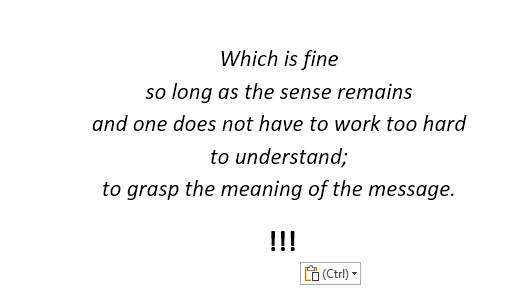
A while ago we gave you a blog about apostrophes and the two apparently different jobs they do. In actual fact, however, their jobs are not so very different as both uses indicate something has been left out thus effectively shortening the statement – a thing we tend to do when talking. Which is fine so long as the sense remains and one does not have to work too hard to understand; to grasp the meaning of the message.
Back then we concentrated on the apostrophe of possession (AKA the apostrophe of ownership or belonging) and gave you the example of how a string of apostrophised words can make perfect sense with the little nonsense story of “Jan and Her Gran”.
The other use of the apostrophe (also known as a “raised comma” but in grammatical circles is referred to as the “apostrophe of contraction”) is, in a sense, simpler as it reflects what we all do when talking: run words together so that two or three sound like one. This means that, when writing, we omit a letter (or letters) along with the space between the words.
I’ve become aware for several years of a move to dump apostrophes all together as the correct use of them is seen as too hard; confusing; not necessary; writing would be simpler…; too many people don’t know how to use them…
If they are taught well all these objections are virtually non-existent. In my experience as a school-marm all my working life I know that pretty well every eight or nine year old can learn to use them appropriately.
What fascinates me is the effect ditching the apostrophe of contraction could well have on our reading of such words as he’ll, she’ll, we’ll, she’d, we’d, can’t, won’t, I’ll. Pause a moment and consider each of these minus its apostrophe.
Reading written English can be a challenge at the best of times due to a number of factors I won’t go into here. So why on earth make it harder than it need be? Surely what we really need is simple, effective teaching that explains things clearly.
Just in case you had a bit of trouble visualising the effect of omitting the apostrophe on the short list I gave you above:
Admittedly, this last is not commonly used these days. But, according to my big, fat, two volume Shorter(!!) Oxford Dictionary there are no less than ten separate, distinct meanings for “cant” varying from “dispose of by auction” and “jargonistic” through “bold, brisk, lively, hearty” to “push or pitch sideways”… Just to list but a few of those ten!!
To recap what I said in the beginning about making changes to the language:
“You should serialise your books,” a friend said, showing me her latest e-reader. “Once you have finished the book, you can publish it. That’s what some of the authors I read do.”
And my friend reads constantly. You could say she’s attached to her e-reader.
Voila! Kindle Vella popped up as an option.
I looked into this enterprising option.
No go. Unless you live in the USA.
A suggestion at the bottom of the website I had been researching about Kindle Vella suggested a story platform called Wattpad. Wattpad seemed to embrace all those of the universe left out of the US Kindle Vella orbit.
Looked promising.
Further investigation revealed Wattpad was one of the top platforms for reading and writing stories. Millions of stories free. Writers could upload their stories, chapter by chapter, week by week in serial form. An added bonus was that they had an opportunity to receive feedback from their readers.
To me it looked like one big world-wide writers’ group.
Wattpad touted that its Artificial Intelligence (AI) searches with its algorithms, finding books of promise which it then highlights to readers. So, rather than rely on a bunch of readers to raise your story’s profile, as the rest of the World Wide Web does, Wattpad’s “robot” agents do the job.
They, I mean, I guess it’s their AI, will act as an “agent” and Wattpad puts out the “carrot” for aspiring authors that their book may be picked up by major publishing houses and film makers.
Right, let’s get to it.
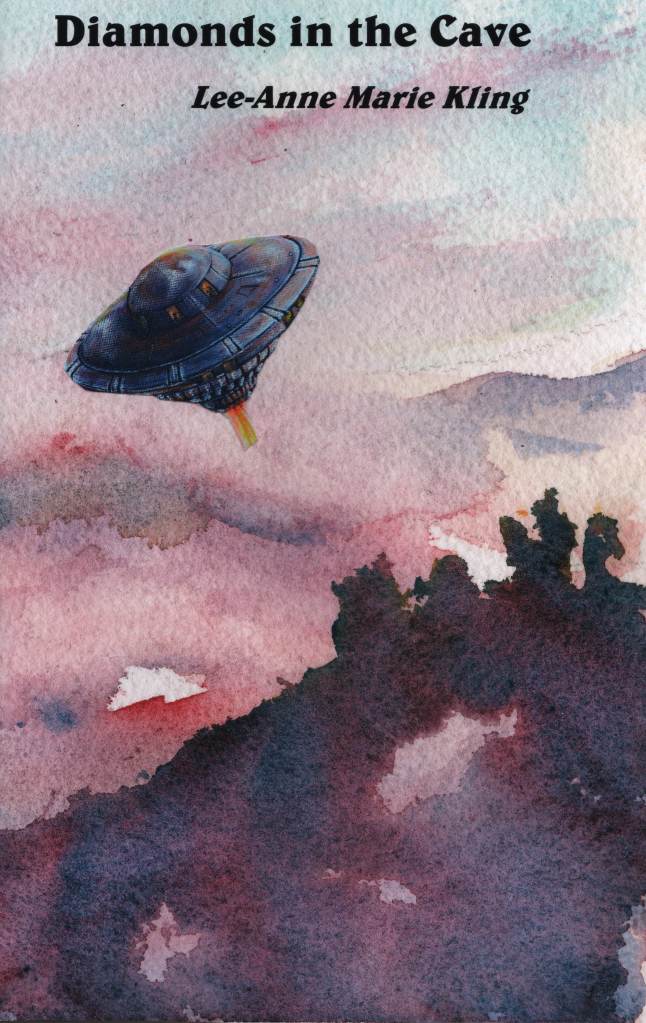
Full of hopefulness and anticipation for some Beta readers, I launched the first chapter of my novel Diamonds in the Cave on Wattpad. Not sure about the AI but decided to try out the platform as a test case. After all, there seemed to be a healthy cohort of readership for Sci-fi.
Oops! Downsides.
On further investigation, I discovered that Wattpad is geared towards Millennials and Gen Z’s. Upside if you are in that cohort. But if you are not…well…um…
Suddenly, I felt like an old chook trying to sneak into a trendy (or whatever word my children use) nightclub.
Faced with this dilemma, I asked my younger musician son, if I could sneak in using his identity. No, not a good idea. I was afraid that Wattpad might have AI bouncers, who, upon seeing my ancient, in their terms, age, would kick me off the platform.
I applied and that didn’t happen. I was comforted to read that Margaret Attwood is on Wattpad. I will be following her.
Success, of sorts
So, this “old chook”, me, has entered the realm of Wattpad, under the guise of Tessa Trudinger. Funny story about that. When I tried to register under my real name, they, the AI refused to accept me. Hence, I resorted to my maiden name, “Trudinger” and they received me with much enthusiasm saying, “Welcome Home, Trudinger”. Perhaps Trudinger is a hip name in Wattpad world. Fortunately, I had already assigned my nom de plume, Tessa Trudinger, to my detective series which I am currently working on.
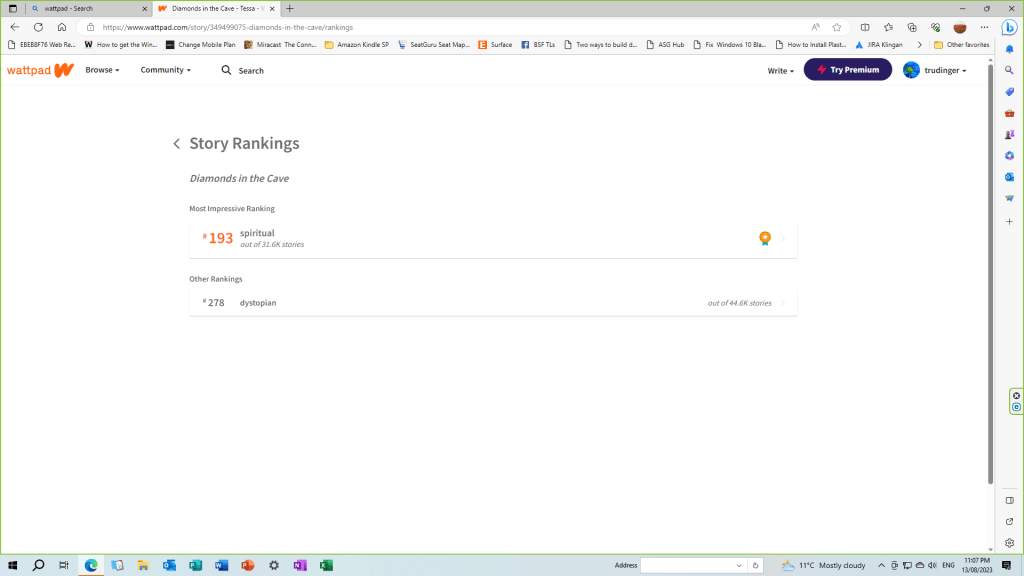
Anyway, a few days in, and the first chapter of Diamonds in the Cave steadily gained attention. Wattpad AI was pleased and awarded it the ranking #193 out of 31.6K in “Spiritual”. And something like #278 out of 44.6K in Dystopian. Two days later the story was still in the top 600 in those two categories.
*[Photo 2: Oh, joy! The statistics on Wattpad]
From there, things went south.
As I said, I’m looking for Beta readers and feedback to improve my story. No comments have appeared on Wattpad. One WordPress reader gave me encouraging feedback, saying I write beautifully. Another reader who has followed me, my friend actually, gave feedback face to face. She suggested that I need more of a “hook” in the first paragraph and that it must be rewritten.
Upon that advice, I rejigged the first paragraph, bringing elements of what the story promises to deliver—a combination of chocolate laced with time/space transporting microbes and the fearful Wend community, driven to witch hunts.
May have to eat more chocolates and play around with the first para some more in the future…
As for navigating the Wattpad website, I’m still getting used to the way Wattpad works. Uploading the story is simple enough; much like I do on WordPress. Copy and paste what I have already written on a Word document. An important strategy as I read in reviews about Wattpad taht quite a number of writers have lost their work by relying solely on Wattpad. One note, though, make sure track changes are off and not showing, or they show through on Wattpad. Messy.
I also found the story notes app provided useful in consolidating characters, the story and pitch. It made me think about my protagonist, Minna, and ensure her character remains consistent and yet grows in maturity and depth. I used the “logline” that I was asked to construct (had to be less than 150 characters), as a lead into Diamonds in the Cave on my WordPress blog.
Reading tips
I began reading a couple of stories on Wattpad. However, I discovered, when I tried to go back to them, they had vanished. Solution: apart from writing down the author’s name and book title on a separate piece of paper, I found that I could follow the authors, and put their books into my “Library” on Wattpad.
Another problem with reading in Wattpad—no bookmarks. Again, trusty old pen and paper come to the rescue. In this respect Kindle is far superior. It has bookmarks.
When I work out how to give Wattpad feedback, I will suggest that they programme some in. I checked the box volunteering to be a “Beta-user”.
This is my story of my journey into Wattpad, so far. Check out Diamonds in the Cave on Wattpad, and please do give some constructive feedback. I don’t mind if you post your comments on WordPress, Facebook, or on Wattpad.
You may need to join up on Wattpad to read, follow or comment on stories there. Not such a scary thing, I’ve done it. Just think of the millions of free stories begging for attention.
Maybe, like my friend, then, the e-reader will always be by your side.
The Trials and Tribulations of Making a Print Copy—My Recent Journey with Amazon
That little tool, “Create a paperback” beckons. Sounds enticing, doesn’t it?
You’ve launched your e-book, perhaps on Kindle, as I did, and then you notice the offer to make your “baby” into something tangible, a paperback.
One reason you might be tempted, is that many of your friends say they want something tangible, a hard copy of your book; they don’t do e-books.
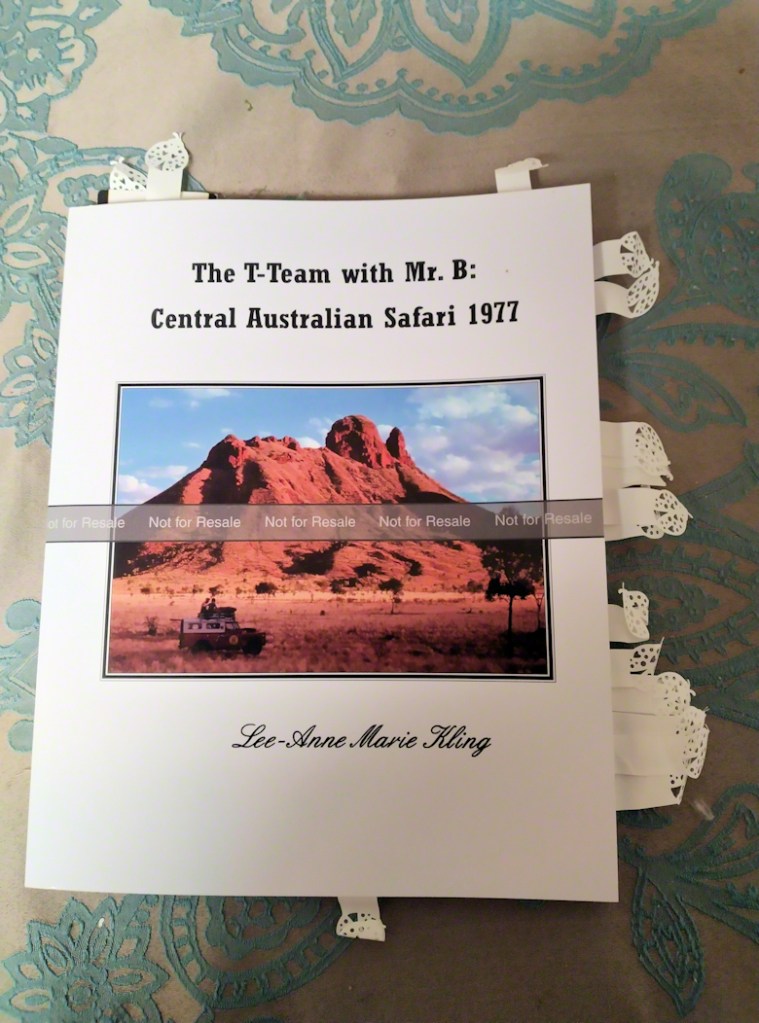
Hence, after my latest e-book, the T-Team with Mr. B went live, I set about the process of making a print book through Amazon. Since my travel memoirs are designed to be a “coffee table” book with entertaining travel stories and colour photos, the page size is not the standard novel format (5”x7” or 6”x9”), but slightly larger at 8”x10”. You’ll notice that I am using Imperial measurements rather than metric. And here lies the problem as an Australian indie author. Just as certain International space programmes can be brought down by the Imperial vs metric discrepancy, so can designing your print copy of your book fall foul of what I’m calling the Imperial computer programme used by Amazon. It seems I fall in this trap every time I attempt to make a print copy of my latest book.
You see, the Microsoft publisher programme I use to design the book cover is in metric. I looked at ways to convert it to Imperial, but such secrets remain a mystery to me. Instead, I use the “Inches to Centimetres” converter found on the internet. This I did and created my book cover which is (8”x10”) x 2, for front and back cover, plus .35” for the spine. In metric that is 20.32cm x 2 plus .9cm for spine.
So far, so good.
Once I inserted the pictures, title and blurb for the back, I then saved the file in Publisher. Then I converted the publisher file to PDF.
Looking good…
With my body/text/manuscript file formatted (for 8”x10”) and also converted to PDF, I was ready to begin the process of making a print book on Amazon. Click on “Create paperback” and follow the prompts. Make sure all required fields are filled in. Then upload the body/text file and cover. Before proceeding to pricing, which is the next page, it is important to launch previewer and check book for errors. Errors will be highlighted.
This is where my attempt at creating a print book came undone. The manuscript was fine, no problems, but the powers that be (computer programme and people who check) had issue with my cover. Each time I loaded it up, “error” in bold red letters glared at me. I uploaded it several times, each time adjusting the cover so that all images and lettering, especially related to the spine, fit in the designated parameters. After about five attempts, the manuscript and cover were accepted, and I ordered a “proof copy”.
Although Amazon quoted ten days for the proof to arrive, it came in three days.
The important thing to remember with proofs is that they are there for a reason. Take time to thoroughly check the proof, not just the cover and how it looks, but on the inside. Seeing work in print helps discover errors and typos. Just because someone proofread your manuscript beforehand, doesn’t make it immune from typos that have been missed. I found a whole heap of Mr B’s that should have been Mr. B.
After addressing the typos and errors in my proof, I set about uploading my manuscript, once again. My cover also had an issue; one of those infernal Mr B’s. I corrected the typo which required another visit to Publisher. That was my mistake.
Satisfied that my cover and manuscript were the best they could possibly be, I uploaded the work for Amazon’s perusal. They were happy with the manuscript, but not at all happy with the cover. In the process of adding just one tiny little dot after Mr, I’d inadvertently used the wrong sized cover size. Worse, I had saved over the “approved” cover from the proof.
Twenty uploads later, I was still no near the elusive approval for my cover. Even when all the images and text were neatly inside the red rimmed parameters. Again and again, the same error message plagued my cover’s existence: “Your expected cover size is 16.602 x 10.250, your submitted file is 16.599×10.000.”
I began writing down my progress, or lack of it.
Eventually I worked out that the wording was my stumbling block and discovered that “submitted” is the “variable”, meaning it can be changed, but “expected” is the constant, meaning it can’t be changed. I decided to go back to my publisher files and make both the “submitted” and the “expected” files match in size. (16.602”x 10.250” or in metric: 42.169×26.035cm) I found a ready-made “paper size” that matched the “expected” and slotted my cover made into a JPEG into the page.
And…it worked!
Elsie King was comforted by the fact that it took me all Tuesday to work this out. When we came to do her historical romance, A Suitable Heir, we nailed it in one go.
We are both looking forward to receiving our print copies in the mail in the next week.
Following on from “Raised commas aka Dratted apostrophes” back in September, we thought you might enjoy the following text of a children’s story featuring these pesky punctuation marks (taken to a somewhat bizarre level, we must admit). Bizarre as they are, in this piece we can assure you that this is grammatically correct.
Jan and her Gran
Jan has a Gran,
Gran belongs to Jan
And Jan has fun with her Gran.
Jan’s Gran has a van.
The van belongs to Gran,
Gran belongs to Jan
And Jan has fun with her Gran.
Jan’s Gran’s van had wings,
the wings belonged to the van,
the van belongs to Gran,
Gran belongs to Jan
and Jan has fun with her Gran.
Jan’s Gran’s van’s wings had nuts.
The nuts belonged to the wings,
the wings belonged to the van,
the van belongs to Gran,
Gran belongs to Jan
and Jan has fun with her Gran.
Jan’s Gran’s van’s wings nuts held the wings onto Jan’s Gran’s van
so Jan and her Gran could hop in the van and go off on trips.
For many, many years I was convinced that I “couldn’t write” even though I loved reading, even though I had ideas zooming around in my head, even though I loved words and playing around with them, even though I made up endless stories…
I did write poems, but they were different from stories. My poems were little, short snippets of language where the words were crafted in my head, fiddled around with to get the best ones in the best place, where everything sounded just right before I had to record them on paper. That was fun. There was a sense of achievement.
Stories and essays were a very different kettle of fish. They were hard work. Producing them was a matter of painstaking drudgery that began in Primary school. Back then, at the start of every school year children were issued with a heap of pristine exercise books that had to be taken home, covered and had our own name and the particular subject name written neatly on the front.
The expectation was that the work in each one was to be our very best. No scribbling; no scratching out; no careless, untidy work; no crumpled or torn pages. In other words, by the end of the year that exercise book should be as pristine as it had been on day one but full of work in our very best handwriting. Unattainable perfection for most of us!!
As far as writing was concerned the two that were my nemesis; my tragic downfalls were labelled Handwriting and Composition. The former was bad enough, but it was the latter that led to my conviction: “I can’t write”. Apart from the “Product Perfect” headset the other thing about compositions was that they had to be written straight into the composition book with correct spelling, perfect punctuation, excellent handwriting… no rough copy, no first draft, no preliminary notes. Straight from the brain cells to the page; no muckin’ about.
If I wanted to use a nice long expressive word like ginormous but didn’t know how to spell it correctly, I had to make do with a little short one I could spell (big) because errors were out, frowned upon, seen as evidence of lack of learning, failure… Where was the interest or excitement in that? I was effectively crippled.
Fortunately, education in this area seems to have moved on. Composition books as I knew them have gone the way of the dodo. Teachers and students now talk about first drafts and final copies. Thanks be.
If you can relate to that last paragraph then count your blessings and keep pouring your ideas, thoughts, stories out onto paper or into your computer. If it is the rest (or even part of the rest) and you want to write but think you can’t then ditch the doubts, grab a writing implement – pen, paper, computer – jump in and make a splash. Mistakes and stuffing up are potholes, not impassable roadblocks.
We learn by doing! And lots of practice!! So go to it and good luck.
[Currently, I’m editing Diamonds in the Cave, the next novel in my War on Boris series. This article, though first posted five years ago, is a pertinent reminder of all that the editing process involves.]
Editing—No Writer is an Island
Some time ago, a member of our writers’ group published a book.
‘I don’t want to tell anyone,’ they said, ‘because I needed a lot of help.’
Certain members of the writers’ group ensured they revealed and celebrated the news; their achievement was our achievement. A book doesn’t happen in isolation; it’s a group effort. Just as a village raises a child, for the best outcome, a community or group births a book. There’s the writer with the ideas, then comes the editor, test-readers, friends and family, the proof-reader and finally, the audience, the readers out there in reader-world.
We write stories for readers, that’s why the editing process is vital. A story needs to be readable to be effective. Readers need to understand the story to enjoy it. It’s the reason language, especially written language has rules for grammar, spelling, and the art of storytelling has a structure.
So, you’ve finished your masterpiece, but now the challenge: how will you go about editing your work? That’s where the writers’ group comes in. Fellow writers are your work’s first point of contact. Their reaction to your story will tell you if your creation is a winner or a flop. Either way, there will be more work required to perfect your piece of genius—more pen to paper, more fingers tapping on the keyboard, more pain and hair-pulling before your work can be “birthed”.
Once you have completed your work, file it away in a drawer for about three months. You need distance between you and your “baby”. When you revisit your work, you may be amazed at how brilliant you have been putting all those words together in such a clever way, or be horrified at how the gremlins of grammar, spelling, typos, weasel words, repetitions, and so on have bred and multiplied. With fresh eyes, you’ll see ways to improve your story, thus creating your second draft.
Repeat the process of draft and distance until you feel it’s ready to meet fresh eyes that don’t belong to you. But who?
Ever had trouble getting someone to peruse your work? Suddenly, they’re all busy. Or they take your story and sit on it for months, years… Again, happy are those in a writers’ group. Or be bold and blog. If you are wanting to sell your novel down the track, having a http://www.presence and band of followers may help.
For those finishing-touches to refining your work, you may seek out a professional editor. When paying an editor, ensure that you define the time and rates in a contract. For Trekking With the T-Team, I negotiated an hourly rate and a limit on the number of hours the editor would work on my book.
There are two types of editing: big picture and proof-reading. Big picture editing looks at the plot, pace, character development, language use and content. Proof-reading deals with the technical side of the work such as grammar, spelling, and formatting. But as my friend who’s an editor said, ‘It’s hard to separate the two. If the content and ideas trigger you, then it’s difficult to be objective and it affects how you respond to the piece.’
So, while it may be preferable for an editor to be outside the genre in which you are writing, it may not work for your book. A good editor, of course, is impartial, but they are still human and will approach your story from their worldview. And on the other side, we as writers are human and see the world through a filter of attitudes and the way we see ourselves. A good editor who is paid, then, is only as good as the receptiveness to feedback of the writer who pays them. After all, you are paying for that objective set of eyes, and feedback based on their experience as a reader and what they perceive as good literature or entertainment. In the end, whatever comments an editor makes, it’s up to you, the writer, to implement those changes—it’s your work, your story.
The last step of editing is proof-reading; the nit-picking of the piece before it surfaces for publication. Ernest Hemmingway, in an interview for The Paris Review (1958), said that he rewrote the end of Farewell to Arms 39 times before he was satisfied with it. However, each writer is different. I use five different coloured pencils: 1) grammar, 2) spelling, 3) word-use, 4) formatting, and 5) content. That being said, I am sure I have perused my works near 39 times by the time it reaches the Amazon shelves.
Other tips: • Reading out aloud helps with sentence structure, flow, and the art of storytelling. Even better, if you can bear it, use a voice-recorder as you read out your story, and then play it back. • Line by line editing. Print out your story and then use a ruler under each sentence to concentrate on each word. Effective for exposing typos and formatting flaws. • Start with the last chapter first, and so work through your piece backwards. Again, helps with plot-holes, character consistency and pacing. • Have an English grammar book and a dictionary within reach, for you’ll be reaching for them repeatedly. I’ve discovered that an online dictionary, or Google are also reliable resources, but beware, as dodgy information slips through the cracks of the Internet.
In the end, it’s up to you, but it’s also a group effort. We are all part of the larger community collective of writers, readers, sharers and receivers of ideas. And I cannot stress enough, the more you read, the more effective your writing will become. We learn from each other.
These little things seem to cause more angst, confusion and errors than any other feature of our written language. There is even a move afoot to eliminate them altogether. Which would be tragic as they play a critical role in clarifying meaning. By way of demonstration, can you decode the precise meaning of each of the following phrases:
1. The dog’s collar;
2. The dogs’ collars;
3. The dog’s collars;
4. The dogs’ collar.
Three words; the only differences being that two of the final words end in ‘s’ and also the position of the apostrophe. Yet each of those four has a very different meaning and, lacking that little squiggle, the meaning would be, not only obscure, but impossible to work out. Context could help of course but not necessarily. Why make life harder than it need be?
Let’s see if I can clarify the issue. Apostrophes have one job to do, and one only. Part of the confusion lies in the fact that this one job has two different aspects to it.
The one job is that it indicates something has been left out so therefore it is a form of abbreviation.
This happens when we turn speech into writing. When speaking we tend to hurry things along a bit – it’s much easier to say can’t and didn’t than cannot and did not. Used in this way our squiggle is termed an “Apostrophe of Contraction” because we have left out, not only the space between two words, but one or more of the sounds and therefore, the letters that represent those sounds, when we put it into writing.
The second instance is called the “Apostrophe of Possession” and is somewhat more complex. But not impossible as there is a rule you can follow that simplifies things beautifully. Before we get onto this “rule” let’s sort out just what is left out though.
Possession means someone or something belongs to someone or something; alternatively there is an owner and who or what is owned by that owner. Thus it always involves two naming words (i.e. nouns in grammar speak). For instance “Jane’s brooch” tells us that Jane owns the brooch; the brooch belongs to Jane. Thus it is the words denoting ownership that have been omitted.
Well then, what is this rule that is going to simplify things?
Take a deep breath and follow the steps:
1. Work out who or what is the owner and what is being owned.
2. Write down the name of the owner and nothing else. If it is a person then the name is easy but if it happens to be more than one thing (e.g. a couple of dogs; a herd of cows; a fleet of yachts…) the owner is plural so that is what you must write down.
3. Add the apostrophe.
4. Say the phrase aloud (owner and what it is that belongs to that owner) listening carefully. If you hear yourself saying “s” (or an extra “s” if the owner’s name happens to end in “s”) on the end of the owner then add it.
5. Write down what is owned.
Done! And done correctly.
The result can, on occasion look quite bizarre. By way of example consider the following: A visitor arrives, is welcomed and asked to take a seat; heads for a comfortable looking chair but host says, “Sorry, please don’t sit there. That’s puss’s chair”. Go through the steps and you’ll see this is grammatically correct, both spoken and written
Were you able to sort out the dogs and collars puzzle I gave you in the beginning?
If not, here is the solution:
1. The dog’s collar (one dog and one collar – presumably that collar belongs to that dog).
2. The dogs’ collars (several dogs each with its own collar).
3. The dog’s collars (obviously a pampered pooch with a whole wardrobe of collars!!).
4. The dogs’ collar (possibly a succession of family dogs with the same collar serving several generations. Or maybe – sad to say – several dogs having to share the same collar!!).
“You need a sparkling synopsis.” ~ Fiona McIntosh 2015
So, what do you need after you have edited your novel? If you intend to submit it for publication or to an agent, a synopsis is a requirement. Even in self-publishing, a synopsis is a great exercise to summarise your novel for marketing and creating your blurb.
A synopsis is more than a summary of your novel. It must capture the attention of a publisher or agent. A working document, it condenses your plot succinctly, introduces the major protagonists, defines the conflict, and ties it all up into a logical and satisfying ending.
Announce the title and mention the genre, word count, setting and era.
The synopsis must be short and easy to read. I recommend one page. Single spaced with a word count of 500-700 words but if submitting a novel for a competition, agent, or publisher check if they have specific requirements.
Grammar, spelling, and word selection must be perfect. The synopsis is selling you as a writer. Get it checked by someone with editing skills.
Write in the third person and use gender neutral language. E.g., police officer, not policeman.
Cover all the major plot points, including spoilers and the ending. There should be no mysteries in a synopsis. The publisher wants to know you have finished the book, and it has a great ending.
Name two or three of major protagonists and their motivations. Bring them alive. Demonstrate how they grow and change and make them shine.
Clearly convey the tone of the novel but the emphasis is the story, allow the theme to sneak in without belabouring the point.
Avoid praising yourself in a synopsis or include positive reader reviews.
Expect to write, rewrite, rewrite and then do it again so give yourself time to get it right.
This edit is most effective when you have finished the structural edit and are satisfied that your story reads, flows well, and makes sense.
Copy editing, also called “line editing” or “content editing”, means that you go through your manuscript line by line to make sure each sentence and paragraph zing.
I find copy editing difficult. I just don’t see the grammar and spelling errors and lose focus quickly. Knowing your weakness as a writer is important and I use whatever help I can to line edit my work.
Lorena Goldsmith suggests you don’t edit from the beginning of your manuscript and work through to the end as you will get caught up in the story and the last chapters tend to suffer as you rush to finish. She advises that skipping around the manuscript is more helpful. Select several pages for editing, then skip to another part of the book and select the next lot of pages. This helps you stay focussed and ensures consistency.
I do multiple edits, each with a different focus. I might edit looking for contractions and adverbs in one edit, and then look at sentence length and overuse of words. Editing for me is a tedious process, but others love it and are geniuses at spotting mistakes. Give them a red pen and they edit like tigers. Revere and reward these people.
Cheating or not, I also use technology. Microsoft Word has a good basic spelling and grammar check and thesaurus. I also use a program called ProWritingAid, which has multiple checks and reviews for the editing impaired. I also pay a professional editor who hones my words into the final draft for proof-reading.
The following is a checklist of things to look for when editing. It’s not definitive.
Have I used the right word/s. Is the meaning clear? Replace a word with a stronger word.
Remove weak/or excessive verbs and adverbs. E.g., He walked quickly, replace with He marched. She spoke gently, replaced by she leaned over and whispered.
Eliminate filler words (for example: just, really, very, that, even.)
Is the selected word in the right mood for the sentence/scene?
Look at word usage. Everyday words are easy to read and understand and don’t stop the flow for the reader. Mix up words, use a thesaurus to find the right word for your line.
Is the word politically correct?
Look for long sentences.
Does the sentence make sense?
Is the paragraph too long?
Are you explaining things too much and repeating information unnecessarily?
Do paragraphs start with the same word, the same style? Mix up your beginnings.
Show not tell. Don’t say “He was nervous” use sweat made him cold as the biting wind cut the air from around him.
Avoid describing emotions. Instead, write a description of your character that incorporates what they smell, hear, feel, see, and touch in their situation that conveys the emotion.
Dialogue–does it flow naturally? Use contractions, e.g. I will to I’ll, as this makes the dialogue more realistic. Does each character have their own voice? Remove unnecessary dialogue, such as “Hello, how are you?” “Yes, good thank you.” It’s just boring. The dialogue should be relevant and move the story along, so make it snappy.
Reduce dialogue attributions. “Where are you going Jim?” Jane asked. Unnecessary, if only Jane and Jim are in the scene.
Look out for cliches. Make metaphors and similes unique and interesting.
After completing your structural and line edit, give it a read. If it’s easily read, tight, well-paced and without obvious bloopers, send it to a professional editor or a competent astute fellow writer. Make amendments, and then it’s ready for the “Proof reading” edit and formatting.
Reference:Lorena Goldsmith-Self Editing Fiction that Sells. (How to Book Ltd. UK-2013)